
Technology | Social Media
By Open Chronicle with agencies
Meta has agreed to a sweeping settlement worth up to $18 billion to resolve claims brought by dozens of US attorneys general alleging that the company misled consumers about the risks its social media platforms pose to children and teenagers.
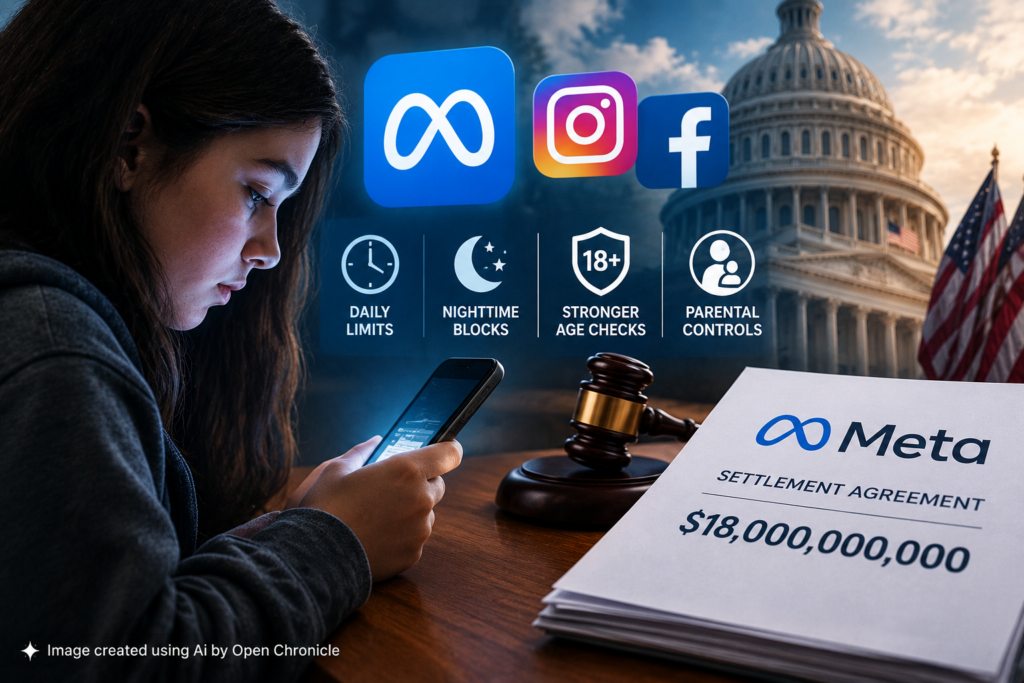
The agreement goes far beyond financial compensation. It would require significant changes to the way young people use platforms including Instagram and Facebook, introducing daily usage limits, nighttime restrictions, stronger age verification measures and additional parental controls.
The settlement, announced on Wednesday, remains subject to judicial approval.
Major changes for teenage users
Under the agreement, Meta would introduce a two hour daily usage limit for teenage users and prevent access during designated nighttime periods.
The company would also strengthen its age assurance systems, an increasingly important issue for regulators seeking to prevent children from circumventing protections simply by entering a false date of birth.
Parents and guardians would receive additional tools for managing how teenagers interact with Meta’s platforms.
The measures represent one of the most substantial attempts yet to reshape the relationship between major social media companies and younger users in the United States.
California Attorney General Rob Bonta described the agreement as a significant victory for families.
“Today, we have secured a settlement with Meta that will make social media less dangerous for our kids and make a world of a difference for children and their families,” Bonta said.
He added that Meta had agreed to extensive changes intended to reduce potential harm from its platforms within months.
Billions for participating states
Meta said approximately $12.7 billion, representing about 70 percent of the overall settlement, would go to participating states.
The remaining $5.3 billion would be connected to similar measures and payments involving TikTok and YouTube, according to details released about the agreement.
The size of the settlement reflects both the scale of the litigation and growing political pressure on technology companies over the effects of social media on young people.
What began as a lawsuit involving 29 state attorneys general in 2023 eventually expanded to include 52 attorneys general representing US states, the District of Columbia and US territories.
Trial focused on alleged addictive design
The agreement emerged during the second week of a federal trial in Oakland, California.
At the centre of the case were allegations that Meta deliberately designed elements of Facebook and Instagram to encourage compulsive use among children and teenagers while failing to adequately communicate the potential risks.
The states argued that features intended to maximise engagement could contribute to excessive platform use among younger audiences.
Meta has faced mounting scrutiny for years over how recommendation systems, notifications, engagement metrics and other design features influence teenage behaviour.
The litigation sought to establish whether those practices crossed the line from ordinary product design into conduct that created or concealed unreasonable risks for children.
Social media enters a new regulatory era
The settlement could have consequences extending well beyond Meta.
Governments around the world are increasingly reconsidering the relatively permissive regulatory environment in which social networks developed during the previous two decades.
Age verification has become one of the central elements of that debate.
Regulators face a difficult balance. They want platforms to reliably distinguish children from adults without forcing users to surrender unnecessary amounts of sensitive personal information.
Daily usage restrictions represent another potentially significant shift.
Rather than relying primarily on parental supervision or voluntary screen time tools, mandatory protections could place greater responsibility directly on technology companies to limit how their products are used by minors.
Nighttime restrictions similarly reflect concerns that persistent social media use can interfere with sleep and encourage prolonged engagement.
Pressure extends beyond Meta
The case is part of a much broader legal and political challenge confronting the social media industry.
TikTok, YouTube and other major platforms are facing similar scrutiny over how their products are designed and how recommendation algorithms interact with younger audiences.
The financial component involving measures associated with TikTok and YouTube also demonstrates that regulators increasingly view youth social media use as an industry wide issue rather than a problem involving a single company.
That could ultimately lead to more consistent standards governing age verification, parental controls, recommendation systems and platform access across the sector.
A potentially historic settlement
The significance of the agreement may ultimately depend less on the headline financial figure than on whether the required product changes alter how teenagers actually experience social media.
A two hour daily limit, nighttime access restrictions and stronger age checks would represent substantial changes if implemented effectively across platforms used by hundreds of millions of people.
They could also establish expectations that regulators seek to apply elsewhere.
Meta, meanwhile, faces the challenge of implementing those protections without fundamentally undermining the accessibility and commercial model of its platforms.
The agreement still requires approval from the court, meaning its final terms could change.
If approved in its current form, however, the settlement would represent a major turning point in the long running debate over social media companies’ responsibility for protecting children online, shifting the issue from voluntary safety features toward legally enforceable limits on how platforms engage their youngest users.