
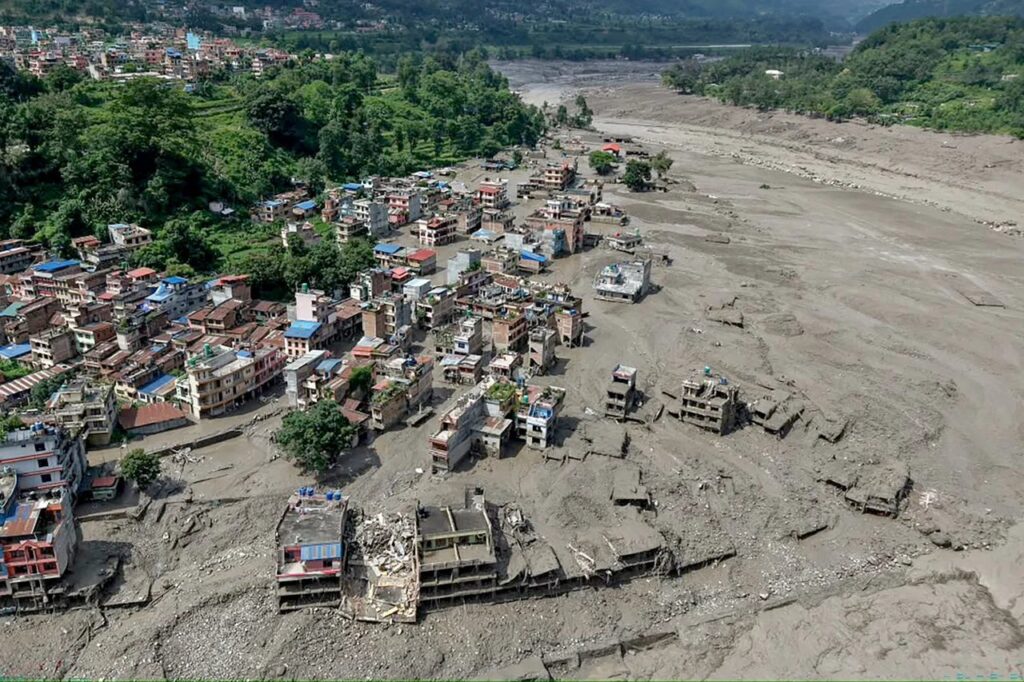
Image: from KanekoaTheGreat X @KanekoaTheGreat
World | Climate & Disasters
By Open Chronicle with agencies
A devastating flash flood originating in Tibet has swept through central Nepal, killing nearly 160 people and leaving hundreds missing after a violent surge of water, mud and debris destroyed communities, bridges, roads and hydropower infrastructure along several major river systems.
Nepal Police said at least 157 people had been confirmed dead. Nepalese authorities reported around 500 people missing, while Chinese state media reported three deaths and another 265 people missing on the Chinese side of the border.
The scale of the disaster has triggered a major search-and-rescue operation involving Nepal’s military and security forces, while neighbouring India has begun providing humanitarian assistance.
Among those reported missing are foreign nationals from India and more than two dozen other countries.
Flood sweeps south from Tibet
The disaster began on Wednesday morning in the mountainous border region between Tibet and Nepal.
Nepalese Foreign Minister Shisir Khanal told parliament that an earthquake was recorded in Tibet at 8:37 a.m. local time and that reports of flash flooding emerged approximately three minutes later.
Officials are investigating whether the tremor may have contributed to a glacial lake outburst or another sudden release of water.
Nepal’s National Disaster Risk Reduction and Management Authority said the flood entered the Bhote Koshi River near Timure following a rockslide and the swelling of the Lhende River along the Nepal Tibet frontier.
The water then surged into the Trishuli River system and travelled downstream through several districts, including Rasuwa, Dhading, Nuwakot, Chitwan, Gorkha, Tanahu and Nawalparasi East.
Significantly, Nepal’s Department of Hydrology and Meteorology said rainfall in Rasuwa was not responsible for the flooding, strengthening concerns that the disaster originated from a sudden event farther upstream.
Nepal flash flood (26 Aug 2026) 💔🇳🇵
A sudden surge from an avalanche/earthquake near the Tibet border hit Rasuwa district, killing dozens (reports up to ~95) and leaving hundreds missing—including many tourists. Villages, bridges, roads and ~430 MW of hydropower were destroyed.… pic.twitter.com/egrzottl37
— Purely Green (@worldclick56) August 26, 2026
Towns, roads and bridges swept away
Videos emerging from the affected region showed enormous quantities of brown water carrying rocks and debris through valleys and settlements.
Buildings were torn from their foundations, vehicles were carried downstream and bridges collapsed under the force of the flood.
One video showed a four storey building being swept away. Other footage showed vehicles floating through rapidly moving water and residents running toward higher ground.
The Kathmandu Post reported that approximately 42 kilometres of road connecting Betrawati in Nuwakot with the Rasuwagadhi border crossing in Rasuwa had been washed away.
Government officials later said 19 motorable bridges had been destroyed.
The damage has severely complicated rescue operations in mountainous areas where roads and bridges are often the only practical means of reaching isolated communities.
Flash floods triggered by a glacier avalanche have killed at least 95 people in Nepal, with hundreds more missing near the China border. Rescue teams are still searching.
384 tourists. Missing. In one flash flood.
An avalanche on the Nepal-Tibet border unleashed floodwater that… pic.twitter.com/5bj14gWERv— Lucia (@Lucia_6X) August 26, 2026
Hydropower infrastructure badly damaged
The disaster has also dealt a significant blow to Nepal’s electricity infrastructure.
According to the Independent Power Producers’ Association Nepal, eight operational hydropower projects with a combined generating capacity of 354 megawatts were damaged, together with five projects still under construction in Rasuwa and Nuwakot.
Among the affected facilities are the 111 MW Rasuwagadhi Hydropower Project, the 78 MW Sanjen Khola project and the 60 MW Upper Trishuli 3A facility.
The extent of the damage and the potential impact on Nepal’s electricity supply were not immediately clear.
Hydropower provides the backbone of Nepal’s electricity system, making damage to generating facilities and transmission infrastructure another potentially serious consequence of the disaster.
Flash floods triggered by a glacier avalanche have killed at least 95 people in Nepal, with hundreds more missing near the China border. Rescue teams are still searching.
384 tourists. Missing. In one flash flood.
An avalanche on the Nepal-Tibet border unleashed floodwater that… pic.twitter.com/5bj14gWERv— Lucia (@Lucia_6X) August 26, 2026
Hundreds missing as rescue operation expands
Around 100 people had been rescued from affected areas, according to officials, with approximately 30 receiving treatment at Tribhuvan University Teaching Hospital in Kathmandu.
Nepal’s security forces have been deployed across the disaster zone.
The Nepal Army said it had mobilised 12 helicopters for search-and-rescue missions. An MI 17 helicopter carrying an Emergency Medical Rescue Team was also dispatched to the region, while a treatment centre was established at Military Training Centre No. 1 in Trishuli.
The military reported rescuing people from Syaphrubesi, Mailung and Dhunche in Rasuwa.
The scale of the flooding has also affected rescue personnel themselves. Khanal told lawmakers that 80 members of Nepal’s security forces, including 44 soldiers, were missing at various locations.
Prime Minister Balendra Shah chaired an emergency government meeting before ordering additional Nepal Army, Armed Police Force and Nepal Police personnel into the affected districts.
Foreign tourists among the missing
The disaster has taken on an international dimension because of the large number of foreign visitors believed to have been in the region.
Officials said at least 133 Indian citizens and 37 non-resident Indians were among those missing.
At least 50 Indians were reportedly participating in the Kailash Manasarovar Yatra, a pilgrimage that takes travellers through the Himalayan region.
The Isha Foundation said 77 of its members who had been at an immigration centre were unaccounted for, although hundreds of other participants had returned safely. Nepalese authorities subsequently said the entire staff of the immigration centre was also out of contact.
Tourists from more than two dozen countries, including the United States, United Kingdom, Malaysia, South Africa, Australia and the Netherlands, were also reported among those unaccounted for.
The number of missing people remains fluid as authorities attempt to restore communications and determine who had been travelling through the affected areas.
India sends humanitarian assistance
Indian Prime Minister Narendra Modi spoke with Nepalese Prime Minister Balendra Shah and offered humanitarian assistance.
India subsequently dispatched an initial shipment of relief supplies and began coordinating with Nepalese authorities over the search for Indian nationals.
The Indian Embassy in Kathmandu established emergency contact numbers at +977 985 131 6807 and +977 970 910 7500.
India’s embassy in Beijing also opened an emergency line at 0086 185 1428 4905, including WhatsApp access.
Nepal’s Tourism Board announced the toll free emergency number 1234, hotline 1144 and Tourist Police contact 9851289445.
China launches rescue effort
Rescue operations are also underway north of the border.
Chinese President Xi Jinping ordered authorities to make an all out effort to locate and rescue people affected by the disaster.
Chinese state media reported that 145 officers and soldiers from the Xigaze detachment of the People’s Armed Police were deployed toward the affected border area.
Communications disruptions have complicated attempts to establish the full scale of destruction on both sides of the Himalayas.
Danger has not passed
Nepalese authorities have warned residents that another surge remains possible.
Information received from the Chinese side indicated that a lake created around a river blockage had not completely drained.
Nepal’s Flood Forecasting Division therefore warned people living around the Bhote Koshi and Trishuli rivers to remain away from riverbanks and seek safe locations.
The National Disaster Risk Reduction and Management Authority repeated the warning, stressing that the danger would persist until the blocked water had been safely released or stabilised.
That uncertainty means rescue teams must simultaneously search for survivors while preparing for the possibility of further flooding.
Renewed concerns over Himalayan glacial hazards
The catastrophe is also likely to renew concern over the vulnerability of Himalayan communities to sudden glacial and mountain related floods.
Nepal’s steep terrain, extensive river systems and rapidly changing high altitude environment make the country particularly exposed to landslides, flash floods and glacial lake outburst floods.
When large volumes of water are suddenly released from a glacial lake or natural blockage, they can accelerate rapidly through narrow mountain valleys, carrying rocks, sediment and debris capable of destroying settlements and infrastructure far downstream.
The precise cause of Wednesday’s disaster has yet to be established. Authorities will need to determine whether the reported earthquake triggered a glacial event, destabilised a natural dam or contributed to a combination of geological processes.
Nepal suffered deadly flooding along the Bhote Koshi last year as well, when at least 10 people were killed in Rasuwa.
The magnitude of the latest disaster, however, is far greater.
As helicopters continue searching valleys and isolated settlements, the immediate priority remains finding survivors and reaching communities cut off by destroyed roads and bridges.
With hundreds still missing on both sides of the border and authorities warning that upstream water has not yet fully drained, the final human cost may remain uncertain for some time.