
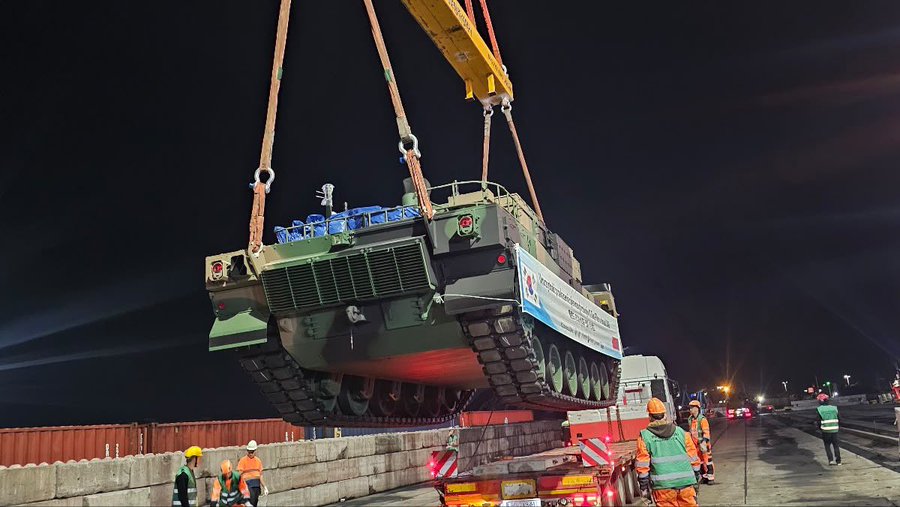
Image: from Visegrád 24 X @visegrad24
By Open Chronicle Defence
Poland has received the first 28 K2 Black Panther main battle tanks from its second major contract with South Korea’s Hyundai Rotem, marking another step in Warsaw’s rapid expansion and modernization of its armored forces.
Polish Defense Minister Władysław Kosiniak-Kamysz announced the arrival of the tanks on Tuesday, confirming that the vehicles will be assigned to the 16th Pomeranian Mechanized Division.
The delivery is the first under a contract signed on August 1, 2025, covering another 180 K2 tanks and worth approximately $6.5 billion. The agreement follows Poland’s initial acquisition of 180 K2GF tanks, deliveries of which were completed in November 2025.
The latest shipment consists of standard K2 tanks, but the program will eventually move into a more significant phase for Poland’s domestic defense industry with production of the Polish-specific K2PL variant.
JUST IN: 🇵🇱🇰🇷🇷🇺 Poland Is Preparing A K2 Tank Army As Russia Threat Looms
Poland has received another 28 K2 Black Panther tanks, bringing its K2 fleet to 208 tanks.
And Warsaw is far from finished.
Another 88 K2GF tanks are due by 2027, followed by 64 Poland specific K2PL… pic.twitter.com/rJRsRiclxE
— War Radar (@War_Radar2) August 26, 2026
Another 180 K2 Tanks for Poland
The second contract considerably expands Poland’s investment in the South Korean armored platform.
Under the current schedule, Poland is expected to receive 116 K2GF tanks between 2026 and 2027.
These will be followed by 64 K2PL tanks between 2028 and 2030.
The K2PL represents more than another vehicle purchase. It is intended to establish a greater degree of Polish industrial participation in the program through domestic assembly, locally produced components and technology transfer.
Of the 64 K2PL tanks covered by the agreement, 61 are scheduled to be assembled in Poland at the Bumar-Łabędy plant in Gliwice.
The facility belongs to PGZ, Poland’s state-owned defense group.
This domestic component has become an important element of Warsaw’s wider rearmament strategy as Poland attempts not merely to purchase weapons abroad, but also to rebuild the industrial infrastructure necessary to manufacture, maintain and modernize increasingly large military fleets.
The K2 Black Panther
Developed in South Korea, the K2 Black Panther is a modern third-generation main battle tank designed to combine firepower, mobility, sophisticated sensors and advanced fire-control technology.
Its principal weapon is a 120 mm smoothbore cannon supported by an automatic loading system.
Secondary armament includes a 7.62 mm machine gun and a 12.7 mm heavy machine gun.
The autoloader reduces the required crew compared with tanks employing a dedicated human loader and allows ammunition handling to be highly automated.
The K2 was originally designed for the particular requirements of the South Korean military, including operations across difficult terrain.
For Poland, however, the platform has acquired a different strategic role.
It is becoming one of the central components of a much larger armored force being constructed along NATO’s eastern flank.
The K2PL Brings Production to Poland
The K2PL phase will be particularly important.
Rather than relying exclusively on tanks manufactured in South Korea, the program will increasingly involve Polish industry.
Kosiniak-Kamysz described the latest delivery as part of a process that simultaneously strengthens Poland’s military capabilities and expands domestic production capacity.
Technology transfer included within the contract is intended to support that transition.
The decision to assemble 61 K2PL tanks at Bumar-Łabędy also provides Poland with industrial experience that could become valuable for long-term maintenance and future modernization.
Modern armored fleets require extensive logistical ecosystems extending far beyond the tanks themselves.
Engines, transmissions, electronics, weapons, ammunition, spare parts, training systems and specialized maintenance facilities all contribute to operational availability.
Domestic industrial involvement can therefore become strategically important during a prolonged conflict, when foreign supply chains may be placed under considerable pressure.
Support Vehicles Included in the Agreement
The $6.5 billion package extends well beyond the 180 main battle tanks.
It also includes 81 specialized support vehicles based on the K2 chassis.
These comprise 25 combat engineering vehicles, 25 armored bridge layers and 31 armored recovery vehicles.
Such platforms are essential to maintaining armored formations during combat.
Recovery vehicles can assist damaged or immobilized tanks. Engineering vehicles support operations through difficult terrain and obstacles, while bridge layers enable armored units to cross rivers, ditches and other barriers that could otherwise slow an advance.
The agreement additionally includes ammunition, logistical support, training and technology transfer.
Brigadier General Artur Kuptel, head of Poland’s Armament Agency, signed the agreement on behalf of Warsaw at the Bumar-Łabędy facility, while Hyundai Rotem CEO Lee Yong-Bae represented the South Korean manufacturer.
16th Mechanized Division Remains at the Center of K2 Expansion
The 16th Pomeranian Mechanized Division has become the principal recipient of Poland’s K2 fleet.
Based in northeastern Poland, the division occupies an especially important geographical position within the country’s defense structure.
Units previously equipped with K2 tanks include the 20th Bartoszyce Mechanized Brigade, the 9th Braniewo Armored Cavalry Brigade and the 15th Giżycko Mechanized Brigade.
Six additional tanks from the earlier contract were assigned to the Land Forces Training Center in Poznań.
The concentration of modern armor in northeastern Poland reflects the country’s broader focus on strengthening its ability to defend NATO’s eastern territories.
Since Russia’s full-scale invasion of Ukraine, Warsaw has dramatically accelerated procurement programs covering tanks, artillery, air defense, aircraft, helicopters and ammunition.
Poland Is Building One of Europe’s Largest Tank Forces
The K2 acquisition represents only one pillar of Poland’s armored modernization.
Warsaw is simultaneously introducing American M1 Abrams tanks while continuing to operate German-designed Leopard 2s.
Poland had received roughly 117 M1A2 SEPv3 Abrams tanks by early 2026.
Together, the Abrams, K2 and Leopard fleets are intended to provide Poland with one of Europe’s largest concentrations of modern main battle tanks.
Polish officials have spoken of an ambition to operate approximately 900 tanks across the three families by 2030.
If achieved, that would represent an extraordinary transformation of the country’s land forces within less than a decade.
It would also reinforce Poland’s emergence as one of NATO’s most heavily armed European members.
Three Tank Families Create a Logistics Challenge
The scale of the program brings complications.
Operating K2s, Abrams and Leopard 2s simultaneously creates significant logistical requirements.
Each tank family has different components, maintenance requirements, training systems and supply chains.
Crew training must also be maintained across different platforms.
From a purely logistical perspective, operating a more standardized fleet could offer advantages.
Poland’s strategy, however, has been shaped by the urgency of rapidly rebuilding military strength.
Purchasing tanks from several suppliers has allowed Warsaw to acquire large numbers of modern vehicles more quickly than would have been possible through a single production line.
The expansion of domestic K2PL assembly could eventually help mitigate some of these logistical pressures by establishing a stronger Polish support base for what is becoming one of the country’s largest armored fleets.
South Korea Becomes a Major European Defense Supplier
The K2 agreement also reflects South Korea’s growing importance within the European defense market.
Poland has become one of the most important customers for South Korean military equipment outside Asia.
Its purchases extend beyond the K2.
Warsaw has also acquired K9 self-propelled howitzers and FA-50 combat aircraft from South Korean manufacturers, while broader industrial cooperation between the two countries continues to develop.
South Korean companies have benefited from their ability to offer modern equipment combined with relatively rapid production schedules.
For European governments attempting to replenish inventories and expand military forces, production capacity has become nearly as important as technical performance.
Poland’s partnership with South Korea demonstrates how the war in Ukraine has changed the geography of European defense procurement.
European rearmament is no longer dependent exclusively upon European and American manufacturers.
South Korea has become an increasingly important part of the equation.
Rearmament on NATO’s Eastern Flank
Poland’s military expansion ultimately reflects geography.
The country borders Ukraine and Belarus, while the Russian exclave of Kaliningrad sits directly on Poland’s northeastern frontier.
That position gives Warsaw a central role in NATO’s eastern defense architecture.
The Suwałki region connecting Poland with Lithuania is particularly strategically important because it provides the land connection between the Baltic states and the rest of NATO territory.
Large, modern Polish ground forces consequently contribute not only to national defense but also to the wider Alliance’s ability to reinforce its northeastern members.
Armor remains important within that strategy despite repeated predictions that drones and precision weapons would make tanks obsolete.
The war in Ukraine has instead demonstrated a more complicated reality.
Tanks remain powerful battlefield systems when properly integrated with infantry, artillery, air defense, electronic warfare, reconnaissance and unmanned systems.
What has changed is the environment in which they must operate.
From Procurement to Industrial Capacity
The most consequential part of Poland’s second K2 agreement may therefore emerge several years from now.
The arrival of another 28 tanks immediately increases military capacity.
Domestic assembly of the K2PL could produce something more durable.
It could give Poland greater control over the maintenance, production and future evolution of a major component of its armored forces.
That distinction is central to Europe’s wider rearmament debate.
Buying equipment can strengthen an army quickly.
Building the industrial capacity to produce and sustain that equipment creates strategic resilience.
Poland is attempting to do both.
With 28 additional K2s now arriving, another 152 tanks covered by the contract still to follow and Polish assembly of the K2PL scheduled to begin later in the decade, the country’s armored transformation remains far from complete.
By 2030, however, Poland could possess an armored force dramatically larger and more modern than the one it fielded at the beginning of the decade.
And increasingly, some of those tanks will not simply be purchased for Poland.
They will be assembled in Poland as well.