
By Open Chronicle Defence
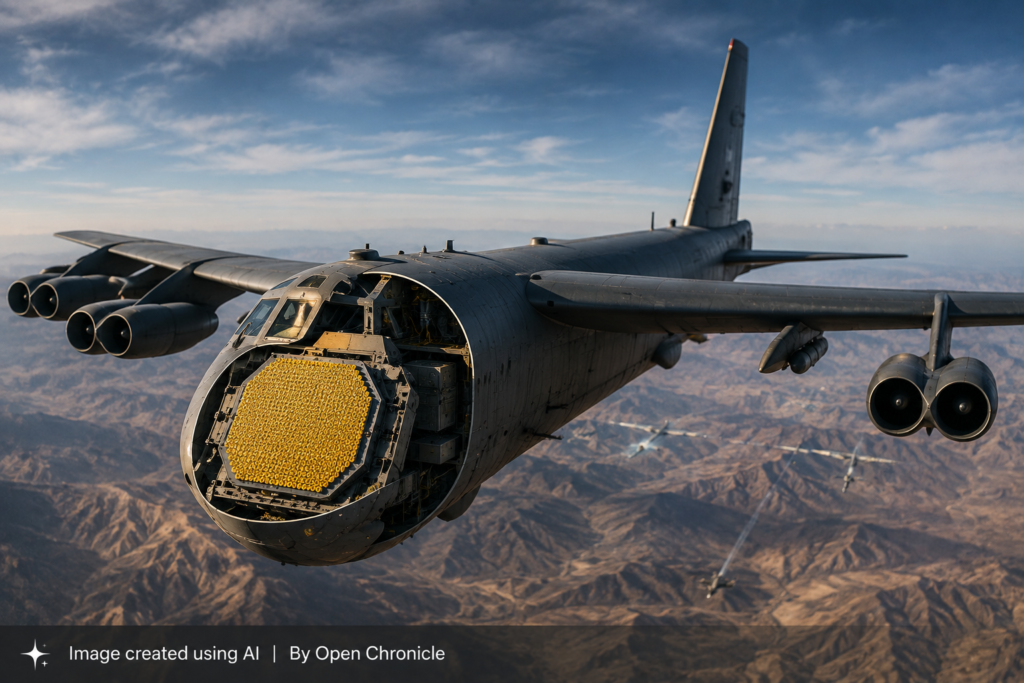
The U.S. Air Force has awarded Raytheon a contract worth up to $603 million to produce and sustain a new radar system for the B-52 Stratofortress, advancing one of the key modernization programs intended to keep the legendary strategic bomber operational well into the 2050s.
The contract covers production and sustainment of the AN/APQ-188, also known as the Bomber Modernized Radar System. The active electronically scanned array, or AESA, radar will eventually replace the aging AN/APQ-166 currently carried by the B-52H fleet.
The modernization promises to significantly improve the bomber’s sensing and situational awareness capabilities, but it comes after years of delays and rising costs that have complicated the wider transformation of the B-52.
$603 Million Contract for the New Radar
The indefinite delivery, indefinite quantity contract carries a ceiling value of $603 million and is being managed by the Air Force Life Cycle Management Center at Wright-Patterson Air Force Base in Ohio.
The contract, designated FA8628-26-D-B001, was awarded as a sole-source acquisition.
Approximately $46 million in fiscal 2026 aircraft procurement funding was obligated with the initial delivery order.
Work will take place at several locations across the United States, including Forrest, Mississippi; El Segundo, California; McKinney, Texas; and Warner Robins, Georgia.
Completion under the contract is expected by August 20, 2031.
The Air Force listed the award date as August 21.
Bringing AESA Technology to the B-52
The AN/APQ-188 represents a major technological leap over the radar currently installed aboard the bomber.
Developed by Raytheon, now part of RTX, the system draws heavily from the AN/APG-79 AESA radar used aboard the U.S. Navy’s F/A-18E/F Super Hornet.
AESA technology electronically steers radar beams rather than relying exclusively on mechanically moving the antenna.
For the B-52, the new radar is intended to provide considerably improved reliability, situational awareness and target detection while supporting the aircraft’s evolving conventional and strategic missions.
The Air Force intends to modernize all 76 B-52H aircraft currently in service.
Transforming the B-52 for Another Generation
The radar replacement forms part of a much larger effort to transform an aircraft whose origins date to the early Cold War.
The first B-52 flew in 1952, and the aircraft entered operational service with the Air Force in 1955. The B-52H variant flying today was produced during the early 1960s.
Despite its age, the bomber has remained relevant because of its range, payload capacity and ability to accommodate new weapons, sensors and communications systems.
The current modernization effort is intended to extend that adaptability for several more decades.
Alongside the radar program, the B-52 fleet is receiving new Rolls-Royce F130 engines as part of the Commercial Engine Replacement Program.
The extensive changes are associated with the future B-52J configuration.
If current plans are achieved, the B-52 could remain operational into the 2050s, giving the design an extraordinary service life approaching a century.
A Critical Partner for the B-21
The Air Force’s long-term bomber strategy increasingly revolves around two very different aircraft.
The B-21 Raider is being introduced as America’s next-generation penetrating stealth bomber, designed to operate in heavily defended environments.
The B-52, by contrast, offers enormous weapons capacity, long range and the ability to launch stand-off weapons without necessarily penetrating the most sophisticated enemy air defences.
That combination could make the modernized B-52 an important complement to the B-21.
Rather than replacing the Stratofortress immediately, the Air Force intends to operate both aircraft as components of its future bomber force.
Keeping the B-52 technologically relevant therefore requires far more than replacing its engines.
Its sensors, communications systems, weapons integration and electronic architecture must evolve as well.
The AN/APQ-188 is an important part of that transformation.
The Program Has Not Progressed Smoothly
The radar modernization effort has nevertheless encountered significant difficulties.
Boeing selected Raytheon as the radar supplier in 2019, but subsequent development experienced repeated schedule delays.
Flight testing was originally expected to begin in fiscal 2024.
That milestone eventually slipped to fiscal 2026.
The Air Force cited several challenges behind the delays, including environmental qualification, software development and difficulties obtaining components.
A B-52H equipped with the new radar completed a ferry flight to Edwards Air Force Base in December 2025, preparing the aircraft for a program of ground and flight evaluations expected to continue through 2026.
Testing is crucial because installing a modern fighter-derived AESA radar aboard an aircraft designed more than seven decades ago requires extensive integration.
The radar must function not simply as an independent sensor, but as part of the bomber’s broader mission systems architecture.
Costs Have Also Increased
Schedule problems have been accompanied by cost growth.
According to figures reported by the Government Accountability Office, the estimated total cost of the B-52 Radar Modernization Program increased from approximately $2.343 billion in 2021 to $2.58 billion.
That increase raises the average cost associated with upgrading the relatively small 76-aircraft operational fleet.
The Pentagon’s Office of the Director of Operational Test and Evaluation has also highlighted the effect of delays on the integration schedule.
A decision concerning integration of the radar on the first 28 B-52Hs was expected during fiscal 2026, approximately two years later than originally planned.
Installation across the remaining aircraft could potentially not begin until fiscal 2028.
Air Force Reassesses What the B-52 Actually Needs
Cost pressure has encouraged the Air Force to reconsider some of the program’s requirements.
Lt. Gen. Andrew Gebara, deputy chief of staff for strategic deterrence and nuclear integration, has indicated that the B-52 does not necessarily require every capability available from the radar architecture used by the Super Hornet.
That distinction matters.
A carrier-based multirole fighter and a strategic bomber perform fundamentally different missions.
Reducing unnecessary requirements could therefore provide a way of controlling costs without sacrificing capabilities considered essential to the B-52’s operational role.
The Air Force has also gathered information concerning alternative commercially available or off-the-shelf multimode radar systems.
For now, however, the service says its plan to field the AN/APQ-188 remains unchanged.
More Than a Radar Replacement
The modernization has significance beyond improved detection performance.
A modern AESA radar can contribute to a much broader information environment, helping crews build a more accurate picture of the battlespace and supporting operations involving increasingly sophisticated weapons.
That becomes particularly important as the B-52 evolves into a long-range weapons platform capable of operating within highly networked American and allied forces.
Future warfare is likely to depend increasingly upon aircraft exchanging information with satellites, unmanned systems, other aircraft, naval forces and ground-based sensors.
The effectiveness of the bomber will therefore depend not simply upon how many weapons it can carry, but upon how effectively it can understand and interact with the battlespace around it.
Modernizing a Cold War Aircraft for 21st Century Warfare
Few military aircraft demonstrate evolutionary design as dramatically as the B-52.
The airframe was conceived for a strategic environment dominated by high-altitude nuclear bombing.
It subsequently adapted to low-level penetration, conventional bombing, maritime operations, close air support and long-range precision strike missions.
Modern weapons transformed it again.
Instead of necessarily flying directly over a target, the B-52 can increasingly function as a large stand-off weapons carrier, launching precision weapons from considerable distances.
New engines should improve efficiency and sustainability.
New communications systems will improve connectivity.
New weapons will extend its striking power.
And the AN/APQ-188 is intended to give the aircraft a sensor system more appropriate for the increasingly digital battlespace in which it will operate.
A $603 Million Step in a Much Larger Transformation
The latest Raytheon contract does not resolve every uncertainty surrounding the program.
The award does not specify exactly how many radar sets will ultimately be purchased under the $603 million ceiling.
Nor does it establish a final timetable for completing installation across all 76 aircraft.
Testing must still demonstrate that the system can deliver the required performance reliably and at an acceptable cost.
But the award represents another significant step toward transforming the B-52 from a Cold War bomber into a platform intended to remain relevant through the middle of the 21st century.
The extraordinary aspect of the B-52 story is no longer simply that the aircraft continues flying.
It is that the United States continues finding ways to make it useful.
If the radar, engine and associated modernization programs succeed, crews could still be flying B-52s more than 100 years after the aircraft’s first flight.
Few weapons systems in aviation history can claim anything comparable.