
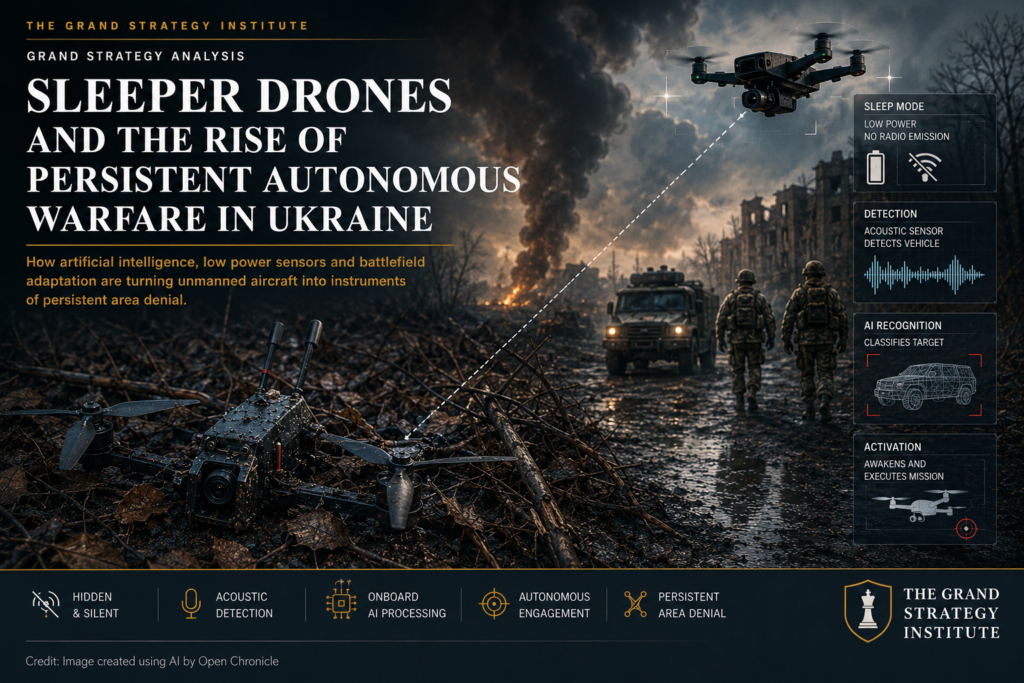
How artificial intelligence, low power sensors and battlefield adaptation are turning unmanned aircraft into instruments of persistent area denial
The Grand Strategy Institute
Defence and Emerging Warfare Analysis
The drone revolution in Ukraine is entering a new phase.
For much of the war, the defining image of unmanned warfare was an aircraft in motion: reconnaissance drones circling above trenches, FPV systems racing towards armoured vehicles, long range strike drones crossing hundreds of kilometres, and operators attempting to maintain fragile command links through an electromagnetic environment saturated with jamming.
The emerging concept of the sleeper drone changes that relationship.
The drone does not necessarily patrol. It does not need to transmit continuously. It can land, conceal itself, reduce its electronic signature and wait. When a relevant stimulus appears, the system can be reactivated, either to observe, report or attack.
Recent reporting from the Ukrainian battlefield indicates that Russian forces have been landing drones near important roads and using acoustic sensing to detect approaching vehicles. According to Forbes, Ukrainian personnel have reported drones concealed near logistics routes, high rise buildings and other positions, where microphones can provide warning of approaching traffic before the system or its operator determines what happens next.
The concept itself is not entirely new. A Russian developer publicly described a hibernation capability for the Joker family of FPV drones years earlier, claiming that prepositioned aircraft could remain dormant for weeks before being remotely reactivated. That claim originated with the manufacturer and should therefore be treated accordingly, but it demonstrates that persistent prepositioned FPV ambushes have been an explicit design objective for some time.
What is new is the convergence of this concept with rapidly improving artificial intelligence, inexpensive onboard computing, acoustic detection and increasingly autonomous terminal guidance.
The strategic significance extends far beyond another innovation in drone warfare.
If these technologies mature and scale, armed forces may be approaching a battlefield in which unmanned weapons do not merely fly across contested territory. They can inhabit it.
That would begin to blur the distinction between drone, sensor, mine, reconnaissance post and autonomous weapon.
And it could profoundly alter how military forces understand control of terrain.
Executive Assessment
The emergence of sleeper and waiting drones represents part of a wider transition from remotely piloted unmanned aircraft towards distributed, persistent and increasingly autonomous battlefield systems.
The most important development is not any single Russian or Ukrainian drone. It is the convergence of several technologies that previously existed separately.
Cheap FPV aircraft provide mobility.
Low power acoustic sensors provide persistent detection.
Onboard computing allows signals to be processed locally.
Computer vision can assist with target recognition and terminal guidance.
Artificial intelligence can reduce dependence upon continuous operator control.
Electronic hibernation reduces detectable emissions.
Together, these capabilities could allow inexpensive unmanned systems to be positioned throughout contested terrain and activated only when battlefield conditions justify it.
Recent Russian use of acoustically triggered waiting drones appears, according to available reporting, still to involve operators in important parts of the engagement process. Claims that current sleeper drones routinely identify people and independently decide to kill them should therefore be treated cautiously. The wider trajectory towards greater autonomy, however, is well documented. Ukraine is already deploying AI enabled systems capable of continuing terminal attacks after operator lock on despite loss of the communications link, while both sides are investing heavily in machine vision and autonomous navigation.
This distinction matters.
There is an enormous legal, technological and strategic difference between automated detection, autonomous terminal guidance and autonomous target selection and engagement.
They should not be treated as interchangeable.
But the technological distance separating them is narrowing.
1. From Flying Weapon to Waiting Weapon
Traditional FPV operations impose several constraints.
The drone must reach its target.
Its battery is consumed during flight.
Its control signal can reveal activity.
Electronic warfare may disrupt the command link.
The target may have warning as the drone approaches.
The operator must often search for targets while simultaneously flying the aircraft.
Landing a drone near a likely target route changes this equation.
Instead of expending energy continuously in the air, the aircraft can use terrain as concealment.
A roadside.
A courtyard.
A damaged building.
A rooftop.
Vegetation.
An abandoned structure.
Any location overlooking or adjoining a predictable logistics corridor can potentially become a temporary unmanned observation position.
The drone effectively transforms from an aircraft into a mobile sensor emplacement.
Once a target or relevant activity is detected, it becomes an aircraft again.
This is conceptually important.
A conventional land mine waits for a target but cannot relocate itself.
A reconnaissance drone can relocate but normally consumes energy and creates signatures while maintaining surveillance.
A sleeper drone combines aspects of both.
It can move into position.
Wait.
Observe.
Potentially reposition.
And, depending upon its configuration, attack.
The tactical concept therefore occupies an unusual space between aviation and land warfare.
2. The Acoustic Revolution
One of the most interesting developments is remarkably simple.
Sound.
Modern battlefield drones are usually associated with cameras, thermal sensors, radio links and sophisticated optics. But acoustic sensing can provide an inexpensive alternative for detecting activity.
According to recent battlefield reporting, Russian waiting drones have been positioned near roads and equipped to detect vehicle noise. The system does not necessarily need direct visual contact with the road while waiting. A microphone can identify an approaching acoustic signature while the aircraft remains concealed.
That provides several advantages.
Video surveillance requires power.
Continuous transmission creates emissions.
An exposed camera requires some degree of line of sight.
An acoustic sensor can operate with much lower energy requirements.
More importantly, processing can increasingly occur at the edge, meaning aboard the drone itself.
The system does not necessarily need to transmit every sound it hears.
Algorithms can analyse incoming signals locally and determine whether they resemble relevant categories such as engines, tracked vehicles or other battlefield activity.
Only then does the system need to communicate.
This creates a much more difficult electronic warfare problem.
3. The Electromagnetic Paradox
Ukraine has become perhaps the world’s most intensive laboratory for tactical electronic warfare.
Both Russian and Ukrainian forces continuously attempt to jam drone command frequencies, navigation systems and data links.
This created an evolutionary pressure towards systems requiring less communication.
Fibre optic FPV drones represented one response.
Autonomous navigation represents another.
Sleeper systems create a third.
A dormant drone that is not actively transmitting offers electronic warfare systems relatively little to detect or jam.
The problem therefore changes.
Traditional electronic warfare asks:
What frequency is the enemy using?
Persistent autonomous warfare increasingly asks:
Where is the enemy machine physically located?
That is a fundamentally different challenge.
Electronic suppression alone becomes insufficient.
Counter drone operations begin to resemble mine clearance, reconnaissance and counter infiltration.
The battlefield becomes populated not merely by radio emitters but by silent machines.
4. Artificial Intelligence Changes the Equation
Artificial intelligence becomes strategically important because it can reduce the amount of information that must travel between drone and operator.
Consider a conventional FPV attack.
The camera transmits video.
The operator watches the feed.
The operator recognises a target.
The operator steers the drone.
The drone attacks.
Every stage depends heavily upon the communications link.
Now move parts of that decision chain aboard the aircraft.
The drone can process imagery locally.
Computer vision can assist in recognising vehicles or other objects.
Navigation software can maintain course.
Terminal guidance can continue after the communications link disappears.
Ukraine is already fielding AI enabled systems incorporating versions of these capabilities. Forbes reported this month on Ukrainian autonomy modules that allow drones, after an operator identifies and locks onto a target, to complete the terminal phase without maintaining the control connection.
The United Kingdom and Ukraine have also established a defence AI partnership centred partly upon Ukraine’s enormous collection of battlefield imagery. Reuters reported that Ukraine’s AI infrastructure includes millions of annotated battlefield images and that systems analysing drone feeds are already being used to improve target identification. The partnership also includes work on low power AI chips for drones and autonomous systems.
This is highly relevant to sleeper systems.
A low power processor can potentially analyse acoustic or visual inputs locally while minimising transmissions.
The drone becomes less dependent upon the network.
And therefore harder to suppress by attacking the network.
5. The Autonomy Ladder
It is important not to describe every AI enabled drone as an autonomous killer.
There are several different levels of machine involvement.
At the simplest level, a sensor detects activity and alerts a human operator.
At another level, AI highlights or classifies objects in a video feed.
At another, the operator selects a target and software maintains terminal tracking.
At a higher level, the system detects and selects a target from predefined categories.
At the most consequential level, the weapon could detect, select and engage a human target without meaningful human intervention.
These categories are strategically and legally different.
Current battlefield reporting provides strong evidence for rapidly expanding AI assisted targeting and terminal autonomy. Evidence for widespread, routine deployment of completely independent lethal target selection remains much less certain.
That uncertainty itself is important.
The United Nations and International Committee of the Red Cross renewed calls this week for binding international rules governing autonomous weapons, reflecting growing concern that technological development is advancing faster than international regulation.
Ukraine may therefore be providing the world with an early view of a much larger strategic problem.
6. From Kill Zone to Persistent Denial Zone
The tactical effect could be profound.
Much of the Ukrainian front is already characterised by increasingly deep drone dominated zones in which movement can be detected and attacked kilometres behind the nominal line of contact.
Sleeper systems can make those zones more persistent.
Imagine a logistics road that appears empty.
No aircraft can be seen overhead.
No obvious control transmission is detected.
Yet several small drones may already be concealed near intersections, buildings or vegetation.
One detects an approaching vehicle.
Another provides visual confirmation.
A third attacks.
Alternatively, the sensor drone communicates the vehicle’s coordinates to artillery or another strike system.
The important point is that the weapon does not have to destroy the vehicle itself to create military effect.
Detection may be enough.
This turns sleeper drones into nodes within a larger kill chain.
Sensor.
Identification.
Communication.
Fire assignment.
Strike.
Battle damage assessment.
The individual drone may be inexpensive.
The network it enables can be extremely powerful.
7. Area Denial Without Traditional Minefields
This creates an intriguing comparison with mine warfare.
Traditional mines deny territory through uncertainty.
A road does not need to contain hundreds of mines to influence behaviour.
Soldiers merely need to believe that it might.
Sleeper drones can generate a similar psychological and operational effect.
A logistics route suspected of containing waiting FPVs becomes dangerous even when no drone is visible.
Vehicles slow down.
Routes change.
Convoys require protection.
Movement may shift to darkness.
Engineering and reconnaissance assets become necessary.
Supply operations become less efficient.
The strategic effect is produced not only through destruction but through uncertainty.
That is why the concept potentially represents a new form of area denial.
The objective is not simply to destroy everything entering a zone.
It is to make entering the zone costly enough that the adversary changes behaviour.
8. Logistics Becomes the Primary Target
Modern armies depend upon enormous logistical networks.
A frontline battalion needs ammunition.
Food.
Fuel.
Batteries.
Medical supplies.
Replacement drones.
Electronic warfare equipment.
Personnel rotation.
Vehicle maintenance.
Every one of these requirements generates movement.
And movement creates signatures.
The Ukrainian battlefield has increasingly demonstrated that the rear area is no longer truly rear.
Waiting drones positioned along supply corridors could expand this vulnerability further.
A cheap unmanned aircraft does not need to destroy a main battle tank to create disproportionate strategic value.
Destroying a fuel truck may matter more.
So might locating an ammunition vehicle.
Or identifying a recurring convoy route.
Or simply forcing logistics traffic onto longer and less efficient roads.
The objective becomes systemic disruption.
This is warfare against movement itself.
9. The Economics Are Potentially Transformative
The sleeper concept also reinforces one of the defining characteristics of the Ukraine war.
Cost exchange.
A relatively inexpensive drone can threaten equipment worth orders of magnitude more.
Adding acoustic sensors and inexpensive computing may increase capability without fundamentally changing that economic relationship.
More importantly, waiting systems conserve one of the drone’s most important resources.
Battery power.
An airborne aircraft continuously consumes energy simply remaining in the sky.
A landed aircraft does not.
This extends persistence without requiring expensive endurance platforms.
The result could be a new class of attritable battlefield sensor weapon.
Cheap enough to deploy in quantity.
Capable enough to create operational consequences.
Expendable enough that losing individual systems does not matter greatly.
This is precisely the kind of technology that scales dangerously well in industrial warfare.
10. The Joker Concept
Russia’s Joker programme illustrates the evolution of the concept.
A Russian developer previously claimed that Joker family FPV drones equipped with a hibernation device could be positioned in advance and remain dormant for several weeks before reactivation. According to the developer, elevated positions such as rooftops could be selected so that the drone would need to travel only a short distance when eventually ordered to attack.
These claims came from the Russian manufacturer rather than independent battlefield evaluation and should not be accepted uncritically.
Nevertheless, the concept is revealing.
The manufacturer was not merely attempting to build a better FPV aircraft.
It was attempting to change the temporal geometry of an FPV attack.
Ordinarily:
launch → transit → search → attack.
With prepositioning:
deploy → wait → activate → attack.
The distance between activation and impact can therefore become extremely short.
Reaction time contracts.
And defensive systems designed to respond to an approaching drone may receive far less warning.
11. The Next Step: Distributed Machine Ambushes
The strategic importance becomes clearer when moving from one sleeper drone to many.
A single waiting drone is a tactical curiosity.
A network of hundreds or thousands is something else entirely.
Road junctions.
Bridges.
Forest approaches.
Urban ruins.
Supply corridors.
Likely vehicle hides.
Rear area staging points.
These could become temporary locations for distributed unmanned sensors.
Not all need explosives.
Some can listen.
Some can watch.
Some can relay communications.
Some can attack.
Some can deliberately remain silent until another sensor activates them.
At that point the battlefield begins to resemble a distributed machine ambush architecture.
The intelligence and strike network is no longer concentrated aboard large platforms.
It is dispersed across inexpensive devices embedded throughout the battlespace.
12. Countermeasures Will Evolve
No military technology remains dominant indefinitely.
Once sleeper drones become sufficiently important, countermeasures will follow.
The relevant competition will probably expand beyond conventional radio jamming.
Forces will increasingly need better detection of small objects on or near roads.
Thermal and multispectral reconnaissance may become more important.
Ground robots could search dangerous routes.
Small reconnaissance drones may inspect rooftops and vegetation ahead of convoys.
Acoustic deception could potentially generate false triggers.
Camouflage will evolve to confuse machine vision.
Vehicle signatures may be deliberately modified.
Routes will change more frequently.
Autonomous counter drone systems may hunt autonomous strike systems.
This leads to a striking possibility.
The answer to distributed unmanned ambushes may itself be distributed unmanned reconnaissance.
Machines hunting machines.
13. The Battlefield Moves Underground
The broader trend is already visible.
When aerial surveillance becomes persistent, armies seek concealment.
Vehicles hide under trees.
Troops use tunnels and covered positions.
Logistics movements occur in poor visibility.
Camouflage becomes more sophisticated.
Positions are dispersed.
The increasing integration of AI makes this competition harder because camouflage must now deceive both humans and algorithms.
Ukrainian developers report that Russian forces are already changing camouflage practices in attempts to confuse computer vision systems.
This represents another profound change.
For most of military history, camouflage was designed primarily against human perception.
Future camouflage must increasingly be designed against machine perception.
The battlefield is becoming an environment contested not only by soldiers but by competing algorithms attempting to interpret reality.
14. Tactical Autonomy Changes Command
There is also a command problem.
A remotely controlled drone requires substantial operator attention.
If one operator controls one aircraft, scaling the force requires scaling personnel.
Autonomy changes that ratio.
An operator might eventually supervise multiple systems rather than directly pilot each one.
The transition is analogous to moving from manual control towards mission command for machines.
The human provides objectives and constraints.
The machines execute increasing portions of the task.
That could dramatically increase combat density.
A force with 1,000 trained drone pilots might eventually control not 1,000 aircraft but several thousand simultaneously operating systems.
This is why autonomy matters even when humans remain formally inside the decision process.
It multiplies human command capacity.
15. The Strategic Problem for NATO
The implications extend well beyond Ukraine.
Many Western armed forces remain organised around expensive platforms.
Advanced combat aircraft.
Armoured vehicles.
Precision missiles.
Sophisticated communications networks.
These systems remain extraordinarily powerful.
But Ukraine demonstrates that they may increasingly operate inside environments saturated with inexpensive sensors and unmanned weapons.
A €10 million armoured vehicle does not need to be destroyed by another €10 million system.
It may be detected by a sensor costing hundreds of euros and attacked by a weapon costing thousands.
This changes procurement mathematics.
Western militaries will need to think not only about platform survivability but about signature management at scale.
How does an armoured brigade move when thousands of cheap sensors may exist across its route?
How are logistics protected?
How are dormant systems detected?
How much electronic warfare is useful against devices that rarely transmit?
How many counter drone interceptors can be afforded?
These are not merely Ukrainian questions.
They are questions about the future structure of land warfare.
16. A New Form of Military Geography
Sleeper drones may ultimately change how territory itself is understood.
Traditional military geography distinguishes between controlled territory, contested territory and enemy territory.
Autonomous sensors complicate this.
A force may physically occupy a road while enemy machines remain concealed around it.
An urban district may appear cleared while dormant sensors remain embedded inside buildings.
A retreating force could leave behind unmanned systems without leaving soldiers.
This produces what might be called latent contested terrain.
Territory appears controlled.
But enemy combat capability remains physically present.
This resembles mine warfare, but with an important difference.
A mine cannot normally observe, communicate, reposition and make increasingly sophisticated distinctions between objects.
An intelligent mobile sensor weapon potentially can.
The concept of clearing territory may therefore become much more technologically demanding.
17. The Legal Threshold
The deepest issue is ultimately not technical.
It is political and ethical.
Who decides that a human being is a legitimate target?
If a drone detects sound, wakes up and alerts an operator, responsibility remains relatively clear.
If computer vision locks onto a vehicle selected by an operator, the machine is performing guidance.
If software independently classifies a person as a combatant and initiates lethal force, the nature of the decision has changed fundamentally.
International humanitarian law still applies.
But autonomy complicates accountability.
Was an incorrect strike caused by the commander?
The programmer?
The manufacturer?
The dataset?
The algorithm?
The operator who deployed the system days earlier?
These questions are becoming urgent enough that the UN and ICRC are pressing governments for specific rules governing autonomous weapons.
The legal debate is therefore no longer theoretical.
The technological foundations of the problem are appearing on real battlefields.
18. The Industrial Dimension
There is one final reason why sleeper drones matter.
They fit the economics of mass warfare.
The future battlefield may not be dominated exclusively by a small number of exquisite autonomous weapons.
It may instead contain enormous quantities of relatively simple systems with modest autonomy.
That distinction matters.
A sophisticated autonomous aircraft costing millions is a scarce strategic asset.
An FPV platform carrying inexpensive sensors and edge computing can potentially become ammunition.
Ukraine and Russia have already demonstrated the extraordinary speed at which drone designs can evolve.
Software can change faster than traditional weapons procurement.
Commercial components can be incorporated quickly.
Frontline feedback reaches developers directly.
Countermeasures appear.
Counter countermeasures follow.
The innovation cycle may take weeks rather than decades.
Recent analysis of Ukraine’s defence technology ecosystem emphasises precisely this relationship between battlefield adaptation, scalable production and increasingly autonomous systems.
Industrial capacity therefore becomes inseparable from algorithmic capability.
The army capable of producing the best autonomous drone is not necessarily the winner.
The advantage may belong to the army capable of producing hundreds of thousands of good enough autonomous systems and improving them faster than the enemy can adapt.
Strategic Assessment
Sleeper drones should not be understood simply as another Ukrainian war novelty.
They represent an early manifestation of a larger transformation in warfare.
The first drone revolution placed inexpensive aircraft above the battlefield.
The second connected them to artillery, intelligence networks and precision strike systems.
The third is giving them increasing autonomy.
The sleeper drone introduces another dimension:
persistence without continuous presence in the air.
The aircraft can become part of the terrain.
That creates a potentially powerful synthesis of mine warfare, reconnaissance, artificial intelligence and precision attack.
The strategic consequences could be considerable.
Electronic warfare becomes less decisive against systems that minimise transmissions.
Rear areas become increasingly vulnerable.
Logistics routes become contested spaces.
Area denial can be created with inexpensive mobile sensors.
Human operators can supervise larger numbers of weapons.
Machine vision begins to shape camouflage and manoeuvre.
And the distinction between sensor and weapon becomes increasingly difficult to maintain.
The most important evolution may ultimately occur when these technologies converge completely.
A future sleeper system could potentially deploy itself, select a concealed observation position, enter a low power state, recognise relevant activity, communicate with other systems, reposition if necessary and participate in an attack.
At that point, warfare enters a qualitatively different era.
The battlefield would no longer merely contain autonomous weapons.
It would contain an autonomous ecology of sensors, decision systems and weapons distributed throughout physical terrain.
Ukraine is not yet fully at that point.
But the direction of travel is increasingly visible.
Key Findings
- Sleeper drones represent a transition from continuously airborne unmanned systems towards persistent, prepositioned battlefield sensors and weapons.
- Russian forces have recently been reported using landed drones with acoustic sensing to detect vehicles along contested logistics routes.
- Earlier Russian claims concerning Joker FPV hibernation systems demonstrate that extended dormant prepositioning has been an explicit development objective, although manufacturer claims require independent scrutiny.
- Acoustic sensing can reduce power consumption and allow drones to remain concealed without continuous visual surveillance.
- Local processing can reduce the need for continuous radio transmission, complicating traditional electronic warfare.
- Current reporting should not automatically be interpreted as evidence that sleeper drones routinely make independent lethal decisions. Automated sensing, AI assisted targeting, terminal autonomy and fully autonomous engagement are distinct capabilities.
- Ukraine is already deploying AI enabled terminal guidance designed to continue attacks after the communications link is lost.
- Large battlefield datasets and low power AI processors are likely to accelerate machine perception aboard tactical drones.
- Networks of waiting drones could become inexpensive systems for persistent area denial and logistics interdiction.
- The tactical effect resembles mine warfare, but mobility, sensing and communications potentially make sleeper drones substantially more flexible than conventional mines.
- Counter drone warfare will increasingly require physical detection, multispectral reconnaissance and unmanned route clearance in addition to electronic jamming.
- AI enabled surveillance is forcing camouflage to evolve from hiding primarily from human observers towards deceiving machine vision.
- Increasing autonomy could allow individual operators to supervise multiple unmanned systems, dramatically increasing battlefield combat density.
- Western militaries must prepare for environments in which expensive platforms operate inside territories saturated with inexpensive distributed sensors.
- Autonomous weapons raise unresolved questions of accountability, distinction and meaningful human control, concerns reflected in renewed UN and ICRC calls for international regulation.
- The decisive military advantage may ultimately belong not to the state possessing the most sophisticated individual drone, but to the state capable of producing, networking and continuously improving autonomous systems at industrial scale.
Grand Strategy Judgment
The strategic importance of the sleeper drone lies in a deceptively simple idea:
the drone no longer has to search continuously for the battlefield because it can wait for the battlefield to come to it.
That inversion changes the economics of surveillance, the geometry of ambush and the relationship between machines and terrain.
For centuries, armies left mines, obstacles, observation posts and soldiers behind to deny territory.
The emerging autonomous battlefield may combine all four functions inside machines small enough to be carried by an individual soldier and inexpensive enough to be deployed by the thousands.
The strategic competition that follows will not therefore concern drones alone.
It will concern who controls perception.
Who can hide.
Who can move.
Who can distinguish real targets from deception.
Who can build autonomous systems quickly enough.
And ultimately, how much authority states are prepared to transfer from human soldiers to machines.
The Ukraine war has repeatedly demonstrated that technologies initially regarded as tactical improvisations can rapidly become structural features of modern warfare.
Sleeper drones may be another such moment.
Not because a single hidden FPV changes the balance of power.
But because a battlefield populated by thousands of inexpensive, patient and increasingly intelligent machines might.
That is the larger transformation defence establishments should be watching.
The Grand Strategy Institute
Continue Exploring Strategic Analysis
Return to The Grand Strategy Institute for strategic assessments, long-form analysis and research examining geopolitics, military affairs, international security, emerging technologies and the changing international order.
← Back to The Grand Strategy Institute