
Department: Defence & Security | Americas | Counter Narcotics
By Open Chronicle with agencies
Ecuadorian security forces, supported by the United States military and federal law enforcement agencies, have carried out a sweeping series of counter narcotics operations targeting some of Ecuador’s most powerful criminal organisations, resulting in more than 40 arrests and the destruction of infrastructure allegedly used to transport drugs internationally.
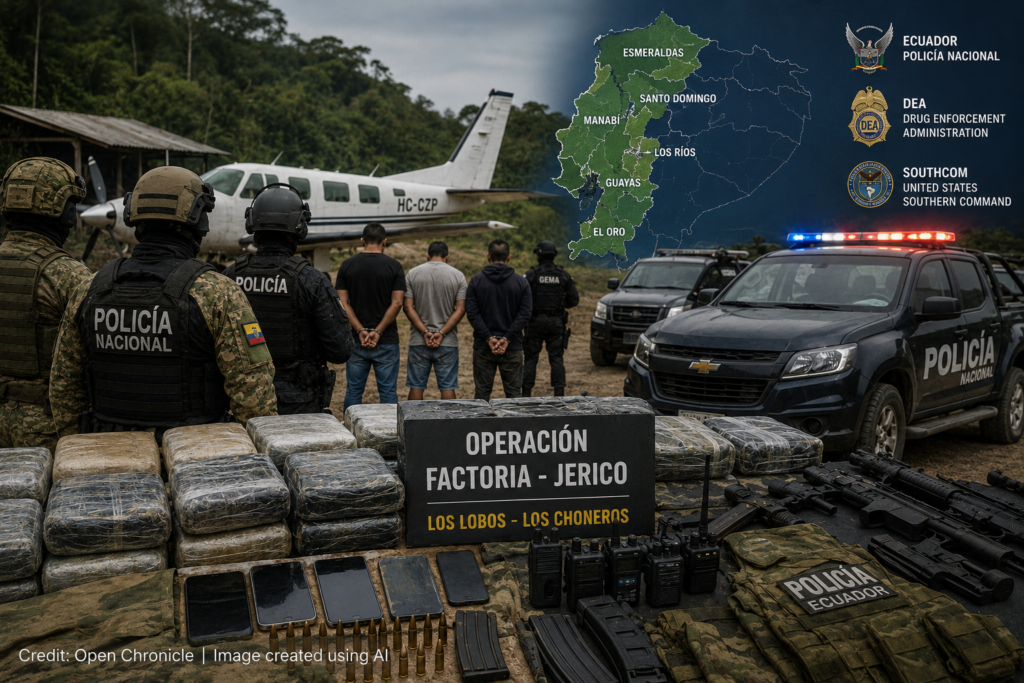
The operations, known as Operation Factoria and Operation Jerico, targeted networks associated with Los Lobos and Los Choneros, two criminal organisations that have become central players in Ecuador’s increasingly violent organised crime landscape.
Authorities conducted operations across six provinces, Guayas, Santo Domingo, El Oro, Los Rios, Manabi and Esmeraldas.
The campaign involved Ecuador’s National Police and State Attorney General’s Office, with support from the U.S. Drug Enforcement Administration and the U.S. military’s Southern Command.
43 Suspects Arrested in Simultaneous Raids
General Pablo Vinicio Davila, commander in chief of Ecuador’s National Police, said security forces carried out 36 simultaneous raids and arrested 43 suspected members of criminal networks.
Among those detained were two individuals described by authorities as high value targets, identified by the aliases “CC” and “Leon.”
Ecuadorian Interior Minister John Reimberg said the suspects also included two Mexican nationals believed to have worked as pilots for the Jalisco New Generation Cartel, one of Mexico’s most powerful organised crime groups.
According to Ecuadorian authorities, the pilots were allegedly responsible for transporting cocaine by aircraft from Ecuador towards Mexico and ultimately the United States.
The arrests could provide investigators with valuable intelligence about the increasingly international structure of narcotics trafficking networks operating through Ecuador.
Clandestine Airstrips Destroyed
One of the most significant elements of the operation was the discovery and dismantling of two clandestine airstrips allegedly used to support international narcotics trafficking.
Security forces also seized a light aircraft and nearly 1,000 litres of aviation fuel.
The presence of aviation infrastructure illustrates the logistical capabilities available to trafficking organisations operating in the region. Small aircraft can move large quantities of narcotics rapidly between isolated locations before shipments are transferred into wider trafficking networks.
Authorities also confiscated 21 vehicles and 47 mobile devices, along with communications equipment that investigators are expected to examine for information about trafficking routes, financial networks and contacts.
Firearms, ammunition, bulletproof vests and cash were also recovered.
Officials reported the seizure of significant quantities of cocaine and synthetic drugs, although authorities did not immediately provide a complete figure for the narcotics confiscated.
US Agencies Support Ecuadorian Operations
The campaign represents a significant example of expanding security cooperation between Washington and Quito.
The operations were coordinated by Ecuador’s State Attorney General’s Office alongside the DEA and U.S. Southern Command, according to authorities.
General Francis Donovan, commander of SOUTHCOM, described the preliminary results as successful and characterised the combined effort as a significant victory for regional security.
American involvement reflects growing concern in Washington over Ecuador’s role within international cocaine trafficking networks.
Ecuador itself is not one of the world’s largest producers of cocaine, but its geographical position between Colombia and Peru, major cocaine producing countries, combined with its Pacific ports, has made the country an increasingly important transit and export hub.
Criminal organisations have exploited container shipping, ports, highways and clandestine aviation networks to move narcotics towards North America and Europe.
Ecuador’s Battle Against Organised Crime
The operations come as President Daniel Noboa’s government continues an aggressive campaign against criminal organisations blamed for an extraordinary rise in violence across Ecuador.
Los Choneros and Los Lobos have become two of the country’s most prominent organised crime networks, competing for control over drug trafficking routes, prisons, ports and territory.
Their expansion has contributed to assassinations, prison violence, kidnappings, extortion and attacks against state institutions.
The government has increasingly treated the security crisis as a national security challenge rather than solely a conventional law enforcement problem, allowing greater involvement by Ecuador’s armed forces.
Cooperation with the United States has simultaneously expanded in intelligence, counter narcotics operations and law enforcement.
Washington Expands Pressure on Ecuadorian Gangs
The latest crackdown follows moves by the administration of President Donald Trump to classify Los Lobos, Los Choneros and the Chone Killers as foreign terrorist organisations.
That designation significantly increases the legal and financial tools available to Washington against organisations placed under the classification.
It can also facilitate greater intelligence sharing and coordination between American and Ecuadorian authorities seeking to identify financial networks, trafficking routes and international partners associated with the groups.
The involvement of alleged Jalisco New Generation Cartel pilots in the latest investigation also highlights the increasingly transnational character of Ecuador’s security crisis.
Rather than operating exclusively as domestic gangs, Ecuadorian criminal organisations have developed relationships with larger international trafficking networks seeking access to the country’s ports and Pacific coastline.
A Battle Over the Drug Supply Chain
Operation Factoria and Operation Jerico therefore extend beyond the arrest of individual suspects.
The destruction of clandestine airstrips, seizure of an aircraft and aviation fuel, confiscation of communications equipment and detention of suspected pilots indicate an attempt to disrupt the logistical architecture that allows narcotics to move between South America, Mexico and the United States.
For Ecuador, the broader challenge will be ensuring that dismantled networks cannot quickly regenerate or be replaced by rival organisations.
For Washington, the operations demonstrate a strategy increasingly focused on attacking transnational criminal networks closer to the beginning of their international supply chains.
The raids represent one of the most substantial joint counter narcotics operations conducted since Ecuador expanded security cooperation with the United States.
Whether they produce a lasting disruption to trafficking networks will depend on what investigators uncover from the arrests, seized communications equipment and financial evidence, as well as the ability of Ecuadorian authorities to maintain pressure on the criminal organisations controlling key trafficking corridors.