
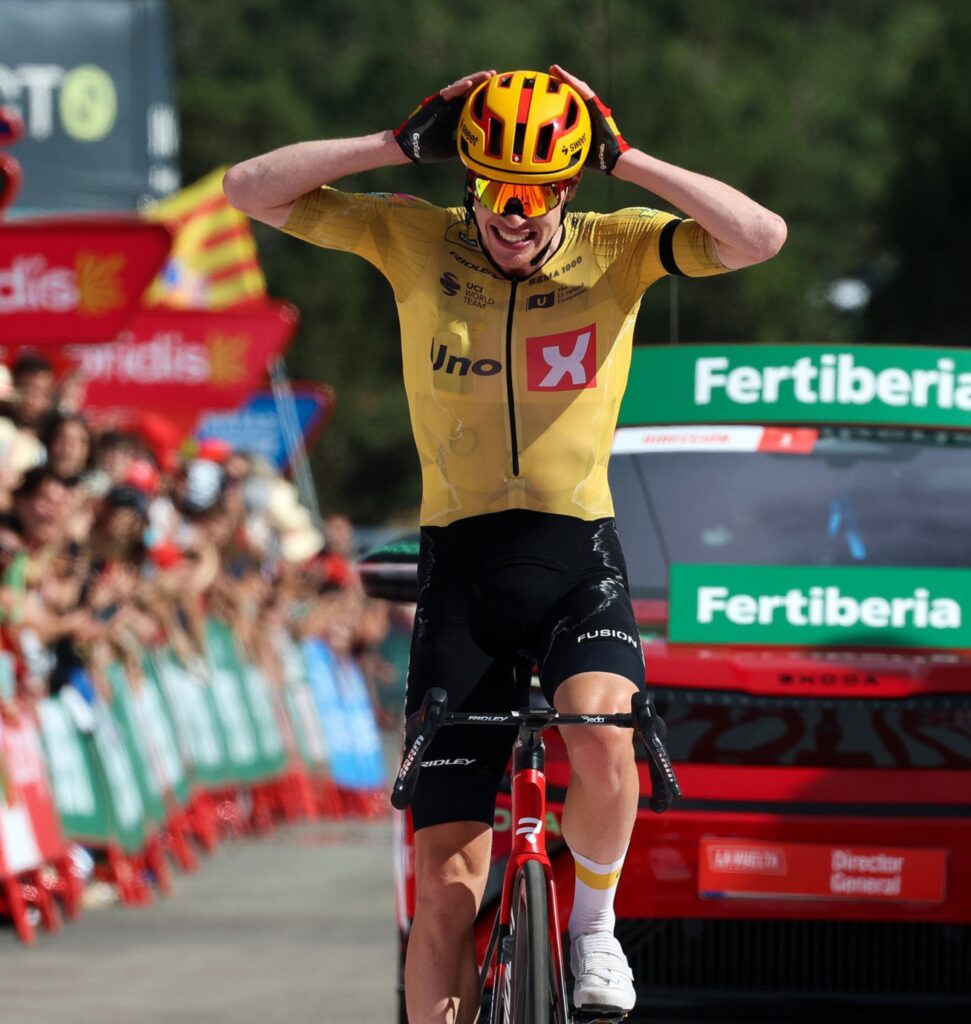
Image: from Portuguese Cycling Magazine X @PCMPTMag
By Open Chronicle Sports
28 August 2026 | Vuelta a España 2026 | Stage 7
Andreas Leknessund claimed his first career stage victory at the Vuelta a España with a superb mountain performance at Aramón Valdelinares, completing a memorable day for Uno X Mobility at the end of Stage 7.
The Norwegian completed the 149.8 kilometre mountain stage from Vall d’Alba to Aramón Valdelinares in 3:49:47, turning the final ascent into the scene of one of the most significant victories of his career.
It was more than an individual triumph. Uno X Mobility executed the decisive phase of the race brilliantly, placing itself in a commanding tactical position before Leknessund delivered the winning attack on the climb to Valdelinares.
Behind the fight for the stage, the general classification contenders faced another important mountain examination as the opening week of the Vuelta continued to take shape.
A Day Made for the Breakaway
Stage 7 represented another substantial change of terrain after the previous day’s battle on the road to Castelló.
There would be no hiding on the road to Valdelinares.
The 149.8 kilometre route steadily accumulated fatigue before the final mountain provided the decisive selection. With the general classification teams conscious of the demanding stages still ahead, the conditions created an opportunity for ambitious riders prepared to commit to the breakaway.
Uno X Mobility recognised it.
Andreas Leknessund was exactly the type of rider capable of exploiting such a situation.
The Norwegian possesses the combination of endurance, climbing ability and resistance required for long days in difficult terrain. Once he found himself in contention for the stage, the question became whether he could convert that opportunity into victory.
Uno X Takes Control of the Tactical Battle
The decisive feature of Stage 7 was Uno X’s strength in numbers.
Having more than one rider at the front dramatically altered the tactical possibilities on the approach to Valdelinares. Instead of requiring Leknessund to respond personally to every acceleration, the Norwegian team could force its rivals to make decisions.
That numerical advantage became increasingly valuable as the road climbed.
Every attack required energy.
Every hesitation created opportunity.
And when the decisive moment arrived, Leknessund did not hesitate.
Leknessund Attacks
With approximately 7.5 kilometres remaining, Leknessund made his move.
It was not an attack designed merely to test the opposition.
He committed.
On a summit finish, seven kilometres can represent an enormous distance to defend alone. The gradient continues taking energy from the legs while the chasing riders can cooperate behind.
But Leknessund found his rhythm.
The Norwegian climbed with the controlled aggression required for such an effort, maintaining momentum as the kilometres disappeared beneath him.
The chase could see what was happening.
Stopping it was another matter.
Leknessund continued towards the summit.
The possibility of victory became probability.
Then certainty.
First Vuelta Stage Victory
Leknessund crossed the line at Aramón Valdelinares after 3 hours, 49 minutes and 47 seconds of racing.
The achievement carried particular significance.
It was Andreas Leknessund’s first stage victory at the Vuelta a España.
For a rider who has already demonstrated his ability on difficult terrain and in stage racing, victory at a Grand Tour represents a major addition to his palmarès.
And this was no ordinary victory.
Leknessund had attacked on the final mountain and made the move stick.
There was no sprint to decide it.
No photo finish.
He had created the winning margin on the climb.
A Huge Day for Uno X Mobility
The result also represented an important moment for Uno X Mobility.
The Norwegian team has steadily developed its presence at the highest level of professional road cycling, combining Scandinavian talent with increasingly ambitious performances in the sport’s biggest races.
A Grand Tour mountain stage victory provides another marker of that progression.
More importantly, the manner of the victory demonstrated that Uno X was not simply present in the race.
The team influenced it.
It placed riders in the decisive move, created a tactical advantage and converted that position into victory.
Stage racing rewards strength.
It also rewards intelligence.
At Valdelinares, Uno X displayed both.
Pogačar Strengthens His Position
Behind the fight for the stage victory, another contest continued.
Tadej Pogačar entered Stage 7 wearing the Red Jersey after his victory in Castelló and once again emerged from the mountains with his overall position strengthened.
The Slovenian had already established himself as the dominant force of the opening week.
Victory in the Monaco time trial had given him the first Red Jersey.
His attack in Andorra had reinforced that status.
Then came another victory on Stage 6, when he defeated Enric Mas after an aggressive finale towards Castelló.
Valdelinares did not produce another Pogačar stage win.
It did not need to.
The objective was control.
By the end of Stage 7, Pogačar held a 3:50 advantage over Enric Mas, while Primož Roglič sat 4:50 behind.
The situation was becoming increasingly favourable for the race leader.
Mas Emerges as the Closest Challenger
Enric Mas continued to establish himself as Pogačar’s nearest rival in the general classification.
The Spaniard had already demonstrated his condition by following Pogačar deep into the decisive phase of Stage 6.
Stage 7 reinforced his position near the top of the race.
The gap remained substantial, but Mas had separated himself from several other contenders and entered the remainder of the Vuelta as the rider closest to the Red Jersey.
Roglič remained another obvious threat, although the deficit was approaching five minutes.
In a Grand Tour, that is significant.
It is not necessarily definitive.
Van Aert Moves Into Green
Another important classification changed hands at Valdelinares.
Wout van Aert moved into the Green Jersey as leader of the points classification.
That development ended Pogačar’s unusual possession of several classification leads simultaneously and provided Van Aert with a tangible reward for his consistency across different terrain.
Van Aert’s versatility makes the points competition particularly interesting.
He does not require exclusively flat sprint stages to accumulate points. Reduced finishes, demanding transitional stages and selective terrain can all provide opportunities.
That characteristic could become increasingly important as the Vuelta progresses.
The Young Riders Continue Their Battle
Oscar Onley remained prominent in the youth classification as the younger generation continued its own race within the race.
Grand Tours contain multiple narratives simultaneously.
While the cameras naturally focus on the Red Jersey and stage victories, young rider classifications can reveal competitors capable of becoming Grand Tour leaders in future seasons.
The mountains are often where those prospects become clearer.
Valdelinares provided another test.
A Different Kind of Mountain Victory
The previous mountain stages had largely been defined by the general classification battle.
Stage 7 belonged to someone else.
That distinction matters.
Grand Tours are not simply three week contests between a handful of overall contenders. Their complexity comes from the opportunities available to different riders on different days.
Sprinters wait for flat finishes.
General classification riders target the decisive mountains.
Time trial specialists measure their seasons in seconds.
Breakaway specialists look at a stage profile and see possibilities invisible to everyone else.
On 28 August, Leknessund saw his opportunity.
Then he took it.
Valdelinares Adds Another Norwegian Chapter
Norwegian cycling has produced an increasingly significant presence in international professional racing.
From sprinters and Classics riders to climbers and stage racers, Norway has developed a generation capable of competing across the WorldTour calendar.
Uno X Mobility has become an important part of that story.
Leknessund’s victory consequently carries significance beyond the result itself.
A Norwegian rider.
A Norwegian team.
A Grand Tour summit finish.
And a victory earned through an attack rather than waiting for circumstances to decide the race.
For Uno X, it was the type of result around which team history can be built.
Stage 7 Result
| Pos. | Rider | Team |
|---|---|---|
| 1 | Andreas Leknessund | Uno X Mobility |
| 2 | Tobias Halland Johannessen | Uno X Mobility |
| 3 | Wout van Aert | Visma Lease a Bike |
The presence of Tobias Halland Johannessen in second place underlined the scale of Uno X’s performance.
First and second on a Vuelta mountain stage.
It was not simply Leknessund’s day.
It was Uno X’s day.
Stage 7 at a Glance
Date: Friday, 28 August 2026
Route: Vall d’Alba → Aramón Valdelinares
Distance: 149.8 km
Profile: Mountain
Winner: Andreas Leknessund
Team: Uno X Mobility
Winning time: 3:49:47
Second: Tobias Halland Johannessen
Third: Wout van Aert
Milestone: First Vuelta a España stage victory for Andreas Leknessund
What Stage 7 Meant
For Leknessund, Valdelinares delivered a first Vuelta stage victory and one of the defining results of his career.
For Uno X Mobility, it delivered something even larger: proof that the team could not only compete in a Grand Tour, but control the tactical narrative of a difficult mountain stage and finish first and second.
For Van Aert, the day brought the Green Jersey.
For Pogačar, it represented another successful defence of red and another step towards consolidating his command of the general classification.
And for the Vuelta, Stage 7 demonstrated once again why mountain stages cannot be understood solely through the battle for overall victory.
Sometimes the strongest rider in the race does not need to win.
Sometimes a breakaway survives.
Sometimes a team plays the tactical game perfectly.
And sometimes, high above the Spanish roads, a rider discovers the greatest victory of his Grand Tour career.
At Valdelinares, that rider was Andreas Leknessund.