
By Open Chronicle History Desk
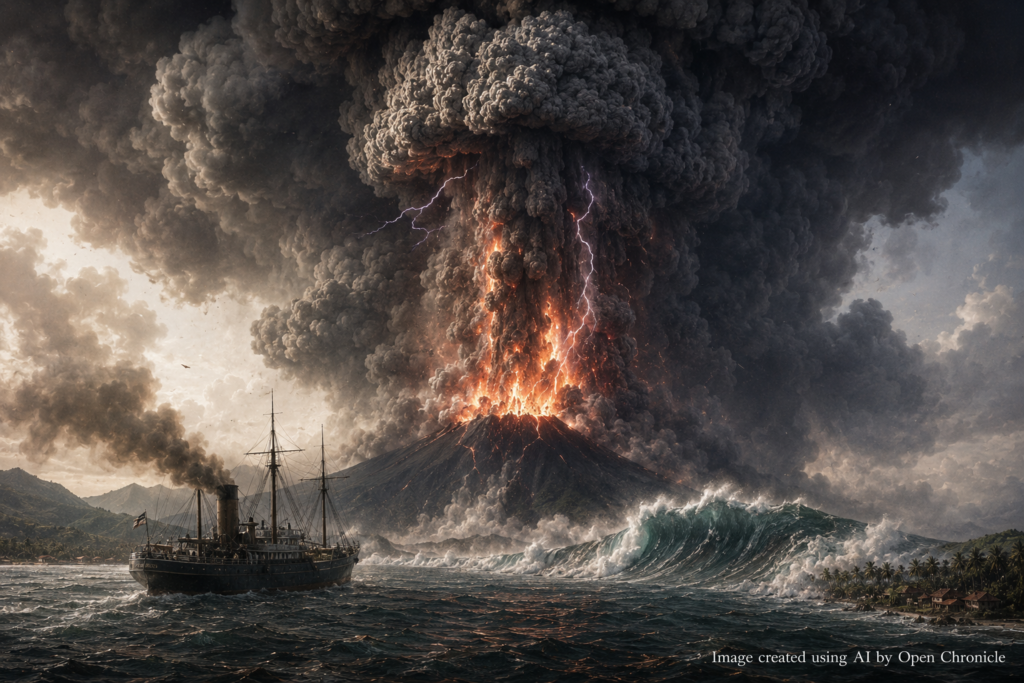
In the early hours of August 27, 1883, one of the most violent volcanic events in recorded history reached its catastrophic climax in the Sunda Strait between the Indonesian islands of Java and Sumatra.
The volcanic island of Krakatoa, known in Indonesia as Krakatau, had been erupting intermittently for months.
Then the eruption entered a different phase.
Four enormous explosions occurred during the morning.
The final and most powerful blast, at approximately 10:02 a.m. local time, was so immense that it became one of the loudest sounds documented in modern history.
The island was torn apart.
Much of Krakatoa collapsed into the sea.
Enormous tsunamis raced across the Sunda Strait, destroying coastal towns and villages.
More than 36,000 people were killed, the overwhelming majority by the waves rather than by the eruption itself.
The disaster did not remain confined to Indonesia.
Atmospheric pressure waves travelled around the planet.
Barometers thousands of kilometres away recorded the disturbance.
Volcanic material rose high into the atmosphere and spread around the globe.
For months afterward, observers in distant countries reported extraordinary sunsets and unusual atmospheric colours.
Krakatoa became something more than a regional catastrophe.
It became one of the first natural disasters of the modern communications age to be experienced, measured and discussed as a truly global event.
A Volcano Between Two Great Islands
Krakatoa stood in the Sunda Strait, the narrow maritime passage separating Java and Sumatra.
The location was geologically dangerous.
Indonesia lies along one of the most volcanically active regions on Earth.
Here, tectonic plates interact along the immense system commonly known as the Pacific Ring of Fire.
The Indo Australian Plate moves beneath the Sunda Plate, generating magma and producing a chain of volcanoes across the Indonesian archipelago.
Volcanism has shaped the region for millions of years.
It created fertile soils.
It built islands.
It also repeatedly destroyed communities.
Krakatoa was part of that geological system.
Before 1883, the island consisted of several volcanic peaks, including Perboewatan, Danan and Rakata.
The surrounding Sunda Strait was one of the world’s important maritime passages.
Ships moved through waters that connected the Indian Ocean with the seas of Southeast Asia.
Nearby coastlines supported towns, villages, ports and agricultural communities.
For generations, people lived within sight of volcanic landscapes.
Few could have imagined what would happen in 1883.
Krakatoa Before 1883
Krakatoa had erupted before.
Historical evidence indicates volcanic activity in the region long before the nineteenth century.
A significant eruption occurred in 1680 and 1681.
Then the volcano entered a long period of relative quiet.
By the nineteenth century, vegetation covered much of the island.
Ships passed nearby.
People visited.
To observers, Krakatoa might have appeared dormant.
But beneath the surface, geological forces remained active.
In 1883, the volcano awakened.
May 20, 1883
The first major warning came in May.
On May 20, Krakatoa began erupting.
Explosions sent columns of ash and steam into the atmosphere.
The activity was visible from considerable distances.
Ships passing through the Sunda Strait reported ash.
Residents of Batavia, modern Jakarta, heard explosions.
At first, the eruption attracted curiosity.
Some people even travelled toward the volcano to observe it.
During the following weeks, volcanic activity fluctuated.
At times it appeared to diminish.
Then it intensified again.
Multiple vents became active.
Ash columns rose above the island.
Explosions continued.
The volcano was preparing for something far greater.
The Dutch East Indies
The catastrophe occurred within the Dutch East Indies, the colonial territory that would eventually become modern Indonesia.
The Netherlands controlled much of the archipelago through a colonial system built around administration, commerce and extraction.
Java was one of the most economically important islands in the colonial empire.
The region produced coffee, sugar and other valuable commodities.
Ports connected colonial production with global markets.
European officials, merchants and scientists lived alongside millions of Indonesians whose lives were shaped by colonial rule.
This context matters.
Most of the people who died in the Krakatoa disaster were local inhabitants of Java and Sumatra.
Their communities carried the overwhelming human cost of a catastrophe that would later become famous around the world.
August 26
By August 26, the eruption had intensified dramatically.
Explosions became increasingly powerful.
Ash rose tens of kilometres into the atmosphere.
Ships in the Sunda Strait encountered darkness, falling pumice and violent seas.
The sound of the volcano travelled across the region.
By afternoon and evening, the situation was becoming catastrophic.
Tsunamis began striking nearby coastlines.
Ash and volcanic debris filled the air.
Lightning flashed through the eruption clouds.
The Sunda Strait entered a world of darkness, noise and destruction.
But the greatest explosions were still to come.
August 27
During the morning of August 27, Krakatoa produced four enormous explosions.
They occurred at approximately 5:30 a.m., 6:44 a.m., 10:02 a.m. and 10:52 a.m.
Each represented a massive release of volcanic energy.
The third explosion, at approximately 10:02, was the most powerful.
It became legendary.
The sound travelled thousands of kilometres.
People heard it across vast areas of the Indian Ocean.
Reports came from locations in Australia and from the island of Rodrigues in the western Indian Ocean.
At distances where ordinary sound should have been impossible to hear, Krakatoa was still audible.
Few natural sounds in documented human history have travelled so far.
The 10:02 Explosion
The great explosion at 10:02 was associated with catastrophic structural collapse at Krakatoa.
The volcanic system had been destabilised by the eruption.
As enormous quantities of magma were expelled, sections of the island collapsed.
Sea water interacted with volcanic processes.
Much of the existing island disappeared.
Where volcanic peaks had previously risen above the Sunda Strait, a vast caldera formed.
The geography of Krakatoa was permanently transformed.
But the collapse created another catastrophe.
The sea itself became a weapon.
The Tsunamis
Enormous tsunamis radiated outward across the Sunda Strait.
Some waves reached heights of several tens of metres in the most severely affected areas.
They struck coastlines with extraordinary force.
Villages disappeared.
Buildings were torn from foundations.
Trees were uprooted.
Ships were carried inland.
People attempting to flee had little time.
The waves were responsible for most of the deaths associated with the eruption.
Coastal communities on Java and Sumatra were devastated.
The destruction was so extensive that entire settlements effectively vanished.
Anjer
The port town of Anjer, on the western coast of Java, was among the communities devastated by the tsunami.
Anjer had been an important stop for ships passing through the Sunda Strait.
After the eruption, much of the town was destroyed.
The lighthouse was damaged and the coastline transformed.
Other communities along both sides of the strait suffered similar devastation.
The disaster demonstrated a danger that would become increasingly important to modern volcanology.
A volcanic eruption does not need to kill only through lava or ash.
When volcanic islands collapse or large quantities of material enter the sea, the resulting displacement of water can create tsunamis capable of destroying communities far from the eruption itself.
Merak and the Coast of Java
Communities along Java’s western coastline experienced successive waves.
People who survived one tsunami could be struck by another.
The sea withdrew and returned.
Debris filled the water.
Houses, boats, trees, animals and human bodies were carried inland and back toward the sea.
Infrastructure disappeared.
Communications were broken.
The landscape itself became difficult to recognise.
For survivors, the catastrophe was not a single moment.
It was a sequence of explosions, darkness, waves and destruction.
The Town of Telok Betong
Across the Sunda Strait, southern Sumatra also suffered catastrophic damage.
Telok Betong, now part of Bandar Lampung, was struck by enormous waves.
The destruction demonstrated the scale of the event.
Krakatoa was not merely destroying its own island.
It was transforming coastlines across a substantial region.
The final official colonial death toll would exceed 36,000.
Modern estimates sometimes vary, but the scale of mortality is beyond dispute.
Tens of thousands of people died within hours.
A Ship Carried Inland
Among the most remarkable stories associated with the tsunami involved the Dutch steamship Berouw.
The vessel was lifted and carried inland by the waves near Telok Betong.
The image of a large ship displaced from the sea became one of the most striking symbols of the tsunami’s force.
Such events demonstrate the physical power involved.
A tsunami is not simply an unusually large breaking wave.
It represents the movement of an immense volume of water.
When that water reaches shallow coastal areas, it can surge inland with devastating energy.
Buildings and ships offer little protection against sufficiently powerful flows.
Darkness at Midday
The eruption transformed daylight into darkness across parts of the region.
Ash filled the atmosphere.
Ships reported conditions in which navigation became extraordinarily difficult.
Falling pumice covered the sea.
Volcanic debris struck decks.
Electrical activity flashed within the eruption cloud.
The combination of darkness and sound must have been terrifying.
People did not possess modern satellite imagery or real time volcanological monitoring.
They could see only fragments of what was happening.
A volcano was exploding.
The sea was attacking the land.
Day had become night.
And nobody knew when it would end.
Pyroclastic Flows Across the Sea
One of the most remarkable scientific questions surrounding Krakatoa concerns how extremely hot volcanic currents travelled across stretches of water.
Pyroclastic density currents generated by the eruption moved outward from the volcano.
Some apparently crossed tens of kilometres of sea before reaching parts of Sumatra.
These currents carried hot gases, ash and volcanic material at high speed.
They contributed to deaths in areas that might otherwise have appeared protected by water.
Modern research into Krakatoa has helped volcanologists understand how large explosive eruptions can produce hazards extending far beyond the volcanic cone itself.
The Loudest Sound?
Krakatoa is frequently described as producing the loudest sound in recorded history.
That description requires some caution because nineteenth century measurements cannot be compared perfectly with modern acoustic instrumentation.
What is certain is that the explosion generated extraordinary pressure waves.
The sound was reportedly heard thousands of kilometres away.
On Rodrigues, more than 4,000 kilometres from Krakatoa, observers reported hearing distant explosive sounds.
In parts of Western Australia, the eruption was also heard.
At closer distances, the pressure was powerful enough to cause physical discomfort and damage.
The scale is difficult to imagine.
A geological event in Indonesia announced itself across an enormous portion of the planet.
The Pressure Wave Circles Earth
The eruption produced an atmospheric pressure wave that travelled around the globe.
Barometers recorded the disturbance at weather stations far from Indonesia.
The pressure wave did not simply travel outward once.
It circled the Earth repeatedly.
For nineteenth century scientists, this provided extraordinary data.
The world was increasingly covered by meteorological stations equipped with standardised instruments.
Krakatoa therefore occurred at a unique historical moment.
A similarly enormous eruption centuries earlier might have left scattered eyewitness accounts.
The 1883 eruption left measurements.
Science could follow the catastrophe around the planet.
Telegraphy Creates a Global Disaster
Technology also changed how the world learned about Krakatoa.
By the 1880s, submarine telegraph cables connected much of the world.
News could travel between continents with unprecedented speed.
Reports of the eruption moved through telegraph networks.
Newspapers in Europe, America and elsewhere described events in the Dutch East Indies.
For perhaps the first time, a volcanic catastrophe in Southeast Asia became a global news story almost immediately.
Krakatoa therefore belongs to both geological history and media history.
The Earth had always produced global phenomena.
Humanity was only now developing communications systems capable of experiencing them collectively.
The Royal Society Investigates
The eruption generated intense scientific interest.
The Royal Society in Britain established a committee to investigate the phenomenon.
Reports were collected from ships, meteorological stations and observers around the world.
The resulting study became one of the landmark scientific investigations of a volcanic eruption.
Researchers examined atmospheric pressure waves, oceanic effects, ash distribution, unusual sunsets and other phenomena.
Krakatoa helped demonstrate the value of international scientific observation.
A volcano in Indonesia could produce evidence recorded in Europe, Africa, Australia and the Americas.
Understanding such an event required global data.
Ash Reaches the Upper Atmosphere
The eruption injected enormous quantities of ash, dust and gases high into the atmosphere.
Fine volcanic material spread around the planet.
The effects persisted long after the explosions stopped.
Atmospheric circulation transported particles over vast distances.
Observers began reporting unusual optical phenomena.
The Sun and Moon sometimes appeared strangely coloured.
Twilight glows became exceptionally vivid.
The sky itself carried evidence of Krakatoa.
Blood Red Sunsets
During the months following the eruption, spectacular sunsets were reported around the world.
Skies glowed red, orange and purple.
Some observers initially interpreted the colours as signs of distant fires.
Scientists increasingly connected them with volcanic material in the atmosphere.
The effects were visible in Europe and North America as well as other regions.
Krakatoa had effectively painted the world’s skies.
The phenomenon provided scientists with valuable evidence about atmospheric circulation.
Particles injected high into the atmosphere could travel enormous distances.
A volcanic eruption was therefore capable of influencing the appearance of the sky on a planetary scale.
Krakatoa and The Scream
A famous cultural theory connects the atmospheric effects of Krakatoa with Edvard Munch’s painting The Scream.
Munch described experiencing an extraordinary blood red sky over Norway.
Some researchers have proposed that the vivid colours he remembered may have been influenced by volcanic twilight effects following Krakatoa.
The connection is intriguing but cannot be established with certainty.
Munch’s work was created years later and its meaning is psychological and artistic rather than documentary.
Still, the theory illustrates how deeply Krakatoa entered global cultural memory.
The volcano’s atmospheric effects were witnessed by millions of people who had never heard its explosions.
Global Temperature Effects
Large volcanic eruptions can influence climate by injecting sulfur compounds into the stratosphere.
These compounds form aerosols capable of reflecting a portion of incoming solar radiation.
Krakatoa contributed to measurable global cooling in the years following the eruption.
The effect was temporary.
But it demonstrated that volcanic events can influence climate beyond their immediate region.
Modern scientists now study major eruptions partly through this climatic framework.
Krakatoa became one of the historical cases that helped reveal the connection between volcanism and global atmospheric change.
The Human Cost
Scientific measurements can make Krakatoa seem like an abstract demonstration of planetary physics.
It was first and foremost a human catastrophe.
More than 36,000 people died.
Many disappeared into the sea.
Families were destroyed.
Villages ceased to exist.
Agricultural land was devastated.
Survivors lost homes, boats, livestock and livelihoods.
Disease and displacement followed.
Most victims were Indonesians living under colonial rule.
Their individual names and stories are far less well preserved than the scientific records of the eruption.
That imbalance is itself part of the historical record.
The world remembered Krakatoa’s sound.
Local communities endured its consequences.
Colonial Responses
Dutch colonial authorities organised relief efforts after the catastrophe.
Officials attempted to assess damage, distribute assistance and restore communications.
But the enormous scale of destruction made recovery difficult.
Roads and settlements had vanished.
Coastal geography had changed.
Thousands were homeless.
The catastrophe also occurred within a colonial political system in which European officials possessed greater institutional visibility than the Indonesian population they governed.
Modern histories increasingly attempt to recover the experiences of local communities rather than viewing Krakatoa solely through European scientific and colonial records.
Islam and the Disaster
The affected regions contained overwhelmingly Muslim populations.
Religious interpretations formed part of how survivors understood the catastrophe.
Some communities interpreted the eruption through spiritual or moral frameworks.
The disaster occurred during a period of growing social and political tensions within the Dutch East Indies.
In subsequent years, religious movements and resistance to colonial authority developed in parts of western Java.
Historians have examined whether the social disruption created by Krakatoa contributed indirectly to later unrest.
Natural disasters do not occur outside politics.
They interact with existing social structures, inequalities and beliefs.
A Changed Map
When the eruption ended, Krakatoa no longer looked as it had before.
Much of the island had disappeared.
The northern portions containing Perboewatan and Danan were gone.
Only part of Rakata remained above the sea.
A vast submarine caldera occupied the devastated volcanic system.
Smaller surrounding islands had been altered.
New deposits appeared.
Coastlines changed.
The eruption had rewritten geography in a matter of hours.
Maps produced before August 1883 had suddenly become historical documents.
Life Returns
At first, the devastated remnants of Krakatoa appeared almost lifeless.
The eruption had stripped vegetation from surviving land.
This created an extraordinary scientific opportunity.
Biologists could observe how life recolonised an environment effectively reset by catastrophe.
Seeds arrived through wind, ocean currents and animals.
Plants gradually returned.
Insects appeared.
Birds visited.
Ecological communities developed.
Krakatoa became a natural laboratory for the study of ecological succession and island biogeography.
The volcano that had become famous for destruction also became important for understanding how ecosystems recover.
Anak Krakatau
The story of Krakatoa did not end in 1883.
Beginning in the late 1920s, volcanic activity beneath the sea created a new island inside the old caldera.
It became known as Anak Krakatau, meaning “Child of Krakatoa.”
The island grew through repeated eruptions.
Layer after layer of volcanic material accumulated above sea level.
A new volcano was being constructed where the old one had destroyed itself.
The name carried an almost mythological quality.
Krakatoa had produced its successor.
The 2018 Collapse
On December 22, 2018, Anak Krakatau provided a devastating reminder that the volcanic system remained dangerous.
Part of the volcano collapsed during an eruption.
The collapse displaced seawater and generated a tsunami in the Sunda Strait.
Coastal communities in Java and Sumatra were struck.
More than 400 people were killed.
There had been no major earthquake to provide the warning people commonly associate with tsunamis.
The event demonstrated the continuing danger of volcanically generated waves.
More than 135 years after Krakatoa’s catastrophic eruption, the Sunda Strait again experienced the same fundamental hazard.
Krakatoa and Modern Volcanology
Today, volcanoes are studied with tools unimaginable in 1883.
Seismometers detect earthquakes beneath volcanic systems.
Satellites observe thermal activity and deformation.
GPS instruments measure changes in the ground.
Gas emissions are analysed.
Radar can track ash clouds.
Computer models simulate eruptions and tsunamis.
Yet prediction remains difficult.
Scientists can identify increasing unrest and estimate hazards.
They cannot always predict precisely when a volcano will erupt or how large an eruption will become.
Krakatoa therefore remains relevant.
It reminds modern societies that volcanic systems can change rapidly and produce cascading hazards.
More Than an Eruption
Krakatoa was not simply a volcanic explosion.
It was a chain of interconnected disasters.
The eruption destabilised the island.
Collapse displaced the sea.
Tsunamis destroyed coastlines.
Pyroclastic currents crossed water.
Ash entered the atmosphere.
Pressure waves travelled around Earth.
Atmospheric aerosols altered sunsets and climate.
Communications networks carried news around the world.
Scientists collected global measurements.
Each part of the event interacted with another.
Modern disaster science increasingly uses this kind of approach.
A catastrophe is rarely only one thing.
Krakatoa and Pompeii
Krakatoa invites comparison with the eruption of Mount Vesuvius in AD 79.
Both eruptions destroyed communities.
Both became defining examples of volcanic catastrophe.
Both transformed the scientific understanding of eruptions.
But they belong to very different historical worlds.
Vesuvius was described principally through archaeology and the extraordinary letters of Pliny the Younger.
Krakatoa occurred in an age of steamships, telegraphs, newspapers, barometers and organised scientific institutions.
The eruption could be measured across the planet.
The difference illustrates the transformation of human knowledge.
In AD 79, one witness gave history an extraordinary description.
In 1883, the world itself became the observing instrument.
The First Global Natural Disaster?
Krakatoa is sometimes described as the first global natural disaster of the modern age.
The phrase does not mean that earlier catastrophes lacked global effects.
Enormous eruptions had occurred throughout human history.
The 1815 eruption of Tambora, also in Indonesia, was even larger and contributed to the famous “Year Without a Summer” in 1816.
What made Krakatoa different was communication.
Telegraph cables connected continents.
International newspapers rapidly reproduced reports.
Scientific observatories exchanged information.
Steamships carried detailed accounts.
A person in London or New York could read about events in Indonesia while their atmospheric effects were still unfolding.
Humanity was beginning to experience disasters globally.
The Sound That Became History
Perhaps no detail captures the imagination more strongly than the sound.
Imagine standing thousands of kilometres away from Indonesia and hearing what seemed like distant artillery.
The source was a volcano across an ocean.
Closer to Krakatoa, the explosion was beyond ordinary human experience.
Yet sound alone does not explain the historical importance of the eruption.
Its real significance lies in the combination of human tragedy and scientific transformation.
Krakatoa showed that the atmosphere was globally connected.
It showed that volcanic eruptions could generate devastating tsunamis.
It demonstrated that pressure waves could circle the planet.
It revealed how high altitude volcanic material could influence skies and climate far from its source.
And it showed how modern communications could transform a distant catastrophe into a shared global event.
Why August 27 Matters
On August 27, 1883, geography changed in the Sunda Strait.
A volcanic island largely destroyed itself.
Coastal settlements disappeared.
Tens of thousands of people died.
Ships were thrown inland.
Day turned to darkness.
The sound travelled across oceans.
Then the physical evidence continued outward.
Pressure waves crossed continents and circled the planet.
Volcanic material entered the upper atmosphere.
Sunsets changed colour thousands of kilometres away.
Temperatures were affected.
Scientific instruments recorded a catastrophe occurring on the other side of the world.
Krakatoa therefore belongs to several histories simultaneously.
It belongs to the history of Indonesia.
It belongs to the history of European colonialism in Southeast Asia.
It belongs to the history of volcanology.
It belongs to the history of telecommunications.
It belongs to the history of climate science.
Above all, it belongs to the history of humanity’s changing understanding of the planet.
For most of human history, natural catastrophes were experienced locally even when their physical consequences travelled much farther.
Krakatoa occurred at the moment when that began to change.
Telegraph cables connected continents.
Meteorological instruments created comparable measurements.
Newspapers created global audiences.
Scientists exchanged observations internationally.
For the first time, humanity could begin to watch a planetary event unfold through a worldwide network of information.
The people living beside the Sunda Strait experienced something very different.
For them, Krakatoa was not a scientific phenomenon or a newspaper sensation.
It was an approaching wall of water.
It was darkness in the middle of the day.
It was the disappearance of villages.
It was the loss of families.
It was a familiar landscape transformed beyond recognition.
More than 36,000 people were dead.
That human reality must remain at the centre of the story.
Today, Krakatoa’s successor continues to rise and erupt within the old caldera.
Anak Krakatau is a reminder that the geological forces responsible for 1883 never disappeared.
The Earth continues moving beneath Indonesia.
Volcanoes continue building islands and destroying them.
And the Sunda Strait continues to carry the memory of the morning when four explosions tore Krakatoa apart and sent evidence of the catastrophe around the entire world.