
World | Global Affairs
By Open Chronicle with agencies
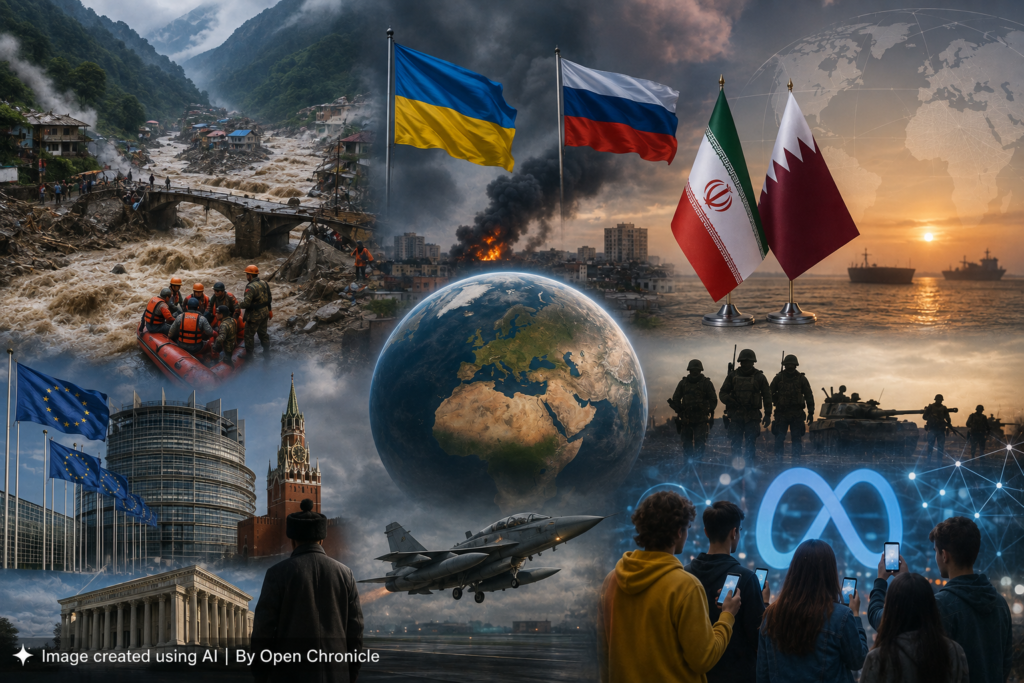
The international agenda on August 27 is dominated by the catastrophic Himalayan flood across Nepal and Tibet, where hundreds have been killed and more than 1,000 people remain missing. At the same time, the six month war involving Iran appears to be entering a costly stalemate, while Qatar intensifies mediation efforts in Tehran and limited shipping movements through the Strait of Hormuz offer a fragile sign of possible easing.
Europe remains focused on Russia’s war against Ukraine, renewed Russian attacks, possible September negotiations and debate over the use of frozen Russian assets. Meanwhile, Washington is reviewing its future military posture in NATO, political tensions are rising in France and Canada, and governments around the world are confronting new questions over social media regulation, cyber security and the growing use of drones.
Himalayan Flood Becomes One of the Region’s Worst Disasters in Years
Rescue teams are searching through devastated valleys in Nepal and neighbouring Tibet after a massive wall of ice, mud, rock and water swept through mountain communities.
Hundreds of people have been confirmed dead and more than 1,000 remain missing across Nepal and China.
The disaster appears to have been triggered by the collapse of high mountain ice and rock into a river system, producing an enormous flash flood that tore through settlements, roads, bridges and hydropower infrastructure.
Authorities have warned that the danger has not passed.
Additional upstream lakes remain unstable, raising fears that further surges could follow.
Hundreds of Foreign Tourists Missing
The disaster has acquired an international dimension because large numbers of foreign visitors were travelling through the affected region.
Nepalese tourism officials said hundreds of foreign tourists from dozens of countries remain unaccounted for.
Pilgrims travelling through Nepal toward religious sites in Tibet are among the missing.
Australia said information concerning at least 34 missing citizens remained extremely limited, while families in India and other countries are urgently seeking information about relatives caught in the disaster.
International aid has begun arriving in Nepal as governments and humanitarian organisations send money, rescue equipment and emergency supplies.
Climate Change Raises Himalayan Risk
Scientists are warning that climate change is increasing the likelihood of similar disasters.
Rising temperatures can destabilise glaciers, frozen rock and mountain slopes.
When ice, rock or natural dams collapse, enormous quantities of water and debris can move through narrow valleys with extraordinary speed.
The Himalayan disaster therefore represents not only a humanitarian emergency but another warning about the growing vulnerability of high mountain regions to climate related instability.
New Earthquake Hits Tibet
A magnitude 5.0 earthquake struck Tibet on Thursday, hundreds of kilometres north of the area devastated by the flood.
There was no immediate indication that the earthquake had caused significant additional damage.
Nevertheless, the tremor added to concerns about geological instability across the wider region as Chinese and Nepalese authorities continue monitoring potentially dangerous lakes and mountain slopes.
Qatar Tries to Revive Iran Diplomacy
Qatar’s prime minister travelled to Tehran in another attempt to revive diplomatic efforts surrounding the war involving Iran.
The visit comes as Washington intensifies what Tehran describes as an economic war designed to isolate the Iranian economy.
Qatar joins Oman and Pakistan among regional governments attempting to maintain channels between Washington and Tehran.
The diplomatic activity suggests that despite six months of conflict, governments across the region continue searching for a negotiated path out of the confrontation.
Six Months Into the Iran War, a Costly Stalemate Emerges
The Iran conflict has reached the six month mark without producing a clear strategic victory.
Heavy fighting has diminished from earlier phases, but the fundamental confrontation remains unresolved.
Iran has endured extensive military and economic pressure while refusing to accept Washington’s principal demands.
The United States has meanwhile escalated sanctions and sought to sever Tehran’s economic connections internationally.
Both sides have demonstrated considerable ability to absorb costs.
That has increasingly created the conditions for a prolonged stalemate rather than a decisive conclusion.
Hormuz Traffic Begins to Rise Slightly
Shipping through the Strait of Hormuz increased slightly on Thursday as markets watched talks between Iran and Oman over the possibility of creating a temporary navigational corridor.
Traffic remains far below normal levels.
Nevertheless, even a modest increase is significant because the strait is one of the world’s most important routes for oil and liquefied natural gas.
Any sustained reopening could ease pressure on energy markets, particularly after months of severe disruption to Gulf exports.
Greek Operated Air Defence System Intercepts Drones Over Saudi Arabia
A Greek operated air defence system in Saudi Arabia intercepted a swarm of drones in the wider Yanbu region.
Yanbu contains major oil refining facilities, making the incident particularly sensitive during the continuing Iran conflict.
The interception illustrates how the war has expanded the importance of air and missile defence across the Gulf.
Drone attacks remain one of the most difficult threats confronting regional energy infrastructure because comparatively inexpensive unmanned aircraft can threaten installations worth billions of dollars.
Russia Launches Major Air Attack Against Ukraine
Russia launched another large scale missile and drone attack against Ukraine, striking Kyiv and other cities.
Ukrainian officials said ports, industrial facilities and retail distribution centres were among the targets.
Air defence systems intercepted part of the attack, but damage was reported in several areas.
The latest strikes demonstrate that despite diplomatic speculation surrounding possible negotiations, the military campaign remains intense.
Ukraine Russia Talks Could Resume in September
Kyiv has indicated that Ukrainian and Russian negotiating teams could potentially meet in September.
Kyrylo Budanov, a senior aide to President Volodymyr Zelensky, said US representatives could also participate.
The possibility remains uncertain.
Fundamental disagreements over territory, security guarantees and the future military relationship between Ukraine and the West continue to divide the two sides.
Even limited talks, however, would represent another attempt to revive diplomacy after previous initiatives failed to produce a settlement.
Russia Confirms CIA Director Meeting in Moscow
Russia’s foreign intelligence chief Sergei Naryshkin confirmed that he met CIA Director John Ratcliffe during Ratcliffe’s highly unusual visit to Moscow.
Naryshkin described the encounter as a working level meeting.
The confirmation resolves one of the principal mysteries surrounding the American intelligence chief’s journey but does not reveal what the two men discussed.
Possible subjects include Ukraine, Russia’s relationship with Iran, intelligence deconfliction and other sensitive issues.
The meeting demonstrates that intelligence channels between Washington and Moscow remain active despite severe political confrontation.
Russia Intensifies Warning Against Britain
Moscow has warned that British military targets could be struck in response to Ukrainian attacks using UK supplied weapons.
Russia has issued similar warnings previously, but the latest language was described as unusually forceful.
Britain has been among Ukraine’s strongest military supporters and has supplied long range strike weapons.
The rhetoric highlights the persistent danger that the Ukraine conflict could generate direct confrontation between Russia and a NATO member.
Four EU Countries Reopen Debate Over Frozen Russian Assets
Sweden, the Netherlands, Spain and Poland are pushing the European Union to reconsider proposals for using immobilised Russian sovereign assets to support Ukraine.
Hundreds of billions of euros in Russian central bank assets remain frozen in Western jurisdictions.
European governments have already used some proceeds generated by those assets to assist Ukraine.
Full confiscation remains far more controversial because of legal concerns, financial implications and fears of retaliation.
The renewed debate illustrates the growing pressure on European governments to find sustainable sources of financing for Ukraine.
Pentagon Reviews Future US Troop Presence in Europe
The Pentagon is preparing options concerning the future deployment of American forces within NATO.
The review is expected to provide Defence Secretary Pete Hegseth with alternatives by November.
European governments are watching the process closely because American forces remain an essential component of NATO’s deterrence posture.
Washington has repeatedly encouraged European allies to assume greater responsibility for their own defence.
Any significant reduction in US forces would accelerate that process.
Poland Says It Does Not Want Nuclear Warheads on Its Territory
Poland’s deputy defence minister said Warsaw does not currently want nuclear weapons stationed on Polish soil.
The comments are notable because Poland has become one of NATO’s most heavily armed members and has dramatically expanded its conventional military forces.
Warsaw remains strongly committed to NATO’s nuclear deterrence but appears reluctant to pursue permanent deployment of nuclear warheads inside Poland itself.
Bulgaria Expands Black Sea Mine Warfare Capability
Bulgaria has approved plans to acquire seven minehunter ships from Belgium and the Netherlands.
The purchase reflects growing concern over naval mines and the security of commercial shipping in the Black Sea.
The war in Ukraine has significantly increased the importance of mine countermeasures because drifting or deliberately deployed mines can threaten both military and civilian vessels.
Russian Serviceman Killed in St Petersburg Explosion
A vehicle carrying a Russian military serviceman and his wife exploded in St Petersburg.
The serviceman was reportedly killed immediately.
Authorities were investigating the circumstances of the blast.
The incident follows a series of attacks and explosions involving military figures inside Russia during the Ukraine war.
Planned Arson Attack Targets Drone Manufacturer in Slovakia
Slovak prosecutors said three suspects planned an arson attack against Skyeton, a drone manufacturer founded in Ukraine.
A little known organisation describing itself as a peace activist group claimed responsibility.
The incident demonstrates how defence companies connected to Ukraine are becoming security targets across Europe.
It also highlights growing European concern over sabotage and hybrid operations affecting the defence industrial base.
Chad Accuses Sudan of Cross Border Air Strike
Chad has accused Sudan of carrying out an air strike against a military convoy inside Chadian territory.
Authorities raised the security alert in the border region to its highest level.
If confirmed, the incident could widen instability associated with Sudan’s continuing conflict and increase tensions between neighbouring states.
Regional governments are already struggling with refugees, armed groups and cross border insecurity generated by Sudan’s war.
Ratko Mladic Dies in UN Detention
Former Bosnian Serb military commander Ratko Mladic has died while serving a life sentence for genocide and other crimes committed during the Bosnian war.
Mladic was convicted over atrocities including the 1995 Srebrenica massacre, in which more than 8,000 Bosniak Muslim men and boys were killed.
His death closes another chapter in the international prosecution of crimes committed during the violent breakup of Yugoslavia.
For survivors and victims’ families, however, the legacy of those crimes remains deeply present across Bosnia and the wider Balkans.
King Harald of Norway Reported in Very Serious Condition
Norway’s King Harald, 89, is reported to be in very serious condition.
Hundreds of people gathered near the royal palace as concern grew about the monarch’s health.
Harald has served as Norway’s king since 1991 and remains an important symbolic figure within the country’s constitutional monarchy.
France Enters an Intensifying Political and Fiscal Season
France faces mounting political pressure ahead of next year’s presidential election.
Record public debt and budget negotiations are increasing tensions between political parties, while investors are seeking reassurance that Paris can stabilise its finances.
Marine Le Pen is simultaneously attempting to strengthen her appeal among French business leaders as campaigning accelerates.
The combination of fiscal pressure and electoral competition could make the coming budget negotiations particularly difficult.
Quebec Calls October Election
Quebec will hold provincial elections on October 5.
Separatist forces are currently favoured to perform strongly, reopening questions about the political future of Canada’s French speaking province.
The election comes during a turbulent period in Canada US relations marked by escalating tariff disputes.
Economic tensions with Washington could significantly influence voter priorities.
Trump Orders Lake Ontario Renamed Lake America
US President Donald Trump has signed an order seeking to rename Lake Ontario as Lake America.
The move comes during a worsening trade confrontation between Washington and Ottawa.
Because Canada shares sovereignty over the lake, Washington cannot unilaterally change the international geographical name recognised by Canada.
The decision is therefore likely to become another symbolic point of tension between the two countries.
Canada Adjusts Retaliatory Tariffs
Canada has removed American seafood and fish products from its retaliatory tariff list while maintaining wider countermeasures against US imports.
Ottawa recently announced duties covering roughly $20 billion in American goods.
The adjustment illustrates how Canada is attempting to target Washington economically while limiting damage to domestic industries dependent on US supply chains.
Meta Settlement Triggers Global Regulatory Reaction
Meta’s agreement to introduce stronger protections for young social media users in the United States is already producing international consequences.
Australian officials argued that the settlement demonstrates technology companies possess the tools required to protect teenagers more effectively.
Officials in the Philippines said Meta had also pledged stronger protections there.
South Korea’s media regulator said comparable safeguards should ideally be implemented globally.
The development could transform what began as an American legal settlement into a broader international regulatory standard.
Poland Seeks €250 Million EU Fine Against Meta
Poland has asked the European Commission to fine Meta €250 million over allegations that the company has failed to adequately address scams and fraudulent advertising.
The request adds another front to the increasingly difficult relationship between European regulators and major technology platforms.
European governments are demanding greater accountability not only for social media content but also for advertising, consumer fraud and platform design.
US Accuses Chinese Hackers of Breaching Major Institutions
The US Justice Department says Chinese linked hackers infiltrated systems connected to the Justice Department, NASA, the Federal Reserve and the US Senate.
Authorities announced the seizure of domains used by two alleged hacking platforms.
The accusations reinforce the growing cyber dimension of US China strategic competition.
Cyber operations increasingly target government networks, technology infrastructure and sensitive information rather than conventional military systems alone.
Taiwan Parliament Approves Alternative Drone Plan
Taiwan’s opposition controlled parliament rejected the government’s proposed T$210 billion special military drone budget and approved an alternative programme based on annual spending.
The dispute concerns the method rather than the broader objective of expanding Taiwan’s unmanned warfare capabilities.
Drones have become central to Taiwanese defence planning as Taipei studies lessons from the war in Ukraine and prepares for the possibility of conflict with China.
North Korea Condemns New US Arms Sale to South Korea
Pyongyang has denounced Washington’s approval of new missile and military equipment sales to South Korea.
North Korea promised a strong response to what it described as hostile actions.
The warning follows renewed missile activity by Pyongyang and demonstrates that tensions on the Korean Peninsula remain high despite intermittent discussion of renewed diplomacy.
Malaysia Prepares Myanmar Refugee Repatriations
Malaysia said the first phase of a voluntary programme to return Myanmar refugees will begin on September 29.
Approximately 1,500 people are expected to participate initially.
The programme will be watched closely by human rights groups because security conditions remain unstable in Myanmar following years of conflict and political repression.
Indonesia Tightens Security Around Student Protests
Indonesia increased security around parliament and in major cities as students marked the anniversary of deadly anti government demonstrations.
The protests reflect continuing dissatisfaction over political and economic issues.
Authorities are attempting to prevent a repeat of the violence that accompanied demonstrations a year earlier.
Former Malaysian Prime Minister Charged
Former Malaysian Prime Minister Ismail Sabri Yaakob has been charged with failing to declare assets.
He becomes another former Malaysian leader facing prosecution connected to alleged financial misconduct.
The case adds to Malaysia’s long-running struggle with political corruption and accountability.
Nigeria’s Kidnapping Economy Generates Millions
A security study estimates that Nigerian criminal groups collected nearly $5.8 million in ransom payments from civilian kidnappings over the previous year.
Mass abductions have become a major security and economic problem, particularly in rural areas.
The violence is disrupting education, weakening confidence in government institutions and creating substantial financial incentives for armed groups.
Algeria Wildfires Kill 12
Wildfires across several Algerian provinces have killed at least 12 people amid intense heat.
North Africa has experienced repeated periods of extreme temperatures and wildfire danger.
The deaths add to growing concern about the consequences of increasingly severe heatwaves across the Mediterranean region.
Deadly Incident at School Near Berlin
Two people were found dead at a school in Gosen Neu Zittau near Berlin.
Police detained a 19 year old suspect.
Authorities were investigating the circumstances and had not immediately released extensive details.
Car Attack in Caen Kills One
French authorities said a vehicle deliberately struck pedestrians outside the railway station in Caen, killing one person and injuring ten.
Investigators were working to establish the motive behind the incident.
Trial Date Set for Alleged 9/11 Mastermind
A US military judge has scheduled the trial of Khalid Sheikh Mohammed and three co defendants for June 2028.
Mohammed is accused of being the principal architect of the September 11, 2001 attacks.
The proceedings have been repeatedly delayed over legal disputes concerning evidence, detention and interrogation practices.
Yayoi Kusama Dies at 97
Japanese artist Yayoi Kusama has died at the age of 97.
Kusama became one of the most internationally recognised figures in contemporary art through her distinctive use of polka dots, pumpkins and immersive infinity mirror installations.
Her career stretched across decades and connected Japanese avant garde art with the global contemporary art world.
The Bigger Picture
The defining international story of August 27, 2026 is the coexistence of acute humanitarian disaster with intensifying geopolitical fragmentation.
The Himalayan catastrophe has demonstrated the extraordinary vulnerability of mountain communities to environmental and geological shocks.
The Iran conflict remains unresolved after six months but is increasingly generating diplomatic activity around Tehran and the Strait of Hormuz.
Ukraine remains at war even as Washington and Moscow preserve intelligence contacts and Kyiv considers another round of negotiations.
Europe is simultaneously confronting questions about American military commitment, Russian assets, defence industrial sabotage and its own rearmament.
Technology regulation is becoming global, particularly around Meta and teenage social media use, while cyber operations and autonomous weapons increasingly merge technology with national security.
The world of August 2026 therefore continues to be defined less by one dominant crisis than by several interconnected ones.
War affects energy.
Climate affects security.
Technology affects politics.
Trade becomes geopolitical leverage.
And diplomacy increasingly takes place not only between foreign ministries, but through intelligence services, regional mediators, temporary coalitions and economic pressure.
That increasingly fragmented international environment remains the central story connecting today’s headlines.