
Diplomacy & Security | United States, Russia & NATO
By Open Chronicle with agencies
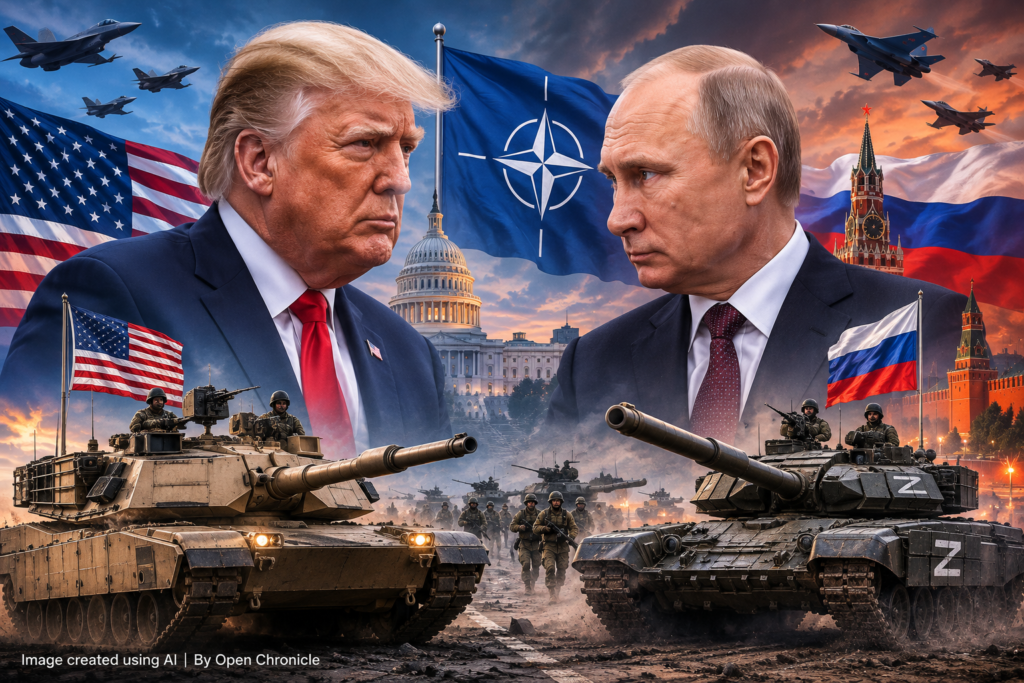
U.S. President Donald Trump said on Thursday that he does not believe Russian President Vladimir Putin will attack NATO territory, playing down concerns about a possible widening of tensions between Moscow and the Western military alliance.
Speaking in the Oval Office, Trump was asked whether Putin had given him a commitment that Russia would not attack a NATO member.
“I had good talks with him. He’s not going to be attacking a NATO territory,” Trump said.
Pressed on whether he wanted to issue a warning to Moscow against any attack on the alliance, the president declined to elaborate.
“I don’t want to comment on that, but they’re not going to attack,” Trump said.
The remarks come at a sensitive moment for European security, with the war in Ukraine continuing and NATO governments closely watching Russian military activity and Moscow’s increasingly confrontational rhetoric toward countries supplying Kyiv.
Trump Says He Is Not Concerned About NATO Attack
Trump reinforced his position in an interview with Axios on Thursday, saying he was “not concerned … at all” about the possibility of Russia attacking a NATO country.
“There is no problem,” he said.
His comments represent a strong public expression of confidence that the conflict in Ukraine will not develop into a direct military confrontation between Russia and NATO.
Such a confrontation would have potentially enormous consequences because NATO’s collective defence system is built around Article 5 of the North Atlantic Treaty, under which an armed attack against one member can be considered an attack against the alliance as a whole.
The United States remains NATO’s most powerful military member and the principal guarantor of the alliance’s deterrence posture.
Ratcliffe Meeting in Moscow
Trump also addressed the recent visit to Moscow by CIA Director John Ratcliffe.
Ratcliffe met Russian Foreign Intelligence Service chief Sergey Naryshkin during the trip, confirming a direct channel between senior intelligence officials from Washington and Moscow at a period of considerable geopolitical tension.
Some reports had suggested that Ratcliffe travelled to Russia carrying a warning against escalating the conflict with NATO members because of their military support for Ukraine.
Trump rejected that interpretation.
He described the meeting between Ratcliffe and Naryshkin as routine contact between the heads of the two countries’ foreign intelligence services.
“Ratcliffe sees his Russian counterpart once every six months or once every year. They have a very good relationship. There was no message and there was nothing unusual,” Trump told Axios.
The president’s account therefore presents the Moscow meeting as part of continuing intelligence communication rather than an emergency diplomatic intervention intended to deter a potential Russian attack.
Intelligence Channels Remain Open
The Ratcliffe meeting nevertheless highlights the continued importance of direct communication between Washington and Moscow.
Even during periods of severe confrontation, intelligence services can maintain channels intended to exchange information, manage risks and prevent misunderstandings from developing into wider crises.
Those contacts have particular significance during the Ukraine war because Russia and NATO possess enormous conventional and nuclear arsenals.
Preventing unintended escalation has consequently remained an important consideration alongside the military and political confrontation surrounding Ukraine.
Naryshkin’s involvement is also significant because he heads Russia’s SVR foreign intelligence service, making him one of Moscow’s most senior intelligence officials.
Trump Links Russia to Strait of Hormuz Crisis
Trump was separately asked whether Washington might punish Putin or impose additional measures against Russia if Moscow continued doing business with Iran despite U.S. warnings.
“It depends. It depends,” Trump replied.
The president then linked his assessment of Moscow’s behaviour to the situation surrounding the Strait of Hormuz.
“So far, I think Russia’s behaved quite well having to do with the Strait of Hormuz,” he said.
The comments suggest that Washington is evaluating Russian behaviour not only through the Ukraine conflict but also through the broader confrontation involving Iran and the strategically critical waterway.
The Strait of Hormuz is one of the world’s most important energy corridors, connecting the Persian Gulf with the Gulf of Oman and international shipping routes beyond.
Any major disruption to navigation through the strait can have immediate consequences for global oil and gas markets.
NATO Deterrence Remains Central
Trump’s confidence that Russia will not attack NATO comes against the background of continued efforts by European governments to strengthen their military capabilities.
Russia’s invasion of Ukraine fundamentally altered Europe’s security environment, prompting NATO members to increase defence spending, reinforce forces on the alliance’s eastern flank and expand military planning for a potential confrontation with Moscow.
The accession of Finland and Sweden also significantly changed NATO’s strategic position in northern Europe and around the Baltic Sea.
At the same time, the alliance has sought to support Ukraine while preventing the war from becoming a direct NATO Russia conflict.
Trump’s latest statements indicate that he currently sees little immediate danger of Moscow crossing that threshold.
However, European governments are likely to continue strengthening deterrence regardless of the president’s assessment, particularly as the war in Ukraine and wider tensions with Russia remain unresolved.
Washington Signals Confidence While Maintaining Contact
Taken together, Trump’s remarks suggest an American strategy combining confidence in NATO deterrence with continued direct communication with Moscow.
The president is publicly dismissing the possibility of an imminent Russian attack on NATO territory while portraying intelligence contacts between Washington and Moscow as routine rather than crisis driven.
His comments also show that relations with Russia are being assessed within a broader geopolitical environment involving Ukraine, NATO and Iran.
For now, Trump’s message is unequivocal. Despite continuing confrontation between Russia and the West, he does not expect Putin to launch an attack against NATO territory.