
Energy & Economy | United States
By Open Chronicle with agencies
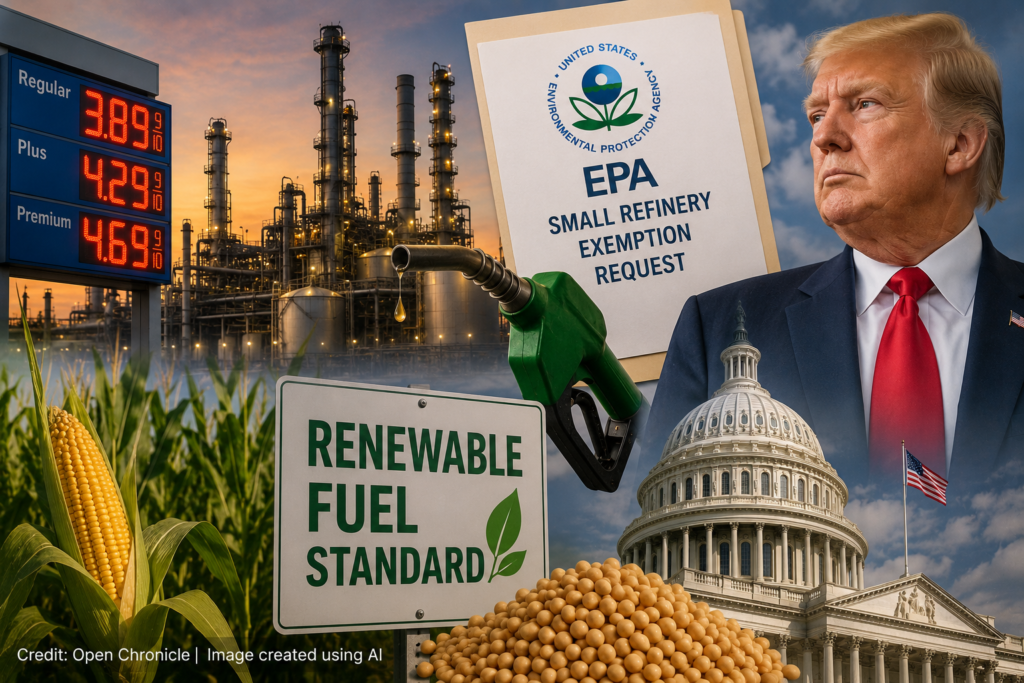
U.S. President Donald Trump and senior administration officials are considering a significant expansion of exemptions from federal biofuel blending requirements, triggering opposition from agricultural and renewable fuel groups that warn the move could damage demand for corn, soybean oil and American produced biofuels.
The debate comes as the White House searches for ways to contain elevated gasoline prices amid disruption to global energy markets caused by the war involving Iran and restrictions on Middle Eastern oil flows.
According to Reuters, Trump and senior energy, environmental and agriculture officials discussed the issue on Wednesday, including possible measures designed to protect biofuel producers from the impact of additional exemptions granted to small oil refineries.
Farm Groups Appeal Directly to Trump
A coalition representing farmers and the renewable fuels industry urged Trump on Thursday to reject a major expansion of the exemptions.
The groups include the Renewable Fuels Association, Growth Energy and the National Farmers Union.
They want the administration to keep exemptions for the 2025 compliance year broadly consistent with the levels assumed by the Environmental Protection Agency when it established renewable fuel requirements for 2026 and 2027.
The administration is considering exemptions covering as many as 1.8 billion renewable fuel credits, compared with approximately 990 million credits under previous assumptions, according to Reuters. A decision is expected before the end of August.
Agricultural and biofuel organisations argue that exemptions on such a scale would substantially weaken the economic incentives created by federal renewable fuel mandates.
They warned that excessive waivers could sharply reduce demand for ethanol and biodiesel, with consequences extending into America’s agricultural economy through lower consumption of corn and soybean oil.
What the Renewable Fuel Standard Does
At the centre of the dispute is the Renewable Fuel Standard, or RFS, one of the most important federal policies supporting the American biofuel industry.
The system requires oil refiners and fuel importers to incorporate specified quantities of renewable fuels, including ethanol and biodiesel, into the U.S. transportation fuel supply.
Companies that do not physically blend sufficient quantities can purchase Renewable Identification Numbers, commonly known as RINs, to satisfy their obligations.
Smaller refineries can seek exemptions when they demonstrate that complying with the requirements would cause significant economic hardship.
The political and economic controversy concerns what happens when large numbers of those exemptions are granted.
Unless waived volumes are subsequently reassigned, exemptions effectively reduce the amount of renewable fuel required by the national programme.
Renewable Fuel Credit Prices Fall
Financial markets have already responded to expectations of broader exemptions.
Prices for renewable fuel credits have fallen sharply as traders anticipate that additional refinery waivers would reduce demand for RINs and potentially for the biofuels underlying them.
U.S. ethanol credits recently fell to a four month low after the EPA delayed a compliance deadline and markets began pricing in the possibility of exemptions covering between 1.2 billion and 1.8 billion RINs.
That market reaction illustrates why the issue is so important to both industries.
Oil refiners contend that expensive renewable fuel credits increase operating costs and ultimately contribute to higher fuel prices.
Biofuel producers dispute that argument. They maintain that ethanol can help reduce fuel costs by expanding the overall supply of transportation fuel while supporting American agriculture.
Gasoline Prices Put Pressure on White House
The administration’s deliberations are taking place against an increasingly difficult energy backdrop.
Disruption associated with the Iran conflict has contributed to higher oil and gasoline prices, creating economic and political pressure ahead of November’s U.S. midterm elections.
The Trump administration has already taken several measures intended to reduce energy costs, including drawing from emergency petroleum reserves and easing some seasonal gasoline regulations.
U.S. Strategic Petroleum Reserve inventories recently fell to about 289.7 million barrels, their lowest level since 1982, as part of a broader emergency release programme.
The refinery waiver debate therefore places two important constituencies in direct competition.
Oil refiners are seeking relief from potentially expensive biofuel obligations, while farmers and renewable fuel producers want Washington to preserve demand generated by the RFS.
Iowa Senator Criticises Proposed Expansion
The issue is particularly politically sensitive across the American Midwest, where corn and soybean production supports large agricultural economies and an extensive network of ethanol and biodiesel facilities.
Republican Senator Joni Ernst of Iowa has criticised the proposed expansion, arguing that additional exemptions would benefit oil companies while weakening demand for agricultural products.
Her intervention demonstrates the political difficulty facing the administration. Measures intended to reduce costs for refiners and potentially motorists risk provoking opposition among farmers who form an important political constituency for Republicans in several states.
White House Considers Restoring Waived Volumes
One potential compromise discussed by Trump and administration officials would restore renewable fuel volumes lost through exemptions by incorporating them into future annual biofuel quotas.
Such an approach could provide immediate relief to small refineries while attempting to preserve longer term demand for renewable fuels.
However, details about how the mechanism would operate remain unclear.
A White House official said the administration would make its decision based on the interests of consumers, farmers and energy supply chains.
The EPA is separately reviewing dozens of small refinery exemption requests and has extended the compliance timetable for refiners as it works through the applications.
Energy Policy Meets Agricultural Politics
The dispute highlights the difficult balancing act facing Washington as energy security, inflation, agricultural policy and electoral politics increasingly intersect.
Reducing refinery costs could potentially provide some relief to the fuel industry at a moment of elevated gasoline prices. But dramatically expanding exemptions could undermine one of the principal federal mechanisms supporting America’s ethanol and biodiesel industries.
For agricultural states, the consequences extend well beyond energy policy. Corn ethanol and soybean based renewable fuels provide major sources of demand for American crops, linking federal fuel regulations directly to farm income and rural investment.
Trump’s decision will therefore be closely watched across both the oil industry and the Farm Belt.
With the administration expected to decide on the exemptions before the end of August, the dispute has become another test of how the White House intends to balance traditional fossil fuel interests with the increasingly important economic role of America’s renewable fuel industry.