
Department: World / Security
By Open Chronicle with agencies
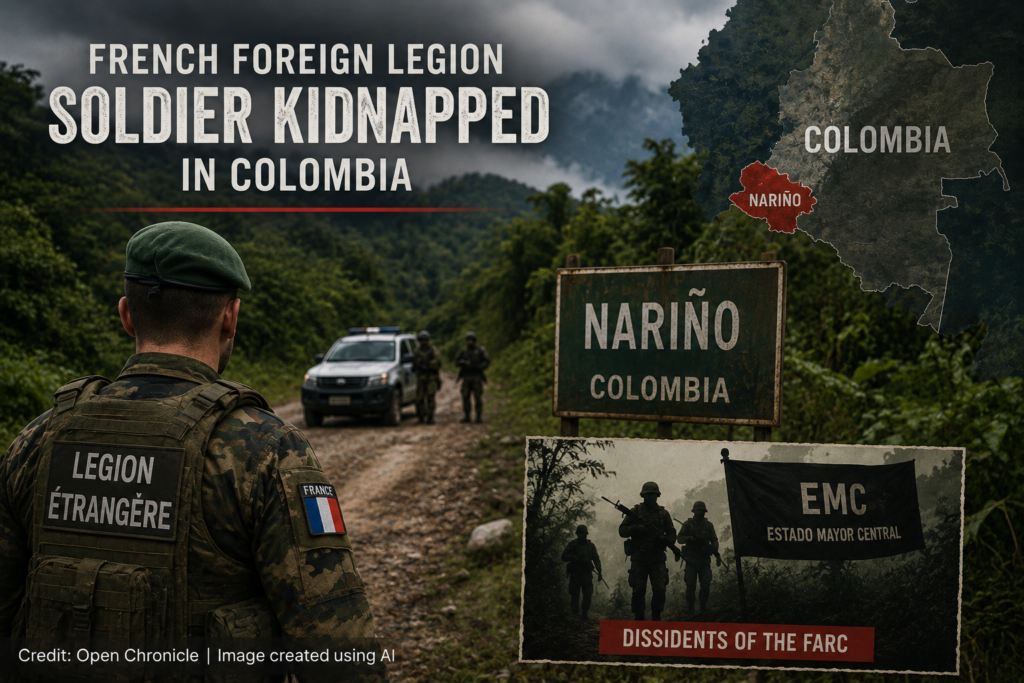
A French Colombian soldier serving in the French Foreign Legion has been kidnapped in southwestern Colombia, with authorities suspecting that dissidents from the former FARC guerrilla movement are responsible for his abduction.
Colombia’s military said José Olger Melo Charry was taken hostage on August 6 while travelling along a road in the department of Nariño, an area where several armed organisations remain active despite years of government efforts to restore security.
According to a Colombian army report, investigators believe members of the Estado Mayor Central, or EMC, were responsible for the kidnapping. The organisation is the largest dissident faction to emerge from the Revolutionary Armed Forces of Colombia, commonly known as FARC, following the historic 2016 peace agreement.
The report indicated that the kidnappers took Melo Charry after discovering that he was a member of the French Foreign Legion.
Soldier Was Visiting Colombia on Leave
Melo Charry holds both French and Colombian nationality and had returned to Colombia while on leave from military service.
Army Colonel Mauricio Osorio told Colombian broadcaster Blu Radio that the soldier joined the French military approximately four years ago and currently holds the rank of corporal.
The French Foreign Legion is an elite branch of the French Army that recruits volunteers from around the world. Its personnel serve under French command and can be deployed on military operations overseas.
The circumstances surrounding Melo Charry’s journey through Nariño and the precise location where he is being held have not been publicly disclosed.
There was also no immediate indication of whether the kidnappers had issued demands for his release.
Estado Mayor Central Suspected
Colombian authorities believe the kidnapping was carried out by the EMC, a powerful collection of FARC dissident factions that rejected or abandoned the peace process.
The organisation is reportedly led by Iván Mordisco, one of Colombia’s most wanted guerrilla commanders.
The 2016 peace agreement formally ended decades of conflict between the Colombian government and the main FARC organisation. Thousands of guerrillas disarmed and entered a political and reintegration process.
However, some commanders refused to accept the agreement, while other former fighters later returned to armed activity. These dissident organisations have since established themselves in several regions of Colombia, frequently competing for control of territory and lucrative illegal economies.
Nariño, which borders Ecuador and has access to Colombia’s Pacific coast, is particularly important because of its strategic position along drug trafficking routes.
Kidnapping Remains a Weapon for Armed Groups
Colombia’s remaining armed organisations derive significant revenue from cocaine trafficking, illegal mining, extortion and other criminal activities.
Kidnapping has also remained part of their operations. Hostages can be used to demand ransom, pressure the authorities or strengthen an armed group’s bargaining position.
The abduction of an active member of the French military could give the case an international dimension, particularly because Melo Charry was reportedly targeted after his captors learned that he belonged to the Foreign Legion.
Colombian security forces have been working to determine his whereabouts and identify the group holding him.
Colombia Confronts Persistent Guerrilla Violence
The kidnapping comes as Colombia’s government intensifies its confrontation with armed organisations following the failure of previous attempts to negotiate broader peace agreements with several guerrilla factions.
President Abelardo de la Espriella has adopted a more confrontational security policy toward guerrilla and criminal organisations, while strengthening cooperation with the United States.
His approach represents a significant change from that of former president Gustavo Petro, whose government sought negotiations with multiple armed groups under an ambitious effort to achieve what it described as comprehensive peace.
Those negotiations struggled to produce lasting results as violence continued in several regions and armed organisations expanded activities financed by drug trafficking and illegal mining.
The kidnapping of Melo Charry illustrates the continuing security challenges facing Colombia a decade after the FARC peace agreement.
For Bogotá, the immediate priority is securing the soldier’s release. The case also highlights the continued influence of FARC dissident organisations in parts of the country where the state has struggled to establish lasting control.