
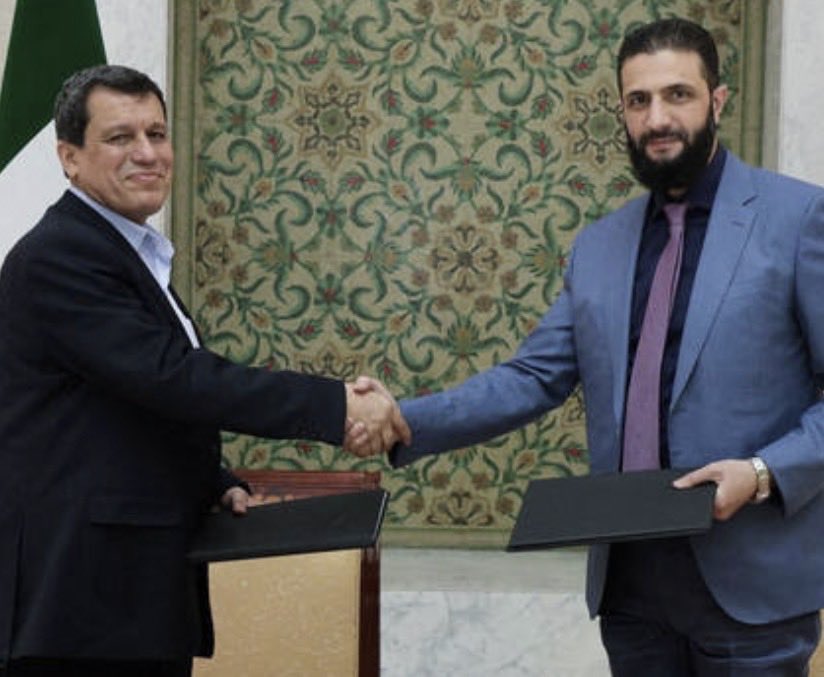
Image: from Rahim Rashidi X @rahimrashidi
Department: World / Middle East
By Open Chronicle with agencies
Syrian President Ahmed al Sharaa has appointed Kurdish leader Mazloum Abdi as an adviser to the presidency, marking another major step in the political and military integration of Kurdish controlled areas into the Syrian state.
The appointment, announced by Syrian state media, comes only days after Abdi declared the dissolution of the Kurdish led Syrian Democratic Forces, or SDF, following an agreement with Damascus to integrate its fighters and civilian institutions into Syria’s national structures.
A presidential decree published by the state news agency SANA announced that Mustafa Khalil Abdi, better known as Mazloum Abdi, had been appointed as an adviser to the presidency.
The decision gives one of Syria’s most influential Kurdish figures a formal position within the country’s new political system and represents a significant development in Damascus’s efforts to consolidate authority following years of territorial fragmentation caused by the Syrian civil war.
From SDF Commander to Presidential Adviser
Abdi spent years commanding the SDF, the Kurdish led military coalition that became one of Washington’s most important partners in the campaign against the Islamic State group.
The SDF was established in 2015 and developed into the principal military force governing large parts of northern and northeastern Syria. Kurdish fighters had already gained international prominence during the battle for Kobane, where they successfully resisted Islamic State forces.
With extensive support from the United States, the SDF subsequently participated in operations that dismantled much of the jihadist group’s territorial presence in Syria.
The force eventually became the military backbone of the Kurdish led semi autonomous administration established across significant areas of northeastern Syria.
That political and military structure is now being incorporated into the Syrian state.
Abdi announced earlier this week that the SDF had been formally dissolved following the completion of the process of integrating its forces into brigades of the Syrian army.
The move implemented an agreement reached with President Sharaa earlier this year.
Damascus Consolidates State Control
Syria’s new authorities have been seeking to restore central government control across the country since the fall of longtime president Bashar al Assad in December 2024.
The integration of Kurdish forces represents one of the most important steps in that process.
For Damascus, the agreement removes one of the country’s largest independent armed formations and brings strategically important territory in northeastern Syria closer to direct state authority.
For Kurdish leaders, however, the settlement also represents the end of longstanding ambitions to obtain formal political autonomy for the region.
Abdi agreed to accelerate integration following clashes earlier this year in which Kurdish forces lost substantial territory to Syrian government troops. The changing relationship between Washington and Damascus also altered the strategic environment surrounding the Kurdish administration.
The United States, which had long supported the SDF, has increasingly engaged with Syria’s new government.
US special envoy to Syria Tom Barrack welcomed the integration agreement, arguing that incorporating former rivals into national institutions could strengthen Syrian sovereignty.
Abdi’s appointment appears to form part of that broader political settlement.
Kurdish Language Gains Official Recognition
The military integration has been accompanied by significant concessions concerning Kurdish cultural and political rights.
During the fighting earlier this year, President Sharaa issued a decree recognising Kurdish as a national language and formally acknowledging Kurdish national rights.
The decision represented an important departure from previous Syrian policies toward the Kurdish population.
Syria’s Education Ministry has now gone further by authorising Kurdish language instruction in public and private schools in areas where Kurdish citizens represent a significant proportion of the population.
Kurdish classes will be permitted alongside Arabic and English.
The measure is particularly significant given the history of restrictions and discrimination experienced by Syria’s Kurdish community since the country’s independence in 1946.
Approximately two million Kurds are believed to live in Syria, primarily in northeastern areas, although substantial Kurdish communities also exist in Damascus and Aleppo.
A New Political Chapter for Syria’s Kurds
Despite the dissolution of the SDF and the integration of Kurdish institutions into the Syrian state, Abdi has indicated that Kurdish political demands have not disappeared.
Last week, he said the integration process had been completed but stressed that efforts would continue to secure Kurdish rights within Syria’s constitutional framework.
The challenge for Damascus will now be transforming the military settlement into a durable political arrangement.
For years, northeastern Syria operated with its own security forces, administrative institutions and political structures. Integrating those institutions into a unified Syrian state while preserving meaningful Kurdish cultural and political rights is likely to remain a sensitive process.
Abdi’s appointment could provide an important channel between the presidency and Kurdish communities during that transition.
It also represents a remarkable transformation in Syria’s postwar political landscape. A commander who once led one of the country’s most powerful independent armed forces will now serve inside the presidency of the state his forces operated largely outside for more than a decade.
The dissolution of the SDF, Kurdish language recognition and Abdi’s appointment together suggest that Syria is entering a new phase in its attempt to rebuild a unified political order after years of civil war.
Whether that settlement can successfully reconcile Damascus’s determination to restore national sovereignty with Kurdish demands for constitutional protections will be one of the defining questions facing Syria’s emerging political system.