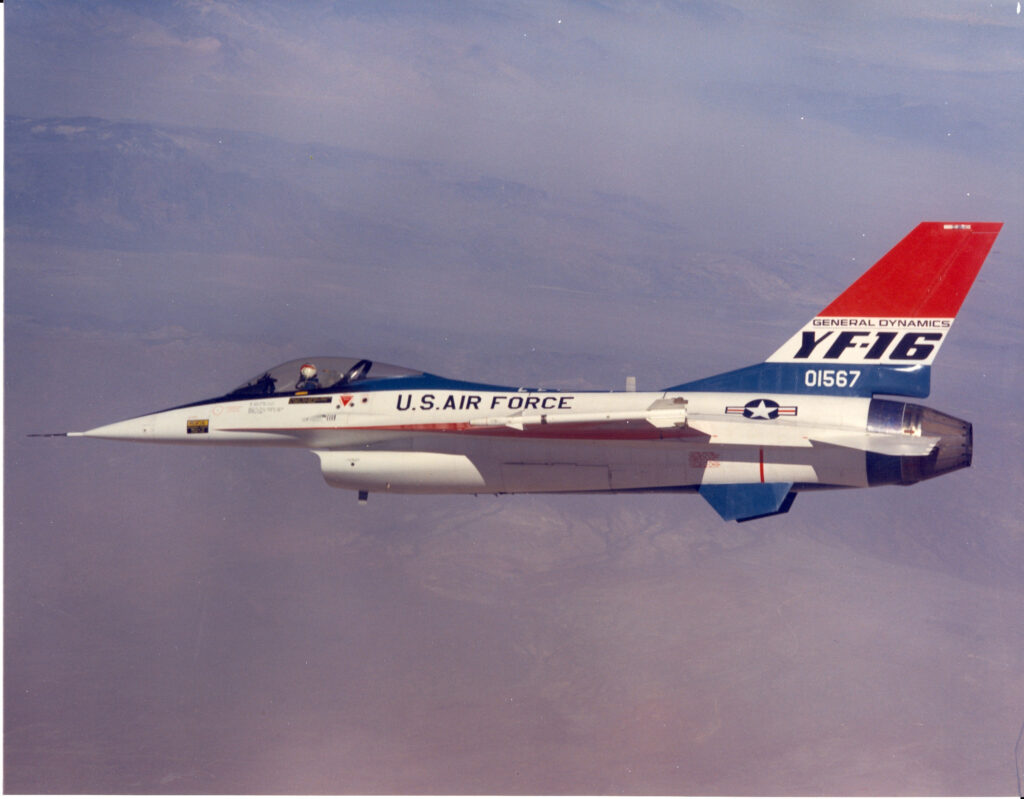
General Dynamics YF-16 prototype in flight over Edwards Air Force Base, California, during the aircraft’s early flight test programme in 1974. Courtesy U.S. Air Force. Public domain.
By Open Chronicle
The General Dynamics YF-16 was an experimental single-engine fighter aircraft developed in the early 1970s for the United States Air Force’s Lightweight Fighter programme.
Only two YF-16 prototypes were built, yet their influence on military aviation was enormous.
The aircraft introduced a combination of design concepts that would become defining characteristics of the later F-16 Fighting Falcon, including relaxed static stability, electronic fly-by-wire flight controls, a side-mounted control stick, a highly reclined pilot seat, a frameless bubble canopy, blended wing-body aerodynamics, and an exceptionally high thrust-to-weight ratio.
The YF 16 competed against the Northrop YF 17 in one of the most consequential fighter evaluations of the Cold War.
Its success led directly to the selection of the design for the Air Combat Fighter programme in January 1975 and ultimately to production of the F-16, one of the most widely manufactured and internationally operated combat aircraft in history.
The prototype therefore occupies an unusual place in aviation history.
It was not merely an early version of a successful fighter.
It represented a different philosophy of combat aircraft design, one that sought manoeuvrability, energy performance, pilot visibility and affordability rather than continuing the trend towards ever larger and increasingly complex fighters.
Quick Facts
Designation: General Dynamics YF-16
Role: Lightweight fighter prototype
Country of origin: United States
Manufacturer: General Dynamics
Programme: Lightweight Fighter, LWF
Number built: 2
Primary competitor: Northrop YF-17
Prototype rollout: 13 December 1973
Unofficial first flight: 20 January 1974
Official first flight: 2 February 1974
Test location: Edwards Air Force Base, California
Principal test pilot: Phil Oestricher
Engine: Pratt & Whitney F100 turbofan
Configuration: Single engine, single vertical tail, cropped delta wing
Control system: Electronic fly-by-wire with relaxed static stability
Successor: F-16 Fighting Falcon
Programme result: Selected as the basis of the Air Combat Fighter in January 1975
Why It Matters
The YF-16 changed the direction of fighter aircraft development.
Its importance lay not in a single technological feature but in the integration of several ideas into one compact aircraft.
Earlier fighters had already experimented with advanced aerodynamics, stability augmentation, and electronic systems.
The YF-16 brought these concepts together from the beginning of the design process.
NASA documentation described the YF-16 as the first aircraft developed with an active flight control system incorporated from its inception. Its control architecture combined relaxed static longitudinal stability, fly-by-wire controls, and a side-stick controller as fundamental elements rather than as later additions.
The aircraft also demonstrated that a relatively small fighter could achieve outstanding combat performance without relying on the size, weight, and expense associated with some contemporary designs.
That idea became central to the later high-low force structure of the United States Air Force, where the F-16 complemented the larger F-15 Eagle.
Origins of the Lightweight Fighter Idea
During the 1960s, combat aircraft were becoming progressively heavier and more technologically complex.
Radar systems, long-range missiles, large engines and sophisticated avionics increased capability, but they also increased cost and weight.
Some American officers, engineers and defence analysts questioned whether this trend had gone too far.
They argued that air combat still required excellent acceleration, sustained turning ability, low weight and high energy performance.
Among the most influential figures associated with this school of thought was United States Air Force officer John Boyd.
Boyd, together with mathematician Thomas Christie, developed energy manoeuvrability theory as a method for comparing aircraft performance during combat manoeuvres.
The concept examined how aircraft gained, retained and lost energy while turning, climbing and accelerating.
Supporters of the lightweight fighter concept believed that a smaller aircraft built around these principles could offer exceptional close combat performance at significantly lower cost.
The group of advocates later became popularly known as the Fighter Mafia, although the term can oversimplify a broader set of institutional and engineering debates.
The Lightweight Fighter Programme
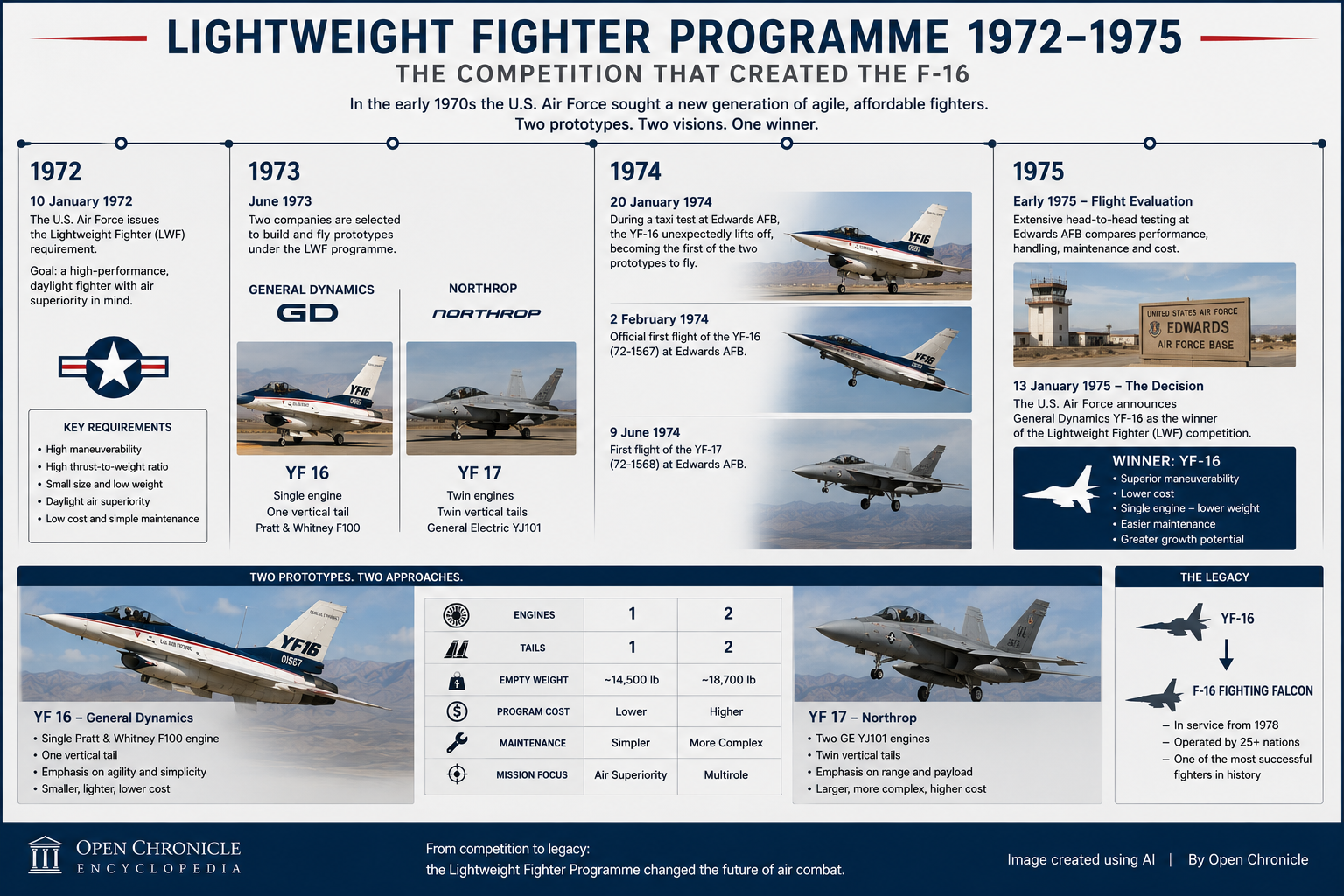
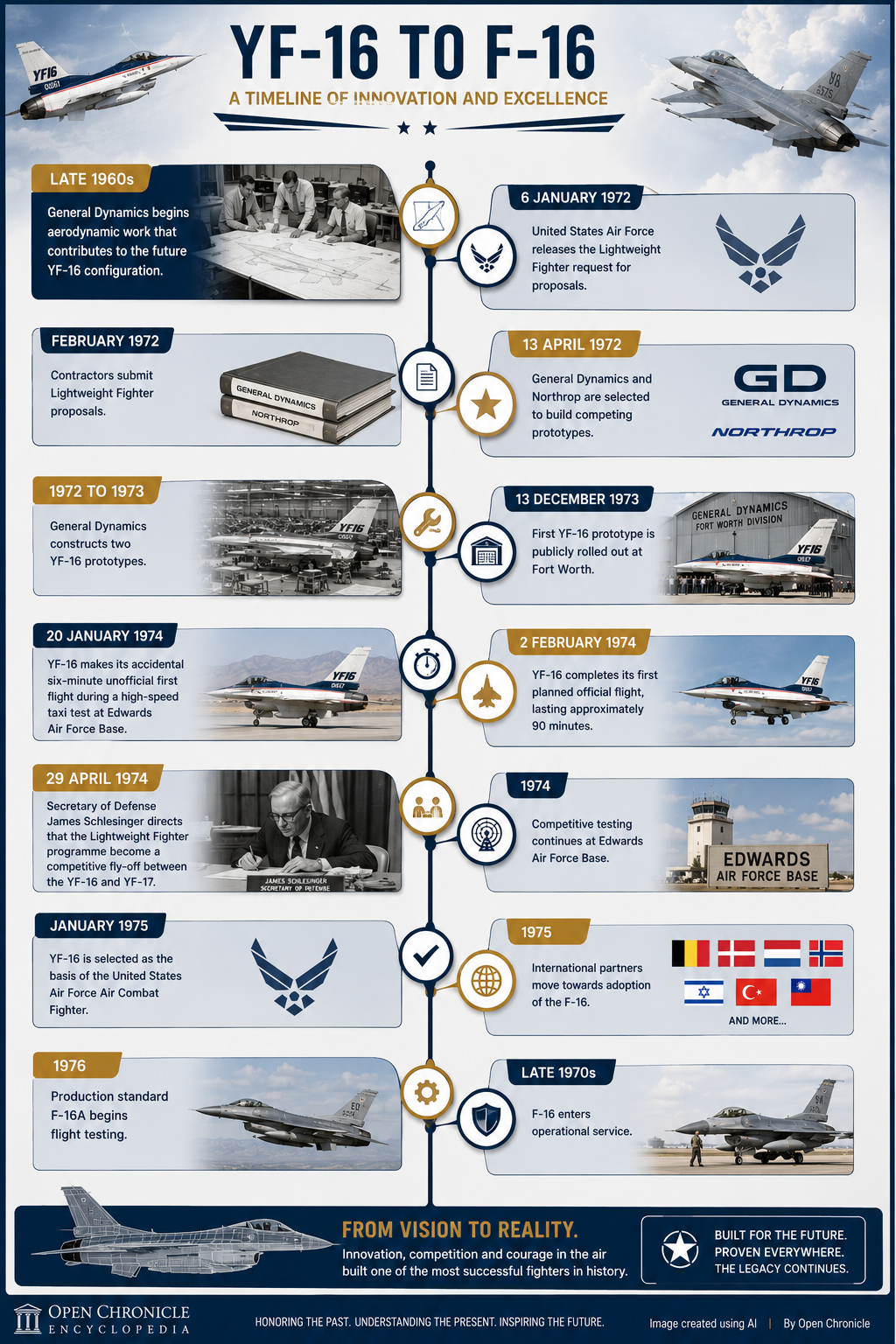
The United States Air Force formally initiated the Lightweight Fighter programme in January 1972.
The programme initially focused on technology demonstration rather than immediate acquisition.
Industry was invited to propose small, highly manoeuvrable fighters designed around demanding performance objectives.
Five companies submitted proposals.
General Dynamics, Boeing, Lockheed and Ling Temco Vought proposed single-engine designs, while Northrop submitted both single- and twin-engine concepts.
On 13 April 1972, the Air Force announced that General Dynamics and Northrop had been selected to build prototypes.
Each company received contracts to construct two aircraft.
General Dynamics developed the YF 16, while Northrop produced the twin-engine YF 17.
The programme sought aircraft with exceptional manoeuvrability and strong supersonic performance while maintaining an average flyaway cost target of approximately three million dollars in 1972 currency for a projected production run of 300 aircraft.
General Dynamics’ Approach
General Dynamics had already been exploring elements of the future YF-16 configuration before the formal Lightweight Fighter competition.
Aerodynamic development work extended back to the late 1960s.
Engineers studied forebody strakes and vortex behaviour at high angles of attack.
NASA research contributed to understanding how controlled vortex lift could improve performance.
Rather than attempting to eliminate separated airflow at high angles of attack, designers learned to exploit it.
Sharp-edged forebody strakes could generate powerful vortices over the wing.
These vortices helped maintain useful lift and delayed stall.
This aerodynamic concept became important to both the YF-16 and later F-16 developments.
General Dynamics combined these aerodynamic concepts with a compact fuselage, a single powerful engine, and an electronic flight control system.
The result was an aircraft fundamentally different in philosophy from many larger fighters of the period.
The Two Prototypes
General Dynamics constructed two YF-16 prototypes at Fort Worth, Texas.
The first aircraft was publicly rolled out on 13 December 1973.
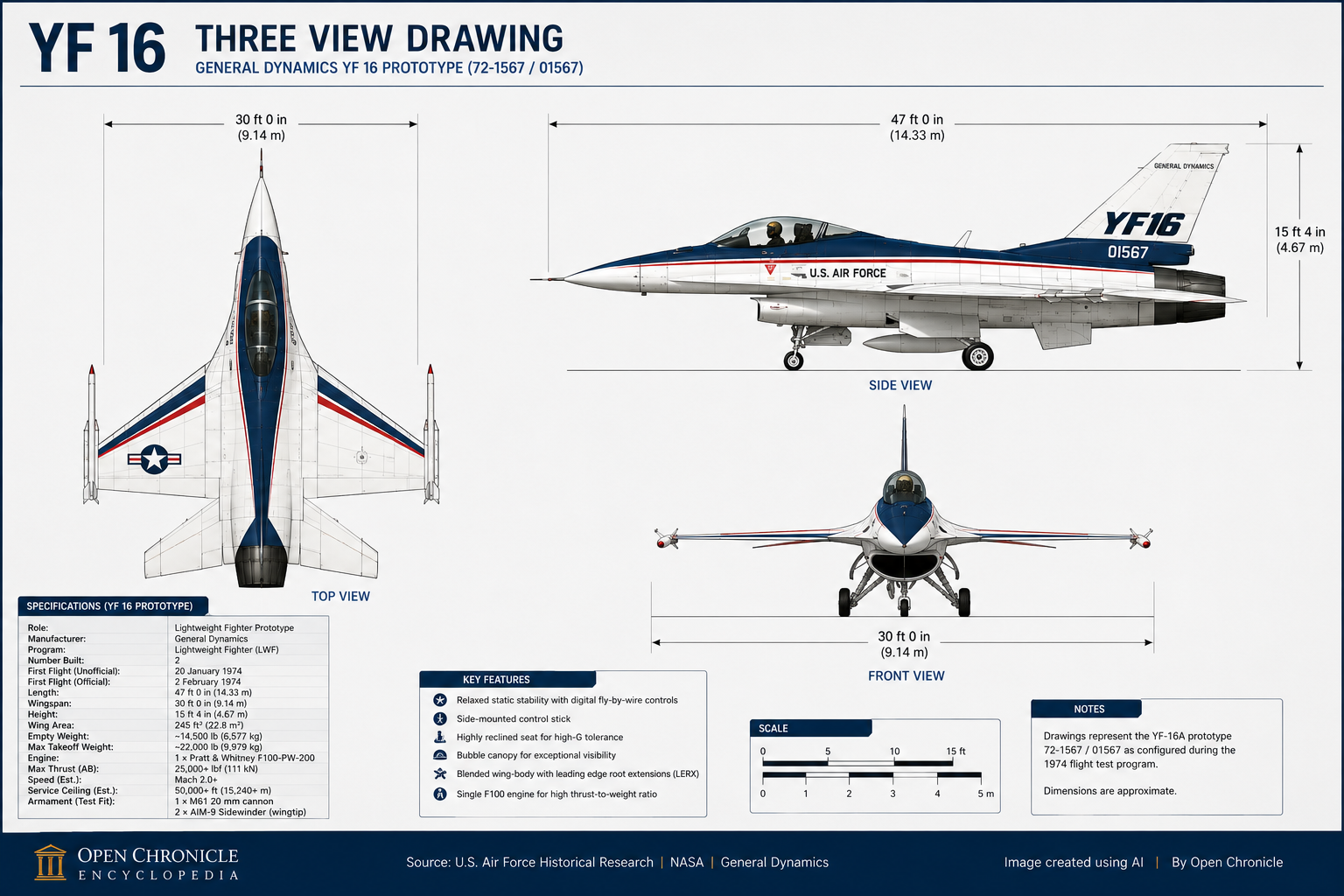
The prototype measured approximately 47 feet in length and had a wingspan of approximately 30 feet.
With internal fuel, an M61 cannon, and two AIM-9 missiles, it weighed roughly 22,000 pounds according to contemporary Air Force historical documentation.
Power came from a Pratt & Whitney F100 turbofan related to the engine developed for the F-15.
The engine could produce more than 25,000 pounds of thrust in afterburner.
Using an engine already connected with the F-15 programme offered important advantages.
It reduced development risk and supported the idea that a lightweight fighter could complement rather than replace the larger Eagle.
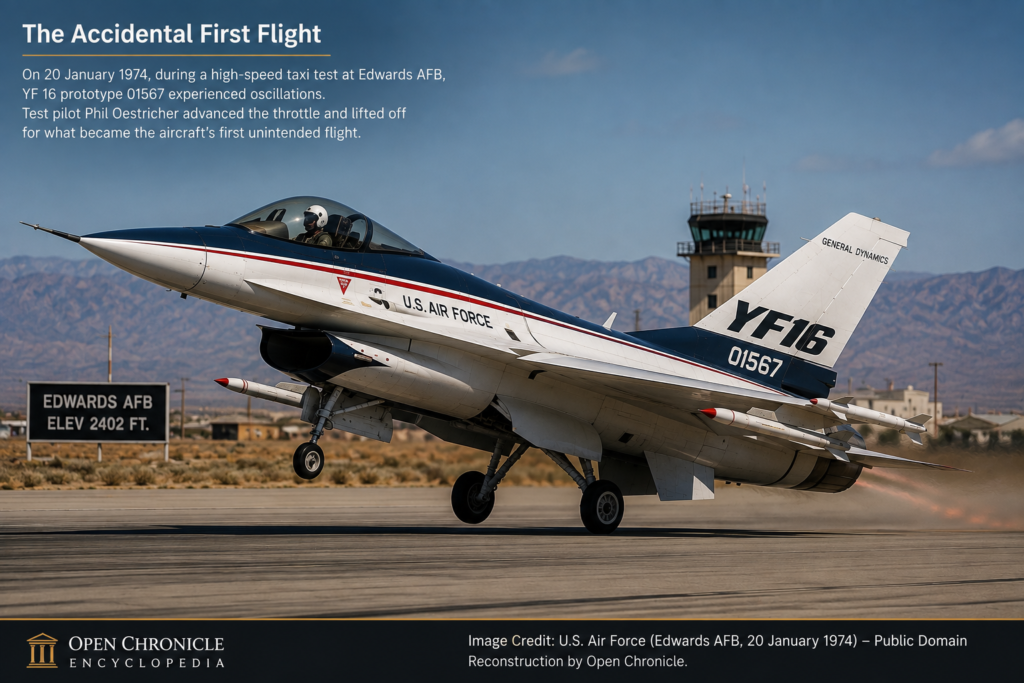
The Accidental First Flight
The YF-16 has one of the most famous first flight stories in aviation history.
On 20 January 1974, General Dynamics test pilot Phil Oestricher was conducting a high-speed taxi test at Edwards Air Force Base.
During the run, the aircraft began experiencing lateral oscillations.
The highly sensitive control system and the pilot’s attempts to correct the motion caused the aircraft to rock from side to side.
One wingtip missile nearly struck the runway.
Oestricher concluded that attempting to stop the aircraft might cause serious damage.
Instead, he increased power and took off.
The flight lasted approximately six minutes before he returned safely to Edwards.
This unexpected event is generally regarded as the YF-16’s unofficial first flight.
The incident demonstrated both the promise and the challenges of the aircraft’s revolutionary control system.
Fixing the Control System
The oscillations observed during the taxi test were analysed extensively.
The problem was connected with pilot-induced oscillation and the responsiveness of the electronic flight control system.
Engineers modified the control system by reducing gain during takeoff and landing conditions.
NASA later studied the incident in detail and concluded that reducing overall system gain substantially reduced the tendency towards lateral pilot induced oscillation.
The event became an important lesson in human-machine interaction.
The YF-16’s electronic controls could react extremely quickly.
The pilot could also react quickly.
If the interaction between pilot inputs and computer response was not properly tuned, the combination could create oscillations that neither the aircraft nor the pilot intended.
This problem would become increasingly important as fly-by-wire systems spread across military and civilian aviation.
Official First Flight
After modifications and repairs, the first YF-16 conducted its official maiden flight on 2 February 1974.
Phil Oestricher again served as pilot.
The flight lasted approximately 90 minutes.
The successful flight began an intensive test programme examining performance, handling qualities, engine behaviour, weapons integration and flight control characteristics.
The second prototype subsequently joined the programme.
Together, the two aircraft generated the data required for comparison with the Northrop YF 17.
The YF 16 and the YF 17
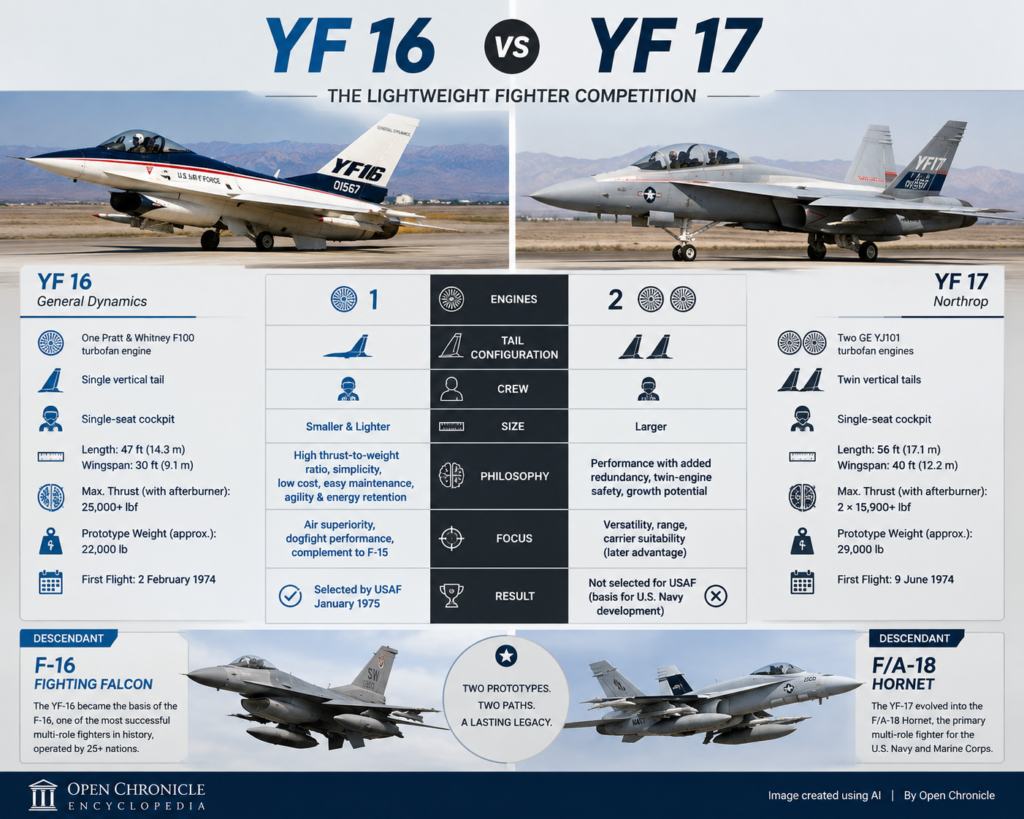
The General Dynamics YF 16 and Northrop YF 17 represented two distinct solutions to the Lightweight Fighter requirement.
The YF-16 used one Pratt & Whitney F100 engine.
The YF-17 used two General Electric YJ101 engines.
The YF-16 had a single vertical tail.
The YF-17 used twin tails.
Both aircraft incorporated advanced aerodynamics and emphasised manoeuvrability.
The YF-17 offered the redundancy of two engines and later proved especially adaptable to naval development.
The YF-16 offered lower weight, strong acceleration and logistical commonality with the F-15 through use of the F100 engine.
Although the competition ultimately selected the YF-16 for the United States Air Force requirement, the YF-17 did not disappear.
Its design evolved into the naval aircraft that became the F A 18 Hornet.
The Lightweight Fighter competition therefore produced the foundations of two of the most important Western combat aircraft families of the late twentieth century.
From Technology Demonstrator to Fighter Competition
The Lightweight Fighter programme was not initially intended to create an immediate operational aircraft.
Air Force leadership remained cautious.
Some officials feared that a successful lightweight fighter could threaten procurement of the larger F-15.
This changed during 1974.
On 29 April 1974, Secretary of Defense James Schlesinger directed the Air Force to transform the programme into a competitive fly-off between the YF-16 and YF 17.
The aircraft would now compete for a potential operational requirement.
Air Force concerns were reduced by assurances that the new lightweight aircraft would complement the F-15 rather than replace it.
This high-low structure became central to the future composition of American tactical aviation.
NATO and International Pressure
The competition gained additional importance because several NATO countries were simultaneously considering replacements for ageing fighter aircraft.
Belgium, Denmark, the Netherlands and Norway were evaluating a new generation of combat aircraft.
Potential candidates included American and European designs.
The possibility of a large multinational purchase increased political and industrial pressure to select a fighter capable of serving both American and allied requirements.
The YF-16’s combination of performance, projected operating cost and commonality with American systems became increasingly attractive.
The competition therefore evolved beyond a simple technology demonstration.
It became a decision with major consequences for NATO standardisation and the international fighter market.
Selection of the YF-16
In January 1975, the United States announced that the YF-16 had been selected as the winner of the Air Combat Fighter competition.
The decision considered several factors.
The aircraft demonstrated excellent performance.
Its single-engine configuration offered lower projected cost.
The Pratt & Whitney F100 provided commonality with the F-15.
The design also possessed significant development potential.
The selection did not mean that the prototype could simply enter production unchanged.
The YF-16 would need substantial redesign before becoming an operational fighter.
Nevertheless, the fundamental configuration had won.
General Dynamics now had the basis for what would become the F-16 Fighting Falcon.
Revolutionary Flight Controls
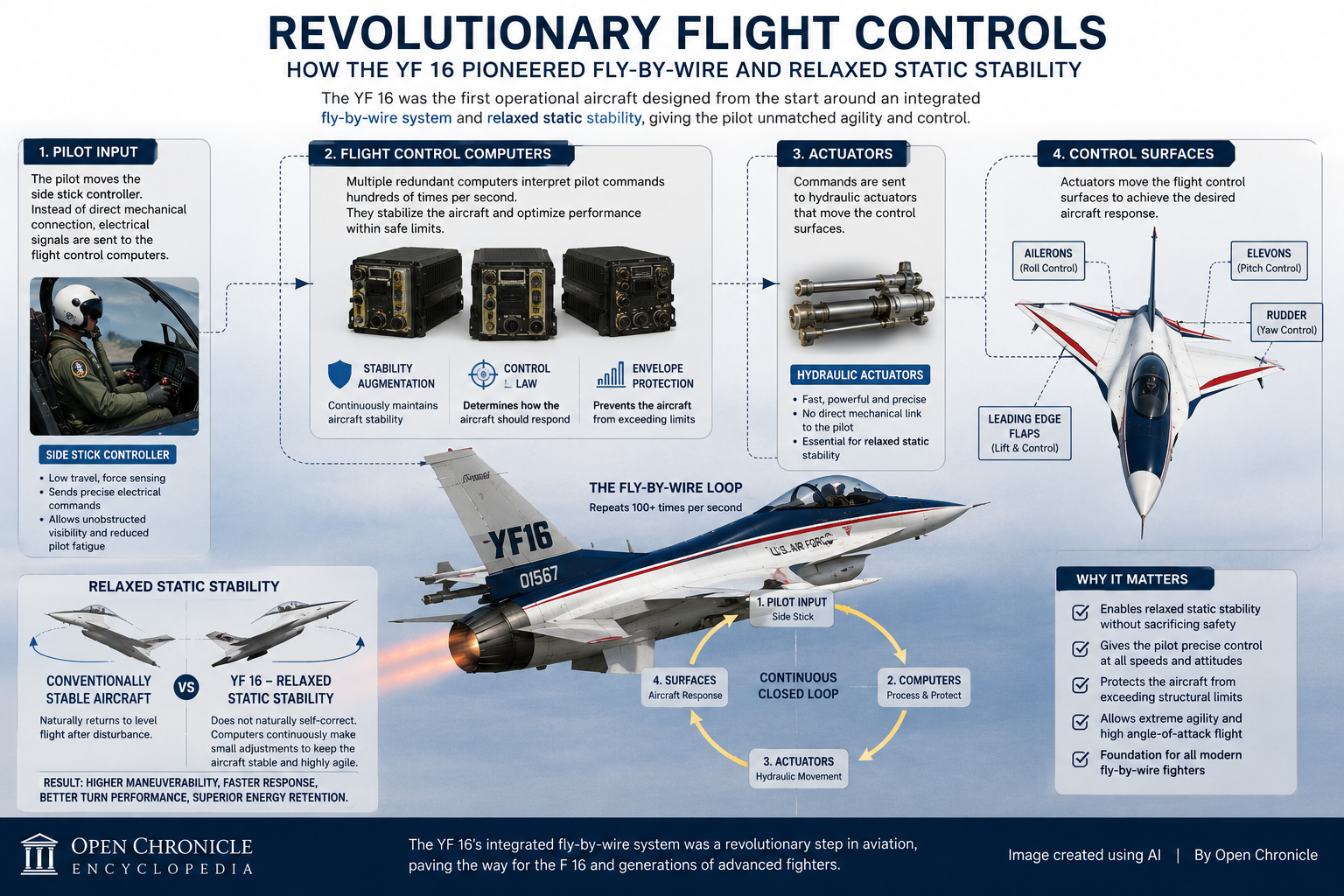
Perhaps the most important technological feature of the YF-16 was its flight control system.
Traditional aircraft are generally designed with positive static stability.
When disturbed, the aircraft naturally tends to return towards its previous condition.
This behaviour makes the aircraft easier to control.
It can also reduce manoeuvrability.
The YF 16 deliberately used relaxed static stability.
Its aerodynamic design placed the aircraft closer to instability.
The aircraft therefore responded rapidly to changes in direction.
However, this configuration required continuous electronic control.
The pilot could not simply control the aircraft using conventional mechanical connections.
Electronic computers had to interpret pilot commands and stabilise the aircraft continuously.
The result was one of the most consequential advances in fighter aircraft design.
Fly-by-wire
The YF-16 used an electronic fly-by-wire flight control system.
There was no conventional direct mechanical connection between the pilot’s stick and the flight control surfaces.
The pilot provided commands to the control system.
Electronic circuits processed those commands.
Hydraulic actuators then moved the aircraft’s control surfaces.
This architecture allowed the aircraft’s unstable aerodynamic configuration to become usable.
The control system effectively stood between the pilot and the aircraft at all times.
Modern combat aircraft now use variations of this concept routinely.
In the early 1970s, it represented a radical departure from conventional fighter design.
The United States Air Force later described the YF-16 as the first operational aircraft to use such a fly-by-wire configuration.
Side Stick Controller
The YF-16 also abandoned the traditional central control column.
Instead, the pilot used a small control stick mounted on the right side of the cockpit.
The original controller moved very little.
It primarily sensed pressure rather than large physical displacement.
This arrangement offered several advantages.
It reduced cockpit obstruction.
It allowed the pilot’s arm to remain supported during high gravitational force manoeuvres.
It also worked naturally with the electronic control architecture.
The side stick became one of the most distinctive features of the production F-16.
Similar arrangements later appeared in other advanced aircraft.
The Reclined Seat
The YF-16 pilot sat in a seat reclined approximately 30 degrees.
This was more inclined than seating positions used in many previous fighters.
The intention was partly to improve pilot tolerance of high gravitational forces.
During extreme manoeuvres, pilots experience forces several times normal gravity.
Blood is pulled away from the brain towards the lower body.
A reclined seating position can reduce the vertical distance between the heart and brain and improve tolerance.
The arrangement also contributed to the YF 16’s distinctive cockpit geometry.
Bubble Canopy
Visibility was a central design priority.
Traditional fighter canopies often used structural frames that obstructed the pilot’s view.
The YF 16 used a large bubble canopy providing exceptionally broad visibility.
The pilot could see forward, sideways, and rearwards with relatively little obstruction.
This was particularly valuable in visual air combat.
Before helmet-mounted sensors and networked situational awareness became common, a pilot’s ability to see an opponent first could determine the outcome of an engagement.
The canopy became another defining feature carried directly into the production F 16.
Blended Wing Body Design
The YF-16’s fuselage and wings were integrated through smooth aerodynamic blending.
Rather than treating the wing and fuselage as entirely separate structures, the design used their intersection to generate lift.
This increased aerodynamic efficiency and created additional internal volume for fuel and equipment.
The configuration also incorporated prominent leading edge root extensions.
At high angles of attack, these structures generated vortices that helped maintain lift over the wing.
NASA research contributed significantly to understanding these vortex phenomena.
Underslung Air Intake
The YF-16 used a large air intake beneath the forward fuselage.
The intake supplied the single F100 engine.
Its location helped keep the upper fuselage aerodynamically clean.
It also contributed to the aircraft’s characteristic appearance.
The intake design had to provide reliable airflow across a wide range of manoeuvres, including high angles of attack where airflow around the fuselage could become highly disturbed.
The general configuration survived into the production F-16, although later versions introduced changes in intake geometry to accommodate different engines.
Energy Manoeuvrability
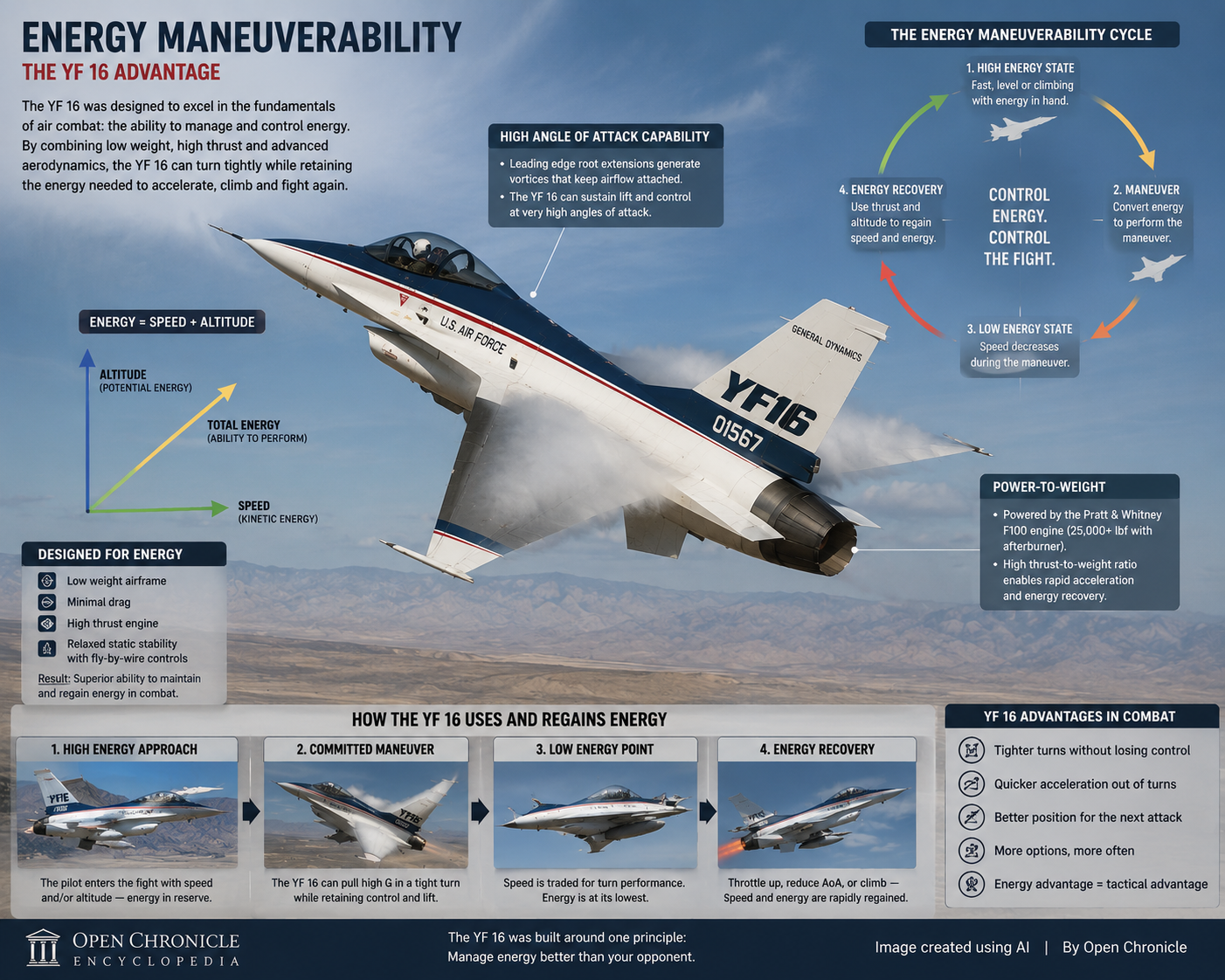
The design philosophy behind the YF-16 placed exceptional emphasis on energy management.
A fighter engaged in combat constantly exchanges speed, altitude and turning performance.
A manoeuvre that produces a rapid turn may also reduce speed.
An aircraft that loses too much energy can become vulnerable.
The YF 16’s low weight, high thrust and aerodynamic efficiency allowed it to retain or regain energy rapidly.
This made it especially effective during sustained manoeuvring.
Energy manoeuvrability theory therefore influenced not merely the aircraft’s turning ability but the overall balance of engine power, wing loading, drag and weight.
High Thrust to Weight Ratio
The Pratt & Whitney F100 gave the small YF-16 exceptional power relative to its weight.
A high thrust-to-weight ratio improved acceleration and climb performance.
It also allowed the aircraft to recover energy rapidly after manoeuvres.
This combination became one of the principal advantages of the design.
Using an engine already associated with the F-15 also simplified development compared with introducing an entirely new propulsion system.
The Pratt & Whitney F100
The F100 was an afterburning turbofan developed for a new generation of American fighters.
It powered both the F-15 and early F 16 aircraft.
This commonality became important politically, operationally, and economically.
The Air Force could support two complementary fighters using related engine infrastructure.
For the YF-16, the engine provided the power needed to make the lightweight fighter concept viable.
A small airframe without sufficient thrust would have produced little advantage.
The F100 allowed low weight and high power to work together.
Prototype Armament Concept
Although the YF 16 was primarily an experimental aircraft, the configuration anticipated operational armament.
The design incorporated provision for an internal M61 Vulcan cannon and wingtip AIM-9 Sidewinder missiles.
This reflected the programme’s emphasis on visual air combat.
The lightweight fighter concept did not originally seek to reproduce every capability of larger aircraft.
Instead, it focused on the weapons and systems required for a highly agile fighter.
As the design evolved into the production F-16, weapons capacity expanded dramatically.
The final Fighting Falcon became a comprehensive multirole combat aircraft far beyond the comparatively focused concept represented by the prototype.
Why the YF-16 Won
No single factor explains the YF-16’s victory.
Its manoeuvrability was important.
Its acceleration was important.
Its engine commonality with the F-15 reduced logistical and development risk.
Its projected cost was attractive.
The aircraft’s single-engine configuration simplified some aspects of production and operation.
Its flight testing also demonstrated substantial growth potential.
The YF-16 therefore provided a combination of performance, affordability and technical maturity that aligned closely with the changing Air Force requirement.
The decision also reflected the emerging concept of pairing a large, powerful fighter with a lighter aircraft available in greater numbers.
From YF-16 to F-16
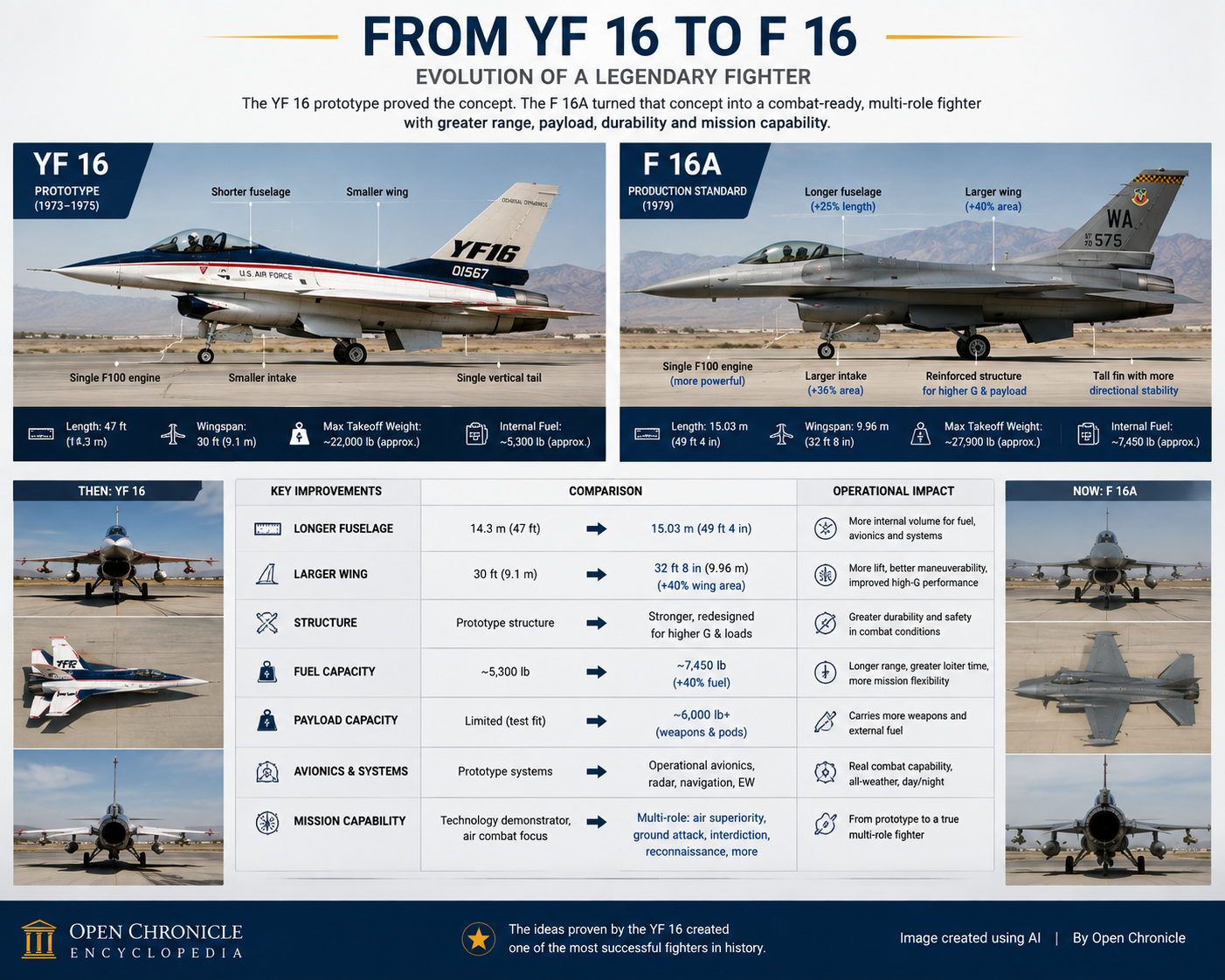
The production F-16 was not identical to the YF-16.
Operational requirements demanded significant changes.
The fuselage was lengthened.
The wing area increased.
The structure was strengthened.
Internal fuel capacity increased.
Additional avionics and weapons capability had to be accommodated.
Landing gear and other systems were redesigned for operational service.
The aircraft gained greater payload and mission flexibility.
These changes increased weight.
The final production fighter was therefore less purely lightweight than the prototype.
However, the fundamental architecture remained unmistakable.
Single engine.
Blended wing body.
Bubble canopy.
Side stick.
Fly-by-wire.
Relaxed static stability.
High manoeuvrability.
The DNA of the YF-16 survived.
The F-16 Fighting Falcon
The first production standard F-16A flew in December 1976.
Operational deliveries followed during the late 1970s.
The aircraft evolved far beyond the original lightweight fighter concept.
Successive blocks added increasingly capable radar, precision-guided weapons, electronic warfare systems, targeting pods, data links and advanced engines.
The F-16 became capable of air superiority, ground attack, suppression of enemy air defences, reconnaissance and numerous specialised missions.
The aircraft that began as an argument for simplicity eventually became one of the most sophisticated fourth-generation fighter families in existence.
The YF 17 Legacy
The YF 16’s victory did not render its competitor historically insignificant.
Northrop’s YF 17 attracted the interest of the United States Navy.
The design was subsequently enlarged and extensively redesigned for carrier operations.
Working with McDonnell Douglas, Northrop’s concept evolved into the F A 18 Hornet.
The Lightweight Fighter programme therefore produced two extraordinary legacies.
The YF 16 became the ancestor of the F-16.
The YF 17 became the ancestor of the F A 18.
Few experimental fighter competitions produced such enduring results.
Influence on Later Aircraft
The YF 16 helped normalise technologies that later became standard in advanced combat aircraft.
Fly-by-wire controls are now commonplace.
Relaxed static stability is widely used.
Side stick controllers appear in both military and civilian aircraft.
Highly integrated digital flight control systems allow modern fighters to achieve aerodynamic configurations that would be extremely difficult to manage through conventional controls.
The aircraft also demonstrated the importance of designing the pilot, computers, and airframe as a single integrated system.
That philosophy became fundamental to later generations of fighter development.
Human Machine Integration
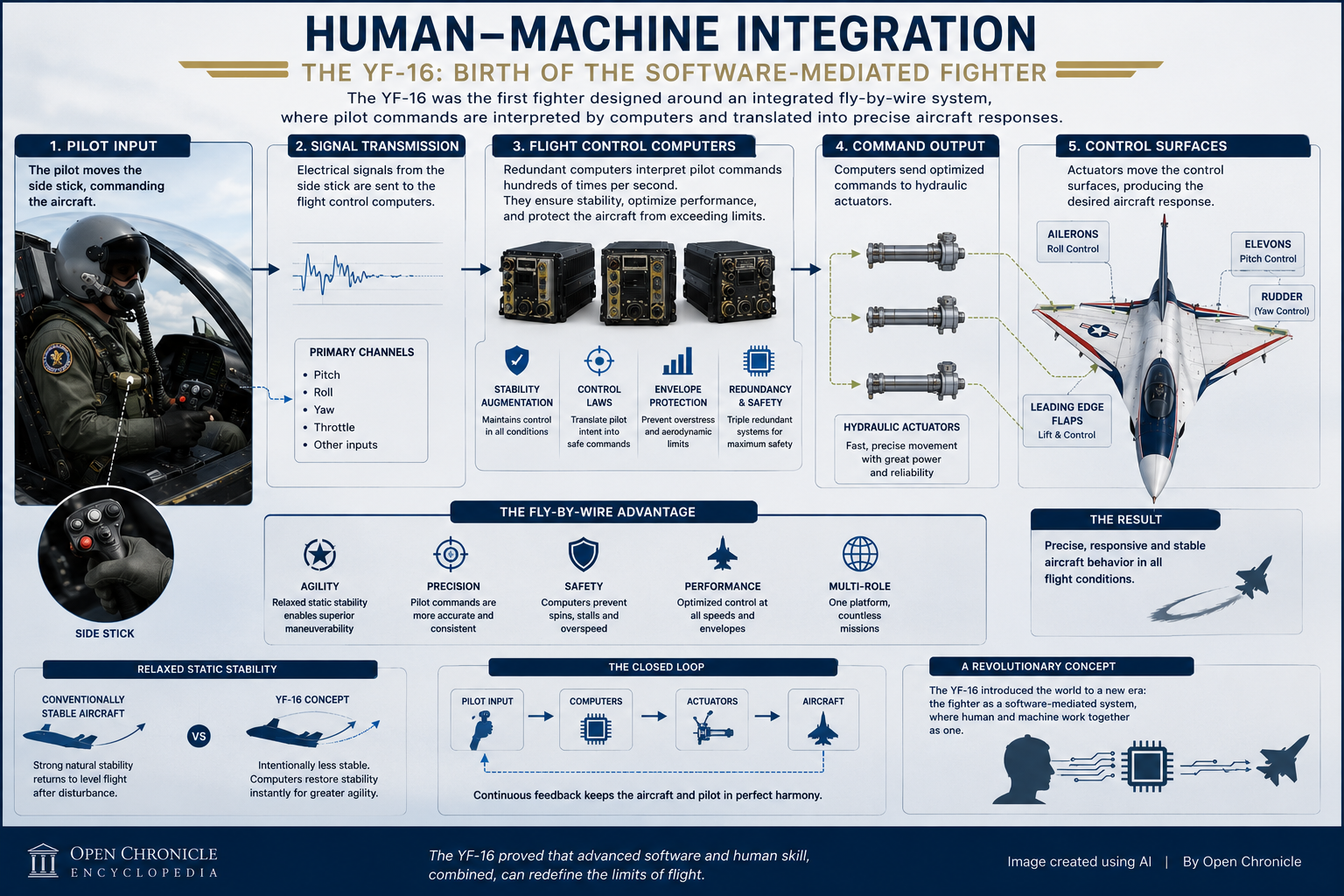
The YF-16 represented an important change in the relationship between pilot and aircraft.
In earlier fighters, the pilot directly controlled mechanical or hydraulically boosted systems.
In the YF-16, the pilot communicated intent to electronic controls.
The aircraft’s computers decided how control surfaces should move to achieve that intent while maintaining stability.
This transformation was subtle but profound.
The pilot remained fully responsible for flying the aircraft.
Yet every manoeuvre depended upon continuous computer intervention.
The modern concept of a fighter as a software-mediated flying system can therefore trace part of its development to aircraft such as the YF 16.
NASA Contributions
NASA research contributed to several areas relevant to the YF-16’s development.
Aerodynamic investigations helped improve understanding of high angle of attack vortex behaviour and forebody strakes.
NASA Langley simulation studies examined flight control and stability issues associated with relaxed static stability.
Researchers were particularly concerned with maintaining control during demanding manoeuvres involving high roll rates, low speeds and large angles of attack.
These contributions illustrate the wider ecosystem behind the aircraft.
The YF 16 was a General Dynamics design, but its success also depended upon decades of American research in aerodynamics, propulsion, controls and human factors.
Experimental Philosophy
The Lightweight Fighter programme demonstrated the value of building and flying competing prototypes.
Instead of selecting an aircraft entirely through paper studies, the United States evaluated actual machines.
Pilots could compare handling.
Engineers could collect real performance data.
Unexpected problems could be discovered.
The accidental first flight itself demonstrated why physical testing remained essential.
Simulation and analysis had advanced significantly, but the interaction between a real pilot and an extremely responsive electronic flight control system produced behaviour that required direct experience to understand fully.
The Meaning of “Y”
The letter Y in the designation YF 16 identified the aircraft’s prototype status.
In American military aircraft designation practice, the prefix indicates a prototype associated with development or evaluation.
The production aircraft dropped the Y prefix and became the F-16.
The transition from YF-16 to F-16 therefore represented more than a change of name.
It marked the transformation of an experimental concept into an operational weapons programme.
What Happened to the Prototypes?
The two YF-16 prototypes continued to support testing after the competition.
As development moved towards production aircraft, their importance gradually shifted from competition to research and evaluation.
Prototype aircraft frequently differ enough from production versions that long-term operational use is impractical.
Their historical value, however, became enormous.
The YF-16 prototypes represented the physical origin of a fighter family that would eventually be produced in thousands of examples and operated by air forces around the world.
Technical Profile
The precise specifications of prototype aircraft varied during testing, and figures should not be confused with later production F-16 performance.
Contemporary Air Force historical documentation describes the original YF-16 as approximately 47 feet long with a wingspan of approximately 30 feet.
The aircraft used a single Pratt & Whitney F100 engine capable of more than 25,000 pounds of thrust.
Its representative weight with internal fuel, gun, and two Sidewinder missiles was approximately 22,000 pounds.
The prototype was therefore smaller and lighter than later operational F 16 variants.
YF 16 versus Production F 16
| Characteristic | YF-16 | Production F-16 |
|---|---|---|
| Purpose | Experimental lightweight fighter | Operational multirole combat aircraft |
| Status | Prototype | Production aircraft |
| Number built | 2 | Thousands |
| Initial role emphasis | Air combat and manoeuvrability | Air combat and increasingly multirole missions |
| Engine concept | Single F100 | F100 or F110 depending on variant |
| Flight controls | Fly-by-wire | Fly-by-wire |
| Static stability | Relaxed | Relaxed |
| Control stick | Side mounted | Side mounted |
| Canopy | Bubble canopy | Bubble canopy |
| Airframe | Smaller prototype configuration | Enlarged and strengthened |
| Payload | Limited prototype configuration | Extensive weapons and sensor capability |
| Legacy | Established the design concept | Became a global fighter family |
YF 16 versus YF 17
| Characteristic | YF 16 | YF 17 |
| Manufacturer | General Dynamics | Northrop |
| Engines | One | Two |
| Vertical tails | One | Two |
| Primary USAF result | Selected | Not selected |
| Major descendant | F-16 Fighting Falcon | F A 18 Hornet |
| Design emphasis | Lightweight, powerful single-engine fighter | Lightweight twin-engine fighter |
| Historical outcome | Became a major USAF and international fighter | Became basis for major naval fighter family |
Timeline
Did You Know?
The YF-16’s first flight happened accidentally during a taxi test.
Test pilot Phil Oestricher chose to take off because continuing along the runway risked damaging the prototype.
The first unplanned flight lasted only about six minutes.
The first official flight occurred approximately two weeks later and lasted around 90 minutes.
Only two YF-16 prototypes were built.
The YF-16 used the same basic engine family as the F-15 Eagle.
The aircraft was intentionally designed with relaxed static stability.
Without continuous electronic flight control, the aircraft would have been extremely difficult to fly safely.
The YF 16’s competitor, the YF 17, eventually evolved into the F A 18 Hornet.
The prototype’s cockpit innovations, including its side stick and reclined seat, survived into the production F-16.
The YF-16 helped establish technologies that later became normal features of modern combat aviation.
Open Chronicle Perspective
The significance of the YF-16 lies in the fact that it challenged assumptions.
It challenged the assumption that better fighters necessarily had to become larger.
It challenged the assumption that aerodynamic instability should always be avoided.
It challenged the assumption that pilots required direct mechanical relationships with control surfaces.
It challenged the assumption that sophisticated capability had to begin with greater complexity.
The aircraft’s designers instead built a machine around balance.
Low weight was combined with high thrust.
Instability was combined with computers.
Pilot visibility was combined with compact dimensions.
Advanced control technology was combined with a comparatively simple airframe.
The result was not a perfect aircraft.
The first taxi tests themselves demonstrated how revolutionary systems could introduce new problems.
Nor did the lightweight ideal survive unchanged.
The production F-16 became larger, heavier and progressively more complex as operational demands expanded.
That evolution should not be seen as a failure of the YF 16 concept.
It demonstrates the strength of the original design.
The prototype possessed enough aerodynamic quality, structural potential and systems flexibility to become far more than its designers initially required.
The YF-16 therefore deserves recognition not simply as the prototype of the F-16 Fighting Falcon.
It was one of the aircraft that helped redefine what a modern fighter could be.
References
United States Air Force Life Cycle Management Center historical publications concerning the Lightweight Fighter programme and the first flights of the YF 16.
United States Air Force historical study, Ideas, Concepts, Doctrine, material concerning development of the Lightweight Fighter programme.
Air Force Test Center historical publication concerning the Lightweight Fighter competition and prototype development.
NASA Technical Reports Server, Charles A. Anderson, Development of an Active Fly-by-Wire Flight Control System, 1976.
NASA historical publications concerning Langley contributions to the F-16 and research into relaxed static stability, vortex lift and advanced control systems.
NASA Technical Memorandum concerning lateral pilot-induced oscillation experienced during early YF 16 testing.
Lockheed Martin historical materials concerning development of the F-16 Fighting Falcon.
Further Reading
Research on the United States Air Force Lightweight Fighter programme.
Studies of John Boyd and energy manoeuvrability theory.
NASA literature concerning fly-by-wire systems and relaxed static stability.
Technical studies of the YF-16 flight control architecture.
Historical accounts of the YF-16 and YF-17 competition.
Research concerning the development of the F-16 Fighting Falcon.
Studies of prototype fighter testing at Edwards Air Force Base.
Historical material concerning General Dynamics aerospace development during the Cold War.
← Back to Encyclopedia Library
Explore this subject
Continue exploring related Open Chronicle Encyclopedia entries through the categories associated with this article.

Staff Writers at Open Chronicle produce trusted journalism, strategic analysis and authoritative reference content across global affairs, geopolitics, defense, science, history, technology, business, culture and sport. Their work combines accurate reporting with historical perspective and analytical depth, helping readers understand not only what is happening, but why it matters. Beyond daily news coverage, Staff Writers contribute to the Open Chronicle Encyclopedia, investigative features, original research projects and long-form reports, building a comprehensive knowledge platform designed to inform, educate and preserve reliable information for a global audience.