
By Open Chronicle History Desk
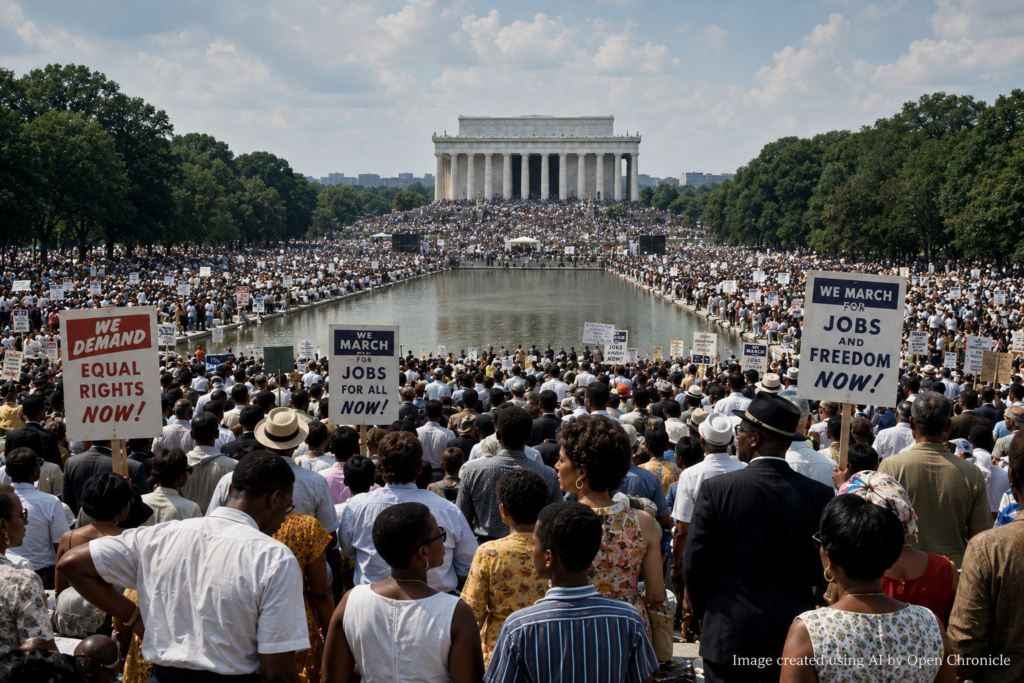
On August 28, 1963, an immense crowd gathered in the heart of Washington, D.C.
They came by bus and train, by car and airplane. They travelled from cities and small towns, from the industrial North and the segregated South. Black Americans stood beside white supporters. Religious leaders marched with trade unionists. Students joined veterans of campaigns that had challenged segregation in buses, restaurants, schools and public spaces.
Their destination was the Lincoln Memorial.
Their demand was both simple and revolutionary.
The United States should fulfil the promise of equality that it had proclaimed but never completely delivered.
The event was officially called the March on Washington for Jobs and Freedom.
More than 200,000 people attended, with many estimates placing the crowd at approximately 250,000.
They gathered beneath the gaze of Abraham Lincoln, the president who had issued the Emancipation Proclamation a century earlier.
Near the end of the programme, a 34 year old Baptist minister from Atlanta approached the microphones.
His name was Martin Luther King Jr.
King had prepared a speech.
But during its delivery, he moved beyond portions of the prepared text and returned to an image he had used before.
“I have a dream.”
What followed became one of the most famous speeches in modern history.
Yet the March on Washington was much larger than a single speech and much larger than a single man.
It represented decades of Black political organisation, labour activism, legal challenges, religious mobilisation and direct action.
It brought together competing organisations and generations of activists.
It demanded not only an end to racial segregation but economic justice.
It exposed both the extraordinary power and the unresolved limitations of the American promise of equality.
And it became one of the defining moments of the Civil Rights Movement.
The Unfinished Promise of Emancipation
The roots of the March on Washington reached back far beyond 1963.
In 1863, during the American Civil War, President Abraham Lincoln issued the Emancipation Proclamation.
Two years later, the Thirteenth Amendment abolished slavery throughout the United States, except as punishment for crime.
The Fourteenth Amendment established citizenship and equal protection under the law.
The Fifteenth Amendment prohibited denying the right to vote on account of race, colour or previous condition of servitude.
For a brief period during Reconstruction, Black Americans participated in political life across the former Confederacy.
Black men voted.
Black politicians held local, state and federal office.
New institutions emerged.
Public education expanded.
But Reconstruction encountered violent resistance.
White supremacist organisations used intimidation, murder and terrorism to destroy Black political participation.
By the late nineteenth century, much of the South had constructed a new system of racial domination.
Slavery had ended.
Racial equality had not arrived.
Jim Crow
The system became known as Jim Crow.
Southern states imposed racial segregation across public life.
Schools were segregated.
Railway cars were segregated.
Restaurants, waiting rooms, theatres, parks and other facilities could be separated by race.
Black Americans faced systematic barriers to voting, including literacy tests, poll taxes and administrative manipulation.
Violence reinforced the system.
Lynchings terrorised Black communities.
White supremacist political power ensured that legal equality often existed only on paper.
In 1896, the United States Supreme Court strengthened segregation through Plessy v. Ferguson, accepting the principle of “separate but equal.”
In practice, separate was profoundly unequal.
The United States entered the twentieth century proclaiming democratic ideals internationally while millions of its own citizens lived under institutionalised racial discrimination.
Resistance Never Disappeared
Black Americans did not simply wait for the Civil Rights Movement of the 1950s.
Resistance to racial discrimination continued across generations.
Journalists such as Ida B. Wells exposed lynching.
Organisations including the NAACP, founded in 1909, pursued legal and political campaigns against discrimination.
Black newspapers challenged segregation.
Churches provided centres of community organisation.
Trade unionists fought workplace discrimination.
Intellectuals debated strategies for racial advancement.
Veterans returned from both world wars demanding rights in the country they had served.
The Great Migration transformed American society as millions of Black Americans moved from the rural South to cities in the North, Midwest and West.
This movement changed electoral politics, culture and labour organisation.
By the middle of the twentieth century, the foundations of a new national struggle had been built.
A. Philip Randolph’s Earlier March
The idea of a march on Washington did not begin with Martin Luther King Jr.
More than two decades before the 1963 gathering, labour leader A. Philip Randolph had proposed a mass march on the capital.
Randolph was president of the Brotherhood of Sleeping Car Porters and one of the most influential Black labour leaders in the United States.
In 1941, as American industry expanded production for the approaching global war, discrimination continued to exclude Black workers from many defence jobs.
Randolph threatened to bring tens of thousands of Black Americans to Washington.
President Franklin D. Roosevelt wanted to prevent the demonstration.
The pressure worked.
Roosevelt issued Executive Order 8802, prohibiting racial discrimination in the national defence industry and establishing the Fair Employment Practice Committee.
Randolph cancelled the march.
But the lesson remained.
Mass mobilisation could force the federal government to act.
Twenty two years later, Randolph would finally lead a march on Washington.
Brown v. Board of Education
One of the great legal breakthroughs came in 1954.
In Brown v. Board of Education, the Supreme Court ruled that racial segregation in public schools was unconstitutional.
The decision rejected the principle of separate but equal in public education.
It was a historic victory.
But court decisions did not automatically transform society.
Resistance across the South was fierce.
Some school districts delayed integration.
Political leaders organised campaigns of “massive resistance.”
Federal authority would repeatedly be tested as activists attempted to turn constitutional rights into lived reality.
Rosa Parks and Montgomery
On December 1, 1955, Rosa Parks refused to surrender her seat to a white passenger on a segregated bus in Montgomery, Alabama.
Her arrest helped trigger the Montgomery Bus Boycott.
Black residents organised a sustained boycott of the city’s bus system.
A young Baptist minister became one of its leading public figures.
Martin Luther King Jr. was only 26 years old.
The boycott lasted more than a year.
Car pools, community networks and churches sustained the protest.
The campaign demonstrated the potential of organised nonviolent resistance.
It also transformed King into a national figure.
Martin Luther King Jr.
King emerged from the Black Baptist religious tradition but developed a political philosophy that combined Christianity, American constitutional ideals and nonviolent resistance.
He studied the example of Mahatma Gandhi and the Indian independence movement.
Nonviolence, for King, was not passive acceptance.
It was a method of confrontation.
Protesters would expose injustice publicly.
They would refuse cooperation with discriminatory systems.
They would accept arrest without abandoning the campaign.
Their discipline would force American society to confront the contradiction between its democratic ideals and racial realities.
In 1957, King and other ministers helped establish the Southern Christian Leadership Conference, or SCLC.
The organisation became one of the principal forces of the Civil Rights Movement.
But it was never the only one.
A Movement, Not a Single Leader
The popular memory of the Civil Rights Movement often centres on King.
The historical movement was far broader.
The NAACP pursued legal challenges.
The Congress of Racial Equality, or CORE, organised direct action.
The Student Nonviolent Coordinating Committee, or SNCC, brought a younger and often more confrontational generation into the struggle.
The National Urban League focused on economic and social opportunities.
Trade unions provided organisational and financial support.
Black churches created networks capable of mobilising entire communities.
Local activists, many of whom never became nationally famous, often carried the greatest risks.
The movement was a coalition.
Its members disagreed about strategy, leadership, economics, nonviolence and the pace of change.
Those disagreements would also shape the March on Washington.
The Sit Ins
In February 1960, four Black college students sat at a whites only lunch counter in Greensboro, North Carolina, and refused to leave when they were denied service.
Their protest inspired similar actions across the South.
Students occupied segregated lunch counters.
They endured insults.
Some were assaulted.
Others were arrested.
The sit in movement demonstrated the growing impatience of younger activists.
They were no longer willing merely to challenge segregation through courts.
They would confront it physically, peacefully and publicly.
SNCC emerged from this wave of activism.
A new generation had entered the movement.
The Freedom Rides
In 1961, interracial groups of activists known as Freedom Riders travelled through the South to challenge segregation in interstate bus travel.
They faced extraordinary violence.
A bus was firebombed near Anniston, Alabama.
Activists were beaten.
Police protection was often absent or deliberately inadequate.
Images of the attacks spread across the country and internationally.
Again, federal authorities faced pressure to enforce rights that formally already existed.
The Civil Rights Movement increasingly understood the importance of creating crises that the federal government could not ignore.
Birmingham
In 1963, that strategy produced one of the most important confrontations of the movement.
Birmingham, Alabama, was one of the most segregated cities in America.
Civil rights activists launched a major campaign against segregation.
King was arrested.
From jail, he wrote his famous Letter from Birmingham Jail, defending direct action against critics who urged patience.
The campaign entered a dramatic phase when children and young people participated in demonstrations.
Police Commissioner Eugene “Bull” Connor responded with police dogs and high pressure fire hoses.
Television and newspaper images shocked audiences.
The brutality of segregation became visible in American homes.
The political climate was changing.
Medgar Evers
The struggle was also deadly.
On June 12, 1963, civil rights activist Medgar Evers was assassinated outside his home in Jackson, Mississippi.
Evers had served as the NAACP’s field secretary in Mississippi.
He worked on voter registration, school integration and investigations of racial violence.
His murder came only hours after President John F. Kennedy delivered a nationally televised address describing civil rights as a moral issue.
The assassination demonstrated the danger faced by activists.
The March on Washington would take place less than three months later.
Kennedy and Civil Rights
John F. Kennedy had entered the presidency cautiously on civil rights.
The political problem was formidable.
Southern Democrats remained powerful in Congress.
Aggressive federal intervention risked destroying parts of Kennedy’s legislative coalition.
But events increasingly forced the administration to act.
Freedom Riders.
University integration crises.
Birmingham.
Violence against demonstrators.
International criticism during the Cold War.
The contradiction between American democratic rhetoric and segregation damaged the country’s image abroad.
In June 1963, Kennedy called for major civil rights legislation.
Activists wanted to ensure that Congress acted.
A mass demonstration in Washington could increase the pressure.
Jobs and Freedom
The march was never intended to concern racial segregation alone.
Its full title matters:
The March on Washington for Jobs and Freedom.
Economic inequality was central to the organisers’ agenda.
Black unemployment remained disproportionately high.
Workplace discrimination restricted opportunities.
Many Black Americans remained concentrated in low wage employment.
Randolph had spent his career connecting racial justice with labour rights.
The march demanded meaningful civil rights legislation, protection against police brutality, desegregation of public schools, voting rights, employment opportunities and economic reforms.
It was simultaneously a civil rights demonstration and a labour demonstration.
That dimension is sometimes lost when the event is remembered only through King’s final speech.
Bayard Rustin
The logistical mastermind of the march was Bayard Rustin.
Rustin was an experienced organiser, pacifist and strategist of nonviolent protest.
He had worked with Randolph and advised King.
He also faced discrimination within the movement because he was openly gay in an era when homosexuality was heavily stigmatised and criminalised in many jurisdictions.
Opponents attempted to use Rustin’s sexuality and previous political associations to discredit the march.
Randolph defended him.
Rustin organised an extraordinarily complex operation.
Transportation.
Security.
Sound systems.
Medical facilities.
Food.
Marshals.
Press arrangements.
Coordination among organisations.
Hundreds of thousands of people were expected to arrive in the capital.
The event had to remain disciplined and peaceful.
Rustin helped make that possible.
The Big Six
Six major civil rights leaders became closely associated with the march.
They were:
A. Philip Randolph, representing the Brotherhood of Sleeping Car Porters.
Martin Luther King Jr., of the Southern Christian Leadership Conference.
Roy Wilkins, of the NAACP.
Whitney Young, of the National Urban League.
James Farmer, of the Congress of Racial Equality.
John Lewis, chairman of the Student Nonviolent Coordinating Committee.
Together they became known as the Big Six.
But the coalition also included religious organisations, labour unions and other civil society groups.
The diversity of the coalition was one of the march’s greatest strengths.
It was also a source of tension.
Washington Prepares
Authorities did not know what would happen.
The scale of the planned gathering generated anxiety within government.
Security preparations were extensive.
Thousands of police officers and military personnel were available.
Alcohol sales were restricted.
Government employees were given special instructions.
Hospitals prepared for emergencies.
Some officials feared violence or disorder.
Those fears proved largely unfounded.
The march became notable for its peaceful and disciplined character.
The participants came to demonstrate political power, not to riot.
August 28, 1963
From early morning, people poured into Washington.
Special trains arrived.
Thousands of buses entered the city.
Groups carried banners identifying churches, unions, cities and organisations.
People sang freedom songs.
They carried signs demanding jobs, voting rights, integrated schools and an end to discrimination.
The crowd assembled around the Washington Monument before moving toward the Lincoln Memorial.
The setting was deliberately symbolic.
The marchers stood in the monumental heart of American democracy.
Behind them was the Washington Monument.
Ahead stood the memorial to Abraham Lincoln.
Between them stretched the Reflecting Pool.
The physical landscape itself became part of the political message.
A Quarter of a Million People
Approximately a quarter of a million people are generally estimated to have attended.
Around one fifth of the participants were white.
The gathering was one of the largest political demonstrations in American history up to that time.
Photographs reveal the scale.
People surrounded the Reflecting Pool.
They filled the spaces around the Lincoln Memorial.
They climbed trees and stood wherever they could see.
Yet the crowd was more than a number.
Each participant represented a journey.
Some had travelled from communities where attempting to register to vote could cost a person employment or invite violence.
Others came from northern cities where segregation was less explicit but discrimination remained deeply embedded in housing and employment.
For many, simply standing together in Washington was an act of political assertion.
Music and Protest
Music played an important role throughout the day.
Artists including Mahalia Jackson, Marian Anderson, Joan Baez, Bob Dylan, Odetta and Peter, Paul and Mary participated in the programme.
Freedom songs connected the march to the spiritual traditions and protest culture of the movement.
Music had long been essential to civil rights organising.
Songs strengthened morale during marches.
They filled churches during mass meetings.
They helped protesters endure arrest and intimidation.
At Washington, music turned a political demonstration into something that also felt communal and ceremonial.
Women and the March
Women had been indispensable to the Civil Rights Movement.
Rosa Parks.
Ella Baker.
Diane Nash.
Dorothy Height.
Fannie Lou Hamer.
Septima Clark.
Gloria Richardson.
And countless local organisers.
Yet the official speaking programme revealed the gender inequalities that existed even within a movement demanding equality.
No woman was included among the principal civil rights speakers in the same manner as the male leaders.
A brief tribute to Black women involved in the movement was included, and women participated prominently throughout the event, but activists criticised the limited speaking role given to them.
Dorothy Height, president of the National Council of Negro Women, later reflected upon this exclusion.
The contradiction matters.
Movements for justice can reproduce inequalities of their own.
John Lewis and the Speech That Was Changed
At 23 years old, John Lewis was the youngest of the major civil rights leaders speaking that day.
He represented SNCC.
His original speech was considerably more confrontational than the version eventually delivered.
Lewis criticised the Kennedy administration’s civil rights bill as insufficient and questioned how long Black Americans were expected to wait for freedom.
Some religious leaders and organisers feared the language would damage the coalition.
Negotiations followed.
Lewis agreed to modify portions of the speech.
He still delivered a forceful message.
The episode demonstrated the generational and strategic tensions within the movement.
The march presented unity to the nation.
Behind that unity were serious disagreements about how rapidly and aggressively America needed to change.
Mahalia Jackson
As the programme moved toward its most famous moment, gospel singer Mahalia Jackson occupied a place near Martin Luther King Jr.
Jackson was one of America’s greatest gospel singers and had a personal connection with King.
According to widely repeated accounts, as King moved through his prepared remarks, Jackson encouraged him to return to a theme she had heard him use before:
“Tell them about the dream, Martin.”
Whether that intervention alone changed the direction of the speech can easily be overstated.
King had already developed the dream theme in earlier sermons and speeches.
But the moment has become part of the history of August 28.
King moved increasingly away from the prepared manuscript.
The speech changed.
Martin Luther King Jr. Takes the Podium
King was the final major speaker.
He stood on the steps of the Lincoln Memorial.
Behind him sat the monumental statue of Abraham Lincoln.
Before him stretched the enormous crowd.
King began by connecting the gathering to emancipation.
A century had passed since Lincoln’s proclamation.
Yet Black Americans, King argued, were still not free.
Segregation and discrimination continued.
Economic inequality continued.
America had made promises through its founding documents.
Those promises had not been fulfilled equally.
King used the metaphor of a financial obligation.
Black Americans had come to Washington to demand payment on a promise of citizenship.
“I Have a Dream”
Then the speech moved into the passage that would define King’s public memory.
He described a future in which the country would live according to the meaning of its professed ideals.
A future in which racial hierarchy would no longer determine human possibility.
A future in which children would not inherit the divisions imposed upon their parents.
A future in which freedom would reach places where segregation seemed deeply entrenched.
The repeated phrase gave the speech rhythm.
But its power came from the way King connected several American traditions.
The Declaration of Independence.
The Constitution.
The Bible.
Black religious preaching.
Patriotic language.
The history of slavery.
The promise of emancipation.
He was not asking America to abandon its ideals.
He was demanding that America apply them.
“Let Freedom Ring”
The final movement of the speech widened geographically.
King imagined freedom ringing from mountains and landscapes across the United States.
The repetition built toward a vision of national transformation.
The speech ended not in despair but in possibility.
That was crucial to King’s rhetorical strategy.
He had described injustice clearly.
But he offered the country a path toward redemption.
The Civil Rights Movement was presented not as an enemy of America but as a force demanding that the nation become what it claimed to be.
The crowd responded enormously.
A speech had become history.
Why the Speech Worked
King’s address lasted less than twenty minutes.
Its historical power came from several elements.
The setting was extraordinary.
The political moment was critical.
Television carried the speech nationally.
King possessed exceptional oratorical skill.
His language connected religious imagery with constitutional principles.
He spoke to Black suffering without presenting racial equality as a sectional concern.
He transformed civil rights into a test of American democracy itself.
The speech could therefore operate simultaneously as protest, sermon, constitutional argument and national appeal.
Few political speeches achieve all four.
Not Everyone Was Impressed
The later iconic status of the speech can obscure contemporary divisions.
Some activists believed the march was too controlled.
Malcolm X later derided it as the “Farce on Washington,” arguing that the demonstration had been moderated and contained by established leaders and the government.
More militant activists questioned whether speeches and symbolic demonstrations could dismantle deeply entrenched racism.
These criticisms became increasingly important later in the decade.
The Civil Rights Movement was never intellectually uniform.
The debate between integration, nationalism, nonviolence, self defence, economic restructuring and political power would intensify after 1963.
The White House Meeting
After the march, civil rights leaders met President Kennedy at the White House.
The administration recognised the extraordinary success of the event.
The march had remained peaceful.
It had demonstrated broad national support.
It had strengthened political pressure for civil rights legislation.
But legislation still had to pass Congress.
That would prove difficult.
The movement could create moral urgency.
Political institutions still had to convert urgency into law.
The Birmingham Church Bombing
Only eighteen days after the March on Washington, America received a brutal reminder of the forces opposing racial equality.
On September 15, 1963, a bomb exploded at the 16th Street Baptist Church in Birmingham, Alabama.
Four Black girls were killed:
Addie Mae Collins.
Denise McNair.
Carole Robertson.
Cynthia Wesley.
The attack horrified the nation.
The contrast with King’s dream could hardly have been more painful.
The movement had demonstrated peacefully in Washington.
White supremacist terrorism answered with murdered children.
Kennedy Is Assassinated
Two months later, another shock transformed American politics.
On November 22, 1963, President John F. Kennedy was assassinated in Dallas.
Vice President Lyndon B. Johnson became president.
Johnson was a Texan with decades of congressional experience and a deep understanding of legislative power.
He decided to make civil rights legislation a central priority.
Invoking Kennedy’s memory while applying his own formidable political skills, Johnson pushed Congress toward action.
The Civil Rights Act of 1964
On July 2, 1964, Johnson signed the Civil Rights Act.
The legislation became one of the most important civil rights laws in American history.
It prohibited discrimination in major areas of public accommodation.
It strengthened federal authority against segregated institutions.
It addressed employment discrimination.
The law did not solve racial inequality.
No legislation could erase generations of discrimination instantly.
But it represented an enormous legal transformation.
The system of officially sanctioned segregation had suffered a decisive blow.
The March on Washington had helped create the political environment in which that transformation became possible.
King Receives the Nobel Peace Prize
In 1964, Martin Luther King Jr. received the Nobel Peace Prize.
At 35, he was then the youngest person to receive the award.
His international stature had grown enormously.
The Civil Rights Movement had become a global symbol.
People living under colonial rule, apartheid and authoritarian systems watched events in the United States closely.
King’s language of nonviolence and universal rights travelled far beyond America.
But major battles remained.
One of the most important concerned voting.
Selma
In Alabama, Black citizens continued facing enormous barriers to voter registration.
In 1965, activists launched a campaign centred on Selma.
On March 7, marchers attempting to cross the Edmund Pettus Bridge were attacked by Alabama state troopers and local law enforcement.
Television images of Bloody Sunday shocked the country.
Again, protest exposed the gap between constitutional principle and political reality.
President Johnson responded by calling for voting rights legislation.
The Voting Rights Act
On August 6, 1965, Johnson signed the Voting Rights Act.
The legislation attacked mechanisms used to disenfranchise Black voters.
Federal oversight transformed voter registration across much of the South.
Black political participation increased dramatically.
The law represented another major victory for the movement.
The arc from Washington in 1963 to the Civil Rights Act and Voting Rights Act was not automatic.
Thousands of activists had organised campaigns between those moments.
Some were beaten.
Some were imprisoned.
Some were murdered.
Legislation was built upon their struggle.
The Movement Moves North
By the middle of the 1960s, the civil rights struggle increasingly confronted problems that could not be reduced to southern segregation laws.
Housing discrimination.
Urban poverty.
Unequal schools.
Police brutality.
Employment inequality.
Residential segregation.
These existed across the country.
King increasingly addressed economic injustice.
The phrase “Jobs and Freedom” had never disappeared from his political vision.
In Chicago, he campaigned against housing segregation.
He began speaking more directly about poverty.
He criticised the Vietnam War.
His politics became broader and, in some respects, more controversial.
The Poor People’s Campaign
By 1967 and 1968, King was helping organise the Poor People’s Campaign.
He wanted to bring poor Americans of different racial backgrounds to Washington to demand economic rights.
The project echoed the economic dimension of the 1963 march.
For King, racial equality without economic opportunity was incomplete.
A person could legally enter a restaurant and still lack the money to buy a meal.
Formal freedom and material inequality existed side by side.
King’s later work therefore complicates the comfortable image of him as simply the author of a dream about racial harmony.
His critique increasingly addressed the structure of American economic and political power.
Memphis
In 1968, King travelled to Memphis, Tennessee, to support striking Black sanitation workers.
Their slogan was simple:
I AM A MAN.
The workers demanded better wages, safer conditions and recognition of their dignity.
The campaign embodied the connection between labour and civil rights that had been central to the March on Washington five years earlier.
King delivered his final speech, commonly remembered as I’ve Been to the Mountaintop, on April 3.
The following day, April 4, 1968, Martin Luther King Jr. was assassinated at the Lorraine Motel.
He was 39 years old.
The Dream After King
King’s assassination did not end the struggle over the meaning of August 28, 1963.
Instead, the speech increasingly became part of American national memory.
Schoolchildren studied it.
Politicians quoted it.
Recordings were replayed.
The Lincoln Memorial became inseparable from the image of King speaking before the Reflecting Pool.
In 1983, legislation established a federal holiday honouring King.
It was first observed nationally in 1986.
In 2011, the Martin Luther King Jr. Memorial opened in Washington.
The civil rights leader who had once marched to demand that America fulfil its promises had entered the country’s official commemorative landscape.
The Danger of Remembering Only the Dream
Commemoration can simplify history.
The phrase “I Have a Dream” is so familiar that it can detach King from the political struggles that produced the speech.
King was not merely asking individuals to be kinder to one another.
He was confronting institutional discrimination.
He supported federal civil rights legislation.
He defended voting rights.
He challenged economic inequality.
He participated in boycotts.
He was repeatedly arrested.
He criticised American militarism.
He supported workers.
He faced surveillance by the FBI.
He was hated by many Americans during his lifetime.
Remembering only the most uplifting passages risks transforming a radical political struggle into a comfortable national myth.
The real history is more demanding.
Bayard Rustin’s Legacy
For decades, Bayard Rustin did not receive public recognition comparable to many other leaders of the movement.
His sexuality contributed significantly to his marginalisation.
Yet the extraordinary organisation of August 28 demonstrated his abilities.
He helped transform an ambitious idea into one of the most successful mass demonstrations in American history.
In later decades, Rustin continued advocating civil rights, democracy and human rights.
In 2013, President Barack Obama posthumously awarded him the Presidential Medal of Freedom.
His growing recognition has helped broaden public understanding of who built the Civil Rights Movement.
A. Philip Randolph Finally Marches
For Randolph, August 28 carried another meaning.
He had first threatened a march on Washington in 1941.
Twenty two years later, at the age of 74, he stood before one of the largest civil rights gatherings in American history.
The moment connected two generations of struggle.
The labour movement of the 1930s and 1940s.
The civil rights campaigns of the 1950s and 1960s.
Randolph’s presence reminds us that great historical moments often have long foundations.
The March on Washington was not invented in the summer of 1963.
It had been developing for decades.
John Lewis and the Long Road
John Lewis would also carry the legacy of the march across generations.
The 23 year old activist who delivered the event’s most confrontational major speech continued working for voting rights.
In 1965, he was beaten on the Edmund Pettus Bridge during Bloody Sunday.
Later he entered electoral politics.
He served in the United States House of Representatives from 1987 until his death in 2020.
His life connected the street protests of the Civil Rights Movement with the institutions those protests sought to transform.
The Lincoln Memorial
The location of the march gave the event exceptional symbolic power.
The Lincoln Memorial had already become an important site in the struggle over American equality.
In 1939, the Daughters of the American Revolution refused to allow Black contralto Marian Anderson to perform at Constitution Hall.
First Lady Eleanor Roosevelt publicly resigned from the organisation.
Anderson instead performed an outdoor concert at the Lincoln Memorial before tens of thousands of people.
Twenty four years later, she returned to participate in the March on Washington.
The monument had become more than a memorial to a president.
It had become a stage upon which Americans argued about the meaning of freedom.
The View from the Memorial
The visual geography of August 28 remains one of the most powerful elements of the event.
King stood beneath Lincoln.
Before him was the Reflecting Pool.
Beyond it rose the Washington Monument.
Farther away stood the institutions of federal government.
The marchers had entered the ceremonial centre of the nation and used its monuments to challenge the nation itself.
That was part of the genius of the demonstration.
The protesters did not reject America’s founding language.
They occupied it.
Equality.
Liberty.
Citizenship.
Democracy.
They demanded ownership of those words.
A Global Audience
The march was watched far beyond the United States.
This was the Cold War.
Washington and Moscow competed not only militarily but ideologically.
The United States presented itself as leader of the democratic world.
Segregation weakened that claim.
Newly independent countries in Africa and Asia watched racial conflict in America closely.
Soviet propaganda exploited American racism.
Civil rights activists understood this international dimension.
Their struggle was domestic, but its implications were global.
Every image of peaceful demonstrators attacked by police damaged American claims about freedom.
Every advance toward equality strengthened them.
The Civil Rights Movement therefore became part of the geopolitical history of the twentieth century.
What the March Achieved
The March on Washington did not itself pass a law.
It did something politically different.
It demonstrated scale.
It demonstrated organisation.
It demonstrated interracial support.
It connected racial equality with economic justice.
It gave civil rights leaders an enormous national platform.
It increased pressure on Congress and the White House.
It showed that mass protest could remain peaceful even when hundreds of thousands gathered.
And it created one of the most enduring public images of democratic mobilisation in modern history.
Political change rarely results from one event.
But some events concentrate years of struggle into a moment that changes what a society believes is possible.
August 28 was one of them.
The Work Was Not Finished
The great danger in treating the March on Washington as the culmination of the Civil Rights Movement is that the most difficult struggles were still underway.
The Civil Rights Act had not yet passed.
The Voting Rights Act had not yet passed.
Freedom Summer had not yet taken place.
The Mississippi Freedom Democratic Party had not yet challenged the Democratic National Convention.
Bloody Sunday had not yet occurred.
King had not yet campaigned in Chicago.
The Black Power movement had not yet transformed national debate.
Urban uprisings had not yet shaken American cities.
The struggle against racial inequality would continue long after segregation laws were dismantled.
August 28 was a landmark.
It was not an ending.
Why August 28 Matters
On August 28, 1963, hundreds of thousands of people assembled peacefully in Washington to demand that the United States honour principles it had proclaimed for generations.
They did not gather only for a dream.
They came for jobs and freedom.
They came because schools remained segregated.
They came because Black citizens were prevented from voting.
They came because employment discrimination restricted opportunity.
They came because racial violence remained a fact of American life.
They came because constitutional promises without enforcement were insufficient.
They came because a century had passed since emancipation and equality remained unfinished.
A. Philip Randolph represented decades of Black labour activism.
Bayard Rustin transformed an immense political vision into an organised demonstration.
John Lewis represented a younger generation unwilling to wait.
Women whose contributions had sustained the movement stood within a programme that still failed to give them equal prominence.
Religious leaders, union members, students, artists and ordinary citizens filled the National Mall.
Then Martin Luther King Jr. stood beneath the statue of Abraham Lincoln.
His speech did not create the Civil Rights Movement.
It did something else.
It gave the movement one of its most powerful expressions.
King connected the suffering of Black Americans with the founding language of the United States.
He transformed equality from a sectional demand into a national test.
He imagined a country in which the promises of citizenship might finally become real.
The speech became famous because it was hopeful.
The march mattered because hope was accompanied by organisation.
Behind King’s words stood boycotts, arrests, lawsuits, sit ins, Freedom Rides, church meetings, voter registration campaigns, labour activism and people willing to risk their lives.
Ahead lay Birmingham’s murdered children, Kennedy’s assassination, Freedom Summer, Selma, the Civil Rights Act, the Voting Rights Act and King’s own assassination.
History did not stop at the Lincoln Memorial.
But for several hours on August 28, 1963, the National Mall became a place where hundreds of thousands of people demanded that American democracy confront the distance between its principles and its reality.
That demand remains the enduring legacy of the March on Washington.
The dream became immortal.
The struggle made it possible.