
By Open Chronicle History Desk
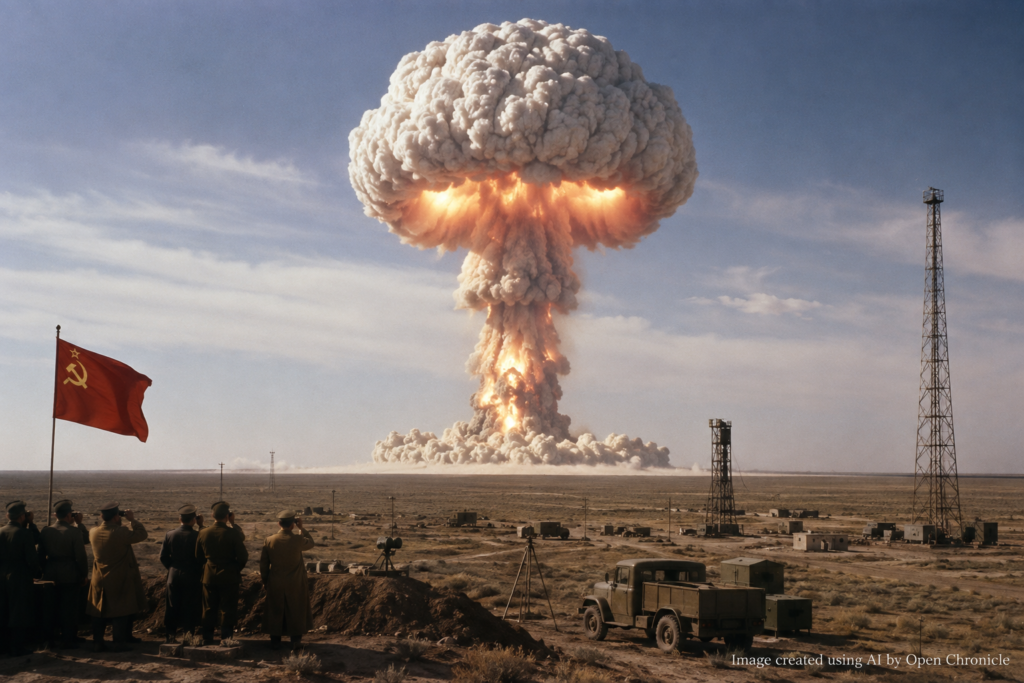
On the morning of August 29, 1949, a powerful explosion tore across the remote steppe of Soviet Kazakhstan.
At the Semipalatinsk Test Site, the Soviet Union had detonated its first atomic bomb.
The device was officially designated RDS 1.
To Soviet scientists and officials, it represented the culmination of an enormous secret programme conducted under extraordinary political pressure.
To the United States, which would later give the weapon the intelligence designation Joe 1, the explosion represented something even more consequential.
America’s nuclear monopoly was over.
Only four years had passed since the United States had detonated the world’s first nuclear device during the Trinity test in New Mexico and then used atomic bombs against Hiroshima and Nagasaki.
During those four years, nuclear weapons had transformed the international balance of power.
Washington possessed something no other government possessed: the ability to destroy an enemy city with a single bomb.
Many American officials expected that advantage to last considerably longer.
Instead, the Soviet Union reached the atomic threshold much sooner than anticipated.
The explosion of August 29, 1949, therefore represented far more than a technological achievement.
It transformed the emerging Cold War.
From that moment onward, any confrontation between the world’s two principal superpowers carried the possibility that both sides might eventually possess the ability to inflict catastrophic nuclear destruction upon the other.
The nuclear age had entered a new and more dangerous phase.
The Nuclear Age Begins
The road to Semipalatinsk began with discoveries made decades earlier.
During the late nineteenth and early twentieth centuries, physicists transformed humanity’s understanding of matter.
Radioactivity was discovered.
The structure of the atom became clearer.
Scientists learned that enormous quantities of energy existed within atomic nuclei.
Then, in late 1938, German scientists Otto Hahn and Fritz Strassmann produced experimental results that were interpreted by Lise Meitner and Otto Frisch as nuclear fission.
The implications were extraordinary.
When certain heavy atomic nuclei split, they released energy and additional neutrons.
Those neutrons could potentially split other nuclei.
A chain reaction might become possible.
Physics had opened the theoretical path toward an entirely new kind of weapon.
War Accelerates Atomic Research
The discovery occurred as Europe approached the Second World War.
Nazi Germany’s expansion created immediate fears among scientists who understood the military implications of nuclear fission.
Could Hitler’s Germany build an atomic bomb?
In 1939, Albert Einstein, acting after discussions with physicist Leo Szilard, signed a famous letter to President Franklin D. Roosevelt warning that uranium could potentially be used to create extremely powerful bombs.
The United States gradually expanded nuclear research.
After America entered the war in December 1941, the effort accelerated dramatically.
The result became the Manhattan Project.
The Manhattan Project
The Manhattan Project was one of the largest secret scientific and industrial programmes in history.
Under the military leadership of General Leslie Groves and the scientific direction of physicist J. Robert Oppenheimer, the United States constructed an enormous network of laboratories and industrial facilities.
Oak Ridge in Tennessee worked on uranium enrichment.
Hanford in Washington produced plutonium.
Los Alamos in New Mexico became the centre for weapon design.
Scientists from the United States worked alongside refugees and researchers from Europe.
The scale was unprecedented.
Entire industrial complexes were created in secrecy.
Billions of dollars were spent.
Tens of thousands of people worked on different parts of a project whose ultimate purpose many did not fully understand.
By 1945, the weapon was ready.
Trinity
At 5:29 a.m. on July 16, 1945, the first nuclear device in history exploded at the Trinity test site in New Mexico.
The weapon was a plutonium implosion device.
The desert briefly became brighter than daylight.
A mushroom cloud climbed into the atmosphere.
The test demonstrated that the theoretical weapon had become reality.
Human beings had released nuclear energy explosively on a scale never previously achieved.
Less than a month later, nuclear weapons would be used in war.
Hiroshima and Nagasaki
On August 6, 1945, an American B 29 bomber dropped a uranium bomb called Little Boy on Hiroshima.
The city was devastated.
Tens of thousands died immediately.
Many more died later from burns, injuries and radiation exposure.
Three days later, on August 9, another B 29 dropped the plutonium implosion weapon Fat Man on Nagasaki.
Again, enormous destruction followed.
Japan announced its intention to surrender on August 15.
The formal surrender followed on September 2.
The Second World War was over.
But a new strategic era had begun.
Stalin Already Knew
For Soviet leader Joseph Stalin, the existence of the American atomic programme was not entirely unexpected.
At the Potsdam Conference in July 1945, President Harry S. Truman informed Stalin that the United States possessed a new weapon of unusual destructive power.
Truman later recalled that Stalin appeared remarkably calm.
There was a reason.
Soviet intelligence had already penetrated the Manhattan Project.
Moscow possessed information about American nuclear research long before Truman’s conversation with Stalin.
The atomic secret was not as secret as Washington believed.
The Soviet Atomic Programme
The Soviet Union had its own tradition of advanced physics.
Soviet scientists had followed developments in nuclear research before the war.
But the German invasion of the Soviet Union in June 1941 forced the country to devote enormous resources to immediate survival.
The conflict on the Eastern Front was catastrophic.
Cities were destroyed.
Industry was relocated.
Millions died.
Scientific resources were redirected toward wartime requirements.
Even so, Soviet authorities gradually became increasingly aware that Britain and the United States were pursuing nuclear weapons.
Intelligence reports provided important evidence.
In 1943, the Soviet government formally intensified its atomic bomb programme.
Igor Kurchatov
Scientific leadership of the Soviet programme was entrusted to Igor Kurchatov.
Born in 1903, Kurchatov had developed expertise in nuclear physics before the war.
He would become the central scientific figure in the Soviet atomic project.
Kurchatov had to coordinate an enormous range of challenges.
Theoretical physics.
Reactor construction.
Uranium mining.
Plutonium production.
Metallurgy.
Explosives.
Instrumentation.
Weapon design.
The Soviet Union possessed outstanding scientists.
But building a bomb required much more than scientific understanding.
It required an entire nuclear industrial infrastructure.
Lavrentiy Beria
Political oversight was entrusted to one of the most feared men in Stalin’s Soviet Union.
Lavrentiy Beria, head of the Soviet security apparatus and a powerful figure within the regime, was given responsibility for supervising the atomic project.
His involvement demonstrated the importance Stalin attached to the programme.
It also created an atmosphere of enormous pressure.
Resources could be mobilised rapidly.
Industrial priorities could be overridden.
Scientists and engineers received access to whatever the state could provide.
But failure carried potentially terrifying consequences.
The Soviet atomic bomb was being developed inside a dictatorship shaped by Stalinist repression.
Scientific achievement and political coercion existed side by side.
The Intelligence War
One of the most controversial aspects of the Soviet bomb concerns espionage.
Soviet intelligence obtained important information from individuals connected with Western nuclear research.
Among the most significant was Klaus Fuchs.
Fuchs was a German born physicist who fled Nazi Germany and eventually worked on the British and American atomic programmes.
While participating in the Manhattan Project, he secretly supplied nuclear information to the Soviet Union.
His information included important details about plutonium implosion weapon design.
Other espionage networks also contributed intelligence.
Klaus Fuchs
Fuchs’s espionage was particularly valuable because he possessed genuine technical expertise.
He understood what he was transmitting.
The information did not eliminate the need for Soviet scientific research.
Nor did espionage simply hand Moscow a completed bomb.
The Soviet Union still had to construct reactors, produce fissile material, develop industrial processes, manufacture components and solve numerous engineering problems.
But intelligence could identify successful approaches.
It could prevent wasted effort.
It could confirm that certain designs worked.
And it could significantly reduce uncertainty.
In a project where years mattered strategically, that was enormously important.
The Rosenberg Network
American investigations later exposed broader Soviet espionage networks.
Julius Rosenberg became associated with efforts to transmit military and atomic information to the Soviet Union.
His wife, Ethel Rosenberg, was also prosecuted.
Both were convicted of conspiracy to commit espionage and executed in 1953.
Their case became one of the most controversial episodes of early Cold War America.
Later archival evidence strengthened the case that Julius Rosenberg had participated in Soviet espionage.
Debate surrounding Ethel’s precise role has remained much more complicated.
The case illustrates how the Soviet atomic breakthrough contributed not only to international strategic competition but also to political fear inside the United States.
Building the Soviet Nuclear Industry
Espionage alone could not create a nuclear arsenal.
The Soviet Union needed fissile material.
That required enormous industrial investment.
Uranium had to be located and processed.
Reactors had to be constructed.
Plutonium had to be chemically separated.
Highly specialised materials had to be manufactured.
Entire secret cities emerged.
One of the most important centres was Chelyabinsk 40, later associated with the Mayak nuclear complex in the southern Urals.
There, the Soviet Union constructed plutonium production reactors and processing facilities.
The project demanded enormous labour.
Some construction involved prisoners from the Gulag system.
The Soviet nuclear programme therefore combined elite scientific achievement with the coercive structures of the Stalinist state.
Plutonium
RDS 1 was a plutonium implosion weapon.
Plutonium presented difficult engineering challenges.
A simple gun type assembly, similar to the design used for the uranium bomb dropped on Hiroshima, was unsuitable for reactor produced plutonium.
Instead, the material had to be compressed extremely rapidly and symmetrically.
Conventional explosives arranged around the plutonium core had to detonate with extraordinary precision.
The implosion increased density and drove the material into a supercritical state.
A nuclear chain reaction followed.
The physics occurred in fractions of a second.
The engineering required years of work.
Similarity to Fat Man
RDS 1 closely resembled the American Fat Man design.
That was not accidental.
Soviet scientists possessed intelligence about the American plutonium implosion weapon.
Stalin and Beria wanted certainty.
A proven design reduced technological risk.
Some Soviet scientists might have preferred alternative approaches or more original designs.
But the political priority was straightforward.
The Soviet Union needed a working atomic bomb as quickly as possible.
Innovation could come later.
The first objective was to end American nuclear superiority.
The Semipalatinsk Test Site
A remote region of the Kazakh Soviet Socialist Republic was selected for nuclear testing.
The site was located on the steppe near Semipalatinsk, today known as Semey.
Its official designation was secret.
It would eventually become one of the principal nuclear testing grounds of the Soviet Union.
The landscape appeared ideal from the perspective of military planners.
It was vast.
It was remote.
It was far from the Soviet Union’s major cities.
But it was not empty.
Communities lived in the wider region.
The consequences of decades of nuclear testing would eventually become a major human and environmental tragedy.
Preparing RDS 1
By 1949, the Soviet programme was ready for its first test.
The device was assembled and transported to the test area.
A tower approximately 30 metres high was constructed.
The bomb was placed at the top.
Around the test site, Soviet scientists created structures and positioned equipment to study the effects of the explosion.
Buildings were constructed.
Military equipment was placed at various distances.
Aircraft, vehicles and other objects could be exposed to the blast.
Animals were also used in experiments.
The Soviet government wanted more than confirmation that the bomb worked.
It wanted data about what nuclear weapons could do.
August 29, 1949
The test took place early on August 29.
RDS 1 detonated successfully.
A brilliant flash illuminated the steppe.
The fireball expanded.
A shockwave raced outward.
Structures near ground zero were destroyed.
A mushroom cloud rose above the test area.
The explosive yield was approximately 22 kilotons of TNT.
The result was close to the scale expected from the design.
The Soviet Union had entered the nuclear club.
Only one other country belonged to it.
A Secret Victory
There was no immediate public celebration.
The test was secret.
Stalin’s government did not announce to the world that it had detonated an atomic bomb.
Soviet officials understood that the strategic significance of the weapon did not require publicity.
The bomb existed.
That was enough.
But nuclear explosions are difficult to hide completely.
Radioactive material entered the atmosphere.
The United States had developed systems intended to detect evidence of Soviet nuclear testing.
Soon, American aircraft found what Washington had feared.
The WB 29 Detection
In early September 1949, a United States Air Force reconnaissance aircraft collected atmospheric samples over the North Pacific.
Analysis revealed radioactive products consistent with a recent nuclear explosion.
Additional evidence followed.
American scientists examined the data.
The conclusion became increasingly difficult to avoid.
The Soviet Union had tested an atomic weapon.
The intelligence shocked Washington.
Earlier Than Expected
American estimates of Soviet progress had varied.
Some officials believed Moscow remained years away from an atomic bomb.
The August test demonstrated that those assumptions were dangerously optimistic.
The strategic timetable had suddenly accelerated.
The United States no longer possessed an exclusive weapon.
Military planning had to change.
Diplomacy had to change.
Civil defence had to change.
The political psychology of the Cold War had to change.
Truman Announces the Soviet Bomb
On September 23, 1949, President Harry Truman issued a statement.
The United States, he announced, possessed evidence that an atomic explosion had occurred in the Soviet Union during recent weeks.
The wording was restrained.
The implications were enormous.
The American public learned that the nuclear monopoly was over.
For four years, the atomic bomb had represented unmatched American military power.
Now the principal geopolitical rival of the United States possessed the same fundamental technology.
The Cold War had become nuclear.
Joe 1
American intelligence referred to the Soviet test as Joe 1, a reference to Joseph Stalin.
The informal designation reflected the highly personalised Western image of the Soviet regime.
But the weapon was more than Stalin’s bomb.
It represented a vast Soviet scientific, industrial and intelligence effort.
Thousands of people had contributed.
Scientists.
Engineers.
Factory workers.
Military personnel.
Intelligence officers.
Prison labourers.
Administrators.
The project demonstrated the ability of the Soviet state to concentrate extraordinary resources on a strategic objective.
The Cold War Before RDS 1
By 1949, relations between the former wartime Allies had already deteriorated dramatically.
The wartime partnership against Nazi Germany had collapsed.
The Soviet Union dominated much of Eastern Europe.
Communist governments had emerged across the region.
Winston Churchill had described an Iron Curtain descending across Europe.
The Truman Doctrine had committed the United States to resisting communist expansion.
The Marshall Plan was rebuilding Western European economies.
Germany had become a central battleground of the emerging confrontation.
In 1948, Stalin attempted to pressure the Western powers out of West Berlin through the Berlin Blockade.
The Western Allies responded with the Berlin Airlift.
In April 1949, the United States, Canada and Western European states created NATO.
The world was already divided.
RDS 1 made that division far more dangerous.
The Nuclear Monopoly Had Mattered
Between 1945 and 1949, the United States possessed nuclear weapons while the Soviet Union did not.
The practical value of that monopoly should not be exaggerated.
America’s early nuclear arsenal was relatively small.
Bombs were complicated to assemble and deliver.
Strategic planning remained under development.
Nuclear weapons did not allow Washington simply to dictate Soviet policy.
Stalin challenged Western interests despite America’s atomic advantage.
But the monopoly still mattered.
In an extreme crisis, only one side possessed atomic weapons.
After August 29, that fundamental asymmetry began to disappear.
Washington Faces a Choice
The Soviet test triggered an intense debate within the United States.
Should America concentrate on building more atomic bombs?
Should it seek international arms control?
Should it develop an even more powerful weapon?
Scientists had already considered the possibility of using nuclear fusion to produce a bomb vastly more destructive than the fission weapons used at Hiroshima and Nagasaki.
The Soviet breakthrough gave that debate new urgency.
The result would be the hydrogen bomb.
Edward Teller and the Super
Physicist Edward Teller became one of the strongest advocates of developing a thermonuclear weapon, often called the Super.
Unlike an atomic bomb based primarily on nuclear fission, a hydrogen bomb would use nuclear fusion.
The theoretical destructive potential was vastly greater.
Some scientists opposed or questioned the project.
Oppenheimer was among those who expressed serious reservations.
The debate was scientific, strategic and moral.
Was there any meaningful limit to the destructive power humanity should create?
The Cold War increasingly answered that question through competition.
Truman Orders the Hydrogen Bomb
On January 31, 1950, President Truman announced that the United States would proceed with development of the hydrogen bomb.
The decision accelerated the nuclear arms race.
The Soviet Union was pursuing thermonuclear research as well.
The logic was becoming familiar.
If one side might develop a more powerful weapon, the other feared being left behind.
Security required more weapons.
More weapons created greater insecurity.
That paradox would define the nuclear age.
The Chinese Revolution
RDS 1 was not the only geopolitical shock confronting Washington in 1949.
On October 1, Mao Zedong proclaimed the People’s Republic of China after communist forces won the Chinese Civil War.
Within little more than a month, American policymakers had witnessed two enormous developments.
The Soviet Union possessed the atomic bomb.
China had become communist.
For many Americans, the global balance appeared to be shifting dramatically.
Political pressure intensified.
Questions about espionage, loyalty and communist influence moved toward the centre of domestic politics.
The Korean War
Then came war.
On June 25, 1950, North Korean forces invaded South Korea.
The Korean War transformed Cold War strategy.
The United States and other United Nations forces intervened.
China later entered the conflict.
The Soviet Union supported the communist side without openly sending conventional armies into direct combat against the United States.
Nuclear weapons existed in the background.
American officials considered possible nuclear use at various moments.
But the bomb was not used.
The Korean War demonstrated something crucial.
Even in the nuclear age, conventional wars could occur beneath the threshold of atomic conflict.
NSC 68
The strategic atmosphere surrounding the Soviet nuclear breakthrough also contributed to the development of NSC 68, a major American policy document completed in 1950.
It portrayed the Soviet challenge in stark terms and recommended a substantial expansion of American military power.
The Korean War accelerated implementation of those recommendations.
Defence spending increased dramatically.
The United States expanded conventional and nuclear forces.
The Cold War became increasingly militarised.
The Soviet Hydrogen Bomb
The nuclear competition continued rapidly.
The United States conducted its first full scale thermonuclear test, Ivy Mike, in November 1952.
The explosion produced a yield measured in megatons rather than kilotons.
An entire island at the test site was effectively destroyed.
The Soviet Union soon demonstrated its own thermonuclear capability.
The strategic competition had entered another level.
Weapons thousands of times more powerful than conventional bombs were becoming central instruments of national security.
From Bombs to Arsenals
RDS 1 was a single device.
The true transformation came when nuclear weapons became arsenals.
Both superpowers began producing bombs in increasing numbers.
Delivery systems improved.
Long range bombers could carry nuclear weapons across continents.
Then ballistic missiles transformed strategy again.
Intercontinental ballistic missiles could reach targets in minutes.
Submarines carrying nuclear missiles could hide beneath the oceans.
By the 1960s, both superpowers were developing what became known as the nuclear triad.
Bombers.
Land based missiles.
Submarine launched missiles.
Destroying an opponent’s nuclear forces in a surprise attack became increasingly difficult.
That created the foundations of nuclear deterrence.
Mutual Assured Destruction
Eventually, both the United States and Soviet Union possessed enough survivable nuclear weapons to destroy each other even after absorbing a first strike.
This strategic condition became associated with Mutual Assured Destruction, commonly abbreviated MAD.
The logic was horrifying but powerful.
If attacking the enemy guaranteed your own destruction, rational leaders should avoid nuclear war.
Nuclear weapons therefore became instruments whose greatest strategic purpose was supposedly to prevent their own use.
Peace rested partly upon the certainty of catastrophe.
The road to that paradox began when nuclear monopoly ended in 1949.
The Arms Race
The numbers became extraordinary.
During the Cold War, the United States and Soviet Union eventually accumulated tens of thousands of nuclear warheads.
Weapons existed for strategic targets.
Battlefield weapons were developed.
Nuclear artillery shells appeared.
Air defence systems carried nuclear warheads.
Submarines carried multiple ballistic missiles.
Bombers remained on alert.
Missile silos stood ready.
Entire military institutions were created around nuclear war.
Human civilisation developed the technical capacity to destroy cities on a scale previously unimaginable.
Nuclear Testing Expands
Weapons development required testing.
The United States conducted tests in Nevada and the Pacific.
The Soviet Union continued testing at Semipalatinsk and later at Novaya Zemlya.
Britain, France and China developed nuclear weapons of their own.
Atmospheric explosions sent radioactive material around the world.
Fallout entered soil, water and food chains.
Public concern increased.
Nuclear testing was no longer simply a military matter.
It became an environmental and public health issue.
The People of Semipalatinsk
For communities living near the Soviet test site, the nuclear arms race had immediate consequences.
The Semipalatinsk region would experience hundreds of Soviet nuclear tests between 1949 and 1989.
Many early tests were conducted above ground or in the atmosphere.
Local populations were exposed to radiation.
The Soviet system provided little public transparency.
People often did not understand the risks they faced.
Later studies documented serious health concerns in affected communities.
Cancer.
Birth defects.
Radiation related illnesses.
Psychological trauma.
Environmental contamination.
The first Soviet bomb was a strategic triumph for Moscow.
For many people in Kazakhstan, the test programme became a multigenerational tragedy.
Kazakhstan and Nuclear Memory
After the Soviet Union collapsed in 1991, independent Kazakhstan inherited part of the Soviet nuclear infrastructure.
President Nursultan Nazarbayev had already ordered the Semipalatinsk nuclear test site closed on August 29, 1991, exactly 42 years after the first Soviet test.
The date acquired new meaning.
What had begun as a celebration of Soviet nuclear power became associated with opposition to nuclear testing.
Kazakhstan subsequently relinquished the nuclear weapons left on its territory after the Soviet collapse.
The country has since made nuclear disarmament an important part of its international identity.
International Day Against Nuclear Tests
The United Nations later designated August 29 as the International Day against Nuclear Tests.
The symbolism is deliberate.
The anniversary of RDS 1 now serves as a reminder of the human and environmental consequences of nuclear testing.
A date once associated with the beginning of Soviet nuclear power has therefore acquired a second historical meaning.
It commemorates the effort to prevent repetition.
Nuclear Espionage and the Red Scare
Back in the United States, the Soviet atomic breakthrough intensified fears of internal betrayal.
How had Moscow built the bomb so quickly?
Espionage investigations accelerated.
Klaus Fuchs was arrested in Britain in 1950.
His confession contributed to investigations that eventually reached Julius and Ethel Rosenberg.
At the same time, American politics entered the period associated with the Second Red Scare.
Senator Joseph McCarthy exploited fears of communist infiltration.
Government employees faced loyalty investigations.
Careers were destroyed.
Accusations spread through politics, entertainment and academia.
The Soviet bomb contributed to an atmosphere in which international insecurity and domestic suspicion reinforced each other.
Civil Defence
The end of nuclear monopoly also changed everyday life.
American civilians increasingly encountered the possibility of nuclear attack.
Governments developed civil defence programmes.
Schools conducted drills.
Public information films explained what citizens should do during an atomic explosion.
Fallout shelters became part of political discussion.
Cities planned evacuation procedures.
Families considered building private shelters.
The atomic bomb moved from distant battlefields into the imagination of ordinary life.
The Soviet Union developed its own civil defence systems.
Both societies learned to live beneath the possibility of annihilation.
The Bomber Gap
Strategic uncertainty repeatedly generated fears that the other side possessed a decisive advantage.
During the 1950s, some American officials worried about a supposed bomber gap favouring the Soviet Union.
Later came fears of a missile gap.
Intelligence eventually demonstrated that some of these fears had been exaggerated.
But uncertainty itself drove competition.
Neither side could safely assume the other was weaker.
Both prepared for worst case scenarios.
The nuclear arms race became partly an arms race against uncertainty.
Sputnik
In October 1957, the Soviet Union launched Sputnik 1, the world’s first artificial satellite.
The achievement shocked the United States.
Sputnik demonstrated Soviet scientific capability.
More importantly from a military perspective, the rocket technology required to place a satellite in orbit was closely related to technology capable of delivering nuclear warheads across intercontinental distances.
The nuclear competition had entered the missile age.
Geography could no longer provide the United States with the protection offered by two oceans.
The Cuban Missile Crisis
The most dangerous moment of the nuclear Cold War came in October 1962.
The Soviet Union secretly deployed nuclear capable missiles to Cuba.
American reconnaissance discovered them.
President John F. Kennedy imposed a naval quarantine.
For thirteen days, the United States and Soviet Union confronted each other directly.
Military forces moved to extraordinary levels of readiness.
Nuclear war appeared possible.
Eventually, Soviet leader Nikita Khrushchev agreed to withdraw the missiles in exchange for American commitments concerning Cuba and the later secret removal of American Jupiter missiles from Turkey.
The world stepped away from catastrophe.
The crisis demonstrated what the nuclear balance created after 1949 could mean in practice.
Arms Control
Fear also produced negotiation.
The Cuban Missile Crisis strengthened recognition that uncontrolled nuclear competition could destroy both sides.
In 1963, the United States, Soviet Union and Britain signed the Partial Nuclear Test Ban Treaty, prohibiting nuclear tests in the atmosphere, outer space and underwater.
Later agreements attempted to limit strategic weapons.
The Nuclear Non Proliferation Treaty opened for signature in 1968.
The Strategic Arms Limitation Talks produced agreements in the 1970s.
The Intermediate Range Nuclear Forces Treaty of 1987 eliminated an entire category of American and Soviet missiles.
Arms control did not end nuclear competition.
It represented an attempt to manage a danger neither side could escape.
Hiroshima and Semipalatinsk
Hiroshima and Semipalatinsk occupy very different places in nuclear history.
Hiroshima was a city destroyed in war.
Semipalatinsk was a weapons testing ground.
But together they illustrate the transformation that occurred between 1945 and 1949.
In 1945, one country possessed the bomb and used it against an enemy that did not.
By 1949, the world’s two emerging superpowers possessed nuclear technology.
The strategic meaning of the weapon had changed.
The bomb was no longer simply an instrument of destruction.
It was becoming an instrument of deterrence, diplomacy, prestige and geopolitical power.
Did Espionage Build the Soviet Bomb?
The question remains historically important.
Without espionage, would the Soviet Union have built an atomic bomb?
Almost certainly.
The Soviet Union possessed exceptional physicists and enormous industrial resources.
The fundamental physics of nuclear fission was internationally known.
A determined major power could eventually reproduce the technology.
The more difficult question is how much time espionage saved.
Information from the Manhattan Project clearly helped Soviet scientists understand American design choices and avoid some uncertainties.
RDS 1 deliberately followed a proven American plutonium implosion design.
Espionage accelerated the programme.
But the achievement still required an enormous indigenous scientific and industrial effort.
Reducing the Soviet bomb to stolen secrets misunderstands both the scale of nuclear engineering and the capabilities of Soviet science.
Stalin’s Strategic Achievement
For Stalin, the successful test solved an urgent strategic problem.
The Soviet Union had emerged from the Second World War victorious but devastated.
Millions of Soviet citizens had died.
Large areas of the western USSR had been destroyed.
Yet the country faced a United States possessing unprecedented industrial strength and nuclear weapons.
Stalin could not tolerate permanent American nuclear superiority.
RDS 1 demonstrated that the Soviet state could close the technological gap.
The price was enormous.
But from the perspective of Soviet strategy, the alternative appeared unacceptable.
Nuclear Weapons and Great Power Status
The Soviet test also established a pattern that would continue throughout the twentieth century.
Nuclear weapons became associated with great power status.
Britain tested its first atomic weapon in 1952.
France followed in 1960.
China tested its first nuclear device in 1964.
Other states later developed nuclear arsenals.
Possession of nuclear weapons provided more than destructive capability.
It conveyed political prestige.
It promised deterrence.
It signalled technological sophistication.
It could compensate for conventional military weakness.
RDS 1 therefore helped establish the nuclear weapon as one of the defining symbols of modern state power.
Science Under Dictatorship
The Soviet atomic project also raises difficult questions about the relationship between science and political systems.
Scientists such as Kurchatov achieved extraordinary technical results.
But they worked inside a state capable of extreme coercion.
Beria’s security apparatus supervised the project.
Prison labour contributed to parts of the nuclear industrial system.
Secrecy concealed environmental and health consequences.
Success brought rewards.
Failure could carry severe personal danger.
The bomb demonstrates how scientific brilliance can coexist with political repression.
Technological achievement does not tell us whether the system producing it was humane.
The Environmental Legacy
The Cold War nuclear competition left environmental scars across the planet.
Semipalatinsk.
Nevada.
Bikini Atoll.
Enewetak.
Novaya Zemlya.
Lop Nur.
French Polynesia.
Algeria.
Testing grounds became laboratories of nuclear power.
Nearby populations often carried risks they had not chosen.
Indigenous communities were displaced.
Soldiers participated in exercises near nuclear explosions.
Radioactive fallout travelled far beyond national borders.
The history of nuclear weapons is therefore not only a history of presidents, generals and physicists.
It is also a history of communities exposed to the consequences of decisions made elsewhere.
The Bomb That Was Never Supposed to Be Used
As arsenals grew, an extraordinary strategic paradox emerged.
The most powerful weapons ever created became weapons whose use policymakers increasingly hoped to avoid.
Their value depended upon credibility.
An adversary had to believe they could be used.
Yet actual use against another nuclear power might produce retaliation and national destruction.
Nuclear strategy therefore developed elaborate concepts.
First strike.
Second strike.
Counterforce.
Countervalue.
Extended deterrence.
Launch on warning.
Escalation.
Each attempted to impose rational structure upon weapons capable of catastrophic destruction.
The origin of that strategic world can be traced directly to the disappearance of monopoly in 1949.
The End of the Soviet Union
The Cold War lasted another four decades.
Then the political system that created RDS 1 disappeared.
In 1991, the Soviet Union collapsed.
The Russian Federation inherited most of the Soviet nuclear arsenal.
Belarus, Kazakhstan and Ukraine also found Soviet nuclear weapons on their territories before eventually transferring or relinquishing them under post Soviet arrangements.
The ideological confrontation between Washington and Moscow had ended.
The nuclear weapons remained.
That fact revealed one of the deepest legacies of August 29.
Political systems can disappear much faster than nuclear arsenals.
August 29 in Historical Memory
August 29 now carries two opposing meanings.
In 1949, it represented technological achievement and strategic power for the Soviet Union.
In Kazakhstan today, it also represents the suffering associated with nuclear testing.
Internationally, it has become a day dedicated to opposition to nuclear tests.
The transformation is striking.
The same date can commemorate both the acquisition of nuclear power and the human desire to control it.
History often works this way.
Events acquire meanings their original participants could not have anticipated.
Why August 29 Matters
The explosion at Semipalatinsk lasted only moments.
Its consequences have lasted generations.
Before August 29, 1949, the nuclear world was unequal.
The United States possessed atomic weapons.
The Soviet Union did not.
After the test, that fundamental fact began to change.
RDS 1 did not instantly create nuclear parity.
America still possessed a larger arsenal, more experience and superior delivery capabilities.
But monopoly had ended.
And once monopoly ended, the strategic logic of nuclear weapons changed permanently.
The United States accelerated its weapons programmes.
The hydrogen bomb followed.
The Soviet Union responded.
Bombers multiplied.
Missiles crossed continents.
Nuclear submarines disappeared beneath the oceans.
Warheads grew more powerful and more numerous.
Governments built shelters.
Children practised civil defence drills.
Scientists designed weapons capable of destroying cities they would never see.
Strategists attempted to calculate how civilisation might survive a war that could unfold in minutes.
Eventually, the ability of both superpowers to destroy one another became one of the foundations of international security.
That extraordinary contradiction defined the Cold War.
Peace through the threat of annihilation.
But August 29 also has another history.
It belongs to the people who lived around Semipalatinsk.
For them, the Soviet nuclear programme was not an abstract balance of power.
It was radiation.
It was contaminated land.
It was illness.
It was secrecy.
It was a legacy inherited by later generations.
The mushroom cloud over the Kazakh steppe therefore represents both technological achievement and human cost.
RDS 1 demonstrated that the Soviet Union had mastered one of the most difficult technologies of the twentieth century.
It also ensured that humanity would never again live in a world where only one great power possessed the atomic bomb.
From that morning onward, the central question of the nuclear age was no longer simply who possessed the weapon.
It was whether rival powers possessing it could prevent themselves from ever using it against each other.
More than seven decades later, that question has not disappeared.