
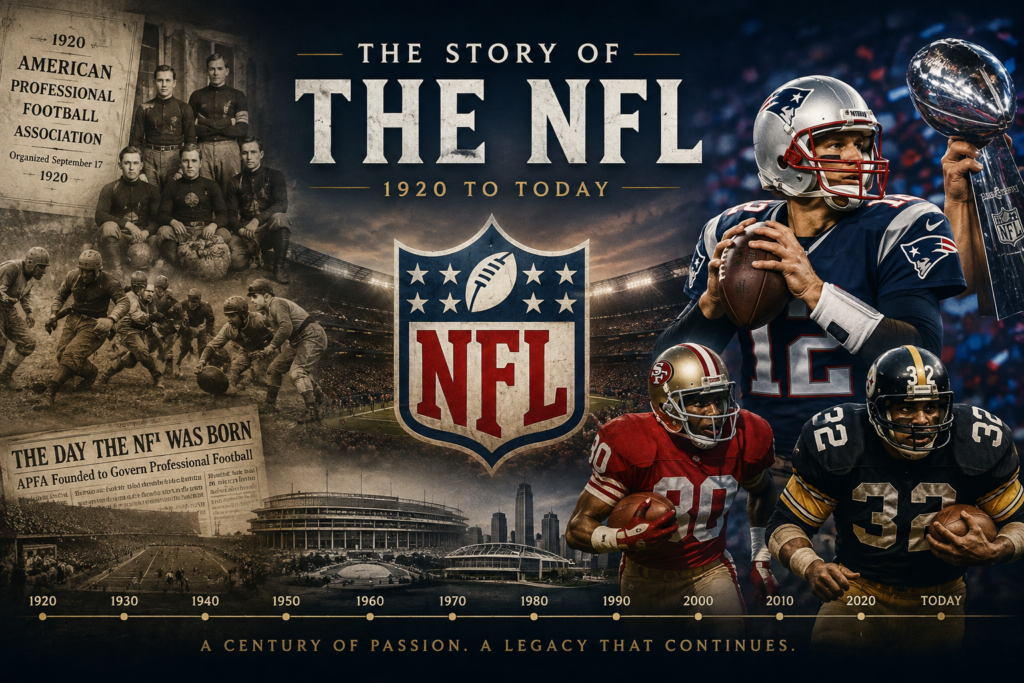
From Its Origins to a Global Sports Institution
By Open Chronicle Sports
There was no Super Bowl. No television spectacle. No billion dollar stadiums. No international games in London, Munich, Madrid or Melbourne.
Some teams appeared and disappeared, players who often worked other jobs, uncertain schedules, modest crowds and a professional game still searching for legitimacy.
From those beginnings emerged the National Football League.
More than a century later, the NFL stands at the centre of American sporting culture and increasingly reaches far beyond the United States. Its championship game has become one of the defining events of the global sports calendar, its franchises are among the most recognisable teams in professional sport, and its players have become part of popular culture.
Yet the road from the improvised fields of early professional football to the modern NFL was neither inevitable nor straightforward.
It is a story of survival, reinvention, rivalry, television, expansion and an extraordinary ability to turn a game into an institution.
Before the NFL
American football developed during the nineteenth century from forms of rugby and association football played at American universities.
College football became the game’s great early institution. Schools built traditions, rivalries and passionate audiences long before professional football acquired comparable prestige.
Professionalism nevertheless began to emerge.
One of the most famous early milestones occurred on November 12, 1892, when William “Pudge” Heffelfinger was paid $500 to play for the Allegheny Athletic Association against the Pittsburgh Athletic Club.
The payment is generally recognised as a landmark in the history of professional American football.
But professional football remained fragmented.
For decades, teams operated independently, particularly across Pennsylvania, Ohio and the industrial Midwest. Clubs competed for players, schedules could be chaotic and financial stability was never guaranteed.
The sport needed organisation.
That need eventually brought a group of football men together in Canton, Ohio.
1920: A League Is Born
On September 17, 1920, representatives of professional football teams gathered inside the Hupmobile automobile showroom owned by Canton Bulldogs owner Ralph Hay.
The surroundings were modest.
The ambition was not.
The meeting produced the American Professional Football Association, the organisation from which the modern NFL would emerge.
Among the teams represented were the Canton Bulldogs, Decatur Staleys, Chicago Cardinals, Akron Pros, Dayton Triangles and Rock Island Independents.
One of the most important figures associated with the new organisation was Jim Thorpe.
Already one of the most famous athletes in America, Thorpe became the league’s first president. His reputation gave professional football something it desperately needed: credibility.
The Akron Pros became the first champions after finishing the 1920 season undefeated.
But the league was still far removed from the NFL that would eventually dominate American sport.
Teams came and went. Financial problems remained common. Franchises relocated. Crowds were inconsistent.
Survival itself was an achievement.
Becoming the National Football League
In 1922, the American Professional Football Association adopted a new name.
The National Football League.
The change was more significant than a simple rebranding.
The word “National” expressed an ambition to move beyond professional football’s regional origins and establish a major league capable of representing the sport across the United States.
Two franchises from those formative years still survive.
The Decatur Staleys moved to Chicago and became the Chicago Bears.
The Chicago Cardinals eventually travelled through St. Louis before becoming today’s Arizona Cardinals.
Their survival provides a direct connection between the improvised world of early professional football and the modern NFL.
Other franchises would gradually become institutions in their own right.
The Green Bay Packers, founded in 1919, developed one of the most unusual ownership structures in professional sport and became inseparable from the identity of their Wisconsin community.
The New York Giants helped establish the league in the country’s largest media market.
Teams such as the Bears, Packers and Giants began creating the rivalries, traditions and mythology upon which the NFL would build.
The Game Finds Its Identity
Professional football gradually separated itself from the college game.
Rules evolved. Passing became increasingly important. Offensive systems became more sophisticated. Coaches developed new formations and tactical concepts.
The NFL also learned that professional sport required personalities.
Stars gave supporters reasons to care beyond the final score.
Red Grange became one of the game’s first major attractions during the 1920s.
Sammy Baugh demonstrated the possibilities of the forward pass.
Don Hutson transformed expectations of what a receiver could accomplish.
Sid Luckman helped redefine quarterback play.
The league was slowly developing its own heroes.
It was also building something equally important: continuity.
Fans increasingly followed franchises across seasons and generations. Team identities became connected to cities, families and communities.
Professional football was becoming tradition.
War, Expansion and a Changing America
The Second World War placed enormous pressure on professional football.
Players entered military service, teams struggled with manpower shortages and some franchises temporarily merged simply to survive.
Yet the league endured.
After the war, the United States entered a period of enormous economic, demographic and technological change.
Television entered millions of homes.
Suburban America expanded.
Mass consumer culture transformed entertainment.
Professional football was extraordinarily well positioned for this new world.
The rectangular field translated naturally to television. Plays produced short bursts of action separated by pauses that allowed broadcasters to explain strategy, show replays and eventually accommodate commercial breaks.
Football became not merely a stadium experience but a television experience.
That transformation would change the NFL forever.
The Television Revolution
If one development explains the NFL’s rise from successful sports league to American cultural institution, television must occupy a central place.
Football proved almost perfectly suited to the medium.
The camera could bring viewers inside the game.
Close ups captured the violence and emotion of individual confrontations. Replays revealed tactical details that spectators in the stadium might miss. Commentary helped audiences understand increasingly complex formations and strategies.
The league also recognised the power of collective television agreements.
Rather than allowing the richest clubs to dominate broadcasting revenue completely, the NFL developed structures that helped distribute television income throughout the league.
Combined with other mechanisms intended to maintain competitive balance, this created one of professional sport’s most important characteristics: uncertainty.
Small market teams could compete with franchises from enormous cities.
A season could produce unexpected contenders.
Supporters entered each year believing that transformation was possible.
That competitive architecture became one of the NFL’s greatest strengths.
A Rival Appears
Success inevitably attracted competition.
In 1960, the American Football League began play.
The AFL was not merely another collection of struggling challengers. It competed aggressively for players, markets, television audiences and legitimacy.
New franchises appeared in cities and regions where professional football had enormous potential.
The rivalry became increasingly expensive as the leagues competed for talent.
But competition also accelerated innovation and growth.
Eventually, confrontation gave way to negotiation.
In 1966, the NFL and AFL announced plans to merge.
Before full integration was completed, the champions of the two leagues would meet in a new championship game.
At first, it was officially known as the AFL NFL World Championship Game.
History would remember it by a much simpler name.
The Birth of the Super Bowl
On January 15, 1967, the Green Bay Packers defeated the Kansas City Chiefs at the Los Angeles Memorial Coliseum.
It was the first game of what became the Super Bowl.
The significance of the event grew rapidly.
Green Bay won again the following season, apparently confirming the superiority of the established NFL.
Then came one of the most important games in American sports history.
Before Super Bowl III, New York Jets quarterback Joe Namath boldly guaranteed victory over the heavily favoured Baltimore Colts.
The Jets won 16 to 7.
The result gave the AFL enormous credibility and transformed Namath into a cultural icon.
When the merger was completed in 1970, the modern conference structure emerged around the American Football Conference and National Football Conference.
The Super Bowl became the destination toward which every season moved.
Eventually, it became far more than a championship game.
Sunday Becomes NFL Territory
During the 1970s and 1980s, professional football became deeply embedded in American weekly life.
Sunday afternoons belonged increasingly to the NFL.
Monday Night Football transformed a regular season game into prime time entertainment.
Franchises developed national followings.
The Pittsburgh Steelers built a dynasty around their Steel Curtain defence.
The Dallas Cowboys became “America’s Team.”
The Miami Dolphins completed the only perfect season in the Super Bowl era in 1972.
The Oakland Raiders cultivated a rebellious identity.
The San Francisco 49ers later combined Bill Walsh’s offensive ideas with the brilliance of Joe Montana.
The NFL was no longer simply selling football games.
It was selling characters, identities, rivalries and stories.
Every franchise represented something.
Every season created another chapter.
The Quarterback Era
No position came to symbolise modern professional football more than quarterback.
The position had always mattered, but increasingly sophisticated passing offences elevated quarterbacks into the central figures of NFL competition.
Johnny Unitas helped define the modern field general.
Joe Montana became synonymous with composure under pressure.
Dan Marino demonstrated extraordinary passing production.
John Elway combined arm strength with mobility and eventually championship success.
Brett Favre brought improvisation and aggression.
Peyton Manning turned the line of scrimmage into a tactical command centre.
Then came Tom Brady.
Selected with the 199th pick of the 2000 NFL Draft, Brady’s career became one of the most remarkable stories in professional sport.
Together with head coach Bill Belichick, he helped construct a New England Patriots dynasty that repeatedly adapted across two decades.
Seven Super Bowl victories eventually made Brady the most successful quarterback in the championship’s history.
Around him, the NFL entered an era increasingly defined by elite quarterback play.
The position became simultaneously athlete, strategist, leader and global celebrity.
The NFL Draft and the Promise of Renewal
One of the league’s most distinctive institutions is the NFL Draft.
Created in the 1930s to improve competitive balance, the draft evolved into a major event of its own.
Its principle is deceptively simple.
The weakest teams receive earlier opportunities to select the best incoming players.
The consequences can reshape franchises.
A single quarterback can transform a team’s future. A late round selection can become a legend. A celebrated prospect can fail completely.
The uncertainty makes the draft compelling.
For supporters of struggling teams, it also provides something essential to professional sport.
Hope.
Even before a new season begins, rebuilding has already started.
Dynasties and Changing Eras
NFL history can be understood through its dynasties.
The Green Bay Packers of Vince Lombardi established an early championship standard.
The Pittsburgh Steelers dominated much of the 1970s.
The San Francisco 49ers became one of the defining teams of the 1980s.
The Dallas Cowboys returned to dominance during the 1990s.
The New England Patriots constructed the defining dynasty of the early twenty first century.
Yet sustained dominance is difficult.
The salary cap, draft system, free agency and scheduling structure constantly work against permanent superiority.
Great teams age.
Coaches leave.
Players become expensive.
Injuries intervene.
Rivals copy successful ideas.
The NFL continually destroys its own hierarchies and creates new ones.
That cycle is fundamental to its appeal.
Football as Strategy
The apparent violence of American football can obscure its intellectual complexity.
At the highest level, the NFL is a contest of information.
Coaches study formations, personnel packages, tendencies and situations.
Quarterbacks read defensive structures before the snap.
Defenders disguise coverages.
Offensive coordinators attempt to manipulate space and create mismatches.
Defensive coordinators respond with pressure packages, substitutions and coverage variations.
Every play is simultaneously physical and tactical.
A game may turn on a confrontation between two linemen weighing more than 130 kilograms.
It may also turn on a quarterback recognising the position of a safety half a second before the ball is snapped.
The combination of physical confrontation and strategic complexity gives American football much of its distinctive character.
The Super Bowl Becomes a Cultural Event
Over time, the Super Bowl escaped the boundaries of sport.
It became a national ritual.
People who rarely watched football gathered for the game.
Advertising during the broadcast became an industry event.
The halftime show became one of the most prestigious stages in popular music.
Cities competed to host it.
Companies built campaigns around it.
Television networks treated it as premium programming.
For players, however, the fundamental meaning remained unchanged.
The Vince Lombardi Trophy represented the ultimate achievement in professional American football.
Decades of commercial expansion never removed the sporting simplicity at the centre of the spectacle.
Two teams.
One game.
One champion.
Beyond America
For most of its history, the NFL was overwhelmingly American in geography and culture.
That is changing.
The league experimented with games abroad for decades. Exhibition contests appeared in Canada, Japan, Britain, Germany and elsewhere.
A decisive milestone arrived in 2005 when the Arizona Cardinals and San Francisco 49ers played at Estadio Azteca in Mexico City.
It became the first NFL regular season game staged outside the United States.
Two years later, the NFL began its modern International Series in London.
The experiment developed into a long-term strategy.
London became an established NFL destination. Mexico remained an important market. Germany emerged as another major centre of European interest. Games subsequently reached Brazil, Spain and Ireland.
By the beginning of the 2026 season, 62 NFL regular season games had already been played outside the United States.
Then came the league’s most ambitious international season yet.
2026: A League Across Four Continents
The scale of the NFL’s transformation can perhaps be understood most clearly through its 2026 international schedule.
Nine regular season games are scheduled outside the United States, the largest international programme in league history.
Games are being staged across four continents, seven countries and eight stadiums.
London remains central to the strategy, while Madrid, Munich and Mexico City continue or renew their relationships with the league.
But the map is expanding.
Melbourne hosts the first NFL regular season game in Australia.
Paris joins the international schedule.
Rio de Janeiro brings the league to another of world sport’s great stadiums, the Maracanã.
What began in small American industrial communities has become a competition capable of taking meaningful regular season games to some of the world’s most famous sporting cities.
The symbolism is difficult to miss.
Building a Global Game
Playing games abroad is only one element of the NFL’s international strategy.
The league’s Global Markets Program allows individual franchises to develop commercial and fan relationships in specific countries.
By 2026, all 32 NFL clubs were participating, with rights distributed across 22 international markets.
Teams are therefore developing identities beyond their traditional American territories.
Supporters thousands of kilometres from Buffalo, Kansas City, Green Bay, Philadelphia or San Francisco can increasingly become part of those communities.
Digital media has accelerated the process.
A supporter no longer needs to live near an NFL city to follow a franchise every day.
Highlights, statistics, analysis, fantasy football, social media and streaming have removed much of the geographical distance that once separated American football from international audiences.
The NFL is becoming global without ceasing to be profoundly American.
Flag Football and the Next Frontier
Perhaps the most important sign of American football’s international ambitions does not involve the NFL itself.
It involves flag football.
The non-contact form of the game requires less equipment, can be introduced more easily in schools and communities, and provides a more accessible route into American football.
NFL Flag programmes have expanded internationally as part of the league’s broader development strategy.
The sport will reach another landmark at the 2028 Los Angeles Olympic Games, where flag football is scheduled to make its Olympic debut.
That development could have consequences extending far beyond a single tournament.
For generations, millions of international supporters experienced American football almost entirely as spectators.
Flag football creates the possibility that far more of them will experience it as players.
That distinction may prove crucial to the sport’s next century.
The League and Its Contradictions
The history of the NFL is not simply a story of uninterrupted triumph.
Professional football has repeatedly confronted difficult questions.
Player safety and the long term consequences of repeated head impacts have fundamentally changed discussions surrounding the sport.
Rules protecting quarterbacks and defenseless players have evolved.
Concussion protocols have become increasingly important.
Questions concerning race, ownership, coaching opportunities, protest, labour relations and the enormous physical cost borne by players have repeatedly entered the national conversation.
The NFL’s prominence ensures that its controversies rarely remain confined to sport.
The league reflects American society because it occupies such a visible place within it.
Its history contains extraordinary athletic achievement, commercial brilliance, and cultural influence, but also conflict and contradiction.
Understanding the NFL requires acknowledging all of them.
Why the NFL Endured
Many professional football leagues have existed.
Most disappeared.
The NFL survived because it repeatedly changed.
It embraced television.
It absorbed its strongest rival.
It created revenue structures that supported competitive balance.
It turned the draft into theatre.
It transformed its championship game into a cultural institution.
It adapted rules to changing styles of play.
It developed franchises into enduring brands.
And when the American market appeared mature, it increasingly looked toward the world.
The league that emerged from a Canton automobile showroom in 1920 would be almost unrecognisable to its founders today.
But one element remains familiar.
Competition.
Two teams still line up across the line of scrimmage.
The ball is still snapped.
Eleven players attempt to defeat eleven opponents through strength, speed, deception, discipline and strategy.
Everything surrounding that confrontation has changed enormously.
The confrontation itself remains the heart of the game.
From Canton to the World
The story of the NFL spans more than a century of American history.
It begins with unstable clubs travelling between industrial towns.
It passes through Jim Thorpe and George Halas, Lambeau and Lombardi, Unitas and Namath, the Steel Curtain and Montana, the Cowboys and the Patriots, Brady and Mahomes.
It passes through radio, black and white television, prime time broadcasts, cable networks, satellite television, streaming and social media.
It travels from Canton to Green Bay, Chicago, New York, Pittsburgh, Dallas, San Francisco and every city that has built its own football traditions.
And eventually it travels farther.
To Mexico City.
To London.
To Munich.
To Madrid.
To São Paulo.
To Melbourne, Paris and Rio de Janeiro.
The National Football League began because a group of professional football teams needed order.
More than a century later, they belong to a sporting institution whose championship is watched far beyond the country that created it and whose ambitions now extend across continents.
The NFL’s history is therefore more than the history of a league.
It is the story of how a rough, uncertain professional game survived long enough to become a tradition, how that tradition became a business, how that business became part of American culture, and how an institution once defined almost entirely by the United States began its attempt to become something larger.
A global game with unmistakably American roots.