
By Open Chronicle with agencies
Department: Europe | Politics
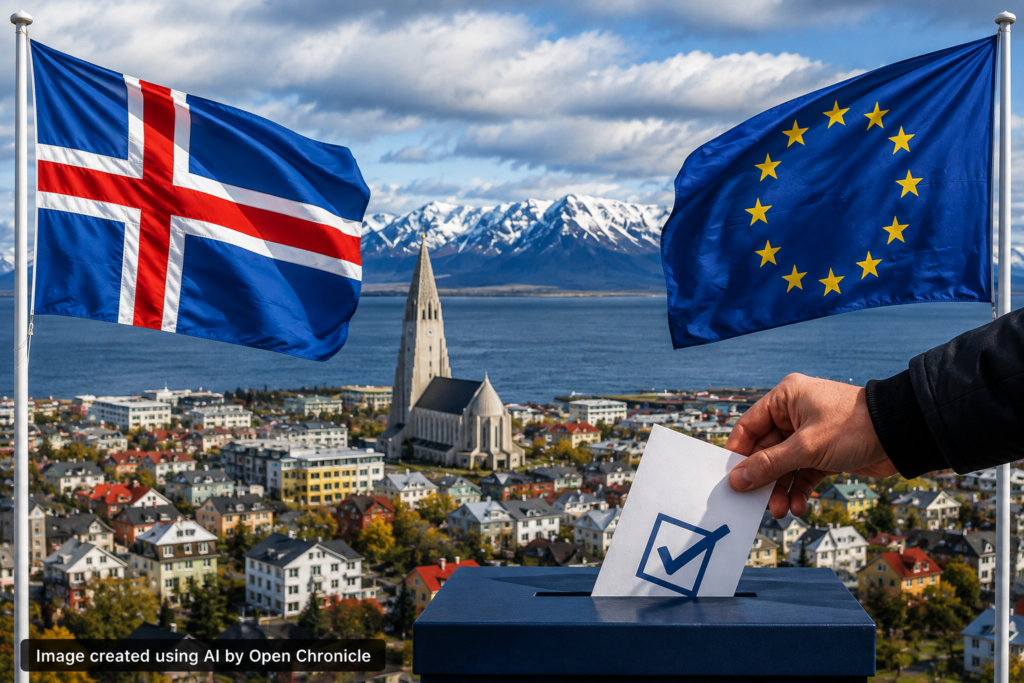
Icelandic voters have rejected a proposal to reopen negotiations on joining the European Union, bringing an immediate end to renewed efforts to revive the country’s long dormant membership process.
According to results reported by Icelandic public broadcaster RÚV, 52.8 percent voted against reopening accession talks, while 47.2 percent supported the proposal.
Turnout reached 82.5 percent, the highest recorded in Iceland since 2009, reflecting the significance of a referendum that exposed deep divisions over the country’s future relationship with Europe.
Rural Vote Turns the Result
Early results initially suggested that supporters of renewed negotiations could secure a narrow victory, particularly after ballots from Reykjavik showed stronger backing for closer integration with the European Union.
However, the balance shifted as results arrived from rural areas, where opposition to reopening negotiations proved significantly stronger.
Prime Minister Kristrún Frostadóttir acknowledged the result and said her government would respect the decision.
She confirmed that the government would not proceed with EU accession negotiations during the current parliamentary term, while stressing that Iceland would continue working to strengthen its economic relationship with the European Union.
Frostadóttir had previously indicated that a rejection would effectively remove EU accession from the government’s agenda until the parliamentary term concludes in 2028.
Economy at the Centre of the Campaign
Economic questions played a major role throughout the referendum campaign.
Supporters of reopening negotiations argued that eventual EU membership could help Iceland address persistent economic challenges, including high interest rates and inflation.
Some supporters also argued that greater integration with the European single market could contribute to lower consumer prices and provide additional economic stability.
Geopolitical concerns also entered the campaign. Supporters pointed to tensions surrounding the Arctic and US President Donald Trump’s statements concerning Greenland as evidence that Iceland should strengthen its political and strategic relationship with Europe.
Fishing and Sovereignty Drive Opposition
Opponents focused heavily on national sovereignty and control over Iceland’s natural resources.
The country’s powerful fishing industry was particularly important to the debate. Critics of EU membership argued that accession could eventually subject Iceland’s fisheries to European policies and potentially restrict national control over fishing quotas.
Farmers and representatives of the whaling industry also expressed concerns about the consequences of adopting EU regulations.
The conservative Independence Party and other opposition forces campaigned against reopening negotiations, arguing that Iceland already benefits from extensive economic cooperation with Europe without needing full membership.
Iceland’s Complicated Relationship With the EU
Iceland has maintained an unusually close relationship with the European Union despite remaining outside the bloc.
The country applied for EU membership in 2009, during the economic turmoil that followed the collapse of Iceland’s banking system and the global financial crisis.
Formal negotiations followed, but the process became increasingly politically contentious. Accession talks were eventually frozen in 2013 amid disagreements over several issues, including concerns surrounding the eurozone and Iceland’s fishing industry.
No membership agreement was ultimately reached.
Already Deeply Integrated With Europe
Despite remaining outside the European Union, Iceland participates extensively in European institutions.
Through membership of the European Economic Area, Iceland has access to much of the EU single market and implements substantial parts of European economic legislation.
However, important areas remain outside that arrangement, particularly agriculture, fisheries, monetary policy and elements of security and foreign policy.
Iceland is also a member of the Schengen Area, allowing largely passport free travel between Iceland and participating European countries.
The arrangement has allowed Iceland to maintain close economic and social ties with Europe while preserving national control over politically sensitive areas such as fisheries.
EU Membership Debate Put on Hold
The referendum does not fundamentally change Iceland’s existing relationship with Europe. Instead, it prevents the government from reopening the formal process that could eventually have led to full membership.
The relatively narrow margin nevertheless demonstrates that the question remains deeply contested.
For supporters of membership, the result represents another setback in a debate stretching back decades. For opponents, it confirms that Iceland should continue pursuing close cooperation with Europe while remaining outside the European Union.
With the government committing not to restart negotiations during the current parliamentary term, Iceland’s EU membership question is now expected to remain formally dormant until at least 2028.