
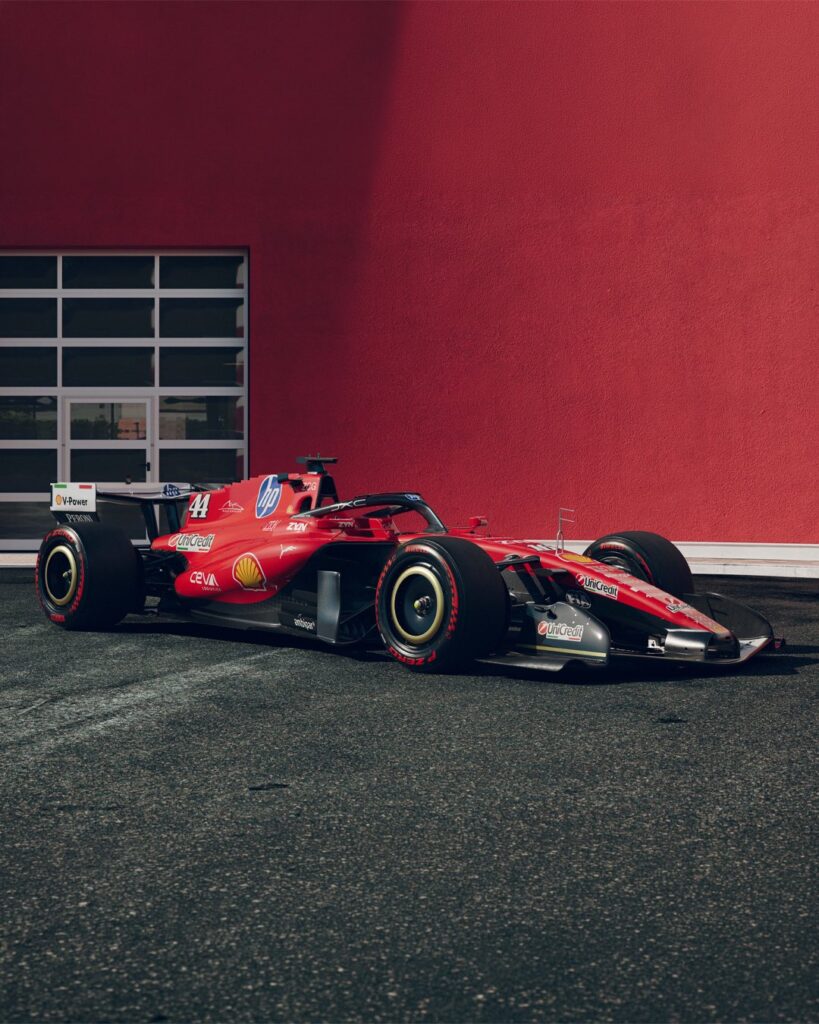
Image: from Autodromo Nazionale Monza X @Autodromo_Monza
Thirty years after Michael Schumacher delivered his first Italian Grand Prix victory for Ferrari, the Scuderia will arrive at Monza with a special F310 inspired livery, commemorative race suits and helmets, while Sebastian Vettel is set to drive the legendary F2002 before Sunday’s race.
By Open Chronicle Formula One Magazine
Ferrari will turn back the clock at Monza this weekend as the Scuderia prepares a major tribute to Michael Schumacher, marking 30 years since the German delivered his first Italian Grand Prix victory for the team.
The 2026 Italian Grand Prix, taking place from 4 to 6 September, will see Charles Leclerc and Lewis Hamilton race Ferrari cars carrying a special design inspired by the 1996 Ferrari F310, the machine Schumacher drove to victory at Monza during his first season with the Italian team.
For Ferrari, the anniversary represents far more than an opportunity for a retro livery.
Schumacher’s 1996 Monza victory came during the early stages of the transformation that would eventually turn Ferrari into the dominant force of Formula One at the beginning of the following decade.
Three decades later, the Scuderia is using its home Grand Prix to reconnect the current team with one of the defining periods in its history.
A livery fit for home 🏡 Our Monza livery is here, inspired by the lasting impact of Michael Schumacher on our team ❤️ pic.twitter.com/MWGlJi4miv
— Scuderia Ferrari HP (@ScuderiaFerrari) September 1, 2026
A Ferrari Inspired by 1996
The cars of Leclerc and Hamilton will retain Ferrari’s traditional red as their dominant colour, but several details will recreate elements of the F310 raced by Schumacher and Eddie Irvine during the 1996 season.
White and black accents will appear around the wings, while the wheels will feature gold detailing intended to strengthen the visual connection with the car from that era.
One of the most significant elements will be the presence of Schumacher’s “MS” logo.
Ferrari will also incorporate a graphic on the nose derived from the design of Schumacher’s helmet.
The intention, according to the team, is to create a visual connection between the Ferrari of 1996 and the modern Scuderia.
Leclerc and Hamilton will complete the tribute with special racewear and helmets, while other members of the Ferrari team will also use commemorative clothing throughout the Monza weekend.
The Victory That Meant Something Different
Schumacher arrived at Ferrari in 1996 as a double Formula One World Champion, having won consecutive titles with Benetton in 1994 and 1995.
Ferrari, however, was attempting to rebuild.
The F310 was far from the dominant machinery that would later define the Schumacher era, and the German’s first campaign in red became as much about laying foundations as collecting results.
Then came Monza.
Schumacher’s victory in the 1996 Italian Grand Prix immediately became one of the symbolic moments of his early Ferrari career.
Winning anywhere for Ferrari carries significance.
Winning at Monza is different.
The circuit represents the emotional centre of the Scuderia’s Formula One identity, where the grandstands become seas of red and victory transforms into a national celebration.
For Schumacher, it was also his first victory at Monza as a Ferrari driver.
It helped establish the bond between the German and the Tifosi that would become one of the defining relationships of modern Formula One.
From the F310 to Ferrari Dominance
The 1996 Ferrari was only the beginning.
Schumacher and Ferrari gradually transformed themselves into the benchmark of Formula One.
After several seasons fighting for the championship, Schumacher finally delivered Ferrari’s long awaited Drivers’ title in 2000.
It opened one of the most dominant periods the sport has ever seen.
Schumacher won five consecutive Drivers’ Championships with Ferrari between 2000 and 2004, while the Scuderia collected six consecutive Constructors’ titles from 1999 through 2004.
The machinery evolved dramatically during that period, and one of the greatest examples will also be present at Monza this weekend.
Three Schumacher Ferraris Return to Monza
Ferrari’s commemoration will extend beyond the current cars.
Three Formula One machines representing important stages of Schumacher’s career with the Scuderia will be displayed at Monza.
Ferrari F310, 1996
The centrepiece is inevitably the F310.
It represents Schumacher’s first Ferrari season and the car associated with his breakthrough Monza victory.
The F310 belonged to a Ferrari still under reconstruction, making its historical significance particularly powerful when viewed against everything that followed.
Ferrari F2002
The second car represents Ferrari at the opposite end of that transformation.
The F2002 became one of the most successful Formula One cars ever produced.
Schumacher used it during a season of extraordinary dominance as Ferrari overwhelmed its opposition and secured both world championships.
Where the F310 symbolises the beginning of the journey, the F2002 represents the moment when Schumacher’s Ferrari project had reached its peak.
Ferrari 248 F1, 2006
Completing the exhibition will be the 248 F1, Schumacher’s final Ferrari Formula One car before his first retirement.
The 2006 season produced another championship battle and brought the first chapter of Schumacher’s Ferrari racing career to an end.
Placed together, the three cars tell an unusually complete story.
The F310 represents reconstruction.
The F2002 represents domination.
The 248 F1 represents the end of an era.
Sebastian Vettel to Drive Schumacher’s F2002
Perhaps the most evocative moment of the weekend is scheduled for Sunday before the Italian Grand Prix begins.
Sebastian Vettel is set to return to the cockpit of a Ferrari Formula One car and drive the F2002 around Monza in a commemorative demonstration lap.
The connection is particularly appropriate.
Schumacher was Vettel’s childhood hero, and the younger German eventually followed a remarkably similar path through Formula One.
Vettel became a multiple World Champion before joining Ferrari, racing for the Scuderia from 2015 to 2020.
Although Vettel never achieved his ambition of winning the World Championship in red, he became one of Ferrari’s most successful Grand Prix drivers and maintained a strong personal connection to Schumacher throughout his career.
Seeing Vettel driving one of Schumacher’s most famous Ferraris around Monza will therefore bring together several generations of the Scuderia’s history.
There will also be a modern technical element to the demonstration.
The F2002 will run using an advanced sustainable fuel, allowing one of Ferrari’s most celebrated V10 era cars to return to the circuit while demonstrating how historic Formula One machinery could potentially continue operating in a lower carbon future.
Hamilton Joins a Ferrari Tradition
The weekend will carry another interesting dimension for Lewis Hamilton.
The seven time World Champion will participate in the Schumacher tribute as a Ferrari driver himself.
Few drivers in Formula One history are as closely linked statistically as Hamilton and Schumacher.
Both became seven time World Champions, and Hamilton spent years pursuing and eventually surpassing several records that had once appeared almost unreachable during Schumacher’s period of dominance.
Now Hamilton will race at Monza wearing Ferrari colours in a car carrying visual references to Schumacher’s first season with the Scuderia.
It connects two of Formula One’s defining careers in a way that would once have seemed impossible.
Leclerc and the Modern Ferrari Generation
For Leclerc, the tribute carries a different meaning.
The Monegasque represents the generation that grew up with Schumacher’s Ferrari as part of Formula One history.
Leclerc has also experienced personally what victory at Monza means to a Ferrari driver.
The emotional relationship between Ferrari, Monza and the Tifosi remains one of the few elements of Formula One that has survived almost unchanged through different technical eras.
The cars have changed.
The engines have changed.
The regulations have changed.
The importance of winning at Monza for Ferrari has not.
More Than a Retro Livery
Formula One teams increasingly use special liveries to commemorate anniversaries, partnerships and historic achievements.
Ferrari’s Schumacher tribute carries considerably more historical weight.
The 1996 victory represents an important chapter in the creation of the team that would eventually dominate Formula One.
When Schumacher joined Ferrari, the Scuderia had not won a Drivers’ Championship since Jody Scheckter in 1979.
The process of returning Ferrari to the summit required years of development involving Schumacher and a formidable leadership structure that included Jean Todt, Ross Brawn and Rory Byrne.
Monza 1996 offered an early glimpse of what that project could eventually become.
Monza Connects Ferrari’s Past and Present
Thirty years later, Ferrari returns to the same circuit with another generation carrying the responsibility of racing in front of the Tifosi.
Leclerc and Hamilton will drive modern Formula One machinery shaped by regulations almost unimaginable when Schumacher climbed into the F310.
Yet the symbolism remains instantly recognisable.
Ferrari.
Monza.
Red grandstands.
A home Grand Prix.
And Michael Schumacher.
For one weekend, the Scuderia will deliberately blur the boundary between its past and present.
The F310 inspired cars will compete on track.
The original Schumacher machines will remind spectators how the story developed.
And Sebastian Vettel will bring the unmistakable sound and presence of the F2002 back to Monza.
The 2026 Italian Grand Prix will ultimately be decided by the current generation.
But before the lights go out on Sunday, Ferrari will remember the victory that helped begin one of the greatest chapters in Formula One history.