
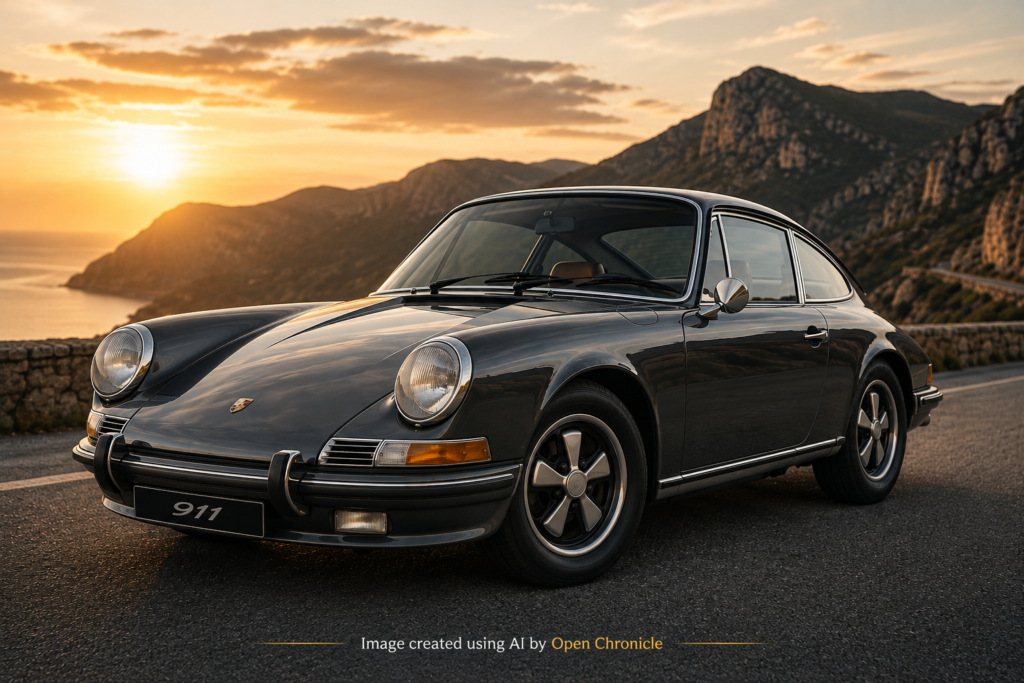
By Open Chronicle Auto Magazine
Few automobiles have managed to evolve continuously for more than six decades without losing the identity that made them famous. The Porsche 911 belongs to that exceptionally small group.
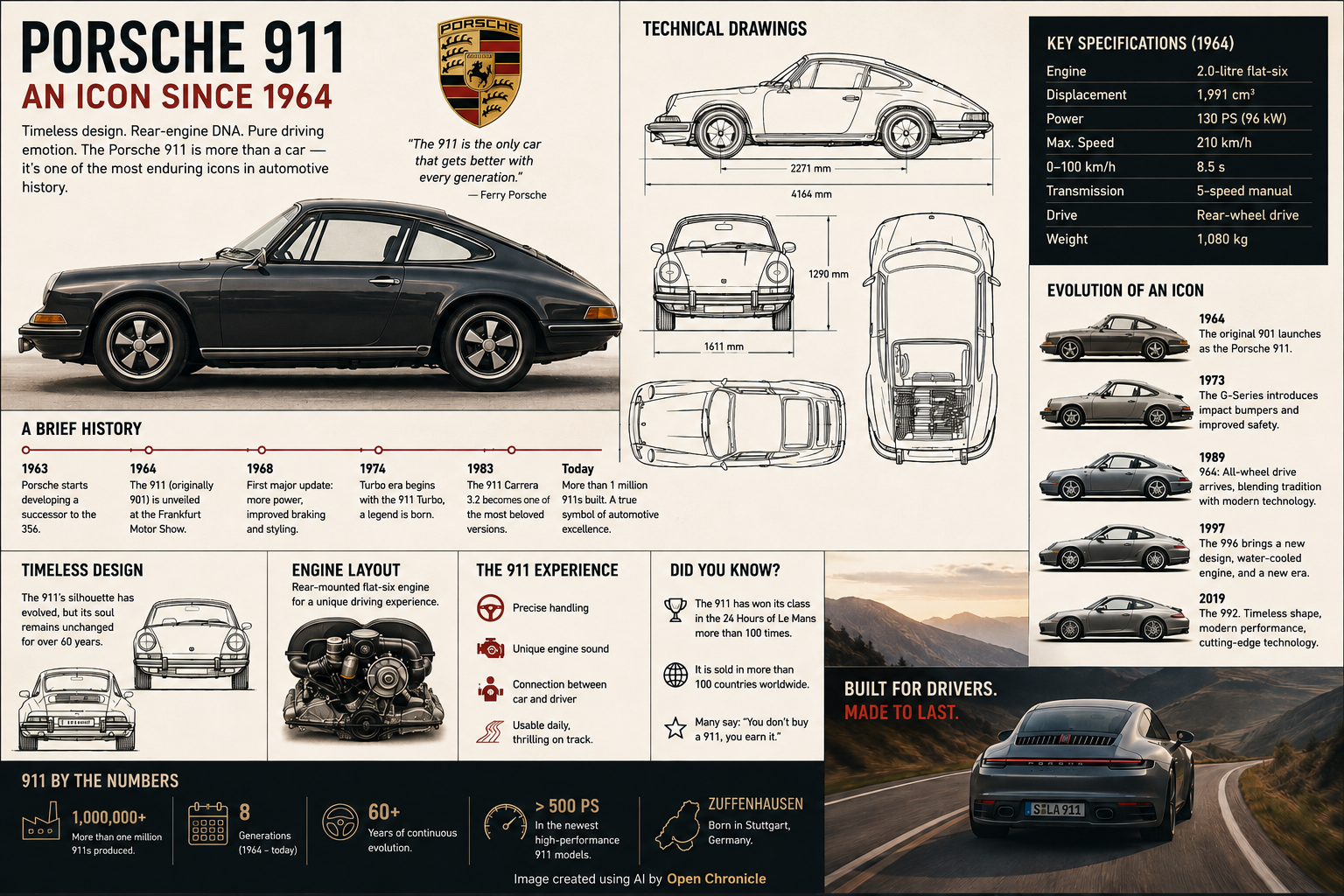
Introduced in the early 1960s as the successor to the Porsche 356, the 911 established a formula that initially appeared unconventional for a high performance sports car: a horizontally opposed six cylinder engine positioned behind the rear axle, compact proportions, two small rear seats and a distinctive fastback silhouette.
That architecture could have disappeared as automotive technology changed. Instead, Porsche repeatedly refined it.
The result is one of the longest running and most recognisable sports car bloodlines in automotive history.
From the 356 to a New Porsche
By the end of the 1950s, Porsche needed a successor to the increasingly dated 356. The company wanted a car that was more powerful, more sophisticated and more practical while preserving the character that had established Porsche’s reputation.
Ferdinand Alexander Porsche, commonly known as Butzi Porsche, played the central role in shaping the new model.
The prototype that emerged was presented publicly at the Frankfurt Motor Show in 1963 under the designation Porsche 901.
That name would not last.
Following a dispute with Peugeot over three digit model names containing a zero in the middle, Porsche changed the designation from 901 to 911.
Production of the new sports car began in 1964, establishing a name that would eventually become inseparable from Porsche itself.
A Shape That Became an Identity
Perhaps the greatest achievement of the 911 is not that Porsche preserved its original appearance, but that the company continuously modernised it without destroying its visual identity.
The early car established several characteristics that remain immediately recognisable today.
Its rounded front wings rose above the bonnet. The roof flowed smoothly towards the rear engine compartment. The cabin featured a relatively upright windscreen and compact greenhouse, while the rear tapered away in a characteristic fastback profile.
Individual generations became wider, lower and considerably more sophisticated, but the underlying proportions remained identifiable.
A modern 911 can therefore be placed beside an early 1960s example and, despite the enormous technological differences between them, their relationship is unmistakable.
The Rear Engine Challenge
The defining engineering feature of the 911 has always been its engine position.
Placing the engine behind the rear axle creates significant traction advantages because considerable mass sits over the driven wheels. It also creates unusual handling characteristics because so much weight is concentrated towards the back of the car.
Early 911s acquired a reputation for demanding respect from inexperienced drivers, particularly when entering corners too quickly or abruptly lifting the throttle.
Rather than abandoning the configuration, Porsche spent decades mastering it.
Suspension geometry, tyres, aerodynamics, chassis stiffness, electronic stability systems, rear wheel steering and increasingly sophisticated differential and traction management progressively transformed the way the 911 behaved.
What began as an engineering challenge eventually became one of the car’s defining advantages.
The Flat Six
Equally important is the horizontally opposed six cylinder engine.
The original production 911 used an air cooled 2.0 litre flat six producing approximately 130 PS. The engine configuration provided a low centre of gravity and became fundamental to the sound and personality of the car.
Displacement and performance increased progressively.
The early 2.0 litre engines gave way to larger 2.2, 2.4, 2.7 and 3.0 litre units. Later generations continued expanding capacity and introducing increasingly sophisticated fuel injection and engine management technology.
Yet one development would transform the 911 more dramatically than almost any other.
Turbocharging.
930 Turbo: The 911 Becomes a Supercar
Introduced during the 1970s, the Porsche 911 Turbo, internally known as the 930, changed perceptions of what the 911 could be.
Its wide rear bodywork, enormous rear spoiler and turbocharged flat six created one of the most distinctive performance cars of its era.
The early 3.0 litre Turbo produced around 260 PS, a remarkable figure for the period. Later 3.3 litre versions increased output further.
Turbo lag could make power delivery dramatic, while the rear engine configuration demanded considerable skill when driven near the limit.
The 930 consequently developed an intimidating reputation.
It also established a lineage that continues today, with the Turbo becoming one of the technological flagships of the 911 range.
Motorsport in Its DNA
Competition has been fundamental to the development of the 911.
The car proved adaptable to circuit racing, endurance competition and rallying. Variants of the 911 and its racing derivatives competed successfully around the world, helping Porsche develop an extraordinary motorsport reputation.
One particularly important model was the 1973 Carrera RS 2.7.
Created partly to satisfy homologation requirements, the Carrera RS combined reduced weight, increased performance and improved aerodynamics. Its distinctive rear spoiler, commonly called the ducktail, became an automotive design icon.
The philosophy behind the RS would survive for generations.
Modern 911 GT3 and GT3 RS models continue the concept of taking technology and experience developed through motorsport and applying them to road legal machines.
Carrera 3.2: Refining the Original Formula
By the 1980s, the basic 911 architecture had already survived numerous predictions that Porsche would eventually replace it.
Instead, the company continued improving the car.
The 911 Carrera 3.2, introduced for the 1984 model year, became one of the most celebrated versions of the classic 911.
Its 3.2 litre flat six combined stronger performance with improved reliability and more sophisticated electronic engine management.
To many enthusiasts, the Carrera 3.2 represents an important balance in the history of the 911: sufficiently modern to be usable regularly, but still closely connected to the mechanical character of the early cars.
964: The Beginning of the Modern 911
The 964 generation arrived at the end of the 1980s and represented a much greater technological transformation than its familiar appearance initially suggested.
Porsche introduced features including ABS and power steering, while the Carrera 4 brought all wheel drive to the production 911.
Aerodynamics also evolved through the introduction of an automatically extending rear spoiler.
The 964 demonstrated a principle that would become increasingly important: Porsche could radically modernise the engineering beneath the 911 while carefully preserving the visual continuity above it.
993: The End of the Air Cooled Era
Introduced during the 1990s, the 993 generation holds a particularly important position among enthusiasts because it became the final air cooled 911.
Its smoother bodywork represented a significant visual evolution, while a redesigned rear suspension substantially improved stability and handling.
The 993 Turbo also introduced twin turbocharging and all wheel drive, creating a formidable high performance flagship.
But its historical significance became even greater when production ended.
The next 911 would abandon one of the defining characteristics that had existed since 1964.
Air cooling was disappearing.
996: The Controversial Revolution
The 996 generation, introduced in the late 1990s, represented one of the biggest breaks with 911 tradition.
The flat six remained, as did the rear engine layout, but the engine was now water cooled.
Stricter emissions requirements, increasing performance expectations and the need for improved thermal management made the transition increasingly difficult to avoid.
The 996 also introduced dramatically different styling, including headlights that departed from the traditional round design.
Traditionalists were divided.
Yet the engineering transition secured the future of the 911. Water cooling provided the foundation for considerably greater performance and allowed Porsche to continue developing the flat six architecture into the twenty first century.
997: Tradition Returns
With the 997 generation, Porsche restored several visual cues enthusiasts associated with earlier cars, most obviously the rounder headlights.
Performance continued increasing across the Carrera, Turbo and GT models, while electronic systems became more deeply integrated into the chassis.
The 997 generation also reinforced the growing distinction between different branches of the 911 family.
A Carrera could remain a sophisticated everyday sports car, while a GT3 offered a more direct connection with motorsport and the Turbo delivered supercar performance with remarkable usability.
The 911 was becoming not merely one model, but an entire performance ecosystem.
991: A Bigger Technological Leap
Introduced in the early 2010s, the 991 generation adopted a longer wheelbase and made extensive use of aluminium, creating a larger yet highly sophisticated 911.
Electric power steering replaced the traditional hydraulic system, another controversial transition among enthusiasts.
Then came an even more significant change.
With the updated 991 generation, mainstream Carrera models moved from naturally aspirated engines to turbocharged flat sixes.
Turbocharging was no longer reserved primarily for the 911 Turbo.
The change reflected the wider automotive industry’s pursuit of greater efficiency and lower emissions while maintaining or increasing performance.
992: The Digital 911
The current 992 generation pushes the concept considerably further.
Its body is wider and its electronics vastly more sophisticated than those of the original car. Digital instrumentation, active chassis technologies, advanced driver assistance systems and increasingly complex powertrain management have transformed the driving environment.
Yet Porsche has continued preserving essential visual elements.
The raised front wings remain. The roofline still flows towards the rear. The flat six remains behind the occupants.
Even more significantly, the 911 has entered the electrified era.
The 992.2 generation introduced the T Hybrid system in the Carrera GTS, demonstrating that electrification can be incorporated into the 911 without fundamentally abandoning its performance philosophy.
Rather than using hybridisation primarily to maximise electric driving range, Porsche employed electrical technology to enhance powertrain response and performance.
It represents another example of the strategy that has sustained the 911 for decades: accept technological change, then adapt it to the character of the car.
One Car, Many Personalities
Part of the longevity of the 911 comes from its extraordinary versatility.
Over successive generations, Porsche has expanded the range into numerous interpretations of the same fundamental architecture.
The Carrera represents the core road car. The Targa combines open air driving with one of Porsche’s most recognisable design traditions. The Turbo provides extraordinary cross country performance. The GT3 places greater emphasis on naturally aspirated response and circuit capability, while the GT3 RS pushes aerodynamics and chassis engineering considerably further.
Models such as the Dakar have even demonstrated that the 911 concept can be adapted for rough surfaces and unconventional terrain.
Few sports car platforms have supported such a wide spectrum of personalities without losing their central identity.
Technical Evolution Across Six Decades
| Era | Generation | Major Development |
|---|---|---|
| 1964 | Original 911 | 2.0 litre air cooled flat six |
| 1973 | Carrera RS 2.7 | Lightweight performance and aerodynamic development |
| 1970s | 930 Turbo | Turbocharging transforms 911 performance |
| 1984 | Carrera 3.2 | Improved engine management and everyday usability |
| 1989 | 964 | ABS, power steering and available all wheel drive |
| 1994 | 993 | Advanced rear suspension, final air cooled generation |
| 1997 | 996 | Water cooled flat six and major platform redesign |
| 2004 | 997 | Traditional styling combined with modern electronics |
| 2011 | 991 | Longer wheelbase, aluminium construction and electric steering |
| 2019 | 992 | Digital architecture and advanced chassis technology |
| 2024 onward | 992.2 | Electrification enters the 911 through T Hybrid technology |
More Than One Million 911s
The 911 began as a relatively specialised European sports car. It eventually became a global performance institution.
Porsche produced the one millionth 911 in 2017, a milestone that illustrated just how far the model had travelled from its modest beginnings.
Its longevity is even more remarkable considering the number of times conventional automotive wisdom suggested that its basic configuration should have become obsolete.
A rear engined sports car should have been replaced by something more conventional.
The air cooled engine eventually was replaced, but the flat six survived.
Naturally aspirated engines gradually gave way to turbocharging across much of the range.
Mechanical controls became electronic.
Analogue instruments became digital displays.
Now electrification has entered the powertrain.
At every stage, the 911 changed.
Why the Porsche 911 Endures
The secret of the 911 is therefore not resistance to change.
It is controlled evolution.
Porsche has repeatedly altered almost every technological component of the automobile while protecting a small group of characteristics that define what a 911 is.
The engine remains at the rear. The flat six remains central to its identity. The silhouette remains recognisable. The cabin remains focused around the driver. Motorsport continues influencing the most extreme versions.
A Porsche 911 built today is vastly faster, safer, cleaner and more sophisticated than the original.
Yet when the two cars are placed together, the family relationship requires no explanation.
That may ultimately be the greatest achievement of the Porsche 911.
For more than sixty years, Porsche has continuously redesigned one of the world’s most famous sports cars while somehow ensuring that it never stops being a 911.