
By Open Chronicle Science Desk
August 31, 2026
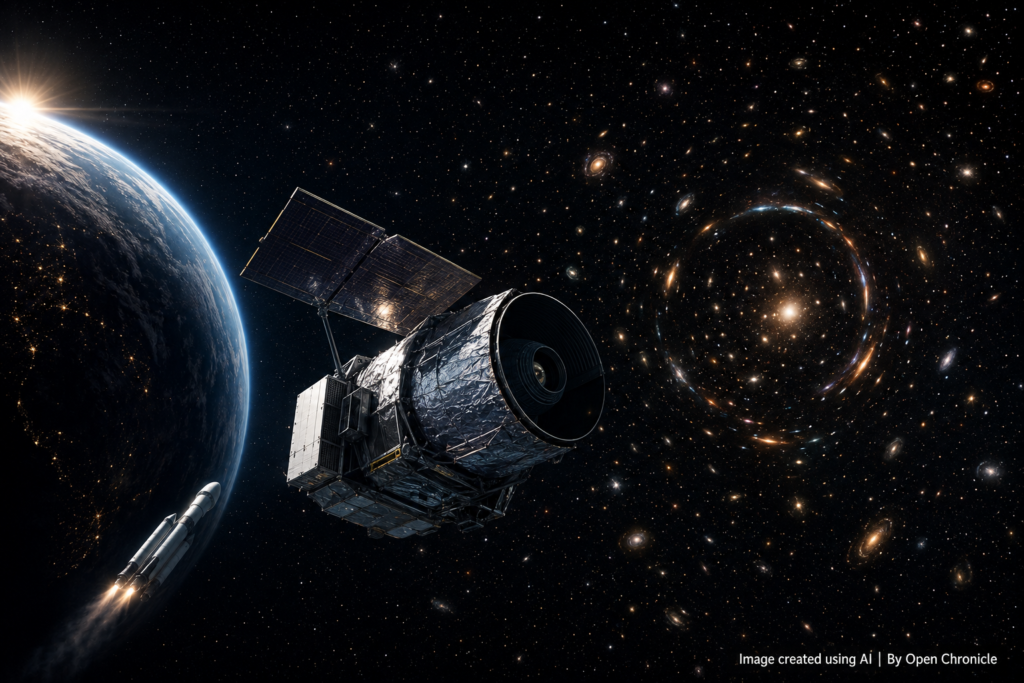
NASA’s Nancy Grace Roman Space Telescope has begun its journey toward a gravitationally stable region nearly one million miles from Earth, opening a new era of wide field astronomy designed to investigate dark matter, dark energy, distant worlds and mysteries astronomers do not yet know exist.
A new eye on the universe is heading into deep space.
NASA’s Nancy Grace Roman Space Telescope has launched from Florida, beginning a roughly three month journey toward the second Sun Earth Lagrange point, known as L2, where it will prepare to conduct one of the most ambitious surveys of the cosmos ever attempted.
Roman lifted off at 7:26 a.m. EDT on Sunday, August 30, aboard a SpaceX Falcon Heavy rocket from Launch Complex 39A at NASA’s Kennedy Space Center in Florida.
The observatory is designed to combine extraordinarily sharp infrared vision with a field of view dramatically larger than that of the Hubble Space Telescope.
That combination will allow Roman to survey enormous areas of the universe with unprecedented efficiency.
NASA says Roman will be capable of surveying the cosmos roughly 1,000 times faster than Hubble, generating an immense astronomical archive that could fundamentally change scientists’ understanding of how the universe evolved.
Its primary targets include two of the greatest mysteries in modern physics, dark matter and dark energy.
But Roman will also search for planets beyond our solar system, investigate galaxies across cosmic history, study stars throughout the Milky Way and potentially reveal phenomena astronomers have never encountered before.
A New Atlas of the Universe
Roman represents a different approach to space astronomy.
Hubble transformed humanity’s understanding of the cosmos by examining relatively narrow regions of the sky in extraordinary detail.
Roman is designed to retain comparable sharpness across vastly larger areas.
The difference can be thought of as changing the size of the astronomical window.
Instead of observing only small sections of the universe at once, Roman will capture enormous cosmic landscapes containing millions of astronomical objects.
NASA Administrator Jared Isaacman described the mission as an example of what the agency hopes to achieve through disciplined development and ambitious science.
“Roman is exactly the kind of success story we want to see across NASA,” Isaacman said.
“Delivered ahead of schedule and on budget, this mission reflects more than a decade of dedication from the NASA workforce and our industry partners. Now, Roman will give us a new atlas of the universe, push the boundaries of discovery, and demonstrate what is possible when America’s space program pairs bold ambition with disciplined execution.”
That atlas could become one of Roman’s greatest scientific legacies.
Instead of focusing exclusively on individual targets, the telescope will repeatedly survey enormous populations of galaxies, stars and planets.
Patterns hidden within those populations could provide clues to some of the deepest questions in cosmology.
Roman Begins Its Million Mile Journey
The first indications that the spacecraft was healthy arrived almost immediately after launch.
Controllers at NASA’s Goddard Space Flight Center in Greenbelt, Maryland, began receiving telemetry from Roman just seven minutes after liftoff.
Falcon Heavy continued operating as planned before separating from the observatory approximately 31 minutes after launch.
Roman then began travelling independently toward its destination.
The spacecraft’s journey will cover roughly one million miles before it reaches the region around Sun Earth L2.
During the first portion of the flight, communications are handled through NASA’s Near Space Network, which provides tracking, telemetry and command services using ground stations and relay satellites.
Approximately 70 minutes after launch, communications transition to NASA’s Deep Space Network.
That global communications system will help mission controllers track Roman as it moves farther from Earth.
Why Roman Is Heading to L2
Roman’s destination is not a planet, moon or conventional orbit around Earth.
It is travelling toward the second Sun Earth Lagrange point, or L2.
Lagrange points are regions where the gravitational influences of two large bodies, in this case the Sun and Earth, combine with a spacecraft’s orbital motion in a way that allows an observatory to maintain a relatively stable configuration.
L2 lies approximately one million miles, or around 1.5 million kilometres, from Earth in the direction away from the Sun.
Roman will operate in an orbit around this region rather than remaining motionless at a single point.
The location offers major advantages for astronomy.
The Sun, Earth and Moon remain broadly in the same direction from the spacecraft, allowing Roman to shield its sensitive instruments from their heat and light.
That creates a stable thermal environment, particularly important for infrared observations.
Roman will join other major observatories that have used the L2 environment for astronomy, most notably the James Webb Space Telescope.
A Global Communications Network
As Roman travels toward L2, NASA’s Deep Space Network will maintain contact through three major facilities distributed around Earth.
The spacecraft will initially communicate through the Canberra Deep Space Communication Complex in Australia.
Approximately six hours later, communications will shift to the Madrid Deep Space Communication Complex in Spain and subsequently to the Goldstone Deep Space Communications Complex in California.
The geographical separation between these facilities allows NASA to maintain contact with spacecraft as Earth rotates.
Together, they form one of the essential pieces of infrastructure supporting exploration throughout the solar system and beyond Earth orbit.
Roman Deploys Its First Systems
The spacecraft began transforming into its operational configuration shortly after leaving Earth.
One hour and 23 minutes after launch, mission controllers confirmed successful deployment of Roman’s solar panels and lower instrument sun shade.
These systems are essential.
The solar arrays provide the electrical power needed to operate the observatory, while the thermal shielding helps maintain the stable conditions required for precision astronomical measurements.
Additional deployments will follow during the journey.
Roman’s high gain antenna and visor like deployable aperture cover are scheduled to deploy as controllers continue checking the spacecraft.
The mission team will also conduct the first of two planned trajectory correction manoeuvres to refine Roman’s path toward L2.
A Telescope Built to Survey the Universe
Roman’s principal scientific instrument is the Wide Field Instrument, an enormous infrared imaging system designed specifically for large astronomical surveys.
At its heart is a camera containing approximately 300 megapixels.
The instrument uses 18 detectors, each containing roughly 4,000 by 4,000 pixels.
Together, they will capture immense panoramas of the infrared universe.
The telescope was engineered to remain optically stable while moving efficiently from one observation to another.
That ability dramatically reduces the time lost between targets.
Instead of spending long periods repositioning and stabilising itself, Roman can rapidly survey neighbouring regions of the sky.
NASA estimates that this architecture will allow Roman to survey the universe approximately 1,000 times faster than Hubble.
Hubble Sharpness Across a Much Wider Sky
Roman and Hubble are not simply competitors.
Their capabilities are complementary.
Hubble excels at extremely detailed observations of relatively narrow regions.
Roman is designed to capture similarly sharp astronomical information across a dramatically larger field.
That difference will allow astronomers to study statistical populations that are difficult to examine with narrower observatories.
Instead of studying hundreds of galaxies, researchers may examine millions.
Instead of observing individual gravitational lensing events, Roman could identify enormous samples.
Instead of finding exoplanets individually, astronomers could build a much broader census of planetary systems throughout the Milky Way.
Scale is Roman’s defining advantage.
Searching for Dark Energy
One of Roman’s primary missions is to investigate dark energy.
Astronomers discovered in the late twentieth century that the expansion of the universe is accelerating.
Something appears to be driving galaxies apart at an increasing rate.
Scientists call the unknown cause dark energy.
It is estimated to dominate the energy content of the modern universe, yet its fundamental nature remains unknown.
Roman will investigate this mystery by mapping the distribution and evolution of galaxies across enormous volumes of cosmic history.
By examining how large scale structures changed through time, scientists can test competing explanations for cosmic acceleration.
The results could help determine whether dark energy behaves like Einstein’s cosmological constant or whether a deeper modification to our understanding of gravity and cosmology is required.
Mapping Invisible Dark Matter
Roman will also investigate another invisible component of the cosmos.
Dark matter does not emit, absorb or reflect ordinary light.
Yet its gravitational influence can be detected throughout the universe.
Galaxies rotate as though they contain far more mass than astronomers can see.
Clusters of galaxies behave similarly.
Light travelling through space is bent by invisible concentrations of mass.
Roman will exploit this phenomenon through gravitational lensing.
Mass curves spacetime, causing light from more distant galaxies to become subtly distorted as it travels toward Earth.
By measuring those distortions across enormous areas of sky, astronomers can reconstruct maps showing where invisible matter is concentrated.
Roman could therefore help produce some of the most detailed maps yet of the universe’s hidden gravitational structure.
Hunting Worlds Beyond the Solar System
Roman’s mission extends beyond cosmology.
The telescope will also conduct a major search for exoplanets, planets orbiting stars other than the Sun.
One important technique will involve gravitational microlensing.
When a foreground star passes almost perfectly in front of a more distant star from Roman’s perspective, the gravity of the foreground system can magnify the background star’s light.
If planets orbit the foreground star, they can create additional signatures within that magnification event.
Microlensing is particularly valuable because it can detect planets at orbital distances and masses that are difficult to find using other methods.
Roman could therefore reveal planetary systems occupying regions of parameter space that remain poorly explored.
The mission is expected to substantially expand humanity’s census of worlds throughout the Milky Way.
Roman’s Coronagraph Takes on Starlight
Roman also carries another remarkable instrument.
Its Coronagraph Instrument is a technology demonstration designed to advance techniques for directly imaging planets orbiting other stars.
Direct imaging presents an extraordinary challenge.
A star can be billions of times brighter than a nearby planet.
Trying to photograph the planet can be compared to attempting to see a tiny object beside an overwhelmingly bright spotlight from an enormous distance.
A coronagraph suppresses much of the star’s light.
Once that glare is reduced, much fainter objects around the star become easier to detect.
Roman’s coronagraph will test sophisticated technologies for controlling starlight with extraordinary precision.
The instrument is expected to image planets broadly comparable in size to Jupiter rather than Earth twins.
But the technologies it demonstrates could influence future observatories.
Preparing for the Search for Another Earth
One potential successor is NASA’s proposed Habitable Worlds Observatory.
That future mission concept aims ultimately to search for potentially habitable Earth like planets around nearby Sun like stars and investigate their atmospheres for evidence that could indicate conditions suitable for life.
Achieving that goal will require extremely advanced control of unwanted starlight.
Roman’s Coronagraph Instrument therefore serves as an important technological bridge.
Lessons learned from Roman could help engineers design future instruments capable of separating the faint reflected light of small rocky planets from the overwhelming brightness of their host stars.
In that sense, Roman is not only searching for planets.
It is helping develop the technology that could one day allow humanity to photograph worlds resembling Earth.
A Torrent of Cosmic Data
Roman’s extraordinary survey speed creates another challenge.
Data.
Once full scientific operations begin, NASA expects Roman to transmit approximately 1.4 terabytes of information to Earth every day.
That represents the highest daily data rate yet for a NASA astrophysics mission.
Across years of operation, Roman will build an enormous archive containing observations of galaxies, stars, gravitational lenses, supernovae, exoplanets and countless other astronomical phenomena.
No individual astronomer could manually inspect such a dataset.
Automated analysis will therefore become essential.
Artificial Intelligence Meets Astronomy
Machine learning and artificial intelligence are expected to play important roles in analysing Roman’s observations.
Algorithms can examine huge numbers of astronomical sources and search for unusual patterns.
They may identify gravitational lenses.
They can classify galaxies.
They can flag transient events.
They can search for objects behaving differently from established populations.
Citizen scientists may also participate, using human pattern recognition to help identify unusual astronomical phenomena.
This combination of professional astronomers, automated systems and public participation could become particularly powerful.
Roman’s surveys may contain discoveries nobody specifically designed the telescope to find.
The Unknown Universe
That possibility is one of the most exciting aspects of the mission.
Major astronomical observatories frequently make discoveries far beyond their original scientific objectives.
Hubble revealed phenomena its designers could not have fully anticipated.
The same happened with other generations of observatories.
Roman’s exceptionally large surveys increase the possibility of similar surprises.
Julie McEnery, Roman’s senior project scientist at NASA Goddard, highlighted precisely that uncertainty.
“We’ve never been able to view the universe with eyes like Roman’s before,” McEnery said.
“There’s no telling what more we’ll know and have seen by this time next year.”
Roman may discover unusual galaxies.
It may identify unexpected populations of planets.
It may reveal transient phenomena occurring in regions astronomers rarely monitor.
It could expose structures within dark matter that challenge existing models.
Some of its most important discoveries may involve questions scientists have not yet thought to ask.
First Images Expected in Early 2027
Roman is not ready to begin routine science immediately.
The journey toward L2 and subsequent commissioning will take approximately three months.
During this period, engineers and scientists will systematically activate, test and calibrate the spacecraft.
A few weeks into the journey, the Wide Field Instrument will be switched on.
Teams will then examine detector performance, optical alignment, thermal stability, pointing accuracy and other characteristics essential for precision observations.
Only after those systems have been thoroughly evaluated will Roman transition toward full scientific operations.
NASA currently expects the observatory’s first images to be released in early 2027.
Those first views will provide the world with its first demonstration of Roman’s enormous astronomical field of vision.
A Discovery Machine
NASA Science Mission Directorate Associate Administrator Nicky Fox described Roman as a mission built around discovery.
“Roman will be a discovery machine that will bring us closer than ever before to answering humanity’s most profound questions about our cosmic history,” Fox said.
“With its large field of view and fast survey speeds, Roman will usher us into a new era of discovery and make the invisible visible, setting the foundation for humanity’s search for life beyond our solar system.”
The description captures what makes Roman unusual.
It is simultaneously a cosmology mission, an exoplanet mission, a technology demonstration and a general purpose astronomical observatory.
Its greatest strength may simply be the amount of universe it can see.
An International Scientific Effort
NASA’s Goddard Space Flight Center manages the Roman mission.
The project also involves NASA’s Jet Propulsion Laboratory in Southern California, Caltech/IPAC in Pasadena and the Space Telescope Science Institute in Baltimore, together with scientists and engineers from numerous research institutions.
Major industrial partners include BAE Systems Inc., L3Harris Technologies, and Teledyne Scientific & Imaging.
Roman also incorporates international contributions.
Partners include the European Space Agency, ESA, the Japan Aerospace Exploration Agency, JAXA, the French space agency CNES, and Germany’s Max Planck Institute for Astronomy.
The mission therefore represents not merely another American space telescope, but part of the increasingly international infrastructure through which humanity studies the universe.
The Next Great Survey of the Cosmos
For more than three decades, Hubble changed humanity’s visual understanding of space.
James Webb then opened an extraordinarily powerful infrared window into the early universe, star formation, planetary systems and distant galaxies.
Roman will add another capability.
Scale.
Its enormous field of view will allow astronomers to connect detailed astrophysics with the statistical structure of the universe itself.
Individual galaxies become populations.
Individual gravitational lenses become maps of invisible matter.
Individual exoplanets become a census of planetary systems.
And individual observations become an enormous dynamic atlas of the cosmos.
Somewhere within that atlas may lie clues to the nature of dark matter and dark energy.
There will be distant planets.
There will be galaxies whose light has travelled across most of cosmic history.
And almost certainly there will be objects and phenomena astronomers did not expect.
Roman has now left Earth.
Its next destination is a quiet gravitational region roughly one million miles away.
From there, a new survey of the universe is about to begin.