
By Open Chronicle Science Desk
August 31, 2026
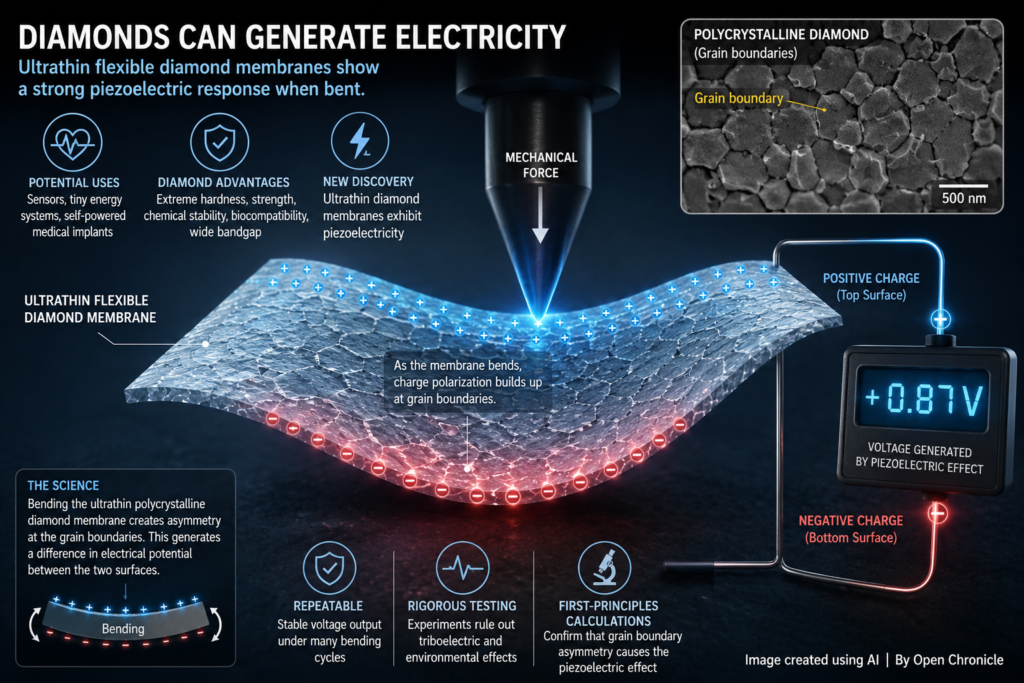
Ultrathin, flexible diamond membranes have produced a strong and repeatable piezoelectric response, overturning a century-old assumption about one of the world’s most remarkable materials and pointing toward future self-powered sensors, micro energy systems and medical implants.
Diamond is famous for being extraordinarily hard. Now scientists have discovered that, under the right conditions, it can also generate electricity when bent.
Researchers at The University of Hong Kong (HKU) have demonstrated a measurable and repeatable piezoelectric response in ultrathin, highly flexible diamond membranes, challenging a scientific assumption that has persisted for more than a century.
The discovery does not mean that an ordinary diamond can simply be squeezed to produce useful electrical power.
Instead, the effect emerges when polycrystalline diamond is engineered into an extremely thin membrane capable of bending far more significantly than conventional bulk diamond.
When the researchers flexed these membranes, they detected stable electrical voltage signals. Further experiments and theoretical calculations indicate that the effect originates from electrical asymmetry around the boundaries between microscopic diamond grains.
The result potentially transforms diamond from a material traditionally regarded as electrically passive in piezoelectric systems into one capable of actively converting mechanical deformation into electrical energy.
Diamond Breaks a Century Old Rule
Piezoelectricity is the ability of certain materials to generate an electrical charge when subjected to mechanical stress.
The phenomenon is already fundamental to modern technology.
Piezoelectric materials are found in sensors, microphones, ultrasound equipment, actuators, precision instruments and numerous microelectromechanical systems.
Apply pressure or deformation to a piezoelectric material and its internal electrical charge distribution changes, producing a measurable voltage.
Reverse the process by applying an electric field and some piezoelectric materials physically deform.
Diamond, however, has traditionally not belonged to this family.
Since the early twentieth century, diamond has generally been classified as a non piezoelectric material.
Its highly symmetrical crystal structure means that mechanical deformation of conventional diamond should not create the electrical polarization required for piezoelectricity.
That assumption influenced more than a century of materials science and engineering.
But the researchers at HKU asked whether diamond might behave differently when its physical structure was radically changed.
An Extraordinary Material With One Missing Property
Diamond already possesses an unusual combination of properties.
It is exceptionally hard and mechanically strong.
It has outstanding thermal conductivity, allowing heat to move through the material extremely efficiently.
Diamond also offers high acoustic velocity, excellent chemical stability, high dielectric breakdown strength and an ultrawide electronic bandgap.
Those characteristics have made synthetic diamond increasingly interesting for advanced electronics, quantum technologies, high power devices and extreme environment engineering.
But its lack of conventional piezoelectricity represented an important limitation.
In microelectromechanical systems, commonly known as MEMS, diamond has therefore often been used as a structural material supporting another layer responsible for producing the piezoelectric response.
The diamond supplied mechanical strength and durability.
Another material supplied the electrical functionality.
The HKU research suggests that this division may no longer always be necessary.
Making Diamond Thin Enough to Bend
The breakthrough depended on changing the physical form of diamond.
Diamond is normally associated with extreme rigidity, but materials can behave very differently when reduced to exceptionally small dimensions.
The HKU researchers used a recently developed edge exfoliation technique to produce an ultrathin polycrystalline diamond membrane.
Polycrystalline diamond differs from the highly ordered single crystals familiar from gemstones.
Instead of consisting of one continuous crystal lattice, it contains numerous microscopic diamond crystals, or grains, separated by boundaries.
Making the material extremely thin also dramatically changes its mechanical behaviour.
The resulting membrane could flex in ways impossible for a conventional piece of bulk diamond.
Researchers then deliberately bent the membrane while monitoring its electrical behaviour.
Something unexpected appeared.
The diamond generated voltage.
Proving the Electricity Really Came From Diamond
Detecting a voltage during mechanical movement is not sufficient by itself to prove piezoelectricity.
Other physical phenomena can produce electrical signals.
One particularly important source of interference is the triboelectric effect, where electrical charge develops when materials contact, separate or rub against one another.
Static electricity produced by friction is a familiar example.
Environmental conditions and experimental equipment can also introduce signals that could potentially be mistaken for a genuine material response.
The HKU team therefore subjected the diamond membranes to extensive mechanical cycling under carefully controlled conditions.
The membranes were repeatedly deformed while their electrical output was monitored.
The researchers also designed the experiments to eliminate possible environmental and triboelectric contributions.
The voltage continued to appear.
More importantly, the electrical response was stable and repeatable across repeated mechanical cycles.
That consistency provided strong evidence that the signal originated within the diamond membrane itself.
The Secret Lies Between the Diamond Crystals
The next question was more fundamental.
If diamond’s crystal symmetry prevents conventional piezoelectricity, why were these membranes producing voltage?
The answer appears to lie at the microscopic boundaries between their individual diamond grains.
Researchers performed first principles calculations, computational techniques that use fundamental quantum mechanical principles to predict how atoms and electrons behave within a material.
The calculations pointed toward structural asymmetry at the grain boundaries of the polycrystalline diamond.
Inside an ideal diamond crystal, carbon atoms form an exceptionally symmetrical arrangement.
That symmetry normally prevents mechanical deformation from creating the charge separation necessary for piezoelectricity.
Grain boundaries disrupt that perfect symmetry.
They represent regions where differently oriented diamond crystals meet.
When the ultrathin membrane bends, these boundary regions experience changing mechanical strain.
According to the researchers’ calculations, stronger bending produces increasing electrical charge polarization around those grain boundaries.
That polarization generates a difference in electrical potential between the upper and lower surfaces of the membrane.
The result is a measurable voltage.
Turning Mechanical Movement Into Electricity
The mechanism means the membrane effectively performs a form of energy conversion.
Mechanical energy bends the diamond.
The deformation changes charge distribution around its microscopic grain boundaries.
That produces electrical polarization.
A voltage then develops across the membrane.
In principle, repeated mechanical deformation could therefore be harvested as electrical energy.
The amount of energy available and the efficiency with which it could be collected will be critical questions for future research.
For now, the importance of the discovery lies primarily in demonstrating that engineered diamond structures can exhibit an electrical functionality previously considered unavailable to the material.
Diamond Could Become an Active Material
The finding could significantly expand the role of diamond in advanced engineering.
Instead of merely providing structural strength to a device, diamond could potentially perform multiple functions simultaneously.
A diamond membrane might act as the mechanical structure.
It could detect deformation.
And it could generate an electrical signal from that deformation.
Such multifunctional materials are particularly valuable in microscopic devices, where every additional layer increases size, manufacturing complexity and potential failure points.
A device constructed from a piezoelectric diamond membrane could therefore potentially combine sensing, structural and energy conversion functions within the same material.
Self Powered Sensors
One of the most promising possibilities involves self powered sensing.
Many modern sensors require very little electrical power.
If mechanical movement from the surrounding environment could generate sufficient energy, some sensors might operate without conventional batteries.
A diamond membrane incorporated into machinery, for example, could potentially detect vibration or deformation while simultaneously producing the electrical signal used to measure that movement.
Such technology could be particularly attractive in environments where replacing batteries is difficult, dangerous or expensive.
Diamond’s extraordinary mechanical and chemical durability could offer an additional advantage.
Sensors based on the material might potentially survive conditions that would degrade conventional devices.
Tiny Energy Systems
The discovery could also contribute to the development of micro energy systems.
As electronics become smaller, powering them becomes increasingly challenging.
Conventional batteries do not always scale efficiently to microscopic dimensions, and they eventually require charging or replacement.
Researchers around the world are therefore investigating energy harvesting technologies capable of extracting tiny amounts of power from motion, vibration, heat or surrounding electromagnetic energy.
Piezoelectric diamond could potentially add another material platform to this field.
Mechanical vibrations that would otherwise be wasted might be converted into electrical energy.
The technology remains at an early research stage, however.
Demonstrating a measurable piezoelectric voltage is not the same as demonstrating a practical power generator.
Future work will need to determine how much electrical power these membranes can produce, how efficiently that energy can be harvested and whether large numbers of devices can be manufactured reliably.
A Potential Role Inside the Human Body
Medical technology could eventually provide one of the most intriguing applications.
Diamond has several properties that make it attractive for biomedical engineering.
It is highly chemically stable and can be made biocompatible.
Diamond based materials are already being investigated for biosensors, neural interfaces, medical coatings and other applications where devices must interact safely with biological tissue.
Adding piezoelectric behaviour creates another possibility.
Future implantable devices could potentially use flexible diamond membranes as sensors capable of detecting movement, pressure or deformation inside the body.
Mechanical activity itself might also provide energy.
Movements generated by breathing, muscle contractions, blood flow or other biological processes could potentially deform microscopic piezoelectric structures.
In principle, some of that mechanical energy could then be converted into electricity.
That raises the possibility of medical implants that require smaller batteries or, for extremely low power applications, devices capable of harvesting part of their operating energy from the body itself.
Significant engineering and biomedical testing would be required before such systems could become practical clinical technologies.
Not Electricity From Gemstones
The discovery also requires an important distinction.
The phrase “diamonds can generate electricity” can easily suggest that ordinary gemstones have suddenly become miniature power sources.
That is not what researchers demonstrated.
The phenomenon depends on carefully engineered ultrathin polycrystalline diamond membranes.
Their flexibility allows substantial mechanical deformation, while their internal grain boundaries provide the structural asymmetry associated with the electrical polarization.
A conventional macroscopic diamond gemstone does not possess those same conditions.
The discovery is therefore fundamentally an achievement in materials engineering.
Scientists have changed the architecture of diamond sufficiently to reveal a property that conventional diamond does not normally display.
When Size Changes the Rules
The research illustrates a broader principle increasingly important in modern materials science.
A material’s properties are not determined solely by its chemical composition.
Its dimensions, geometry, defects, interfaces and internal structure can fundamentally alter how it behaves.
When materials are engineered at micro and nanoscale dimensions, characteristics that are negligible or impossible in bulk materials can become significant.
Graphene provides perhaps the most famous example, with a single layer of carbon atoms exhibiting properties dramatically different from bulk graphite.
Diamond now provides another intriguing case.
Carbon atoms remain arranged primarily in the familiar diamond structure, but reducing polycrystalline diamond to an ultrathin flexible membrane allows its grain boundaries and mechanical deformation to produce an entirely new macroscopic electrical response.
A New Chapter for Diamond
For generations, diamond’s technological importance has been defined by its extreme physical properties.
Its hardness made it invaluable for cutting and machining.
Its thermal conductivity made it attractive for heat management.
Its electronic characteristics have driven growing interest in high power electronics and quantum technologies.
Piezoelectricity could now add another dimension.
If the phenomenon can be controlled, optimized and incorporated into manufacturable devices, diamond could eventually become a platform for sensors, energy harvesters and microelectromechanical systems capable of operating in environments where conventional materials struggle.
Medical applications could prove particularly important because few materials combine mechanical durability, chemical stability and biological compatibility as effectively.
Many questions remain before those applications become reality.
Researchers will need to understand how the piezoelectric response changes with membrane thickness, grain size, grain boundary structure, bending geometry and temperature.
They will also need to determine how long the membranes can withstand repeated deformation and how efficiently their electrical output can be collected.
But the fundamental discovery has already changed something important.
A material regarded for more than a century as intrinsically non piezoelectric has produced a reproducible electrical response when engineered into the right form.
Diamond, one of Earth’s most familiar extraordinary materials, may still have properties scientists are only beginning to uncover.
Story Source:
Materials provided by The University of Hong Kong. Note: Content may be edited for style and length.
Journal Reference:
- Jixiang Jing, Bicong Wang, Yumeng Luo, Yicheng Wang, Zhongqiang Wang, Yiyao Liu, Dong-Keun Ki, Xinghua Shi, Qi Wang, Kwai Hei Li, Yuan Lin, Zhiqin Chu. Uncovering piezoelectric effect in polycrystalline diamond membranes. Science Advances, 2026; 12 (12) DOI: 10.1126/sciadv.aea8318