
By Open Chronicle Science Desk
September 1, 2026
Deep beneath Africa, a gigantic upwelling of mantle rock appears to be helping reshape the continent from below, revealing that the East African Rift is being influenced by forces operating at dramatically different depths inside Earth.
Deep beneath Africa, an enormous body of hot mantle material may be contributing to one of the most remarkable geological transformations taking place on Earth today.
Scientists studying the East African Rift System, the largest active continental rift system on the planet, have found evidence that an immense upwelling known as the African Superplume is helping produce unusual movements beneath the continent.
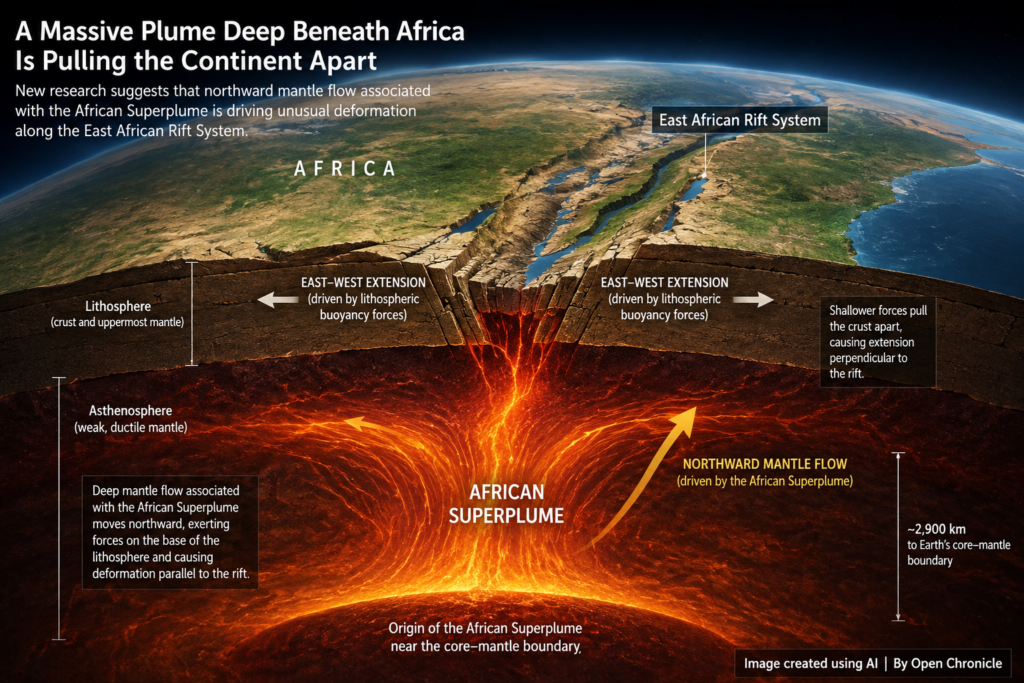
Computer modelling indicates that northward mantle flow associated with the superplume can explain deformation running parallel to the rift, a pattern that conventional models of continental stretching struggled to reproduce.
The findings add another dimension to scientists’ understanding of how Africa is gradually being pulled apart. Rather than a single tectonic force controlling the process, the evidence suggests that shallower forces within Earth’s lithosphere and much deeper circulation within the mantle are working together to reshape eastern Africa.
A Continent Slowly Pulling Apart
Continental rifting begins when Earth’s rigid outer shell starts to stretch and thin.
That shell, known as the lithosphere, includes the crust and the rigid uppermost portion of the mantle.
Its behaviour depends partly on depth, temperature and the timescale over which forces are applied. Near Earth’s surface, relatively cold rocks can fracture, producing faults and earthquakes. Farther below, hotter material can deform much more gradually.
Virginia Tech geophysicist D. Sarah Stamps has compared this behaviour to Silly Putty.
“If you hit Silly Putty with a hammer, it can actually crack and break,” Stamps explained. “But if you slowly pull it apart, the Silly Putty stretches. So on different time scales, Earth’s lithosphere behaves in different ways.”
Over geological timescales, continued stretching can eventually rupture a continent.
If the process continues far enough, magma rises into the thinning region, new crust can form and an ocean basin may eventually develop between the separated continental blocks.
East Africa provides scientists with a rare opportunity to observe some of the earlier stages of that enormous geological process.
The East African Rift Mystery
In most continental rifts, deformation follows a relatively predictable pattern.
The strongest movement generally occurs perpendicular to the rift, corresponding to the direction in which the crust is being stretched.
The East African Rift displays this expected behaviour. Much of the region is undergoing broadly east to west extension as portions of the African continent gradually separate.
But years of precision measurements revealed something unexpected.
After more than a decade of GPS observations, Stamps and her colleagues identified deformation occurring in another direction.
Parts of the region were also moving parallel to the rift, particularly toward the north.
That movement could not easily be reconciled with the simpler model of a continent merely being stretched sideways.
It became an important question for researchers at Virginia Tech’s Geodesy and Tectonophysics Laboratory.
Measuring a Continent in Millimetres
Detecting these movements requires extraordinary precision.
Researchers used GPS and related satellite positioning measurements to track how locations across eastern Africa changed position through time.
Signals transmitted from satellites orbiting thousands of kilometres above Earth allowed scientists to detect surface movements measured in millimetres.
Across many years, those tiny changes reveal the direction and velocity of tectonic motion.
The observations confirmed the expected extension across the rift.
But they also showed the anomalous movement along it.
The question was what could produce both patterns simultaneously.
A Giant Superplume Beneath Africa
One possible answer lies much deeper inside the planet.
Beneath Africa exists an enormous region of anomalously hot and buoyant mantle material known as the African Superplume.
It is associated with a vast structure extending upward from the deep mantle beneath southern Africa and toward the northeast.
As the mantle material travels northward, it becomes progressively shallower beneath the continent.
The scale involved is immense.
Earth’s mantle consists of solid rock, but over millions of years it can flow extremely slowly. Heat escaping from the planet’s interior helps drive this circulation, allowing hotter material to rise while cooler material descends.
Such mantle circulation can interact with the tectonic plates above.
Researchers therefore investigated whether the African Superplume could be influencing the unusual movements detected along the East African Rift.
Recreating the Rift in Three Dimensions
To explore the possibility, scientists turned to sophisticated three dimensional thermomechanical modelling.
These computational models allow researchers to simulate how Earth’s lithosphere and mantle behave under different temperatures, densities and forces.
The modelling work investigated how different configurations of mantle flow might influence deformation across East Africa.
The results indicated that northward mantle flow associated with the African Superplume could generate rift parallel deformation resembling the movement measured at Earth’s surface.
That finding provided a possible explanation for the geological mystery.
The mantle was not necessarily responsible for the principal opening of the rift.
Instead, it appeared capable of adding another component of motion.
Two Forces May Be Reshaping Africa
The findings contribute to a long running discussion over what drives the East African Rift.
One important mechanism involves lithospheric buoyancy forces.
These operate relatively close to Earth’s surface and arise from differences in elevation, crustal thickness and density within the lithosphere.
East Africa contains a particularly important geological feature called the African Superswell, a vast region of unusually elevated terrain.
The gravitational potential associated with such topography can produce forces that help drive the lithosphere apart.
Previous modelling demonstrated that these forces could reproduce much of the conventional deformation observed across the East African Rift.
In particular, they could explain much of the east to west extension occurring perpendicular to the rift.
But they could not adequately explain the unusual northward movement running parallel to it.
That suggested another mechanism was involved.
The Mantle Pulls From Below
The second mechanism involves mantle traction.
As mantle material flows beneath the lithosphere, viscous interaction between the two layers can exert forces against the underside of the tectonic plate.
The African Superplume may provide precisely such a mechanism.
Computer simulations suggest that northward mantle flow associated with the superplume can create deformation aligned with the East African Rift.
This produces a more complicated picture of continental breakup.
The familiar opening of the rift appears to be primarily associated with lithospheric buoyancy forces.
At the same time, deep mantle circulation may be contributing an additional northward component of motion.
Africa’s changing geology may therefore reflect the interaction between processes occurring near Earth’s surface and processes extending far deeper into the planet.
Seismic Waves Reveal a Hidden Pattern
Another important clue comes from seismic anisotropy.
Seismic waves produced by earthquakes travel through Earth’s interior, but their speed can vary depending on the direction in which they pass through certain rocks.
This happens because minerals and structures within the mantle can become aligned.
Mantle flow is one process capable of producing such alignment.
As mantle material moves over geological timescales, minerals such as olivine can develop preferred orientations. Seismic waves travelling through these rocks then reveal a directional pattern.
Scientists have detected seismic anisotropy beneath parts of the East African Rift that runs broadly parallel to the rift.
Significantly, the computer models incorporating northward African Superplume flow reproduced a similar pattern.
The agreement provides another line of evidence connecting deep mantle circulation with the unusual tectonic behaviour observed above.
Connecting the Surface With Earth’s Deep Interior
The importance of the discovery extends beyond East Africa.
Scientists cannot directly observe the deep mantle in the same way they can examine rocks exposed at Earth’s surface.
Instead, they reconstruct its behaviour using several independent sources of evidence.
Satellite positioning measures how the surface moves.
Seismic waves reveal structures deep underground.
Geological observations show how faults and volcanoes are distributed.
Computer models then test whether particular physical mechanisms can explain all of those observations simultaneously.
In East Africa, several of these lines of evidence increasingly point toward interaction between the lithosphere and deep mantle circulation.
Tiny movements measured at Earth’s surface may therefore reveal the effects of processes taking place hundreds or even thousands of kilometres beneath it.
Is Africa Really Splitting Apart?
The East African Rift is frequently described as evidence that Africa is splitting into two continents.
In geological terms, that description reflects a real process, but the timescale is crucial.
Continental breakup occurs over millions of years.
There is no sudden separation of Africa approaching on a human timescale.
Instead, scientists are observing gradual deformation of the lithosphere.
Faults develop. Earthquakes occur. Volcanoes erupt. Sections of crust stretch and thin.
If rifting persists for sufficiently long geological periods, the process could eventually separate portions of eastern Africa from the rest of the continent.
Water could ultimately enter the developing basin and a new ocean could form.
Whether the present rift evolves all the way to complete continental breakup depends on geological processes continuing for millions of years.
How Continents Become Oceans
Earth’s geological record contains many examples of this process.
The Atlantic Ocean itself developed after the supercontinent Pangaea began fragmenting roughly 200 million years ago.
Continental crust stretched and fractured.
Magma rose into the expanding gaps.
Eventually, new oceanic crust formed and the Atlantic began widening between the separating continents.
Similar processes created other ocean basins throughout Earth’s history.
The East African Rift gives geologists an opportunity to investigate how such transformations begin.
What is happening beneath Africa today may therefore offer clues to processes that reshaped the planet hundreds of millions of years ago.
A Natural Laboratory for Planetary Change
Few places provide a better natural laboratory for studying continental breakup than East Africa.
The region contains active faults, volcanic systems, elevated plateaus and some of Earth’s most important rift valleys.
Modern scientific instruments now allow researchers to examine these features at unprecedented scales.
Networks of GNSS stations can track tectonic movement in near real time.
Seismometers can map earthquakes and probe structures deep within the planet.
Satellite observations can detect changes in Earth’s surface.
Geochemical studies can analyse magma rising from the mantle.
And increasingly powerful computational models allow researchers to combine those observations into dynamic representations of Earth’s interior.
Together, these tools are transforming scientists’ understanding of how continents evolve.
A More Complex Picture of Continental Breakup
The emerging picture from East Africa suggests that there may be no single answer to the question of what is pulling the continent apart.
Shallower lithospheric buoyancy forces appear to play a major role in the familiar stretching occurring perpendicular to the rift.
At the same time, deeper mantle flow associated with the African Superplume may help explain the anomalous northward deformation running parallel to it.
Both processes can operate simultaneously.
That means the East African Rift is not simply a crack spreading through Earth’s crust.
It is part of a much larger dynamic system connecting the surface of the planet with the circulation of material deep inside Earth.
Understanding that interaction could help scientists explain not only the future evolution of East Africa but also how continents have repeatedly assembled and fragmented throughout geological history.
Africa’s changing geography may therefore have roots extending astonishingly deep into the planet.
Far beneath the rift valleys and volcanoes visible at the surface, an enormous flow of mantle rock appears to be participating in the slow rearrangement of a continent.
Story Source
Materials provided by Virginia Tech.
Note: Content may be edited for style and length.
Story Source:
Virginia Tech, Deep mantle flow beneath East Africa may be shaping the East African Rift System.
https://news.vt.edu/articles/2023/06/science-east-african-rift-system-stamps-rajaonarison.html
Journal References
1. Asenath Kwagalakwe, D. Sarah Stamps, Folarin Kolawole, Estella A. Atekwana, Michael Taylor, Eliot A. Atekwana, Andrew B. Katumwehe, Peter H. Barry, Emmanuel A. Njinju, Joseph Nyago, Fred Tugume, John Mary Kiberu, Joan Nakajigo, Albert Kabanda, Gladys Kianji, Elifuraha Saria.
Constraining the Kinematics of the Victoria Microplate and the Northern Western Branch of the East African Rift System.
Geophysical Research Letters, 2025; 52 (20).
DOI: 10.1029/2025GL116301
2. Tahiry A. Rajaonarison, D. Sarah Stamps, John Naliboff.
Role of Lithospheric Buoyancy Forces in Driving Deformation in East Africa From 3D Geodynamic Modeling.
Geophysical Research Letters, 2021; 48 (6).
DOI: 10.1029/2020GL090483