
By Open Chronicle History Desk
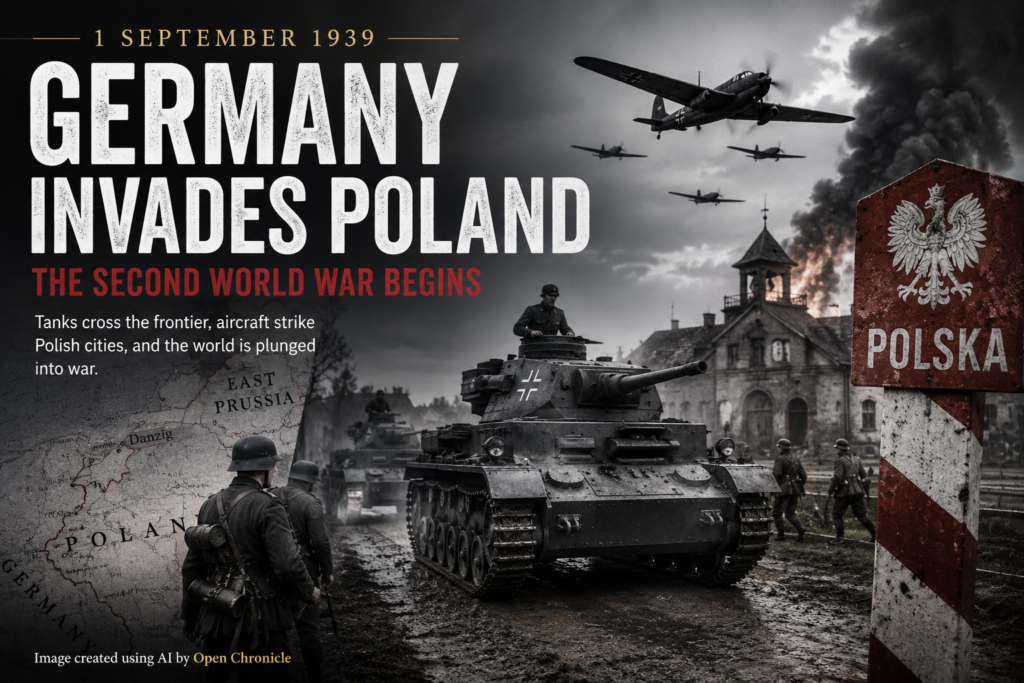
On 1 September 1939, German forces invaded Poland, launching a massive military assault that transformed a European crisis into the opening campaign of the Second World War. Tanks crossed the Polish frontier, aircraft attacked military and civilian targets, and the German battleship Schleswig Holstein opened fire on the Polish garrison at Westerplatte near Danzig.
Within two days, Britain and France would declare war on Germany.
The invasion marked the failure of years of attempts to contain Adolf Hitler’s expansionism through diplomacy. It also began a conflict that would spread across continents, involve dozens of nations and cause destruction on a scale unprecedented in human history.
For 1 September, few events have had consequences as profound as the attack on Poland.
The Road to War
The invasion did not emerge suddenly.
After taking power in Germany in 1933, Adolf Hitler systematically challenged the European settlement created after the First World War. Germany rearmed, remilitarised the Rhineland in 1936, annexed Austria in March 1938 and later demanded territory from Czechoslovakia.
At the Munich Conference in September 1938, Britain, France, Germany and Italy agreed that Germany could annex the Sudetenland, a predominantly German speaking region of Czechoslovakia.
The agreement was intended to prevent another European war.
Instead, Hitler’s ambitions continued.
German troops occupied the Czech lands in March 1939, demonstrating that Hitler’s objectives extended beyond the incorporation of German speaking populations.
Attention increasingly turned towards Poland.
Germany demanded the return of the Free City of Danzig and sought transport connections across the Polish Corridor, which separated East Prussia from the rest of Germany.
Poland refused to surrender its sovereignty over these arrangements.
Britain and France subsequently guaranteed Polish independence.
Europe was moving rapidly towards war.
The Molotov Ribbentrop Pact
One of the decisive developments came only days before the invasion.
On 23 August 1939, Nazi Germany and the Soviet Union signed the German Soviet Non Aggression Pact, commonly known as the Molotov Ribbentrop Pact.
Publicly, the two powers promised not to attack one another.
Secret protocols attached to the agreement were far more consequential. They divided parts of Eastern Europe into German and Soviet spheres of influence, including provisions concerning the partition of Poland.
For Hitler, the agreement greatly reduced the immediate danger of Germany facing a simultaneous war against Poland and the Soviet Union.
For Joseph Stalin, it provided time for Soviet military preparation while extending Soviet influence westward.
Eight days later, Germany attacked Poland.
The Attack Begins
At approximately 4:45 a.m. on 1 September, the German battleship Schleswig Holstein, anchored near the Free City of Danzig, opened fire on the Polish military depot at Westerplatte.
The bombardment became one of the symbolic opening actions of the Second World War in Europe.
Elsewhere, German aircraft struck targets across Poland as ground forces crossed the frontier from several directions.
The invasion involved approximately 1.5 million German troops supported by thousands of tanks, artillery pieces and aircraft.
Poland now faced attacks from the north, west and south.
German operational doctrine emphasised speed, concentration of force, close coordination between armoured formations and aircraft, and the disruption of enemy command and communications.
The campaign would later become closely associated with the term Blitzkrieg, or “lightning war”.
Poland Fights Back
The German invasion is sometimes portrayed as an effortless victory against an obsolete Polish military.
The reality was more complicated.
Polish forces resisted fiercely in numerous battles and inflicted significant casualties. Poland possessed capable soldiers and officers, but its strategic position was extremely difficult.
The country’s long borders made defence challenging. German forces could attack from East Prussia in the north, Germany in the west and German controlled Slovakia in the south.
Germany also possessed significant advantages in aircraft, armour, communications and operational mobility.
Polish commanders hoped to resist long enough for Britain and France to launch substantial military operations against Germany in the west.
That intervention never developed on the scale Poland required.
Westerplatte
One of the most famous episodes of the campaign occurred at Westerplatte.
A small Polish garrison defended the military transit depot against a much larger German force.
German commanders initially expected the position to fall quickly.
Instead, the defenders resisted for seven days.
Repeated bombardments, infantry attacks and attempts to destroy the Polish defensive positions failed to produce an immediate surrender.
Westerplatte became a powerful symbol of Polish resistance and remains one of the defining historical locations associated with the opening of the war.
The Bombing of Wieluń
The opening hours of the invasion also demonstrated what modern warfare would mean for civilian populations.
The Polish town of Wieluń was subjected to devastating German air attacks on the morning of 1 September.
Large parts of the town were destroyed and civilians were killed.
The attack remains historically significant in discussions of the beginning of aerial warfare against populated areas during the conflict.
Across Poland, the invasion rapidly brought civilians into the battlefield.
Roads became crowded with refugees attempting to escape advancing German forces. Towns were bombed, transport networks disrupted and communications severed.
The distinction between the front and the civilian rear was already beginning to collapse.
Britain and France Face Their Decision
The invasion confronted Britain and France with the question they had attempted to avoid throughout the diplomatic crises of the late 1930s.
Would they go to war?
Both countries had guaranteed Polish independence.
Ultimatums were delivered demanding that Germany withdraw its forces.
Hitler did not comply.
On 3 September 1939, Britain declared war on Germany.
France followed later that day.
British Prime Minister Neville Chamberlain announced the decision in a radio broadcast to the nation.
Europe was once again at war, barely twenty one years after the end of the First World War.
The Soviet Invasion
Poland’s position became catastrophic on 17 September.
Soviet forces invaded eastern Poland in accordance with the geopolitical arrangements established between Nazi Germany and the Soviet Union.
The Polish state was now caught between two enormous military powers.
Warsaw continued resisting until 28 September, while organised Polish resistance elsewhere continued into early October.
The campaign ended with Poland divided between Germany and the Soviet Union.
But the Polish war effort did not disappear.
Thousands of Polish soldiers escaped abroad. Polish armed forces would later fight alongside the Allies in France, Britain, North Africa, Italy and elsewhere.
Inside occupied Poland, one of Europe’s largest underground resistance movements developed.
Occupation and Terror
Military defeat was only the beginning of Poland’s catastrophe.
German occupation policies involved systematic repression, mass executions, forced displacement and the destruction of Polish political, intellectual and cultural elites.
Nazi racial ideology regarded large sections of the population of Eastern Europe as racially inferior and considered Polish territory central to plans for German expansion.
Polish Jews were progressively subjected to persecution, confinement and ultimately mass murder as Nazi Germany developed the Holocaust.
The Soviet occupied territories also experienced deportations, arrests and executions.
Among the most notorious crimes was the Katyn massacre, in which thousands of Polish military officers and members of the country’s elite were murdered by the Soviet secret police in 1940.
Poland would suffer proportionally some of the greatest human losses of any country during the Second World War.
A European War Becomes a World War
On 1 September 1939, the conflict was still geographically concentrated in Poland.
It would not remain so.
Germany invaded Denmark and Norway in April 1940.
The following month, German forces attacked the Netherlands, Belgium, Luxembourg and France.
France fell in June.
Britain continued fighting.
In June 1941, Hitler invaded the Soviet Union, transforming Eastern Europe into the largest and bloodiest theatre of the war.
Japan’s attack on Pearl Harbor in December 1941 brought the United States directly into the conflict.
War spread across Europe, North Africa, Asia, the Atlantic and the Pacific.
By the time it ended in 1945, tens of millions of people were dead.
Why September 1 Matters
The invasion of Poland represents far more than the beginning of another military campaign.
It marks the moment when the international system created after the First World War finally collapsed into general European war.
Years of territorial expansion, diplomatic concessions, ideological confrontation and failed deterrence culminated in military action.
The consequences were enormous.
The war destroyed Nazi Germany and Imperial Japan, devastated much of Europe and Asia, accelerated the decline of European colonial empires and transformed the United States and Soviet Union into rival superpowers.
It contributed directly to the creation of the United Nations and shaped the international political order for generations.
It also produced the Holocaust, one of history’s most systematic campaigns of genocide.
Much of the political geography of the second half of the twentieth century can be traced back to the conflict that began in Europe that morning.
September 1, 1939
Before dawn on 1 September 1939, soldiers moved across the Polish frontier and the guns at Westerplatte opened fire.
At that moment, nobody could know the full scale of what was beginning.
Within six years, cities from Warsaw to London, Stalingrad, Dresden, Tokyo and Hiroshima would become synonymous with destruction. Governments would collapse. Empires would disappear. Genocide would murder millions. New superpowers would emerge.
The world of 1945 would be fundamentally different from the world that existed before the invasion.
For that reason, 1 September 1939 remains one of the great dividing lines of modern history, the day a regional invasion became the beginning of the most destructive war humanity had ever experienced.