
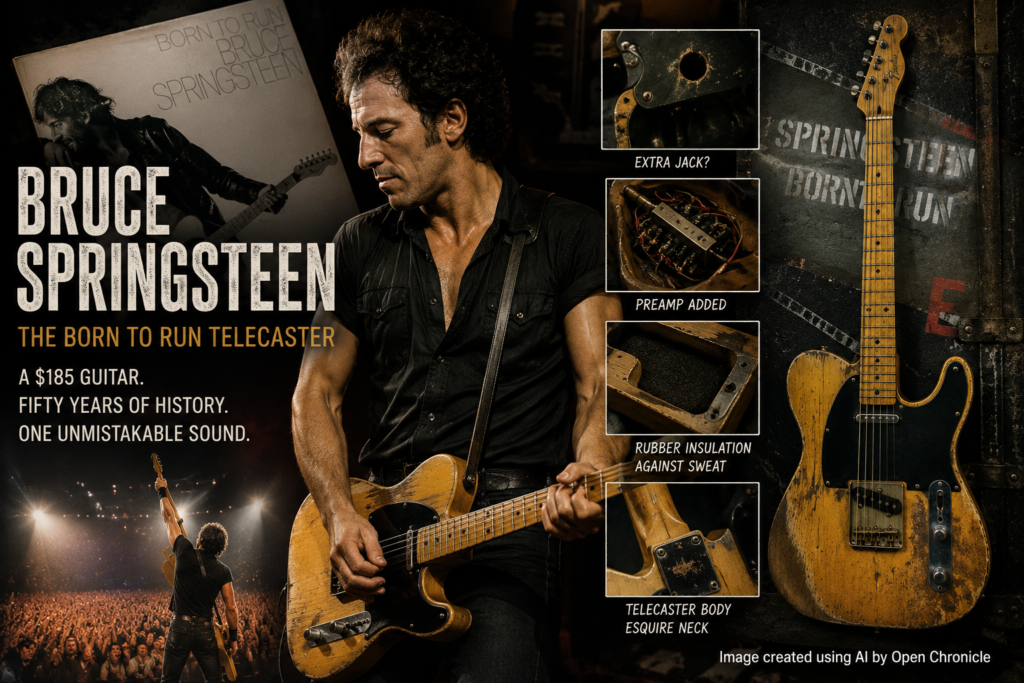
The guitar that became inseparable from Bruce Springsteen started life as a $185 purchase in New Jersey. More than half a century later, the unusual Telecaster and Esquire hybrid remains one of rock ’n’ roll’s most recognisable instruments.
By Open Chronicle GuitarWorldX
Bruce Springsteen has opened up about the history, modifications and enduring mysteries surrounding the battered Fender that has accompanied him through more than five decades of rock ’n’ roll history.
The instrument features prominently in The One That Started It All, a new documentary released as part of Fender’s celebration of the Telecaster’s 75th anniversary. The film brings together musicians from several generations to examine how Leo Fender’s remarkably simple solid body design became one of the defining instruments of modern popular music.
For Springsteen, however, the story is particularly personal.
His famous guitar is not quite an ordinary Telecaster, and perhaps never was.
A $185 guitar that became part of rock history
Springsteen recalls finding the instrument at guitar maker Phil Petillo’s shop in 1972, shortly after signing his first record contract.
He knew what kind of guitar he wanted.
A Telecaster.
The instrument hanging on the wall cost him $185. Springsteen describes it simply as a “mutt”, because it combines an early 1950s Telecaster body with an Esquire neck.
It would prove to be an extraordinary purchase.
Three years later, the guitar appeared around Springsteen’s neck on the famous black and white cover of Born to Run, the 1975 album that transformed his career. Fender itself notes the guitar’s unusual Telecaster versus Esquire identity when recounting the instrument’s place in Telecaster history.
But the guitar was never simply an album cover prop.
It became a working instrument.
For decades it travelled with Springsteen through clubs, theatres, arenas and stadiums, gradually becoming as recognisable as the musician carrying it.
“Your working man’s axe”
Springsteen’s description of the Telecaster reveals much about why the model suited him.
“This is your working man’s axe.”
The phrase feels particularly appropriate coming from a songwriter whose musical identity has so often been built around working lives, American towns, cars, factories, roads and ordinary people.
For Springsteen, the appeal lies partly in the Telecaster’s fundamental simplicity.
Wood, neck, strings, pickups and very little unnecessary complication.
That simplicity is one of the reasons the Telecaster has survived remarkably close to its original concept since its introduction in 1951. Fender describes the instrument as rugged, reliable and versatile, qualities that helped it move far beyond its early association with western swing into rock, soul, country, punk, blues and numerous other genres.
Springsteen saw that versatility in the musicians who played them.
Jeff Beck. Pete Townshend. Steve Cropper. James Burton.
Together, those names represented everything from rock and soul to rockabilly.
For Springsteen, that range provided the answer.
The Telecaster was the guitar for him.
But Springsteen’s guitar isn’t exactly stock
Look beneath the road wear and Springsteen’s instrument becomes considerably stranger.
Over the decades, it has undergone numerous modifications, some made for practical reasons and others apparently dating from before Springsteen acquired it.
One of the mysteries is a small hole in the pickguard associated with an additional jack socket. Springsteen says someone may once have attempted to configure the guitar for stereo operation.
Another modification came directly from the demands of Springsteen’s increasingly physical live performances.
A preamp was installed inside the guitar.
Springsteen wanted the freedom to move around large stages using a very long guitar cable, but the cable length caused a loss of high frequencies. The onboard preamp helped compensate for that problem.
This was before modern wireless systems made roaming around an arena considerably easier.
Springsteen and his guitar had another problem to solve.
Sweat.
A guitar built to survive Bruce Springsteen
Springsteen’s famously energetic performances presented an unusual technical problem.
He recalls sweating so heavily during concerts that moisture could eventually cause the guitar to short out, dramatically degrading its sound.
The solution was wonderfully practical.
The inside of the instrument was insulated with rubber.
It is difficult to imagine a modification that better captures the character of this particular guitar.
This was not a pristine vintage instrument preserved for collectors.
It was a tool being continuously adapted to survive the job.
Springsteen was also operating during a period when he could use the same guitar throughout an entire performance, making reliability especially important.
As he acknowledges in the documentary, the instrument has existed in several different configurations during its life.
More than a guitar
The connection eventually became physical.
When Springsteen previously brought the instrument onto The Late Show with Stephen Colbert in 2021, he explained that after decades of playing it, the guitar no longer felt like an external object.
Other guitars still felt like guitars.
This one felt like part of him.
That distinction helps explain why instruments like Springsteen’s Telecaster occupy such an unusual place in music history.
Their importance cannot be measured entirely by specifications, age or market value.
The scratches matter.
The modifications matter.
The replaced components matter.
So do thousands of hours spent on stage.
A theoretically more valuable vintage Telecaster could never reproduce that history.
75 years of the Telecaster
Springsteen’s story is part of a much larger celebration.
Introduced in 1951, the Telecaster became one of the foundational designs of the solid body electric guitar. Seventy five years later, its basic architecture remains immediately recognisable.
Fender’s anniversary film brings together a remarkable collection of Telecaster players, including Keith Richards, Sheryl Crow, Andy Summers, Jack White, Joe Bonamassa, Vince Gill, John 5, Julien Baker and others. The documentary also explores the craftspeople behind the instrument, including legendary Fender pickup winder Abigail Ybarra.
The diversity of those musicians illustrates the Telecaster’s greatest achievement.
It never acquired just one musical identity.
Country players made it twang.
Soul musicians made it groove.
Rock musicians made it roar.
Punk musicians weaponised its simplicity.
Experimental players discovered entirely different sounds inside the same basic design.
And Bruce Springsteen turned one battered example into a piece of personal history.
The perfect imperfection
Something is fitting about Springsteen’s most famous guitar being a “mutt”.
It is not historically perfect.
It has an early Telecaster body and an Esquire neck. It has been modified, repaired, insulated, and altered according to the practical demands of life on the road.
Yet those imperfections are precisely what make it special.
Springsteen did not acquire a museum piece in 1972.
He bought a working guitar for $185.
Then he worked with it.
More than 50 years later, that instrument has become part of the visual and sonic language surrounding one of America’s defining rock musicians.
For all the mythology surrounding vintage guitars, Springsteen’s Telecaster offers a much simpler lesson.
Sometimes the most important guitar is not the rarest, most expensive or most perfectly preserved.
It is the one that was there when the music happened.
Watch The One That Started It All
Fender’s Telecaster 75th anniversary documentary is available free to watch online and runs for almost 80 minutes.
GuitarWorldX
Lessons, gear, techniques, artists, guitar legends and the stories shaping the world of guitar.
Return to GuitarWorldX ›