
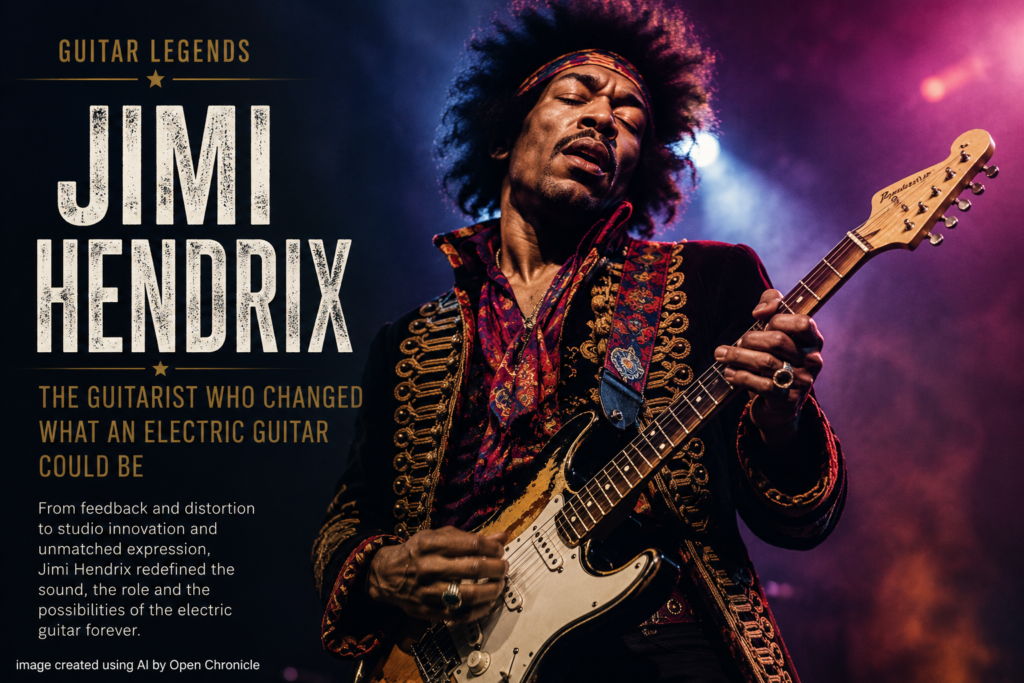
Guitar Legends
By Open Chronicle GuitarWorldX
Few musicians can genuinely be described as having changed the possibilities of their instrument. Jimi Hendrix is one of them.
Before Hendrix, the electric guitar had already become a defining voice of blues, rock and popular music. After him, its boundaries seemed dramatically wider.
Feedback could become musical. Distortion could become expressive. The recording studio could become part of the instrument. Rhythm and lead guitar could merge into a single fluid language. Even noise, in the right hands, could communicate something.
Hendrix did not simply become one of rock’s greatest guitarists.
He changed the question from How should an electric guitar be played? to What else can an electric guitar become?
From Seattle to the guitar
James Marshall Hendrix was born in Seattle, Washington, in 1942. His rise to international fame would eventually be extraordinarily rapid, but his musical development was anything but instantaneous.
Hendrix absorbed the vocabulary of blues, rhythm and blues, soul and early rock and roll. After serving in the U.S. Army, he worked extensively as a backing musician, performing with artists including Little Richard and the Isley Brothers.
Those years mattered.
Long before audiences saw Hendrix setting stages alight with psychedelic guitar, he had learned something fundamental: how to support a song.
Rhythm, dynamics and interaction were already embedded in his playing.
The revolutionary guitarist emerged from a working musician.
London changes everything
The decisive turn came in 1966.
Hendrix travelled to London, where he formed the Jimi Hendrix Experience with bassist Noel Redding and drummer Mitch Mitchell.
British musicians were already pushing blues into increasingly loud and experimental territory. Hendrix arrived in the middle of that transformation and accelerated it.
His performances quickly attracted attention from some of Britain’s most prominent musicians.
Then came the records.
Are You Experienced arrived in 1967, followed by Axis: Bold as Love later that year and Electric Ladyland in 1968.
Three studio albums were enough to establish a legacy that musicians are still studying decades later.
The guitar becomes something else
Hendrix’s importance cannot be reduced to speed or technical difficulty.
His revolution was broader.
He treated the electric guitar, amplifier and effects as parts of one interconnected instrument.
Feedback was no longer necessarily an unwanted accident. It could be controlled.
Distortion did not simply make the guitar louder or heavier. It altered the emotional character of a note.
The wah pedal could make a phrase almost vocal.
Fuzz could turn a guitar into a wall of harmonics.
The vibrato system could destabilise pitch until chords seemed to bend and collapse.
Hendrix explored all of these possibilities while retaining a remarkably strong connection to blues phrasing.
The future was being built on an older language.
Rhythm and lead were no longer separate worlds
One of the most important aspects of Hendrix’s playing can be overlooked because his solos attract so much attention.
He was an extraordinary rhythm guitarist.
His use of chord embellishments, partial chords, double stops, melodic fills and thumb fretting allowed harmony and melody to coexist continuously.
Listen to the way chordal playing flows into fills and back again. The traditional boundary between a rhythm guitarist and a lead guitarist begins to disappear.
The guitar does not simply accompany the song before stepping forward for a solo.
It becomes an evolving conversation throughout the arrangement.
That approach would influence generations of players.
The sound of controlled instability
Hendrix understood something that remains central to expressive electric guitar playing: perfect cleanliness is not always desirable.
Some of his most compelling sounds exist at the edge of instability.
Amplifiers feed back. Notes bloom into harmonics. Pitch bends beyond conventional boundaries. Fuzz compresses and reshapes the attack.
Yet the result rarely feels accidental.
That distinction is essential.
Noise alone is not innovation.
Hendrix developed the ability to make unstable sounds respond to musical intention.
He learned how chaos could be controlled just enough to become expressive.
The Stratocaster
Hendrix became inseparable in popular imagination from the Fender Stratocaster.
As a left handed guitarist who often played right handed Stratocasters restrung for left handed use, Hendrix created one of the most recognisable silhouettes in music history.
But the relationship went far beyond appearance.
The Stratocaster’s pickup combinations, vibrato system and responsiveness suited a player constantly manipulating dynamics, pitch and texture.
Hendrix demonstrated how dramatically the personality of an electric guitar could change depending on touch, amplifier interaction and effects.
The instrument itself was only part of the equation.
The player completed the circuit.
The studio becomes an instrument
Hendrix’s experimentation was not confined to the stage.
Electric Ladyland demonstrated how deeply he had begun thinking about recording itself as a creative medium.
Layered guitars, stereo movement, altered textures and studio processing expanded his sonic vocabulary beyond what a conventional live trio could reproduce.
This was another important step.
The guitarist was no longer simply someone whose performance happened to be recorded.
Recording technology could become part of composition.
That idea would become fundamental to countless guitarists and producers who followed.
Woodstock and a guitar that spoke about America
One performance became larger than almost anything else Hendrix recorded.
At Woodstock in August 1969, Hendrix performed his interpretation of “The Star Spangled Banner.”
The melody remained recognisable, but around it emerged feedback, distortion, violent pitch movement and sounds that listeners could associate with sirens, explosions and machinery.
The performance has been interpreted in different ways ever since, as protest, commentary, transformation and even an unconventional expression of patriotism.
Its enduring power comes partly from that ambiguity.
Hendrix did not need to deliver a speech.
The guitar itself carried the argument.
It demonstrated perhaps more clearly than any technical exercise what he had accomplished.
The electric guitar had become capable of representing something beyond melody and harmony.
It could communicate an idea.
More than psychedelic rock
It is tempting to trap Hendrix inside the psychedelic 1960s.
His influence makes that impossible.
Hard rock inherited his relationship with volume and distortion.
Heavy metal absorbed elements of his sonic aggression.
Funk guitarists developed rhythmic ideas connected to the vocabulary he explored.
Experimental musicians followed his willingness to treat noise as material.
Blues rock players studied his phrasing.
Modern pedal culture continues the search for new textures that Hendrix helped legitimise.
His fingerprints appear across genres that evolved long after his death.
Why Hendrix still matters to guitarists
A modern player has access to technology Hendrix could scarcely have imagined.
Digital modelling can reproduce enormous collections of amplifiers. Pedalboards can contain hundreds of sounds. Recording software can manipulate virtually every aspect of a performance.
Yet Hendrix remains relevant because his greatest lesson was never about equipment.
It was curiosity.
He explored what happened when conventional technique met unconventional sound.
He listened to accidents.
He manipulated limitations.
He combined deep musical roots with a willingness to ignore assumptions about what was acceptable.
That principle has not aged.
What guitarists can learn from Hendrix?
The obvious temptation is to study Hendrix by copying his licks.
There is value in doing that, but imitation only reaches the surface.
The deeper lessons are more useful.
Learn rhythm as seriously as lead playing. Treat dynamics as part of technique. Understand how your amplifier responds to your hands. Explore effects rather than merely switching them on. Listen to unusual sounds before deciding they are mistakes.
Most importantly, remain curious about the instrument.
Hendrix’s legacy is not an instruction to sound like Hendrix.
It is permission to discover sounds that do not yet belong to anyone.
A career measured in years, an influence measured in generations
Jimi Hendrix died in London on September 18, 1970. He was 27 years old.
His period as an internationally famous recording artist had lasted only a few years.
That makes the scale of his influence even more extraordinary.
There were technically accomplished guitarists before Hendrix. There were experimental musicians before Hendrix. There were blues players capable of extraordinary emotional expression before Hendrix.
What made him exceptional was the way those worlds collided.
Tradition and experimentation. Rhythm and lead. Music and noise. Guitar and technology.
He brought them together and demonstrated that the electric guitar was still an unfinished idea.
More than half a century later, guitarists are still exploring the possibilities he helped reveal.
That is why Jimi Hendrix belongs at the beginning of Guitar Legends.
He did not simply master the electric guitar.
He helped redefine what it was.
Guitar Legends
The pioneers, innovators and virtuosos whose sound, technique and vision changed guitar history forever.
GuitarWorldX
Lessons, gear, techniques, artists, guitar legends and the stories shaping the world of guitar.
Return to GuitarWorldX ›