
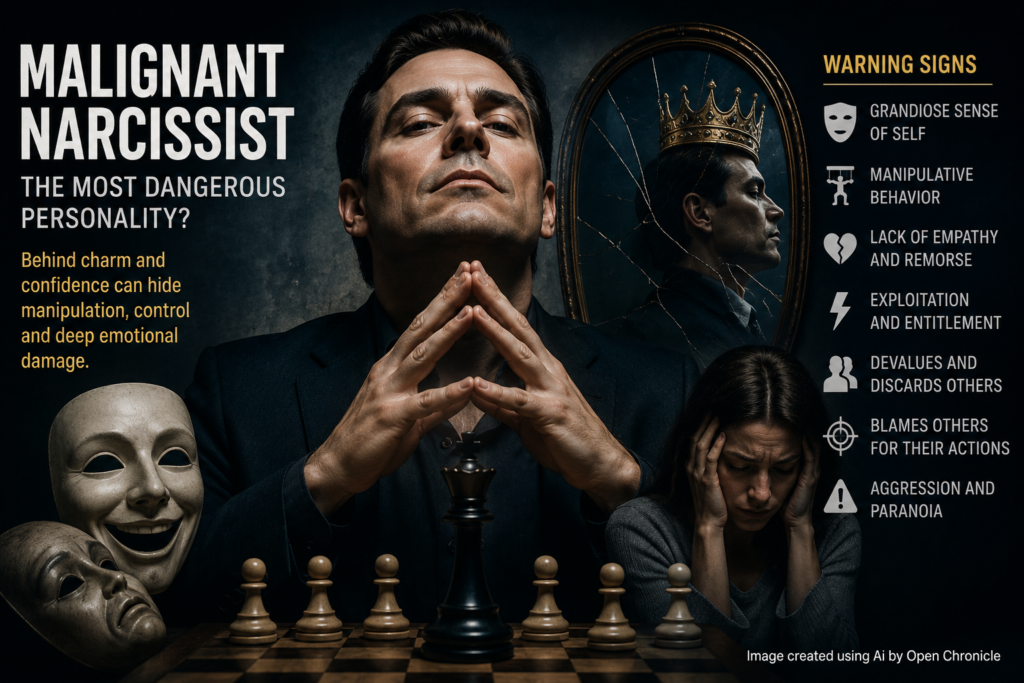
By Open Chronicle Newsdesk with agencies
A former FBI special agent has warned that one of the most damaging personality patterns people may encounter is not necessarily the stereotypical psychopath, but what psychologists have described as a “malignant narcissist”, someone whose grandiosity and need for control can be accompanied by manipulation, aggression, paranoia and a striking disregard for other people.
Joe Navarro, who spent 25 years with the FBI and specialized in behavioral analysis and counterintelligence, said malignant narcissists can cause particularly serious damage within personal relationships. Speaking to LADBible Originals in an interview highlighted by Tyla, Navarro contrasted their behavior with that of psychopaths, arguing that the consequences can extend across a victim’s psychological, emotional and financial life.
However, there is an important clinical distinction. “Malignant narcissism” is not an independent psychiatric diagnosis in the DSM. Researchers and clinicians instead use the term to describe a constellation of severe narcissistic characteristics combined with traits such as antisocial behavior, aggression, paranoia and, in some formulations, sadistic tendencies.
Why Navarro Considers the Pattern So Destructive
Navarro argues that psychopaths may be easier to associate with obvious criminality because their behavior can repeatedly bring them into contact with law enforcement.
The malignant narcissist can operate differently.
According to Navarro, the central interpersonal problem involves an extreme imbalance between how such individuals perceive themselves and how they perceive everyone around them. They may greatly overvalue themselves while simultaneously devaluing other people.
That dynamic can become destructive when combined with manipulation, entitlement and a willingness to exploit others.
Navarro said correspondence he received following the publication of his book Dangerous Personalities led him to believe malignant narcissists may inflict particularly extensive interpersonal harm.
What Is Malignant Narcissism?
The concept has a long history in psychology and psychiatry, although its boundaries remain debated.
Social psychologist Erich Fromm introduced the term, while psychoanalyst Otto Kernberg subsequently developed the concept within his work on pathological narcissism.
Clinical literature has generally associated malignant narcissism with a combination of narcissistic pathology, antisocial behavior, paranoid tendencies and aggressive or sadistic interpersonal characteristics.
Researchers have continued trying to define the construct more precisely. A study published in the Journal of Personality Assessment developed a scoring procedure based on personality traits and found meaningful associations between malignant narcissism and broader difficulties involving personality functioning, relationships, emotions and behavior.
But the absence of a standalone diagnosis matters. Describing someone as a malignant narcissist should not be treated as equivalent to a professional psychiatric diagnosis.
Warning Signs Associated With the Pattern
Descriptions of malignant narcissism frequently include exaggerated self importance, entitlement, exploitation of others, difficulty tolerating criticism and a persistent need for admiration or validation.
More concerning presentations can involve manipulation, lack of remorse, aggressive responses to perceived humiliation, treating supposedly inferior people badly and blaming others for one’s own harmful behavior.
Another characteristic sometimes associated with the pattern is an intensely polarized view of relationships. People can be divided into allies and enemies, while disagreements may be interpreted as personal attacks or betrayals.
The person may also pursue victory or control regardless of the emotional consequences for others.
These characteristics should nevertheless be understood as patterns rather than a checklist allowing someone to diagnose a partner, colleague or family member. Individual behaviors such as selfishness, arrogance or defensiveness do not by themselves establish a personality disorder.
Criticism Can Become a Flashpoint
One particularly important feature concerns reactions to criticism.
People with severe narcissistic traits may project confidence and superiority while simultaneously having difficulty regulating their response when their status or self image is challenged.
Consequently, criticism, rejection or perceived humiliation can trigger disproportionate anger, retaliation or attempts to restore control.
This helps explain why relationships involving severe narcissistic and antagonistic traits can become unstable.
An individual may demand admiration while interpreting ordinary disagreement as disrespect.
Manipulation Without Breaking Any Laws
Navarro’s argument is particularly relevant because serious interpersonal harm does not necessarily involve criminal behavior.
Manipulation can occur within marriages, families, workplaces and financial relationships while remaining largely invisible to outsiders.
A controlling individual may exploit emotional dependencies, undermine another person’s confidence or use financial pressure without displaying the overt criminality normally associated with dangerous personalities.
That distinction helps explain Navarro’s contention that malignant narcissistic behavior can be especially damaging at the interpersonal level.
The consequences may accumulate gradually rather than emerge from a single dramatic incident.
Psychopathy and Malignant Narcissism Are Not the Same
The terms psychopath, narcissist and malignant narcissist are frequently used interchangeably in popular culture, but they describe different concepts.
Psychopathy generally refers to a constellation of traits involving callousness, manipulativeness, shallow affect and antisocial behavior, although psychopathy itself is also not a standalone DSM diagnosis.
Malignant narcissism places greater emphasis on pathological grandiosity, entitlement and the maintenance of an inflated self image, combined with other antagonistic or antisocial characteristics.
The categories can overlap, which is one reason researchers continue studying how malignant narcissism relates to psychopathy, narcissistic personality disorder and antisocial personality traits.
Recognition Is Not Diagnosis
The growing popularity of psychological terminology on social media has made words such as “narcissist” commonplace descriptions for difficult partners, bosses and relatives.
Clinical psychology requires considerably more caution.
Personality disorders involve persistent patterns across situations and over time, and proper assessment requires qualified professionals. Someone behaving selfishly, manipulatively or arrogantly does not automatically have narcissistic personality disorder, much less what researchers describe as malignant narcissism.
For people dealing with genuinely abusive or coercive behavior, the practical question may therefore be less about assigning a psychological label and more about recognizing harmful patterns, establishing boundaries and seeking appropriate professional or personal support.
Navarro’s warning ultimately points toward that broader lesson.
Dangerous interpersonal behavior does not always come from people who look obviously threatening. In some circumstances, the greatest damage can emerge gradually through control, exploitation and manipulation inside relationships that initially appear entirely ordinary.