
By Open Chronicle Newsdesk with agencies
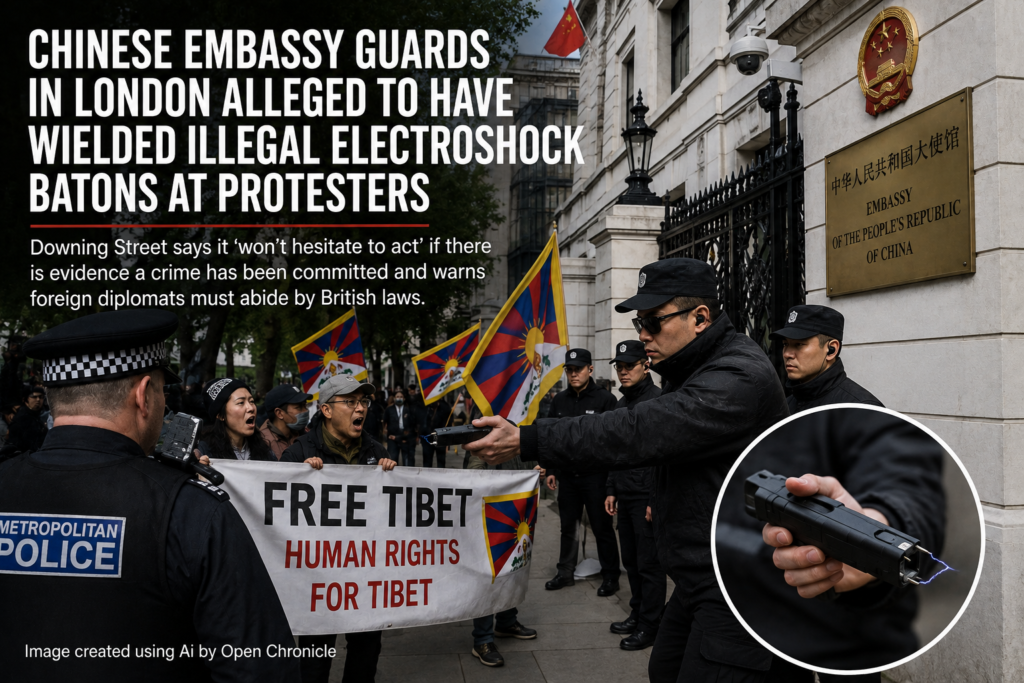
British authorities are investigating allegations that security personnel at the Chinese Embassy in London pointed prohibited electroshock weapons at protesters during a demonstration, prompting Downing Street to warn that attempts by foreign states to intimidate people on British soil will not be tolerated.
The Metropolitan Police said officers were called to the Chinese Embassy on Portland Place on July 3 after two protesters reported that embassy staff had pointed what they described as a Taser towards them.
No injuries were reported and no arrests have been made. Police said investigators are examining evidence, including video footage supplied by witnesses.
The allegations have nevertheless developed into a wider diplomatic controversy, with the British government confirming that it has raised the incident directly with the Chinese Embassy.
Downing Street warns it could act
Prime Ministerial officials said foreign diplomats operating in Britain are expected to comply with UK law.
The Prime Minister’s official spokesperson declined to prejudge the ongoing police investigation but said the government would respond if evidence demonstrated that an offence had taken place.
“If there’s evidence a crime has been committed, we won’t hesitate to act,” the spokesperson said.
Downing Street also issued a broader warning concerning foreign interference and intimidation inside Britain.
“Any attempts by a foreign state to coerce, intimidate, harass or harm individuals on UK soil will never be tolerated,” the spokesperson said.
The government said it expects foreign diplomats in Britain to respect British laws just as British diplomats are expected to comply with the laws of countries where they are posted.
Chinese Embassy rejects allegations
The Chinese Embassy strongly denied the claims against its security personnel.
It described the allegations as “fabrication and defamation” by what it called “Tibetan independence elements”.
According to the embassy’s account, protesters attempted to force their way onto embassy premises during the demonstration.
The competing accounts leave the circumstances surrounding the confrontation under investigation.
The incident is particularly sensitive because diplomatic premises and personnel are subject to international protections, potentially complicating the ability of British authorities to investigate alleged offences occurring within or around embassy property.
Opposition demands stronger response
Shadow national security minister Alicia Kearns accused the government of failing to respond forcefully enough.
Kearns argued that relying on the Metropolitan Police investigation could prove ineffective because international protections surrounding diplomatic premises could make prosecutions difficult.
She also alleged that evidence of prohibited electroshock weapons had emerged at more than one Chinese site.
“The Government needs to deter future threats, but that requires them to act, now,” Kearns said.
Her intervention raises the political stakes surrounding the investigation, transforming what began as an alleged confrontation outside an embassy into a broader debate about how Britain should respond to suspected intimidation by representatives of foreign governments.
Police examining video evidence
The Metropolitan Police confirmed that officers responded at approximately 6 pm on July 3 following reports of a protest outside the embassy.
“Two protesters alleged that embassy staff had pointed a Taser towards them,” police said.
Officers attended the scene, but the protesters subsequently dispersed without police intervention.
“No injuries were reported,” the Metropolitan Police said, adding that no arrests had been made.
Investigators are now reviewing available evidence, including footage provided by witnesses.
Police have appealed for anyone with further information about the incident to contact investigators.
Growing concern over foreign intimidation
The allegations come amid heightened scrutiny in Britain and other European countries of activities by foreign governments targeting political dissidents, activists and diaspora communities.
For London, the immediate question is whether the alleged weapons were present and whether their possession or use constituted an offence under British law.
But the diplomatic implications extend further.
Any evidence that representatives connected to a foreign diplomatic mission threatened peaceful demonstrators could intensify pressure on the government to take diplomatic measures against those responsible.
The case could also test how Britain balances the protections afforded to diplomatic missions with its responsibility to enforce domestic law and protect people exercising their right to protest.
For now, the Metropolitan Police investigation remains active and the Chinese Embassy categorically rejects the allegations.
Downing Street, however, has made its position clear: diplomatic status does not mean Britain will accept intimidation or coercion by foreign states on British soil.