
By Open Chronicle Newsdesk with agencies
The Royal Air Force has redesignated its headquarters as Air and Space Command, formally placing space alongside air power at the highest level of RAF command as Britain expands the role of military space capabilities in defence planning and operations.
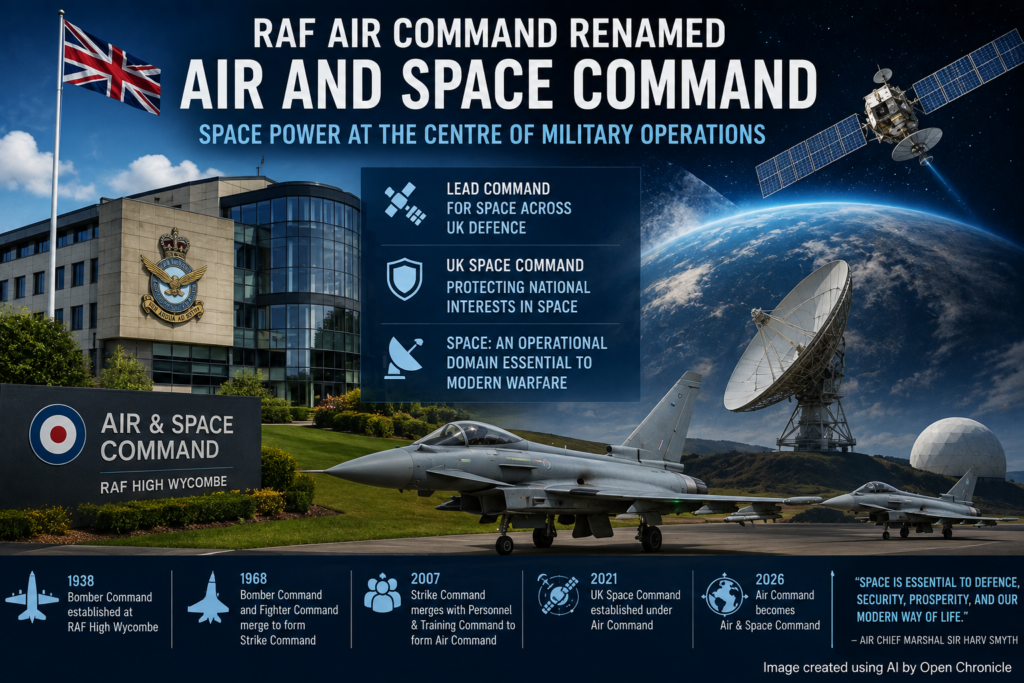
The change replaces the Air Command designation that had been used since 2007 and reflects the RAF’s position as the Lead Command for space across UK defence.
Under the new structure, Air and Space Command will remain headed by the Chief of the Air Staff while continuing to oversee UK Space Command, which was established in 2021.
The redesignation represents more than a change of name. It signals the increasing importance Britain places on satellites, space surveillance, communications, navigation and other orbital capabilities that have become fundamental to modern military operations.
Space moves to the centre of RAF planning
The RAF said the new designation gives space power greater visibility within Britain’s senior military command structure and reflects its growing importance to national security.
Air Chief Marshal Sir Harv Smyth, Chief of the Air Staff, described space as essential not only to defence but also to Britain’s economy and modern society.
“Space is essential to defence, security, prosperity, and our modern way of life. But it is also a domain of growing strategic competition,” Smyth said.
He argued that space has rapidly developed into an operational domain in its own right and is increasingly important to the development of an integrated British military force.
The connection between air and space operations is particularly significant for the RAF.
According to Smyth, the service’s traditional responsibility for gaining and maintaining control of the air increasingly depends upon maintaining freedom of action in space.
Satellites provide modern armed forces with communications, intelligence, surveillance, navigation, missile warning and targeting capabilities. Losing access to those systems could severely restrict the ability of aircraft, ships and ground forces to operate effectively.
Air and Space Command to lead space power
Under Britain’s Lead Command Model, individual military commands take responsibility for capabilities that support the wider Armed Forces.
The RAF has been selected as the Lead Command for space.
The new headquarters at RAF High Wycombe will therefore be responsible for ensuring that space capabilities are integrated into defence planning alongside traditional air operations.
“It is now more important than ever for space power to be planned and delivered through the highest levels of military leadership, like all other domains,” Smyth said.
“Our new HQ Air & Space Command will lead the delivery of space power with the same dedication that it leads for the air domain.”
The move places military space activities more directly within the command architecture responsible for developing RAF capabilities and preparing forces for operations.
UK Space Command remains central
Air and Space Command will continue to oversee UK Space Command, which has operated since 2021.
UK Space Command is responsible for protecting Britain’s military and national interests in space while supporting allied operations and ensuring that British forces can exploit space capabilities during operations around the world.
Its responsibilities reflect the growing militarisation and strategic importance of Earth’s orbital environment.
Modern armed forces depend heavily on satellites, making space infrastructure both a critical military asset and a potential target during conflict.
Competition between major powers has consequently expanded beyond land, sea and air into space, cyber operations and the electromagnetic spectrum.
Britain’s decision to elevate space within the RAF command structure reflects that transformation.
A relationship stretching back to the Cold War
Although the new name represents an important institutional change, the RAF’s involvement with space operations stretches back more than six decades.
In 1963, Britain established its ballistic missile early warning capability at RAF Fylingdales in North Yorkshire.
The installation became a critical component of the Western early warning network during the Cold War and continues to play an important role in detecting missile launches and tracking objects in space.
Britain subsequently launched SKYNET 1A in 1969, beginning a military satellite communications programme that would develop into one of the foundations of British military communications.
The SKYNET network has since supported British forces deployed around the world.
These historical connections helped underpin the decision to designate the RAF as the Lead Command for space.
From Bomber Command to Air and Space Command
The transformation also marks another chapter in the long history of RAF High Wycombe.
The site was established in 1938 as the headquarters of Bomber Command. Its location provided access to London while making the headquarters more difficult for hostile aircraft to locate and attack.
Three decades later, Britain’s changing military requirements produced another major restructuring.
In 1968, Bomber Command and Fighter Command were merged to create Strike Command.
The new organization controlled the RAF’s principal combat aircraft, bringing bomber and fighter operations under a single command structure at RAF High Wycombe.
Another reorganization followed in 2007 when Strike Command merged with Personnel and Training Command.
The result was Air Command, a single headquarters responsible for the entire Royal Air Force.
That structure remained in place for almost two decades.
The establishment of UK Space Command under Air Command in 2021 marked the beginning of the next transformation.
Now, in 2026, Air Command has formally become Air and Space Command.
Warfare increasingly depends on orbit
The change comes as the war in Ukraine and other recent conflicts have demonstrated the importance of space based infrastructure to modern warfare.
Satellite communications can connect forces across enormous distances. Navigation satellites support precision weapons and military movement. Earth observation satellites provide intelligence and surveillance, while early warning systems can detect ballistic missile launches.
Commercial satellite constellations have also become increasingly relevant to military operations.
At the same time, the ability to interfere with space systems is expanding. Electronic warfare can disrupt satellite communications and navigation signals, while cyber operations can target the ground infrastructure controlling spacecraft.
Several countries are also developing capabilities designed to disable or destroy satellites.
Protecting access to space has therefore become increasingly connected to the ability of armed forces to operate on Earth.
Towards an integrated British force
For the RAF, bringing air and space explicitly together reflects the increasingly interconnected character of military operations.
Combat aircraft may depend on satellite communications, navigation and intelligence before they even reach a target. Missile warning satellites can provide information to air defence networks, while space surveillance systems can help commanders understand threats developing far beyond Britain’s borders.
The new command structure is intended to make those capabilities part of military planning from the beginning rather than treating space as a separate supporting activity.
It also places Britain alongside other major NATO powers that have elevated space within their military command structures as competition in orbit intensifies.
For an institution that began its High Wycombe story with Bomber Command before the Second World War, the evolution is striking.
Nearly nine decades later, the same headquarters is preparing for a security environment in which controlling the skies may increasingly depend upon what happens hundreds or even thousands of kilometres above them.