
By Open Chronicle Newsdesk with agencies
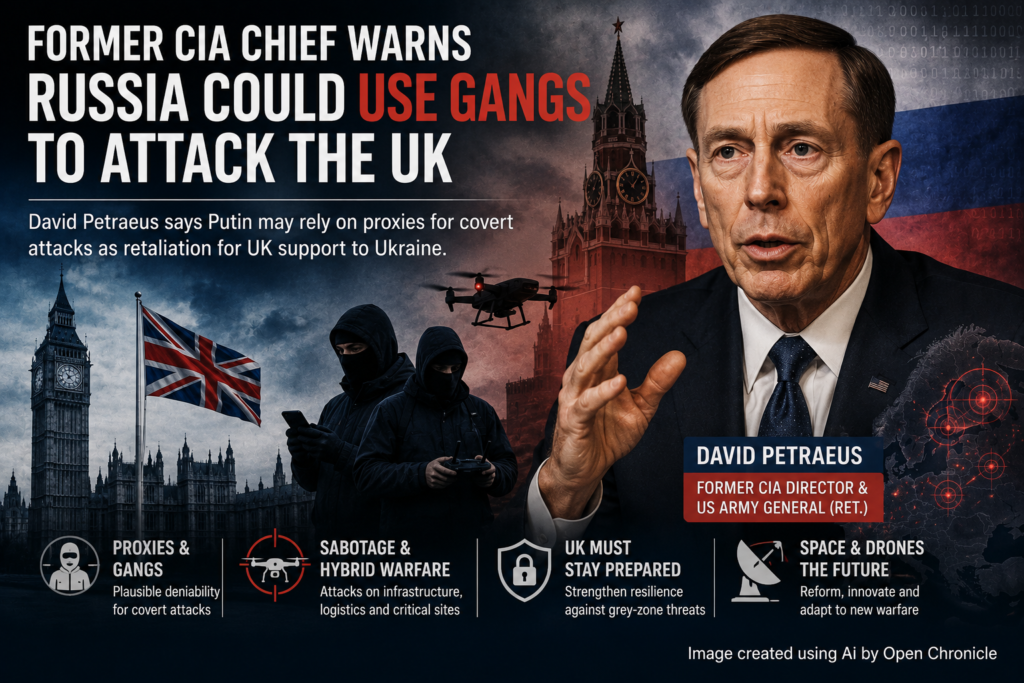
Former CIA director and retired US Army General David Petraeus has warned that Russia could increasingly rely on criminal gangs and other proxies to conduct covert attacks against Britain, allowing Moscow to retaliate for UK support to Ukraine while maintaining a degree of plausible deniability.
Petraeus, who commanded coalition forces in Iraq and Afghanistan before leading the CIA under President Barack Obama, argued that Russian President Vladimir Putin remains unlikely to risk a conventional military attack against a NATO member while Russia is heavily committed in Ukraine.
Instead, he believes Moscow could intensify operations in the so called grey zone, using criminals, private operatives and other intermediaries to carry out sabotage, intimidation and potentially terrorist style attacks whose connection to the Russian state would be deliberately difficult to establish.
The warning comes as Britain deepens its military support for Ukraine and Kyiv expands long range attacks against Russian military and economic infrastructure.
Petraeus warns of operations designed to hide Moscow’s role
Petraeus said Russia could seek ways of striking British interests without using conventional military forces or identifiable Russian intelligence personnel.
He suggested Moscow could employ “gang members to carry out something that would not be as clearly attributable to the Russians”.
The approach would fit a broader model of hybrid warfare in which hostile states operate below the threshold that would normally trigger a conventional military response.
“Putin has been willing to do everything up to and including assassinations in the past, as the UK knows very well, having experienced that,” Petraeus said.
“He has been carrying out various grey zone activities.”
Petraeus said Britain should expect more operations of this type.
His comments echo previous warnings from MI5 Director General Sir Ken McCallum that Russia has increasingly turned to proxies, including criminals and private intelligence operatives, to conduct operations abroad.
British weapons support increases tensions with Moscow
The warning comes amid another expansion of Britain’s support for the Ukrainian military.
According to the information provided, Prime Minister Andy Burnham travelled to Kyiv and announced an agreement to provide Ukraine with designs allowing it to produce Storm Shadow cruise missiles.
Storm Shadow is a long range air launched weapon capable of striking targets deep behind enemy lines.
Ukraine has also reportedly been using British made drones in long range attacks against targets inside Russia.
Moscow has repeatedly warned that deeper Western involvement in Ukrainian attacks on Russian territory could have consequences.
The Russian Embassy in London recently accused Britain of attempting to inflict maximum damage on Russia and warned that the greater Britain’s involvement in the conflict, the greater the price it could face.
Such statements have intensified concern among British security officials about possible Russian retaliation outside the conventional battlefield.
Europe confronts suspected sabotage operations
Petraeus pointed to recent incidents elsewhere in Europe as examples of the methods potentially available to Moscow.
One involved an alleged plot targeting a US citizen in Poland. Another concerned an attempted drone attack against a German airport that authorities have attributed to Russia.
Moscow has rejected allegations surrounding the German incident, describing them as a provocation intended to benefit Ukraine.
German investigators have also reportedly identified a possible DNA connection between the drone case and an earlier European sabotage network.
That investigation has been linked to explosive devices transported through air freight networks in 2024.
One device caused a fire at a warehouse in Birmingham, while another could potentially have endangered an aircraft travelling to London.
Five men are currently on trial in Lithuania over allegations that they carried out terrorist offences on behalf of Russian intelligence. They deny the charges.
The cases have increased European concern about operations in which intelligence agencies allegedly recruit intermediaries to perform sabotage while distancing the sponsoring state from the people carrying out the attack.
The attraction of plausible deniability
For Russia, proxy operations could offer an important strategic advantage.
A direct Russian military attack against Britain would risk triggering NATO’s collective defence mechanisms and potentially lead to a confrontation between nuclear armed powers.
Covert sabotage creates a much more ambiguous situation.
Criminal groups could theoretically be recruited to damage infrastructure, carry out arson, transport explosive devices or conduct surveillance without being formally connected to Russian security agencies.
Even when intelligence services suspect state sponsorship, establishing sufficient evidence publicly can be difficult.
That uncertainty creates what security specialists describe as the grey zone between ordinary competition and open warfare.
Petraeus believes Putin currently has strong reasons to remain within that space.
Ukraine exposing Russian vulnerabilities
The former CIA director argues that Russia’s problems inside Ukraine are limiting Putin’s ability to contemplate a broader confrontation with NATO.
He described Russian battlefield losses as severe, with more than 1,000 personnel reportedly being killed or wounded each day.
At the same time, Ukraine has intensified attacks against Russia’s energy and logistics infrastructure.
Petraeus said Ukrainian forces have demonstrated Moscow’s inability to completely protect strategically important facilities such as oil refineries, fuel storage sites and warehouses.
That vulnerability, he argued, is becoming increasingly difficult for the Kremlin to conceal.
Russia has reportedly deployed paramilitary forces to protect petrol stations amid fuel shortages, while Ukrainian strikes have targeted refineries across large areas of Russian territory.
Major distribution warehouses have also been attacked, including facilities associated with Wildberries, one of Russia’s largest online retailers.
Petraeus believes the cumulative effect is placing growing pressure on Russia’s economy and war effort.
Crimea becoming an increasing burden
Petraeus also highlighted the situation in Crimea, the Ukrainian peninsula annexed by Russia in 2014.
He argued that Ukraine’s campaign against fuel, electricity and logistical infrastructure has transformed territory once considered one of Putin’s most important strategic achievements into an increasingly difficult asset to sustain.
“That was his crown jewel, and it is now becoming an albatross around his neck,” Petraeus said.
He claimed that repeated Ukrainian attacks have disrupted fuel supplies, electricity generation and communications across the peninsula.
Crimea remains strategically important because it supports Russian military operations in southern Ukraine and provides bases for forces operating around the Black Sea.
Any sustained degradation of infrastructure there could therefore have consequences extending beyond the civilian economy.
Could political pressure threaten Putin?
Petraeus stopped short of predicting political collapse inside Russia.
When asked whether Putin might fear being removed from power, he noted the inherent difficulty of predicting the fall of authoritarian governments.
“As with all authoritarian regimes, it is inconceivable that it could be toppled until the day after it’s been toppled, when you say it was inevitable,” he said.
He nevertheless interpreted heightened security measures surrounding upcoming parliamentary elections as evidence that the Kremlin remains concerned about domestic opposition.
Petraeus suggested Russian authorities would seek to prevent discontent from reaching a point where separate sources of opposition could combine into a broader political challenge.
Ukraine as the laboratory of future warfare
Petraeus’s assessment extends beyond Russian hybrid operations.
He believes the war in Ukraine has demonstrated that Britain must radically reconsider how its own Armed Forces are organized.
His most striking recommendation concerns the relationship between traditional armored forces and unmanned systems.
Rather than simply attaching drones to existing tank formations, Petraeus argues that militaries should consider replacing some conventional formations entirely with units built around unmanned and autonomous technologies.
“The UK is positioned almost uniquely to carry out urgent, revolutionary, transformative, institutional change in its military that doesn’t require vast new sums of money or large numbers of troops,” he said.
The battlefield survivability of traditional formations has been challenged by the enormous proliferation of drones, precision weapons and persistent surveillance in Ukraine.
Armored vehicles can now be detected and targeted by inexpensive unmanned aircraft operating alongside artillery and other precision strike systems.
Petraeus consequently describes Ukraine as a “laboratory for the future of war”.
Britain faces two interconnected challenges
His assessment ultimately presents Britain with two different but increasingly connected security problems.
The first concerns Russia’s ability to operate below the threshold of conventional warfare.
Criminal proxies, sabotage networks, cyber operations and other deniable activities could allow Moscow to retaliate against British support for Ukraine without openly attacking NATO.
The second concerns the transformation of conventional warfare itself.
Ukraine has demonstrated how drones, electronic warfare, precision weapons and distributed networks can threaten expensive traditional military platforms and force armies to rethink decades old organizational structures.
Petraeus believes Britain has the institutional flexibility to adapt rapidly, but only if military reform goes beyond simply adding new technologies to existing formations.
At the same time, the UK will have to strengthen domestic resilience against threats that may not look like conventional military attacks at all.
For Moscow, Petraeus’s assessment suggests, ambiguity itself could increasingly become a weapon.