
By Open Chronicle History Desk
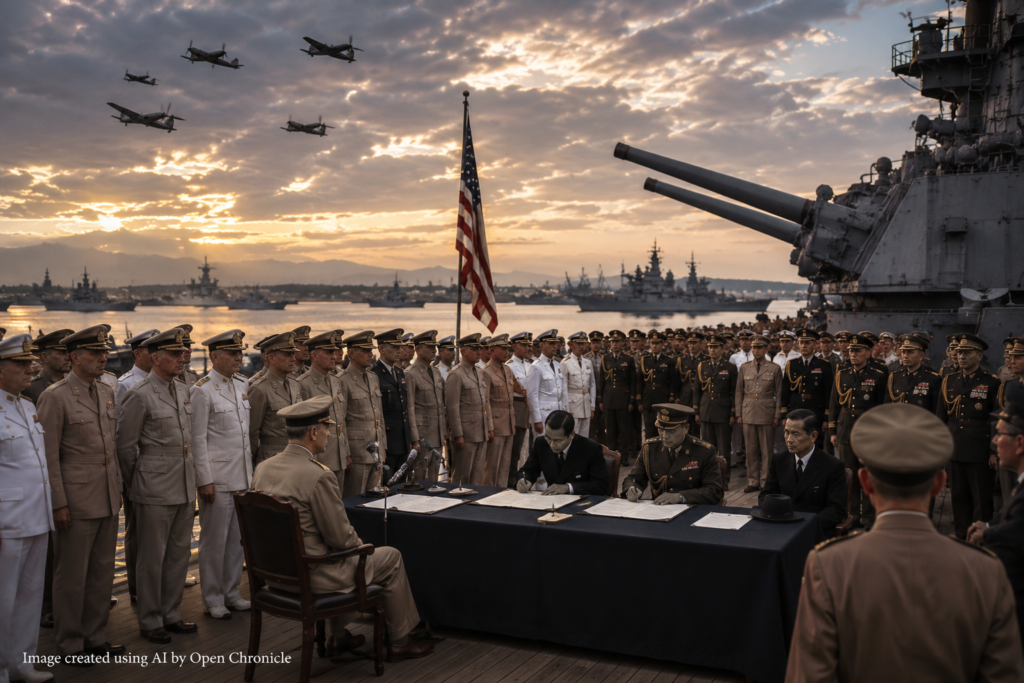
On 2 September 1945, representatives of the Empire of Japan boarded the American battleship USS Missouri in Tokyo Bay and signed the Instrument of Surrender. With a series of signatures completed on the ship’s deck, the Second World War formally came to an end.
The ceremony lasted only a matter of minutes, but it closed a conflict that had consumed much of the world for six years. Cities had been destroyed, empires shaken, tens of millions of people killed and the Holocaust had revealed the terrifying consequences of systematic industrialised mass murder.
For millions of soldiers and civilians, 2 September represented something almost unimaginable after years of warfare: peace.
Yet the world emerging from the conflict was profoundly different from the one that had entered it.
The Final Months of the Pacific War
By the beginning of 1945, Nazi Germany was approaching defeat in Europe, but Japan continued fighting across the Pacific and East Asia.
American forces were advancing towards the Japanese home islands through a series of increasingly destructive campaigns.
The Battle of Iwo Jima, fought between February and March 1945, demonstrated the intensity of Japanese resistance. The subsequent Battle of Okinawa was even more devastating.
Okinawa offered Allied commanders a disturbing indication of what an invasion of Japan itself might involve.
Japanese forces fought from fortified positions while kamikaze aircraft attacked Allied ships. Civilians were caught in the fighting, and casualties were enormous.
Meanwhile, American strategic bombing was devastating Japanese cities.
The firebombing of Tokyo during the night of 9 to 10 March 1945 killed tens of thousands of people and destroyed vast areas of the capital.
Still, Japan did not surrender.
Germany Falls
In Europe, the war reached its conclusion first.
Adolf Hitler died in Berlin on 30 April 1945 as Soviet forces fought through the German capital.
Germany surrendered unconditionally in early May.
Victory in Europe was celebrated on 8 May 1945, but the global war continued.
The Allies could now concentrate even greater military resources against Japan.
American planners prepared for Operation Downfall, the proposed invasion of the Japanese home islands. The operation was expected to involve enormous forces and potentially catastrophic casualties on both sides.
But events during August changed the situation dramatically.
Hiroshima
On the morning of 6 August 1945, an American B 29 bomber named Enola Gay flew over Hiroshima.
It carried a weapon unlike anything previously used in warfare.
At approximately 8:15 a.m., the atomic bomb known as Little Boy exploded above the city.
Hiroshima was devastated.
Tens of thousands of people died immediately or during the following hours and days. Many others would later die from injuries and radiation related illnesses.
The destructive power of nuclear weapons had entered human history.
Yet Japan still did not immediately surrender.
The Soviet Union Enters the War
A second major shock followed.
On 8 August 1945, the Soviet Union declared war on Japan.
Soviet forces then launched a massive offensive against the Japanese Kwantung Army in Manchuria.
The attack destroyed Japanese expectations that Moscow might serve as an intermediary in negotiations with the Allies.
Japan now faced American military pressure from the Pacific, Soviet advances across continental Asia and the possibility of further atomic attacks.
Then came Nagasaki.
Nagasaki
On 9 August, another American B 29, Bockscar, dropped the plutonium bomb Fat Man over Nagasaki.
The city suffered catastrophic destruction.
Again, tens of thousands of people were killed.
The atomic bombings of Hiroshima and Nagasaki remain among the most debated decisions in military and political history.
Supporters of the decision have argued that the bombs accelerated Japan’s surrender and avoided an invasion that might have produced vastly greater casualties.
Critics have questioned whether the bombings were necessary, particularly given Japan’s deteriorating military position and the Soviet entry into the war.
The debate continues.
What is certain is that August 1945 introduced humanity to the nuclear age.
Emperor Hirohito Intervenes
Within the Japanese government, disagreement remained over whether surrender should be accepted.
Some military leaders wanted the war to continue under certain conditions.
Emperor Hirohito eventually intervened.
Japan decided to accept the Allied terms set out in the Potsdam Declaration, provided the imperial institution could be preserved.
During the night before the surrender announcement, a group of Japanese officers attempted to prevent the emperor’s recorded message from being broadcast.
The attempted coup failed.
At noon on 15 August 1945, Japanese citizens heard the voice of their emperor over the radio for the first time.
Hirohito announced that Japan would accept the Allied terms.
His language was formal and indirect. He told his subjects that the war situation had developed “not necessarily to Japan’s advantage” and referred to the enemy’s use of a “new and most cruel bomb”.
Across Allied countries, the announcement produced enormous celebrations.
The fighting was effectively over.
But formal surrender still had to be completed.
Tokyo Bay, September 2
On the morning of 2 September, the USS Missouri lay anchored in Tokyo Bay.
The location carried enormous symbolic significance.
American warships surrounded the Japanese capital while Allied aircraft filled the skies overhead.
Representatives from the Allied powers assembled on the battleship’s deck.
General Douglas MacArthur, Supreme Commander for the Allied Powers, presided over the ceremony.
The Japanese delegation was led by Foreign Minister Mamoru Shigemitsu, representing Emperor Hirohito and the Japanese government. General Yoshijirō Umezu, Chief of the Army General Staff, signed on behalf of the Japanese armed forces.
Shigemitsu approached the surrender table and signed the document.
Umezu followed.
MacArthur then signed on behalf of the Allied powers.
Fleet Admiral Chester W. Nimitz signed for the United States.
Representatives of China, the United Kingdom, the Soviet Union, Australia, Canada, France, the Netherlands and New Zealand subsequently added their signatures.
The formal surrender was complete.
“May Peace Be Restored Throughout the World”
MacArthur addressed those assembled on the Missouri.
The ceremony was deliberately brief.
There were no lengthy speeches or elaborate celebrations on deck. The purpose was unmistakable: to formally end the state of war and establish Allied authority over defeated Japan.
At its conclusion, Allied aircraft flew overhead.
The symbolism was extraordinary.
Only four years earlier, the attack on Pearl Harbor had brought the United States directly into the war. Now Japanese representatives stood aboard an American battleship in Tokyo Bay signing their country’s unconditional surrender.
The Pacific War was over.
The Second World War had formally ended.
Six Years of Global War
The conflict in Europe had begun with Germany’s invasion of Poland on 1 September 1939.
Exactly six years and one day later, Japan signed the Instrument of Surrender.
Between those dates, warfare had spread across an unprecedented geographical area.
Europe, North Africa, the Atlantic, the Soviet Union, China, Southeast Asia and the Pacific became interconnected theatres of a truly global conflict.
The human cost was staggering.
Estimates vary, but somewhere around 70 to 85 million people are believed to have died as a direct or indirect consequence of the war.
The Soviet Union and China suffered enormous losses. Poland lost a devastating proportion of its population. Germany was shattered. Japan’s cities had been burned and bombed.
Millions more were displaced.
Entire communities had disappeared.
The Holocaust
Victory also exposed the full scale of Nazi Germany’s crimes.
Approximately six million Jews had been murdered during the Holocaust.
Millions of other victims were persecuted, imprisoned or killed by the Nazi regime, including Roma, disabled people, Soviet prisoners of war, Polish civilians, political opponents and others targeted by Nazi racial and ideological policies.
The liberation of concentration and extermination camps revealed evidence of crimes whose scale challenged existing concepts of international law.
The aftermath contributed to the development of new legal concepts surrounding genocide, crimes against humanity and individual responsibility for wartime atrocities.
The Nuremberg Trials would begin later in 1945.
A New International Order
The end of the Second World War did not simply restore the political world that had existed before 1939.
That world was gone.
Germany was occupied and divided among the victorious Allied powers.
Japan came under American led occupation.
European powers such as Britain and France emerged victorious but economically weakened.
Two countries possessed unprecedented international power: the United States and the Soviet Union.
Their wartime alliance would rapidly deteriorate.
Within only a few years, Europe would be divided politically and militarily between rival blocs.
The Cold War was beginning.
The United Nations
The Allies were also determined to avoid a repetition of the failures that had followed the First World War.
The League of Nations had proved incapable of preventing aggression during the 1930s.
A new international organisation was therefore established.
The United Nations Charter had been signed in San Francisco on 26 June 1945 and would enter into force on 24 October.
Its purpose included maintaining international peace and security while providing mechanisms for diplomatic cooperation between states.
The organisation that emerged from the ruins of the war remains one of the central institutions of the international system.
The Nuclear Age
Perhaps the most profound technological consequence of the final weeks of the war was the arrival of nuclear weapons.
Hiroshima and Nagasaki demonstrated that a single weapon could destroy much of a city.
The implications extended far beyond Japan.
The United States initially possessed the world’s only nuclear arsenal, but that monopoly would not last.
The Soviet Union successfully tested its first atomic bomb in 1949.
The nuclear arms race that followed became one of the defining features of the Cold War.
For the first time, humanity possessed weapons capable of threatening civilisation itself.
The End of Empires
The Second World War also accelerated the decline of European colonial empires.
European powers had been weakened economically and militarily, while wartime mobilisation had transformed political expectations across Asia and Africa.
Independence movements gained momentum.
India and Pakistan became independent in 1947.
Indonesia fought to secure independence from the Netherlands.
France became embroiled in conflicts in Indochina and Algeria.
Across the following decades, colonial rule retreated across much of the world.
The global political map created after 1945 would look radically different from that which had existed when the war began.
September 2, 1945
The photographs taken aboard USS Missouri show a ceremony that appears remarkably restrained compared with the enormity of the event.
Military officers stand in uniform. Documents rest on a table. Representatives step forward and sign their names.
Yet those signatures closed the most destructive conflict in recorded history.
The world that emerged on 2 September 1945 carried both extraordinary hope and terrifying new dangers.
Fascist regimes had been defeated. International institutions were being constructed. Occupied peoples anticipated liberation and independence.
At the same time, Europe was divided, millions remained displaced, cities lay in ruins and nuclear weapons had permanently altered the meaning of warfare.
The Second World War was over.
Its consequences were only beginning.