
By Open Chronicle Newsdesk with agencies
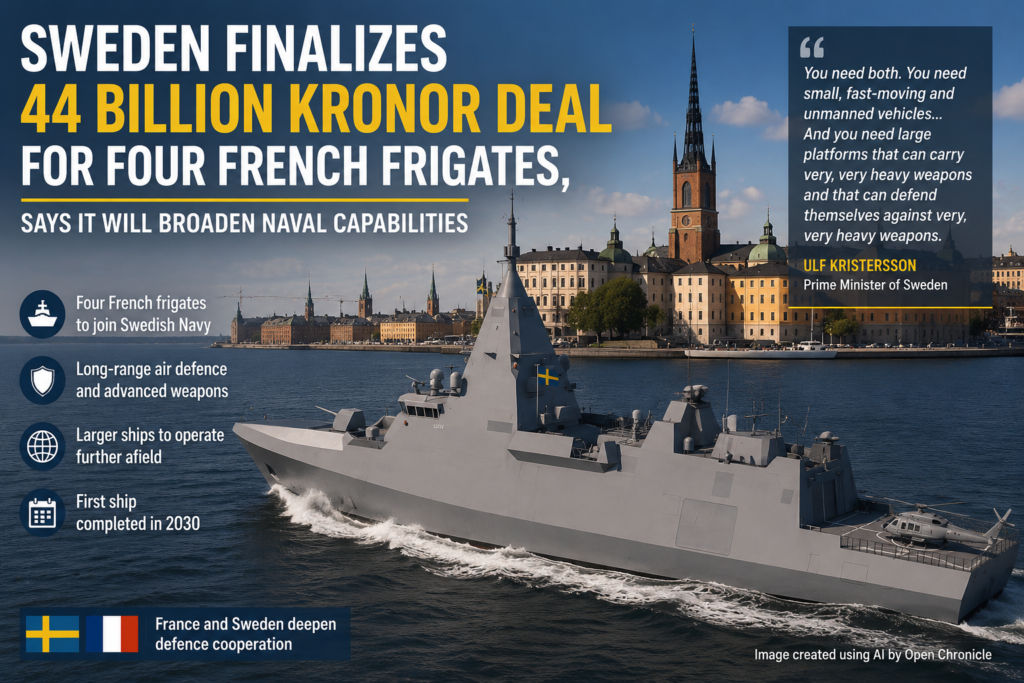
Sweden has finalized a 44 billion kronor agreement to acquire four French frigates, marking a major expansion of the Swedish Navy and giving the country larger warships capable of operating well beyond its traditional Baltic Sea environment.
The agreement was formally signed during French President Emmanuel Macron’s visit to Stockholm, alongside a broader accord intended to deepen defence cooperation between France and Sweden.
The new vessels, which will form Sweden’s future Luleå class, are expected to become the largest combat ships operated by the Swedish Navy. The first frigate is scheduled for completion in 2030.
Swedish Prime Minister Ulf Kristersson said the acquisition reflects Stockholm’s intention to retain a strong focus on the Baltic while developing the ability to deploy naval forces farther from Swedish waters.
“There is no doubt that the Baltic Sea is our home waters,” Kristersson told Swedish news agency TT aboard a French frigate visiting central Stockholm. He added that the acquisition would increase Sweden’s ability to operate in other regions of strategic interest.
Sweden Expands Its Naval Ambitions
The frigates represent a substantial change in scale for Sweden’s surface fleet.
Sweden currently relies heavily on the Visby class corvettes, relatively compact warships optimized for operations in the complex coastal and archipelagic environment of the Baltic Sea.
The Luleå class will be considerably larger, providing greater endurance and the ability to carry heavier weapons, sensors and defensive systems.
During the signing ceremony, Macron and Kristersson emphasized maritime control as one of the missions the ships could perform.
That could include protecting strategically important sea lanes and maintaining freedom of navigation for commercial shipping during a crisis or conflict.
The ability to operate farther from Sweden could also increase Stockholm’s contribution to NATO maritime operations following the country’s accession to the alliance.
Long Range Air Defence Will Be Central
One of the most important capabilities planned for the Luleå class is long range air defence.
Larger warships can carry substantially more sophisticated radar systems and greater numbers of missiles than smaller surface combatants, allowing them to protect not only themselves but potentially other ships operating nearby.
For shorter range threats, the vessels are expected to receive systems including Saab’s Trackfire remote weapon station.
The combination is intended to create layered protection against aircraft, missiles, drones and other threats.
Such capabilities are becoming increasingly important as European navies reconsider how their surface fleets would operate in a high intensity conflict involving large numbers of missiles and unmanned systems.
Ukraine War Raises Questions About Large Warships
The purchase nevertheless comes amid a fundamental debate over the future of naval warfare.
Ukraine has demonstrated that comparatively inexpensive unmanned surface vessels can threaten much larger and more expensive warships.
Ukrainian forces have successfully employed explosive laden sea drones against Russian naval vessels, highlighting the vulnerability of conventional surface ships when confronted by coordinated attacks involving relatively cheap autonomous or remotely operated platforms.
Some defence experts have consequently questioned whether large frigates represent the best investment for Sweden.
Kristersson argues that the answer is not choosing between large warships and unmanned systems, but operating both.
“You need small, fast moving and unmanned vehicles both underwater and in the air,” he said. “And you need large platforms that can carry very, very heavy weapons and that can defend themselves against very, very heavy weapons.”
Designed for the Drone Era
The Swedish government says lessons from Ukraine are being incorporated into planning for the new vessels.
Kristersson said he had received sufficient assurances that the frigates would be capable of defending themselves against threats including swarms of underwater drones.
“These are adapted to be able to defend themselves against a lot of different things,” he said, while emphasizing that technology and tactics will continue evolving before the ships enter service.
“We are learning at a speed that we have not done before, not least from Ukraine.”
That timeline is particularly relevant because the first ship is not expected until 2030. Naval warfare technology could change substantially before the entire four ship class becomes operational.
The vessels will therefore need considerable capacity for modernization throughout their service lives.
France and Sweden Deepen Defence Cooperation
The frigate agreement was one of two defence accords signed during Macron’s visit.
The second establishes a broader framework for deeper bilateral defence cooperation.
France and Sweden have also been discussing questions surrounding Europe’s nuclear deterrence since last spring, although no new details were announced about whether or how Sweden might participate in arrangements connected to France’s nuclear forces.
The subject has become increasingly important as European governments debate how much responsibility they must assume for the continent’s long term defence.
France possesses the European Union’s only independent nuclear arsenal and has increasingly discussed the strategic role its deterrent could play in European security.
For Sweden, closer cooperation with Paris complements the country’s rapidly expanding role within NATO and its broader military modernization program.
A Significant Transformation of the Swedish Navy
The 44 billion kronor acquisition represents more than the replacement of existing ships.
It signals a shift toward a Swedish Navy capable of sustained operations across a wider geographical area while contributing more heavily to NATO’s maritime forces.
The Baltic Sea will remain Sweden’s primary naval environment, particularly given the strategic importance of Gotland, the Baltic approaches and Russia’s military presence around the region.
But larger frigates equipped with long range air defence, heavier weapons and greater endurance would give Stockholm options that its current corvette fleet cannot provide to the same extent.
The central challenge will be ensuring that large surface combatants remain survivable as missiles, autonomous systems and inexpensive drone swarms transform naval warfare.
Sweden’s answer, at least for now, is to combine both approaches: heavily armed major warships supported by increasingly sophisticated unmanned systems above and below the surface.
With the agreement now finalized and the first Luleå class vessel expected in 2030, that strategy is set to shape the Swedish Navy for decades.