
By Open Chronicle Newsdesk with agencies
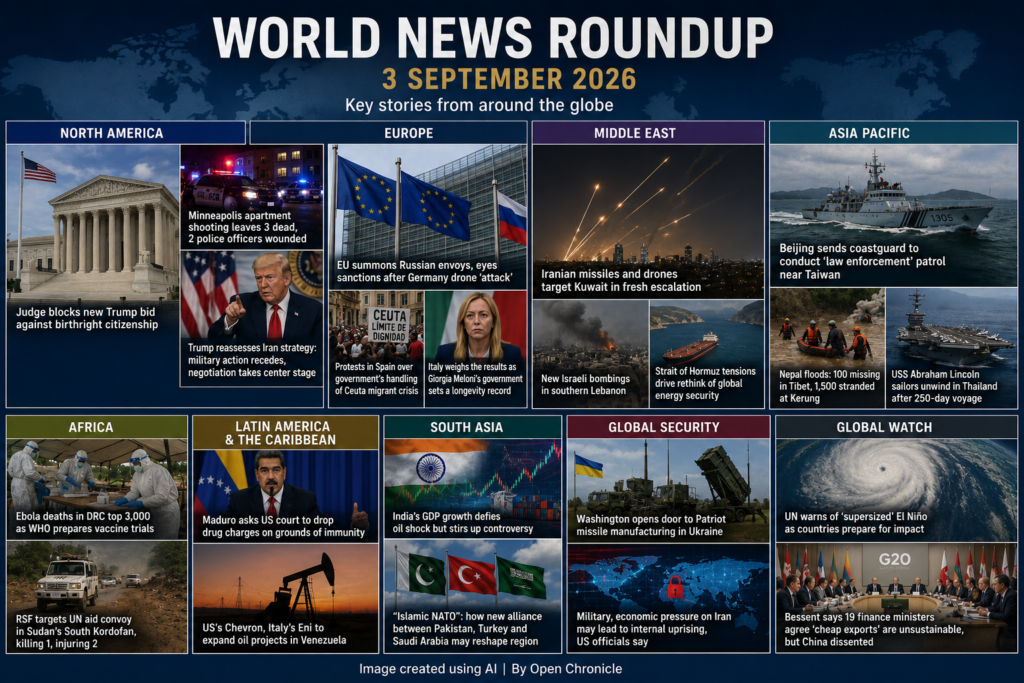
Global attention on Thursday remains dominated by the continuing confrontation with Iran, growing European concern over suspected Russian hybrid operations, the aftermath of catastrophic flooding across Nepal and Tibet, and intensifying strategic competition between China and Western powers in the Pacific.
In the United States, major legal and domestic security stories are also developing, while Venezuela has returned to the centre of international attention through both the case against Nicolás Maduro and new Western investment in the country’s vast oil industry.
Here are the main developments by world region as of September 3, 2026. The overview is based on the developing news material supplied to Open Chronicle.
North America
US courts again confront Trump over birthright citizenship
A federal judge has blocked another attempt by President Donald Trump to restrict birthright citizenship, continuing a major constitutional confrontation between the White House and the judiciary.
The dispute is likely to remain politically significant as the United States approaches the November midterm elections.
Minneapolis shooting leaves multiple people dead
Authorities are investigating a shooting at an apartment building in Minneapolis that left several people dead and police officers wounded.
Early reports differ on the precise casualty total, with some accounts reporting two victims and the suspect dead, while others describe three fatalities and two wounded officers. The discrepancy had not been resolved in the supplied material.
Shooting reported at Virginia school
A separate shooting occurred inside a school in Virginia. According to initial reports, an employee was wounded and the attacker was killed.
Trump administration reassesses Iran strategy
Washington is sending conflicting but potentially significant signals over the future of the war with Iran.
Reports indicate that President Trump is considering declaring the war effectively over and placing greater emphasis on negotiations. At the same time, the Pentagon is reportedly extending some Middle East deployments into 2027.
US officials have also suggested that sustained military and economic pressure could increase internal political pressure on Tehran.
The developments suggest that Washington may be attempting to move from sustained large scale military operations towards a combination of deterrence, economic pressure and diplomacy.
Europe
EU considers further response to suspected Russian hybrid operations
European governments are increasing pressure on Moscow following a series of alleged sabotage and hybrid warfare incidents.
EU governments have summoned Russian representatives, while additional sanctions and other measures are being considered following Germany’s attribution of an attempted drone attack at Leipzig Airport to Russia.
The Leipzig incident has also revived calls for tougher restrictions on Russian visas.
European officials increasingly view sabotage, drone incidents, cyber operations and attacks on infrastructure as interconnected elements of a broader security challenge.
Norway seizes Russian vessel over Naftogaz award
Norway has reportedly seized a Russian vessel as part of efforts to enforce a multibillion dollar arbitration award involving Ukrainian energy company Naftogaz.
The reported action adds another dimension to attempts by Ukraine and its partners to pursue Russian assets through international legal mechanisms.
Ceuta crisis fuels protests in Spain
Thousands of people have demonstrated in Ceuta amid growing anger over the Spanish government’s handling of the enclave’s migration and border crisis.
The dispute is becoming an increasingly important domestic political issue while also raising wider European questions about border security, migration policy and burden sharing.
Malta murder acquittal triggers outrage
The acquittal of a Maltese businessman accused in connection with the 2017 murder of investigative journalist Daphne Caruana Galizia has prompted renewed controversy.
The case has long attracted international attention because of its implications for press freedom, corruption and the rule of law in Malta.
Meloni government reaches Italian postwar longevity milestone
Prime Minister Giorgia Meloni’s government has reached a major longevity milestone, strengthening its claim to be one of the most stable Italian administrations of the postwar period.
The achievement is particularly notable in a country historically characterized by frequent changes of government.
Moscow airports disrupted
Airports serving Moscow reportedly suspended flights for a second consecutive night amid heightened concern about Ukrainian drone operations.
The disruption follows warnings from Ukrainian President Volodymyr Zelensky as Kyiv expands its long range drone campaign against targets inside Russia.
Middle East
Iranian missiles and drones target Kuwait
Iranian missiles and drones have targeted Kuwait in another escalation of the regional conflict.
The Kuwaiti military reported intercepting incoming missiles and hostile drones.
The attacks come amid continuing strikes and counterstrikes involving Iran, the United States and regional military installations.
Trump weighs shift towards negotiations with Iran
Despite the continuing violence, reports indicate that the Trump administration is reconsidering the next phase of its Iran strategy.
Large scale US military action could begin to recede if Washington believes it has sufficiently degraded Iranian capabilities, although American forces remain heavily deployed throughout the region.
The contradiction between possible diplomatic movement and extended Pentagon deployments illustrates the uncertainty surrounding the conflict’s next phase.
Strait of Hormuz remains central to global security
Questions continue over Iran’s capabilities around the Strait of Hormuz, including reports examining whether Iranian rocket systems have been modified to deploy mines into the strategic waterway.
The crisis has already encouraged Asian governments to consider storing larger quantities of oil and gas closer to home.
Hormuz remains one of the world’s most strategically important maritime corridors, making any prolonged disruption a global economic problem rather than simply a regional one.
Houthis launch missiles towards Yemen’s western coast
Yemeni military sources reported that Houthi forces launched 14 ballistic missiles towards areas on the country’s western coast.
The development underlines the continued instability surrounding the Red Sea and Yemen even as international attention remains concentrated on Iran.
New Israeli strikes reported in Lebanon
Israeli forces have reportedly carried out additional strikes in southern Lebanon, including attacks around Hadatha and Barashit.
Lebanese authorities have meanwhile reportedly dismantled a security network linked to Hezbollah and remnants of the former Assad system.
Violence continues in the West Bank
Israeli operations have continued across the occupied West Bank and East Jerusalem.
Separate reports said Israeli sniper fire killed a Palestinian man and a 16 year old boy.
The UK government is meanwhile preparing what has been described as a policy reset concerning Israeli settlements in the West Bank.
Asia Pacific
Pacific leaders seek united response to Chinese missile test
China’s growing military power is dominating discussions among Pacific governments.
The chair of a meeting of Pacific leaders has called for a united response to a Chinese missile test, reflecting concern that strategic competition is increasingly reaching the island states of the region.
Pacific governments are simultaneously attempting to turn their growing geopolitical importance into additional international funding, particularly for climate adaptation.
Australia and United States deepen defence cooperation
Australia and the United States are moving to strengthen defence cooperation as China’s military and political influence expands across the Pacific.
The development forms part of a wider restructuring of regional security partnerships intended to reinforce deterrence and maintain Western strategic influence.
Beijing sends coastguard near Taiwan
China has dispatched coastguard vessels for what it describes as law enforcement patrols near Taiwan.
Such operations have become another instrument through which Beijing asserts its territorial claims while maintaining pressure on Taipei below the threshold of conventional military conflict.
Nepal and Tibet continue to confront catastrophic floods
The humanitarian consequences of the enormous Nepal and China flooding disaster remain severe.
Search operations are continuing for missing people, including foreign tourists, while relief teams are struggling to reach isolated communities.
Reports indicate that around 100 Nepalese nationals remain missing in Tibet and approximately 1,500 people have been stranded around Kerung.
Some missing tourists have managed to establish contact, providing rare positive developments amid the disaster.
The crisis is also creating serious sanitation and privacy problems for women living in emergency shelters.
El Niño threatens further disruption
The United Nations is warning governments to prepare for an unusually powerful El Niño.
A rare sequence of cyclones across the Pacific has already been linked to historically strong conditions, raising concern about further extreme weather across Asia and the Pacific.
Indonesia wildfire haze disrupts education
Around 1.4 million Indonesian students have reportedly been moved to remote learning as severe wildfire haze affects air quality.
The disruption illustrates the growing social and economic consequences of environmental emergencies across Southeast Asia.
USS Abraham Lincoln crew rests in Thailand
Sailors from the USS Abraham Lincoln are continuing their port visit in Thailand after an exceptionally long deployment.
The aircraft carrier’s arrival has brought thousands of American sailors and Marines ashore following months of operations, including deployment connected to the Middle East conflict.
South Asia
India’s economy withstands oil shock
India has reported surprisingly resilient economic growth despite disruption in global energy markets.
The performance has nevertheless generated debate over the underlying economic figures and whether headline GDP growth fully reflects conditions across the wider economy.
India remains particularly exposed to energy market instability because of its substantial dependence on imported oil.
Pakistan, Turkey and Saudi Arabia draw attention over security cooperation
Growing defence and strategic cooperation between Pakistan, Turkey and Saudi Arabia is attracting regional attention, with some commentary describing the emerging relationship as a potential “Islamic NATO”.
Whether the cooperation evolves into anything resembling a formal collective defence structure remains uncertain, but the relationship reflects wider changes in Middle Eastern and South Asian security alignments.
Africa
Ebola death toll in Democratic Republic of Congo reportedly exceeds 3,000
The Ebola crisis in the Democratic Republic of Congo has reportedly passed another grim milestone, with more than 3,000 deaths.
The World Health Organization is preparing vaccine trials as health authorities attempt to contain the outbreak.
If confirmed at this scale, the epidemic represents one of the world’s most serious current public health emergencies.
Sudan aid convoy attacked
The Rapid Support Forces have been accused of attacking a United Nations aid convoy in South Kordofan.
One person was reportedly killed and two others wounded.
The incident further complicates humanitarian operations in Sudan, where conflict has already displaced large numbers of civilians and severely damaged essential services.
Egypt hardens position over Ethiopian Nile projects
Egypt is reportedly adopting a tougher stance as Ethiopia considers additional dam construction along the Nile system.
Water security remains one of the most sensitive strategic disputes in northeast Africa, particularly because Egypt depends overwhelmingly upon the Nile for freshwater.
Latin America and the Caribbean
Maduro seeks dismissal of US charges on immunity grounds
Nicolás Maduro and his wife are seeking to have US drug related charges dismissed, arguing that immunity protects them from prosecution.
The legal challenge adds another extraordinary dimension to the confrontation surrounding Venezuela’s former leadership and Washington.
The outcome could raise important questions about sovereign immunity and the ability of American courts to prosecute foreign political leaders.
Chevron and Eni prepare Venezuelan oil expansion
At the same time, Venezuela’s enormous energy reserves are drawing renewed Western investment.
US energy company Chevron and Italy’s Eni are reportedly preparing to expand oil projects in the country.
Additional reports suggest American energy companies are involved in Venezuelan agreements potentially worth billions of dollars.
Washington is also considering whether Venezuelan heavy crude could play a role in US energy security, including through exchanges involving the Strategic Petroleum Reserve.
The developments suggest Venezuela’s oil sector is undergoing a significant geopolitical realignment.
Global Economy and Energy
Hormuz crisis accelerates rethink of Asian energy security
The disruption surrounding the Strait of Hormuz is encouraging Asian countries to reconsider where they maintain strategic energy reserves.
Governments and companies are examining whether more oil and natural gas should be stored closer to major Asian consumption centres, reducing vulnerability to maritime disruption.
China faces renewed criticism over export model
US Treasury Secretary Scott Bessent said 19 finance ministers agreed that excessively cheap exports were unsustainable, while China dissented from that assessment.
The dispute reflects growing international concern about Chinese industrial overcapacity and the impact of heavily competitive exports on manufacturing industries elsewhere.
Global climate risks rise
The combination of an exceptionally powerful El Niño, Pacific cyclones, Asian flooding and Indonesian wildfire haze is placing climate and disaster preparedness near the top of the international agenda.
These events are occurring simultaneously with major geopolitical crises, increasing pressure on governments already managing defence, energy and economic challenges.
Global Security Outlook
The international picture on September 3 is defined by several overlapping crises rather than one dominant event.
The Iran conflict remains the most immediate geopolitical risk because it connects military escalation directly with global energy supplies and the security of the Strait of Hormuz.
Europe is simultaneously confronting what officials increasingly describe as a sustained Russian hybrid campaign, while the Russia Ukraine war continues to reach deeper into Russian territory through Ukrainian drone operations.
Across the Pacific, China’s military power is driving closer cooperation between the United States, Australia and regional governments.
Meanwhile, devastating floods, wildfire haze and warnings of an exceptionally powerful El Niño demonstrate that governments are confronting major environmental emergencies at the same time as geopolitical tensions intensify.
Taken together, the day’s developments illustrate an international system under pressure on several fronts, military, economic, humanitarian and environmental, with crises in one region increasingly producing consequences far beyond their geographic boundaries.