
By Open Chronicle Newsdesk with agencies
Senior officials in the Trump administration are again openly raising the possibility that sustained military and economic pressure on Iran could trigger internal unrest, deepen divisions within the country’s security establishment and potentially threaten the survival of the government in Tehran.
The renewed discussion comes as President Donald Trump and his advisers are simultaneously considering whether the United States should declare the current phase of the war over, creating an increasingly complex picture of Washington’s strategy towards Iran.
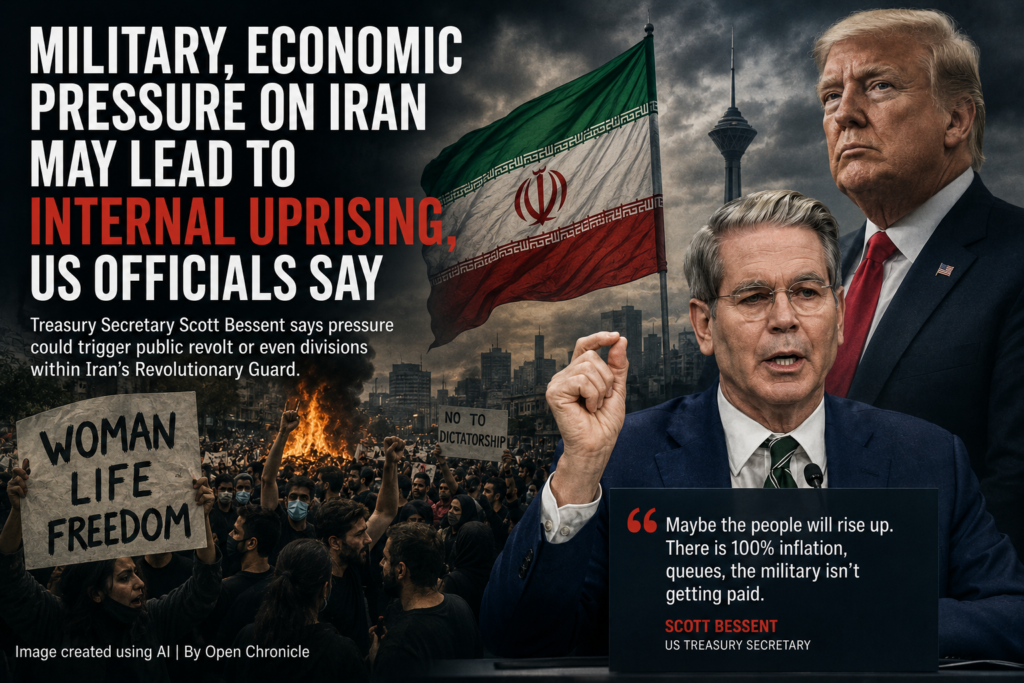
US Treasury Secretary Scott Bessent suggested that the combination of economic deterioration and military pressure could eventually produce either a popular uprising or fractures within the Islamic Revolutionary Guard Corps, one of the central pillars of the Iranian state.
“Maybe the people will rise up,” Bessent said, pointing to inflation, shortages and difficulties paying military personnel as evidence of growing pressure inside the country.
According to Bessent, Iran is experiencing inflation of around 100 percent, while queues and financial disruption are placing additional strain on the population. He also described the Iranian central bank governor as having been in a state of panic in recent days.
The comments indicate that at least some officials in Washington increasingly view economic pressure not simply as a tool for extracting diplomatic concessions, but as something capable of changing the internal political balance inside Iran.
Trump calls on Iranians to rise up
Bessent’s comments followed even more explicit language from Trump.
The president used Truth Social on Wednesday to call on Iranians to rise up and fight, immediately prompting questions over whether Washington is moving towards an explicit policy of encouraging regime change.
Trump was subsequently asked whether his comments meant he would be prepared to authorize the CIA to provide weapons or other assistance to Iranian groups seeking to overthrow the government.
The material available does not establish that such a decision has been taken.
Nevertheless, the president’s rhetoric represents a potentially significant development. Washington has frequently maintained that its military actions are intended to eliminate threats from Iran rather than impose a new government in Tehran. Openly encouraging Iranians to challenge the authorities inevitably raises questions about where military coercion ends and regime change policy begins.
Pressure on the IRGC
The possibility of fractures inside the Islamic Revolutionary Guard Corps could be particularly significant.
The IRGC is far more than a conventional military organization. It occupies a central position within Iran’s political, security and economic system and has historically played a critical role in protecting the Islamic Republic against both external threats and domestic unrest.
Bessent suggested that worsening economic conditions could eventually create divisions even within the organization.
Such an outcome remains speculative. Iranian authorities have survived previous periods of intense sanctions, economic hardship and major demonstrations, while the security establishment has repeatedly demonstrated its ability to suppress internal challenges.
What has changed is the scale of pressure now confronting the country. Iran is dealing simultaneously with military strikes, damage to strategic infrastructure, severe economic disruption and sustained international pressure.
Washington weighs whether to end the war
The increasingly forceful rhetoric about Iran’s internal stability is emerging alongside a seemingly contradictory debate inside Washington.
Trump is reportedly discussing with advisers whether the United States should declare the war over.
Such a declaration could allow the administration to argue that American military objectives have been achieved while shifting towards economic pressure, deterrence and possible negotiations.
It could also reduce the risk of an open ended US military commitment at a time when American forces and equipment have been under considerable pressure after months of operations across the Middle East.
The question would then become whether Tehran considers the conflict over as well.
Military operations may be reduced or suspended by one side, but without a broader political settlement, the underlying confrontation between Washington and Tehran would remain unresolved.
Economic warfare becomes increasingly important
The Treasury Department is central to the next phase of any strategy built around economic coercion.
US sanctions have long targeted Iranian oil exports, financial institutions, shipping networks and companies connected to the country’s military and nuclear programs. Additional pressure could seek to further restrict Tehran’s ability to generate foreign currency and finance government operations.
Washington appears to be calculating that economic deterioration, combined with the effects of military operations, could eventually force Iranian leaders to accept terms they previously rejected.
Bessent echoed Trump’s argument that earlier diplomatic efforts failed because Tehran was still unwilling to accept an agreement considered satisfactory by Washington.
The danger is that economic collapse does not necessarily produce the political outcome policymakers expect. Severe economic pressure can weaken governments, but it can also strengthen hardline factions, intensify repression and create instability without producing an organized political alternative.
Regime change returns to the debate
For months, Washington has faced a fundamental question over its objectives in Iran: whether the goal is deterrence, destruction of specific military capabilities, a negotiated settlement, or ultimately political transformation inside the country.
The latest statements from Trump and Bessent have brought that ambiguity back into focus.
Calling on Iranians to rise against their government moves the administration’s rhetoric closer to openly supporting political change, even if the United States has not formally adopted regime change as its declared objective.
There is also a major distinction between internal unrest and the collapse of the Iranian political system. Even widespread demonstrations would not necessarily threaten the government unless they were accompanied by significant defections from the security services, military or IRGC.
That is why Bessent’s reference to possible divisions within the Revolutionary Guard may ultimately prove more consequential than speculation about demonstrations alone.
A potentially dangerous transition
The debate comes at a particularly sensitive moment in the conflict.
Washington appears to believe that Iran has been substantially weakened and that military pressure has created an opportunity to force political concessions. Tehran, however, retains military capabilities and an extensive security apparatus.
An attempt to exploit internal instability could therefore create new risks even if large scale American military operations begin to wind down.
For the Trump administration, the challenge is increasingly becoming one of converting battlefield and economic pressure into a political outcome.
Whether that produces negotiations, prolonged instability or a genuine challenge to Iran’s leadership remains impossible to determine.
What is increasingly clear is that Washington’s discussion has moved beyond simply degrading Iranian military capabilities. The future stability of the Iranian state itself is now becoming part of the political conversation surrounding the war.