
By Open Chronicle Newsdesk with agencies
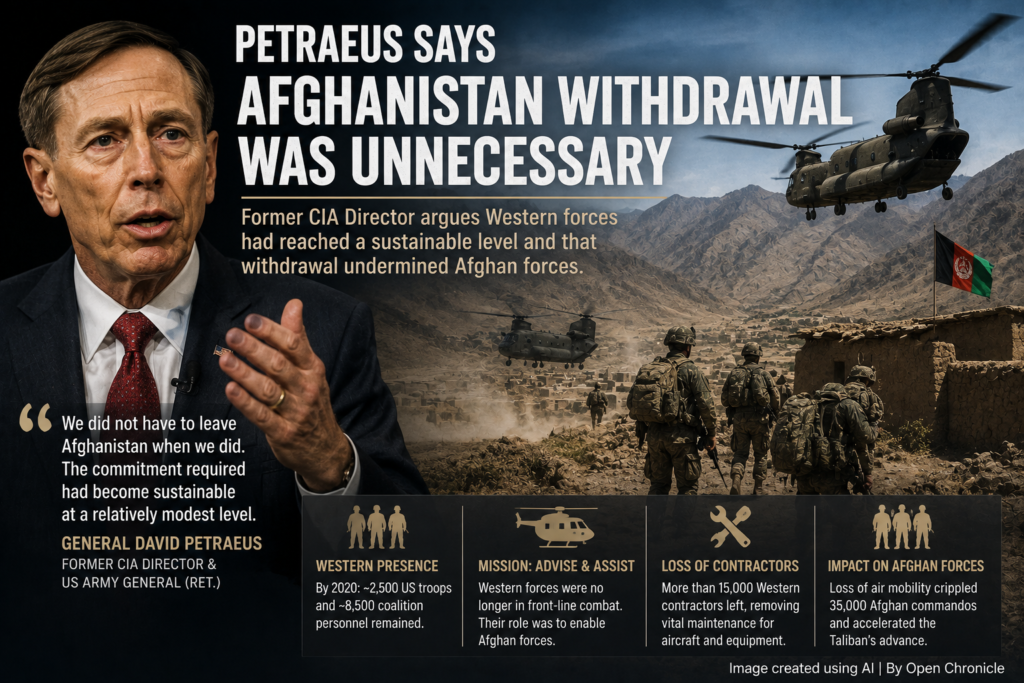
Former CIA director and retired US Army General David Petraeus has argued that the United States and its allies did not need to withdraw from Afghanistan in 2021, saying the Western military presence had reached a sustainable level and that its removal dismantled crucial capabilities supporting Afghan security forces.
Speaking during the Lord Speaker’s Lecture at the House of Lords on September 1, Petraeus rejected the idea that the duration of the conflict was itself sufficient justification for ending the Western military commitment.
Instead, the former commander of US and NATO forces in Afghanistan argued that decisions about remaining in a conflict should be based on whether the human, military and financial costs remain proportionate to the strategic interests being protected.
“And here, allow me an aside to observe that I do not believe we had to leave Afghanistan when we did. Nor do I believe we should have done so,” Petraeus said.
Rejecting the argument to “end endless wars”
Petraeus directly challenged what became one of the central political arguments surrounding Afghanistan in the years before the withdrawal, the need to bring America’s so called endless wars to an end.
“For years I disagreed with the increasingly fashionable argument that we simply had to ‘end endless wars,’” he said.
“That formulation asks the wrong question. The issue is not how long a conflict has lasted. It is whether the commitment required to sustain it remains proportionate to the interests being protected and the costs being borne.”
Petraeus contrasted Afghanistan with the Vietnam War, which he argued eventually imposed military and financial costs that could no longer be sustained.
Afghanistan, in his assessment, had reached a fundamentally different situation by 2020.
“We obviously have to end wars that are not sustainable. But sustainability should be measured principally by the expenditure of our blood and our treasure,” Petraeus said.
“Vietnam, by those metrics, clearly became unsustainable. By contrast, the effort in Afghanistan by 2020 had become sustainable at a relatively modest level.”
A smaller Western military presence
Petraeus pointed to the relatively limited number of Western personnel remaining in Afghanistan before the final withdrawal.
Approximately 2,500 American troops and 8,500 coalition personnel remained, according to the figures he cited.
Importantly, he argued, Western troops were no longer primarily conducting front line combat operations against the Taliban.
Their role had evolved towards supporting Afghan forces.
“The Taliban controlled no major population centers, and our forces were no longer engaged in front line combat,” Petraeus said.
“Their principal role was to advise, assist, and enable Afghan partners and provide capabilities the Afghan security forces had not yet developed for themselves.”
From Petraeus’s perspective, this distinction is critical to understanding why the remaining Western deployment could have continued.
The mission was no longer comparable in scale to the earlier phases of the war, when tens of thousands of NATO troops were directly engaged in extensive combat operations.
The Taliban prisoner release
Petraeus also criticized decisions taken during the diplomatic process that preceded the withdrawal.
Particularly controversial in his assessment was the requirement for the Afghan government to release thousands of Taliban prisoners.
“Nor should we have required the Afghan government to release some 5,500 Taliban detainees merely to secure from our adversary an agreement confirming what it already wanted us to do, to leave,” he said.
The prisoner releases formed part of the political process surrounding the agreement intended to facilitate the departure of foreign forces from Afghanistan.
Petraeus’s criticism reflects his broader argument that Western governments conceded important leverage while simultaneously signaling that their military presence was coming to an end.
The overlooked importance of civilian contractors
One of the most significant elements of Petraeus’s argument concerns personnel who were not soldiers at all.
When Western military forces departed Afghanistan, more than 15,000 Western contractors also left the country.
According to Petraeus, those contractors provided essential technical support for sophisticated military equipment supplied to Afghan forces, particularly aircraft and helicopters.
“The consequences of withdrawal should have been foreseeable,” he said.
“It removed not only American and coalition forces, but also more than 15,000 Western contractors who were indispensable to maintaining the sophisticated American aircraft and helicopters we had provided the Afghan forces.”
This had consequences extending far beyond aircraft maintenance.
Afghanistan’s geography and the dispersed nature of the fighting meant that aviation was central to the government’s military strategy.
Afghan commandos lost critical mobility
Petraeus highlighted approximately 35,000 Afghan commandos who represented some of the government’s most capable military formations.
These troops could be transported rapidly to reinforce conventional Afghan army and police units confronting Taliban offensives.
That model depended heavily upon functioning aircraft.
“As that maintenance capacity disappeared, so did the mobility upon which some 35,000 exceptionally capable Afghan commandos depended to respond to attacks around the country,” Petraeus said.
Without sufficient maintenance support, aircraft availability deteriorated, undermining the ability of elite forces to move quickly between threatened areas.
“Without that air mobility, those commandos could no longer reinforce front lines held by much less capable conventional soldiers and police,” he added.
“The essence of the Afghan strategy was therefore fatally undermined, and once that capability eroded, the collapse accelerated.”
A military system, not simply an army
Petraeus used the Afghan experience to make a broader argument about how military power should be measured.
The size of an armed force, he argued, can provide a misleading picture of its actual combat effectiveness.
Afghanistan possessed hundreds of thousands of security personnel on paper and had received large quantities of Western military equipment. But those forces depended upon a wider system of logistics, intelligence, maintenance, communications, aviation and technical support.
Once important elements of that system disappeared, the effectiveness of the forces themselves deteriorated.
“Military effectiveness cannot be measured simply by counting soldiers, aircraft, ships, or weapons,” Petraeus said.
“It depends upon the institutions, logistics, intelligence, technology, industrial capacity, and professional relationships that enable those capabilities to function.”
The rapid collapse of Afghanistan
The Taliban’s eventual takeover demonstrated how quickly military structures can unravel once their supporting architecture begins to fail.
As Western forces and contractors withdrew, Afghan units faced increasing difficulties maintaining aircraft, supplying isolated positions and moving elite formations around the battlefield.
The psychological consequences were also significant.
Afghan personnel understood that the international military infrastructure that had supported them for almost two decades was disappearing.
As Taliban forces advanced, government positions increasingly collapsed, sometimes without significant fighting.
Kabul ultimately fell in August 2021, bringing the Western backed Afghan government to an end and returning the Taliban to power almost two decades after they had been removed following the September 11 attacks.
A continuing debate over the withdrawal
Petraeus’s intervention returns to one of the most contested questions surrounding the Afghanistan war.
Supporters of withdrawal argued that after two decades of military involvement, enormous expenditure and thousands of coalition deaths, continuing the mission offered little prospect of producing a fundamentally different political outcome.
Petraeus presents a different calculation.
His argument is not that Afghanistan had become stable or that the Taliban had been defeated. Rather, he contends that Western forces had reduced their exposure sufficiently for a relatively small deployment to prevent a much larger strategic collapse.
In this interpretation, the choice facing Washington and its allies was not necessarily between winning the war and withdrawing.
There was a third possibility, maintaining a limited military and technical presence that could continue enabling Afghan forces while preventing the Taliban from taking control of the country.
Afghanistan as a lesson in modern military power
Beyond the continuing political debate over the 2021 withdrawal, Petraeus’s remarks contain a wider lesson for contemporary defence planning.
Modern military power depends upon far more than weapons and personnel.
Aircraft require maintenance crews and spare parts. Elite formations require transportation. Intelligence networks require communications infrastructure. Precision weapons depend upon surveillance and targeting systems. Armies require functioning logistics and institutions capable of sustaining operations.
Remove enough of those supporting elements and an apparently large military force can lose effectiveness extraordinarily quickly.
For Petraeus, Afghanistan demonstrated this principle with devastating clarity.
The withdrawal removed a comparatively small number of Western troops, but it also dismantled much of the support architecture upon which Afghan forces had been built.
His conclusion remains controversial, particularly given the enormous political and human costs accumulated during two decades of Western intervention.
But more than five years after Kabul fell, Petraeus continues to argue that the final collapse was not inevitable simply because the war had lasted 20 years.
In his assessment, the decisive question was never how long the West had been in Afghanistan. It was whether the remaining commitment was sustainable.
And by 2020, he believes it was.
The Grand Strategy Institute
Continue Exploring Strategic Analysis
Return to The Grand Strategy Institute for strategic assessments, long-form analysis and research examining geopolitics, military affairs, international security, emerging technologies and the changing international order.
← Back to The Grand Strategy Institute