
By Open Chronicle Newsdesk with agencies
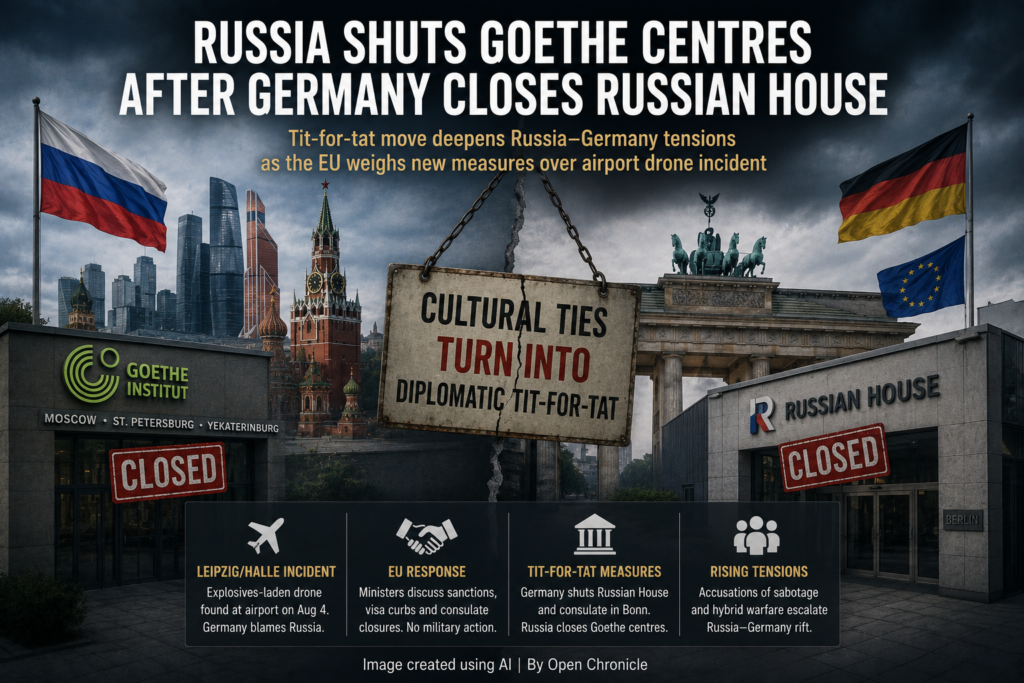
Russia has ordered the closure of German cultural centres in Moscow, St Petersburg and Yekaterinburg in retaliation for Germany’s decision to shut Russian facilities following the attempted attack at Leipzig/Halle Airport, marking another sharp deterioration in relations between Moscow and Berlin.
Russian Foreign Minister Sergey Lavrov said on Thursday that centres operated by Germany’s Goethe Institut would be closed after Berlin announced measures including the closure of the Russian Consulate in Bonn and the Russian House cultural centre in Berlin.
The diplomatic retaliation comes as European Union governments consider additional measures against Moscow over suspected Russian hybrid operations across Europe, including sanctions, visa restrictions and the possible closure of further Russian diplomatic facilities.
The confrontation demonstrates how the fallout from the Leipzig/Halle incident is spreading beyond traditional security policy into diplomatic and cultural relations between Russia and Germany.
Moscow responds to Berlin
Speaking at the Eastern Economic Forum in Vladivostok, Lavrov said Russia could not leave Germany’s decision unanswered.
He argued that any weaker response would demonstrate a lack of “self respect” on Moscow’s part.
According to Lavrov, German authorities “could not have failed to understand” that closing the Russian House in Berlin would mean “the end of their cultural presence in Russia.”
The Goethe Institut has long represented one of Germany’s principal instruments of international cultural diplomacy, promoting the German language and cultural exchange around the world.
Closing its Russian operations would therefore represent more than a symbolic diplomatic response. It would further dismantle cultural links that survived previous periods of political tension between the two countries.
Leipzig/Halle attack transformed relations
The immediate trigger for the escalating confrontation was the August 4 incident at Leipzig/Halle Airport.
An explosives laden drone was discovered near a Ukrainian aircraft at the airport and subsequently defused.
Leipzig/Halle is one of Germany’s most important international freight hubs and has played a role in logistical support connected to Ukraine.
German authorities subsequently blamed Russia for the attempted attack.
The incident has become part of a much broader European security debate over alleged Russian hybrid warfare, encompassing sabotage, cyber operations, disinformation, covert intelligence activities and attacks against critical infrastructure.
Moscow has rejected the allegations.
Germany says it is a daily target
Berlin has increasingly described the security environment as one in which Germany faces sustained hostile activity without being formally at war with Russia.
German Foreign Minister Johann Wadephul said the country had carefully prepared its response to the Leipzig/Halle incident.
Russia, he said, would now have to “live with these consequences.”
At the same time, Wadephul left open the possibility of diplomatic engagement, calling on Moscow to demonstrate that it remained prepared for serious negotiations, particularly over Ukraine.
Germany’s approach reflects the difficult balance facing European governments. They want to impose consequences for suspected Russian operations without allowing the confrontation to escalate into direct military conflict between Russia and NATO.
EU considers additional measures
The dispute is unfolding alongside broader discussions within the European Union about how to respond to suspected Russian operations.
At an informal meeting of EU foreign ministers in Ireland on Wednesday, EU foreign policy chief Kaja Kallas used unusually strong language to describe the alleged campaign.
“It is clear that it has all the hallmarks of state sponsored terrorism,” Kallas said, before asking what measures European governments should take in response.
Options discussed by ministers included additional sanctions, restrictions on Russian visas and the closure of Russian consulates.
Military retaliation was not presented as part of the response.
The approach suggests that European governments are looking for measures that impose political, diplomatic and economic costs while keeping the confrontation below the threshold of armed conflict.
More sanctions under consideration
The European Union has already imposed extensive sanctions on Russia since the full scale invasion of Ukraine in 2022.
Thousands of Russian officials, business figures and entities have been targeted through travel restrictions, asset freezes and broader economic measures.
The sanctions have affected banks, energy companies, defence manufacturers and businesses associated with Russia’s drone and weapons industries.
Kallas said the EU is preparing additional travel bans and asset freezes targeting around 1,600 people.
The Leipzig/Halle incident could therefore become another catalyst for expanding the European sanctions regime.
It may also strengthen arguments within the bloc for restricting Russia’s remaining diplomatic and institutional presence across Europe.
Putin rejects German accusations
Russian President Vladimir Putin has dismissed Germany’s allegations.
He accused Berlin of attempting to divert attention from domestic political problems and public dissatisfaction, while claiming that evidence presented against Russia had been planted.
Moscow has repeatedly rejected Western accusations that it is conducting a coordinated sabotage campaign across Europe.
Russian officials instead accuse European governments of using such incidents to justify tougher policies towards Moscow and continued support for Ukraine.
Those competing narratives have become a central feature of the deteriorating relationship between Russia and Europe.
Cultural diplomacy becomes another casualty
The decision to target cultural institutions illustrates how far relations between Russia and Germany have deteriorated.
For decades, cultural organizations provided channels of communication that remained active even when political relations were strained.
Institutions such as the Goethe Institut were designed precisely to maintain educational and cultural connections independently of day to day diplomatic disputes.
Russian House performed a broadly comparable role in promoting Russian language, culture and international engagement abroad.
Their closure indicates that the confrontation is increasingly reaching institutions traditionally regarded as separate from military and security disputes.
Students, academics, artists and ordinary citizens may consequently lose some of the few remaining institutional connections between the two societies.
Germany and Russia enter a deeper confrontation
The latest dispute represents another stage in the transformation of German Russian relations since the invasion of Ukraine.
Germany was once one of Moscow’s most important economic partners in Europe, particularly through extensive energy ties. The war fundamentally altered that relationship, while Berlin became an increasingly important supplier of military and financial assistance to Kyiv.
Allegations of Russian hybrid operations have now added an internal security dimension to the confrontation.
Germany no longer views the challenge exclusively through developments on the Ukrainian battlefield. Suspected sabotage, cyber operations and attacks against infrastructure are increasingly treated as threats occurring inside Germany itself.
That change has significant implications for Berlin’s Russia policy.
A widening confrontation below the threshold of war
Neither Russia nor Germany is suggesting that the latest confrontation should become a direct military conflict.
Nevertheless, the space separating normal diplomatic competition from open confrontation continues to narrow.
Sanctions, consulate closures, accusations of sabotage, visa restrictions and now the dismantling of cultural institutions are steadily reducing the channels through which Moscow and Berlin interact.
The closure of the Goethe Institut centres may therefore appear secondary compared with the military confrontation in Ukraine or allegations of sabotage across Europe.
Symbolically, however, it carries considerable weight.
Institutions created to maintain communication between societies are becoming casualties of the geopolitical conflict itself.
As the European Union considers its next response to alleged Russian hybrid operations, the confrontation between Moscow and Berlin is increasingly extending far beyond Ukraine, reshaping diplomatic, security and now cultural relations between Russia and one of Europe’s most powerful states.