
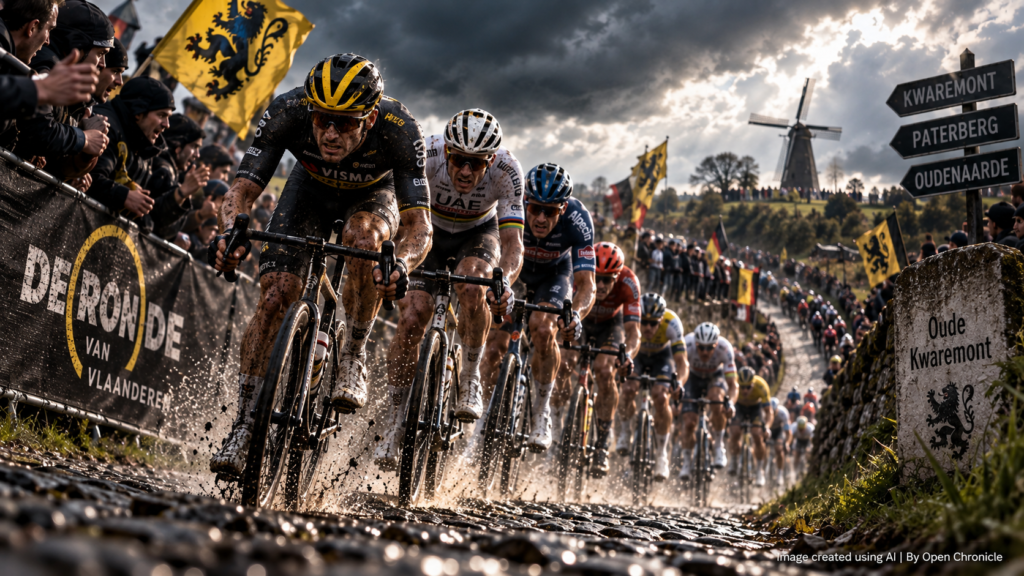
How pavé, wind, narrow roads and the relentless fight for position determine who survives when the northern Classics explode
By Open Chronicle Sports
4 September 2026
The television camera usually follows the attack.
A favourite accelerates on the Oude Kwaremont. A group fractures inside the Trouée d’Arenberg. Someone loses contact on the Carrefour de l’Arbre. A crosswind suddenly tears the peloton into pieces.
It looks like that is where the race was decided.
Often, it was not.
The decisive move may have begun several kilometres earlier, when teams started fighting for the first ten positions approaching a narrow road. It may have begun when one leader entered the cobbles fifth and another entered fortieth. It may have begun when the wind changed direction, when a teammate disappeared, or when a rider was forced to brake behind someone losing momentum.
In the northern Classics, position is not simply tactical convenience. It is a form of energy, protection and insurance.
And on the cobbles, losing position can mean losing the race before the decisive attack has even happened.
Pavé Changes the Physics of Racing
On smooth asphalt, the peloton provides an extraordinary aerodynamic advantage.
Riders can shelter behind one another, conserve energy and move through the bunch when opportunities appear.
Cobbles disrupt that equilibrium.
The bicycle begins moving vertically and laterally. Maintaining momentum becomes more difficult. Rolling resistance rises. Traction changes. Choosing a line becomes important. Mechanical failures become more likely.
Most importantly, the cost of losing speed increases.
On asphalt, a rider who allows a small gap to open can often accelerate gradually back onto the wheel.
On rough pavé, that acceleration is considerably more expensive.
A rider loses momentum. The rider behind brakes. Another moves around them. A tiny separation becomes several bike lengths.
Then the elastic snaps.
This is why cobbled sectors do not need an attack to create a selection.
Sometimes the road makes the attack itself.
The Race Into the Sector
One of the strangest characteristics of the cobbled Classics is that the kilometres immediately before the pavé can be more frantic than the sector itself.
Everyone knows where the danger begins.
That knowledge creates a collective rush.
With several kilometres remaining, domestiques move towards the front. Teams assemble around their leaders. Speeds rise dramatically. Riders fight for wheels and use every available piece of road.
There may be 100 riders who want to enter a sector among the first 20.
Mathematically, most will fail.
That creates what is effectively a sprint before every important obstacle.
The objective is not to win anything immediately.
It is to purchase position.
And position can be enormously valuable.
Why Fifth Is Different From Fiftieth
Imagine two equally strong riders approaching a decisive cobbled sector.
Rider A enters fifth.
Rider B enters fiftieth.
Rider A has four riders ahead. He can see the road, choose his line and respond quickly when the favourites accelerate.
Rider B has dozens of potential problems between himself and the front.
Every rider ahead can puncture.
Every rider can crash.
Every rider can lose momentum.
Every gap must be closed.
Every corner creates an accordion effect.
Even if Rider B possesses exactly the same physical ability as Rider A, they are no longer riding the same race.
This is one of the fundamental lessons of the northern Classics:
Position reduces the number of things that can go wrong.
It cannot eliminate bad luck.
It can dramatically reduce exposure to it.
The Domestique’s Invisible Victory
This is where teammates become essential.
A domestique who delivers his leader into the first five positions before the Oude Kwaremont and then immediately disappears from the race may appear to have accomplished little.
In reality, he may have performed one of the day’s most important jobs.
He has spent his energy so the leader does not have to.
Without that teammate, the favourite might need to accelerate repeatedly through the peloton, fight the wind and defend position personally.
Those efforts accumulate.
The Classics are filled with this invisible transfer of energy.
One rider spends watts so another can preserve them.
When the leader attacks hours later, part of that acceleration belongs to teammates who protected him earlier.
The Accordion Effect
The deeper a rider sits in the peloton, the more violently speed changes can affect him.
At the front, a corner may require a modest reduction in speed.
Further back, riders brake harder.
Then they accelerate harder.
The process repeats through the bunch.
This is the accordion effect.
On narrow roads and cobbles, it becomes particularly punishing.
A rider near the front may ride at relatively constant power while someone much further back repeatedly performs short, intense accelerations simply to maintain contact.
Over several hours, those efforts matter.
Two riders can arrive at the decisive finale having covered exactly the same distance but having paid very different physiological prices.
Position determines part of that difference.
Arenberg: Where Position Becomes Survival
Few places demonstrate this better than the Trouée d’Arenberg.
Arenberg is famous for its brutal cobbles, but the approach is almost as important as the sector.
The peloton accelerates before entering the forest because everyone understands the consequences of starting too far back.
Once inside, overtaking becomes difficult. Lines are limited. Crashes and mechanical problems can create immediate separation.
Arenberg is not usually where Paris Roubaix is won outright.
But it is absolutely somewhere Paris Roubaix can be lost.
That distinction is central to understanding Classics tactics.
Not every decisive location produces the winning attack.
Some exist primarily to eliminate possible winners.
Choosing a Line
Cobbles also introduce another tactical element largely absent from ordinary road racing.
The racing line.
Depending on the sector and conditions, riders may search for smoother stones, crowns in the road, gutters or narrow edges where vibration is reduced.
But the theoretically fastest line is not always available.
Another rider may already occupy it.
Spectators may narrow the usable space.
Mud or standing water may make an apparently smoother line dangerous.
Changing line also carries risk.
A rider must therefore constantly balance speed, traction, space and the behaviour of those around him.
This helps explain why bike handling matters so much in races such as Paris Roubaix and the Tour of Flanders.
Power gets a rider onto the cobbles.
Skill helps ensure that power reaches the road.
Momentum Is Everything
Cobbled climbing adds another dimension.
On climbs such as the Oude Kwaremont and Paterberg, losing momentum can be catastrophic.
The gradient increases the cost of every interruption.
If a rider ahead slows suddenly, those behind may be forced to brake or change line.
Restarting acceleration on steep cobbles requires an enormous effort.
The strongest riders therefore attempt to remain near the front, where they can dictate rather than react.
This is one reason a favourite’s attack can look so devastating.
The leader accelerates cleanly.
Five riders behind, someone hesitates.
Ten riders behind, someone changes line.
Twenty riders behind, the gap already exists.
The attack is amplified by the road.
The Oude Kwaremont: More Than a Climb
The Oude Kwaremont has become one of the defining theatres of the Tour of Flanders.
Its importance comes not merely from gradient.
Length matters.
Cobbles matter.
Position matters.
And, critically, what follows matters.
The Kwaremont can progressively expose weakness before the Paterberg provides a shorter and more explosive test.
Teams therefore approach it with strategic objectives.
Some want to increase the pace before the climb.
Some want to isolate a rival.
Some want to launch an attack.
Others simply need to survive.
The same piece of road can therefore mean completely different things to different riders.
For a favourite, it is an opportunity.
For a sprinter, it is survival.
For a domestique, it may be the end of his job.
For an attacker already ahead, it is a calculation involving seconds and diminishing energy.
The road is identical.
The tactical race is not.
Wind: The Cobbles You Cannot See
Then there is wind.
Northern Europe provides exposed farmland, open roads and rapidly changing weather.
A strong crosswind can become as selective as a climb.
When wind arrives from the side, riders attempt to shelter diagonally behind one another, forming an echelon.
But an echelon cannot contain an unlimited number of riders.
Road width determines how many protected positions exist.
Everyone else is forced into the gutter or exposed directly to the wind.
Then a team accelerates.
The race splits.
There has been no climb.
No cobbled sector.
Sometimes no conventional attack.
Yet suddenly twenty riders have disappeared from contention.
Wind is effectively an invisible gradient.
Why Teams Attack in Crosswinds
Crosswind racing rewards preparation.
Teams study weather forecasts and examine the route for exposed sections and changes in direction.
They know approximately where conditions may become dangerous.
The strongest teams then position their entire group near the front before reaching those roads.
When the direction changes, they accelerate.
This serves several purposes simultaneously.
It places rivals under physical pressure.
It isolates poorly positioned leaders.
It forces other teams to chase.
And perhaps most importantly, it creates uncertainty.
A peloton travelling comfortably can transform into several desperate groups within a minute.
Once the split exists, closing it can require enormous energy.
Again, positioning determines who pays.
The Gutter
The cruelest place in crosswind racing may be the edge of the road.
A rider can see the echelon only metres ahead.
But there is no space to enter it.
Everyone inside receives aerodynamic shelter.
The rider in the gutter receives almost none.
He may be travelling at the same speed while producing substantially more power.
Eventually he weakens.
A gap opens.
The riders behind suffer the same fate.
This is why a crosswind can dismantle a peloton with astonishing speed.
The race does not necessarily explode because somebody suddenly became stronger.
It explodes because the available shelter ran out.
Position Before Power
This leads to an important paradox.
The strongest rider may sometimes need to spend less energy than a weaker rider simply because he is better positioned.
A favourite protected by teammates near the front avoids repeated accelerations.
A rival trapped behind crashes and splits must repeatedly chase.
By the time the decisive climb arrives, the difference is visible.
The favourite attacks.
The rival cannot follow.
Television shows a difference in strength.
But part of that difference was manufactured during the previous four hours.
The decisive attack merely revealed it.
Mechanical Risk
Cobbles also turn equipment reliability into race strategy.
Punctures and mechanical failures cannot be completely prevented.
But teams can prepare for them.
Tyre choice, pressure, wheel setup and bicycle configuration all matter.
So does position.
A mechanical problem near the front may cost seconds.
The same problem when the peloton is already splitting can cost the race.
Support vehicles can also be far behind, particularly after groups fragment.
Teammates therefore become mobile insurance.
A rider may give a wheel or even a bicycle to the team leader.
In a Classic, the team’s hierarchy can become brutally clear in seconds.
Rain Changes Everything
Add rain and the tactical equation changes again.
Cobbles become slippery.
Painted road markings become dangerous.
Corners demand greater caution.
Mud can obscure the best line.
Braking distances change.
Confidence becomes performance.
Some riders thrive in unstable conditions because they remain relaxed and allow the bicycle to move underneath them.
Others become cautious.
That difference may be only a few percent.
Over dozens of corners and kilometres of pavé, it becomes significant.
Weather therefore does more than alter physical difficulty.
It changes risk tolerance.
And risk tolerance changes tactics.
The Psychological Battle for Position
Constantly fighting for position is mentally exhausting.
A rider cannot switch off.
Every roundabout matters.
Every narrow bridge matters.
Every village entrance matters.
Every approaching sector requires anticipation.
After five hours, cognitive fatigue becomes another component of the race.
The greatest Classics riders seem to possess an instinct for this.
They appear near the front before danger becomes obvious.
They move before everyone else moves.
This creates the impression that they are always lucky.
Often, they are simply early.
Knowing When Not to Fight
Positioning also requires restraint.
Remaining permanently in the first five riders would consume enormous energy.
The skill lies in knowing when position matters.
A rider may comfortably sit thirtieth on a wide road with no immediate obstacle.
Five kilometres later, he must be fifth.
The transition between those positions needs to happen before everyone else has the same idea.
This is where route knowledge becomes crucial.
Experienced riders memorise landmarks.
A church.
A roundabout.
A railway crossing.
A village.
They know that after that point the road narrows.
They begin moving.
By the time television commentators announce that the cobbled sector is approaching, the tactical battle may already be almost finished.
The Race Behind the Race
This is perhaps the most important way to understand the northern Classics.
There are always two races.
The visible race contains attacks, breakaways and winners.
The hidden race contains positioning, wind protection, energy conservation, equipment decisions and teammates delivering leaders to precise locations.
The visible race creates the highlights.
The hidden race often determines who is still capable of creating them.
Once you begin watching that second race, the Classics look completely different.
A domestique moving his leader forward becomes significant.
A team suddenly appearing together at the front becomes a warning.
A favourite drifting backwards becomes alarming.
A change in wind direction becomes an attack before anybody accelerates.
And entering a cobbled sector twentieth instead of fifth becomes a tactical event.
The Northern Classics Reward Anticipation
Strength remains essential.
Nobody wins Flanders or Roubaix through positioning alone.
Eventually the great riders must produce extraordinary physical performances.
But the northern Classics punish anyone who believes strength can solve every problem afterwards.
Sometimes there is no afterwards.
A crash blocks the road.
A split becomes permanent.
A crosswind group disappears.
A puncture arrives at the worst possible moment.
A rider enters the Paterberg too far back and watches the favourites ride away.
That is why the greatest specialists do not simply react to the race.
They anticipate it.
They fight for the road before the road becomes important.
They understand where shelter will disappear.
They know where momentum must be protected.
They recognise danger before it becomes visible.
And when the decisive attack finally comes, they are already exactly where they need to be.
Because in the northern Classics, the winning move sometimes begins long before anyone attacks.