
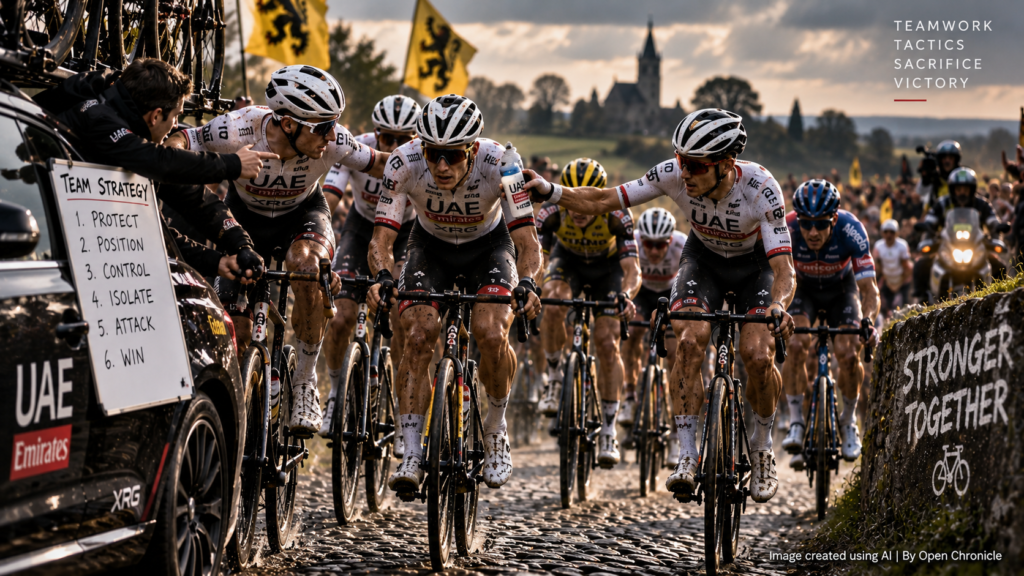
Multiple leaders, domestiques, satellite riders and tactical superiority can turn individual strength into collective control in one day racing
By Open Chronicle Sports
4 September 2026
Cycling crowns an individual winner.
The photograph shows one rider crossing the line. One name enters the record books. One cyclist stands on the highest step of the podium.
But a Classic is rarely won by one rider alone.
Behind almost every great one day victory lies a network of decisions involving teammates who protected the leader from the wind, fought for position, entered breakaways, chased dangerous moves, carried bottles, surrendered wheels, forced rivals to work and sometimes sacrificed their own chance of victory.
At the highest level, team strategy becomes even more sophisticated.
A squad may start with two leaders rather than one. It may place a rider in the breakaway specifically to use him five hours later. It may deliberately refuse to chase because a teammate is already ahead. It may attack repeatedly simply because one rival has been isolated.
The strongest rider remains enormously important.
But in the Classics, having the strongest team can change what the strongest rider is allowed to do.
Eight Riders, One Objective
A team enters a Classic with riders performing very different jobs.
There may be a protected leader.
There may be a second leader or dangerous alternative.
Some riders specialise in controlling breakaways.
Others are selected because they can position the leader before cobbled sectors or climbs.
Some are expected to survive deep into the finale.
Others may spend everything during the first half of the race.
This creates a hierarchy that evolves as the kilometres pass.
At the start, eight riders may have responsibilities.
With 100 kilometres remaining, perhaps four remain relevant.
At 50 kilometres, there may be two.
Eventually, the leader may be alone.
The purpose of team strategy is to ensure that when that moment arrives, the leader has spent less energy and faced fewer problems than his rivals.
The Domestique: Cycling’s Essential Sacrifice
No role illustrates the collective nature of cycling better than the domestique.
A domestique can spend hours working for an outcome that will never appear beside his name in the results.
He collects bottles.
He closes gaps.
He rides into the wind.
He gives up position.
He moves his leader towards the front.
He may even surrender a wheel or bicycle after a mechanical problem.
Then, once his work is complete, he disappears from the leading group.
To an unfamiliar spectator, he has been dropped.
To his team, he may have executed the race perfectly.
The crucial concept is energy transfer.
A domestique cannot literally give physical energy to the leader, but he can spend his own energy preventing the leader from spending theirs.
That difference accumulates over five or six hours.
When the favourite attacks with 30 kilometres remaining, part of the power behind that attack was preserved by teammates much earlier.
Protection Is More Than Drafting
Protecting a leader does not simply mean providing aerodynamic shelter.
It means controlling the leader’s environment.
A teammate can create space in the peloton.
He can guide the leader through dangerous roads.
He can move him towards the front before a cobbled sector.
He can retrieve food and bottles so the leader does not have to move backwards through the bunch.
He can immediately respond when a dangerous rival attacks.
Each task appears small.
Together, they allow the leader to concentrate on the decisions that actually determine victory.
The ideal leader reaches the decisive phase having spent as little unnecessary energy as possible.
Why Multiple Leaders Change Everything
Some teams arrive at a Classic with an obvious favourite.
Others possess something more dangerous:
options.
Imagine a team containing two riders capable of winning.
One is an explosive climber.
The other has a powerful sprint.
Their opponents cannot design one simple strategy.
If they allow the climber to escape, he may win alone.
If they chase every attack, they may deliver the faster teammate to the finish.
The presence of multiple leaders therefore creates tactical ambiguity.
And ambiguity forces rivals to make decisions.
That is enormously valuable.
Leadership Does Not Always Need to Be Decided Before the Race
Modern teams sometimes begin with a clear hierarchy.
But Classics are unpredictable.
Crashes happen.
Mechanical problems happen.
Weather changes.
One leader may simply have better legs.
The strongest teams can adapt.
A rider initially assigned as a secondary option may become the leader after 150 kilometres.
A designated favourite may become a domestique if circumstances demand it.
This flexibility can be uncomfortable because professional cyclists have individual ambitions.
But rigid hierarchy can be even more dangerous.
A team that refuses to adapt may continue protecting a rider who can no longer win while another potential winner is forced to sacrifice himself.
The road occasionally rewrites the team meeting.
Good teams recognise when it has happened.
Numbers in the Final Group
One of the most important tactical situations in a Classic occurs when a small group forms and one team has several riders inside it.
Suppose eight riders remain.
Team A has three.
Every other team has one.
Team A possesses what commentators call numbers.
But numbers are valuable only when used.
If all three Team A riders simply ride together until the finish, their advantage may disappear.
The real power of numbers comes from creating asymmetry.
One rider attacks.
A rival must decide whether to chase.
If he chases, another Team A rider rests.
When the first attack is caught, the second rider attacks.
The rival must chase again.
Then the leader attacks.
The isolated opponent is not racing one rider.
He is effectively racing a sequence of fresh efforts.
The One Two Attack
This is one of cycling’s oldest and most effective tactical patterns.
Rider A attacks.
The rival closes the gap.
Immediately, Rider B attacks.
The rival has barely recovered.
If he closes again, Rider A can counter.
The process repeats.
It is sometimes called a one two.
The objective is not necessarily for the first attacker to succeed.
His attack may exist primarily to force the opponent to spend energy.
This distinction matters enormously.
Not every attack is intended to win the race.
Some attacks are designed to make the next attack more dangerous.
The Isolated Leader
Now reverse the situation.
A favourite remains in a group with several rivals but no teammates.
He is isolated.
This does not automatically mean he will lose.
If he is overwhelmingly strong, he may still dominate.
But tactically, his position has become uncomfortable.
Every dangerous move becomes his problem.
If Rival A attacks, should he chase?
If he closes the gap, Rival B may counter.
If he refuses, the race may disappear.
His teammates can no longer perform those calculations for him.
Isolation therefore creates a tax.
The leader must spend both physical and tactical energy.
That is why teams sometimes increase the pace long before attacking the favourite himself.
Their first objective is simply to remove his helpers.
Kill the Team Before Attacking the Leader
This is a subtle but important strategy.
Suppose the strongest rider in the race has four teammates around him.
Attacking immediately may be pointless.
His team can chase.
Instead, rivals increase the pace on difficult terrain.
They send riders forward.
They force repeated accelerations.
They make the race uncomfortable.
One domestique disappears.
Then another.
Eventually the favourite looks around.
Nobody remains.
Only then comes the real attack.
The objective was never merely to weaken the leader.
It was to dismantle the system protecting him.
The Satellite Rider
One of the most elegant team tactics begins hours before it becomes relevant.
A strong domestique enters an early breakaway.
At first, it appears that he is racing for himself.
Later, his team leader attacks from the peloton and bridges across.
Suddenly the rider ahead has a new purpose.
He becomes a satellite rider.
He can provide pacing.
He can give food or drink.
He can help the leader across exposed roads.
He may tow the leader towards another group.
The team has effectively positioned a support vehicle further up the race.
This tactic is especially powerful in long, difficult Classics where team cars may become separated from the leaders.
The Rider Ahead Changes the Chase Behind
A teammate in front can provide value even without helping physically.
Imagine a dangerous group escapes containing a rider from Team A.
Team A now has no reason to chase.
Its riders can sit behind other teams.
Those teams must decide whether to work.
Meanwhile Team A’s leader receives a free ride.
If the break is caught, the leader is fresher.
If it survives, Team A already has someone contesting victory.
This is called tactical coverage.
The team has protected itself against multiple scenarios.
Why a Team Sometimes Refuses to Work
This is one of the moments that can confuse spectators.
A strong team appears capable of chasing.
Yet its riders remain behind.
Often, the explanation is simple.
They already have a teammate ahead.
Chasing would mean working against themselves.
Instead, responsibility passes to another team.
This is where cycling becomes political.
Teams continuously negotiate responsibility without speaking.
Who has the fastest rider?
Who missed the break?
Who has the race favourite?
Who needs the move brought back?
The team with the greatest reason to chase is often forced to spend the greatest amount of energy.
Smart teams try to make that somebody else.
Forcing Rivals to Work
This leads to a fundamental principle of team tactics:
Your opponent’s energy is a resource you want them to spend.
If your team places a dangerous rider ahead, rivals must chase.
If your secondary leader attacks, rivals must respond.
If your teammates control the front, opponents may need to fight through the wind simply to maintain position.
Winning is not only about preserving your own resources.
It is about manipulating how rivals consume theirs.
The Fast Sprinter Behind
Consider another classic scenario.
A strong breakaway has formed.
One team has a rider in the break.
That same team also has the fastest sprinter in the chasing group.
The riders in front now face a dilemma.
If they cooperate with the team’s breakaway rider, they may help him win.
If they catch him, they may deliver his sprinter teammate to the finish.
The team has created a tactical trap.
This is the ideal outcome of multiple options.
Whatever the opposition chooses, the team retains a path to victory.
Sacrificing a Leader
Sometimes the most dramatic team decision is sacrificing someone who could potentially win.
Imagine two leaders survive into the finale.
One is stronger on the day.
The team may ask the other to attack repeatedly, chase rivals or perform a long turn.
His personal chance disappears.
But the team’s probability of winning increases.
These decisions can define relationships inside teams.
Cycling is an individual sport contested through collective sacrifice.
That tension never completely disappears.
The best squads manage it before the race, establishing clear expectations while retaining enough flexibility to react to circumstances.
Information Is Part of Strategy
Team radios have transformed how tactical information moves through professional cycling.
Sports directors can communicate time gaps, weather changes, dangerous riders and instructions.
But information remains imperfect.
Radio coverage can fail.
Riders may misunderstand instructions.
A director sees the race differently from someone inside the peloton.
And Classics develop rapidly.
Sometimes the rider must decide before the team car can respond.
This is why tactical intelligence remains valuable.
A champion cannot simply wait for instructions.
He must read the race.
The Road Captain
Many teams therefore rely on experienced riders who function as road captains.
They understand positioning.
They recognise dangerous moves.
They communicate with younger teammates.
They help translate the pre race plan into decisions made inside a chaotic peloton.
A road captain may never appear in the final television images.
But his judgement can shape the entire team’s race.
Experience becomes tactical infrastructure.
When the Plan Collapses
No Classic follows the team briefing perfectly.
A crash removes a leader.
A breakaway becomes unexpectedly dangerous.
A crosswind splits the team.
A mechanical problem arrives before a decisive climb.
The best teams are not necessarily those with the most detailed plan.
They are those capable of abandoning the plan intelligently.
This distinction is essential.
Strategy provides structure.
Racing provides uncertainty.
The team that adapts fastest often gains the advantage.
Team Strength Can Become Psychological Pressure
There is also a psychological dimension.
When one powerful team places five riders near the front late in a Classic, everyone notices.
Rivals understand what those numbers mean.
They anticipate attacks.
They become reluctant to spend energy.
They begin watching the dominant team.
Sometimes that attention itself becomes useful.
While everyone watches the favourite, a secondary rider attacks.
Nobody reacts immediately.
The hierarchy becomes camouflage.
But Numbers Can Become a Trap
Having several riders in the final group does not guarantee success.
Teams can become too cautious.
Each rider waits for another to act.
They become obsessed with preserving numerical superiority rather than exploiting it.
Meanwhile an isolated rival attacks and disappears.
This produces one of cycling’s great tactical embarrassments:
A team finishes second, third and fourth.
One opponent finishes first.
On paper, they dominated.
In reality, they lost.
Numbers have an expiration date.
They must be converted into action.
The Final 20 Kilometres
Late in a Classic, team strategy becomes increasingly ruthless.
Domestiques have disappeared.
Radio instructions become simpler.
There may be no energy left for complicated plans.
If two teammates remain, their roles become crucial.
One can attack.
The other waits.
If the attack succeeds, the teammate behind blocks cooperation.
If it fails, the waiting rider has conserved energy.
This is where having even one teammate can transform the tactical landscape.
The isolated rival must make every decision alone.
Blocking Without Breaking the Rules
A rider cannot physically obstruct rivals.
But he does not have to help them chase his teammate.
Suppose Rider A attacks.
His teammate Rider B remains in the chase group.
B moves with the group but refuses to take turns at the front.
Every other rider must contribute more.
If they hesitate, A’s advantage grows.
B is effectively influencing two races simultaneously.
He protects the move ahead while conserving himself behind.
If A is caught, B may immediately attack.
That is tactical leverage.
When Everyone Knows the Plan
The strongest strategies are not necessarily secret.
Sometimes every rival knows exactly what is coming.
A team will increase the pace.
Its domestiques will disappear.
A secondary leader will attack.
Then the favourite will launch on the final climb.
Everybody knows.
And yet stopping it may still be impossible.
This reveals the relationship between strategy and strength.
A perfect tactical plan cannot compensate indefinitely for insufficient power.
But overwhelming strength becomes even more dangerous when organised intelligently.
The Winner Is One Name, the Victory Is Collective
When the race ends, cycling simplifies everything.
One rider raises his arms.
The results show one winner.
The photographs preserve one face.
But the race itself was considerably more complicated.
Someone controlled the breakaway.
Someone rode into the wind.
Someone delivered bottles.
Someone moved the leader forward.
Someone chased an attack.
Someone deliberately did not chase.
Someone sacrificed his own race.
Someone attacked knowing he would probably be caught because catching him would weaken the rival.
And eventually, one rider used everything the team had created.
That is team strategy in the Classics.
Not eight riders trying to survive together.
Eight riders gradually converting themselves into one winning opportunity.
How to Watch Team Strategy
The next time you watch a Classic, look beyond the race leader.
Count teammates.
Ask which favourites are isolated.
Notice which teams have riders in the breakaway.
Watch who is forced to chase.
When one team has three riders in a group of ten, expect movement.
When a favourite suddenly loses his final domestique, pay attention.
When a secondary leader attacks and the main favourite remains motionless behind, understand what is happening.
The attack may not be intended to win.
It may be asking the opposition a question.
Who is going to chase?
Sometimes nobody answers quickly enough.
And another Classic is won.