
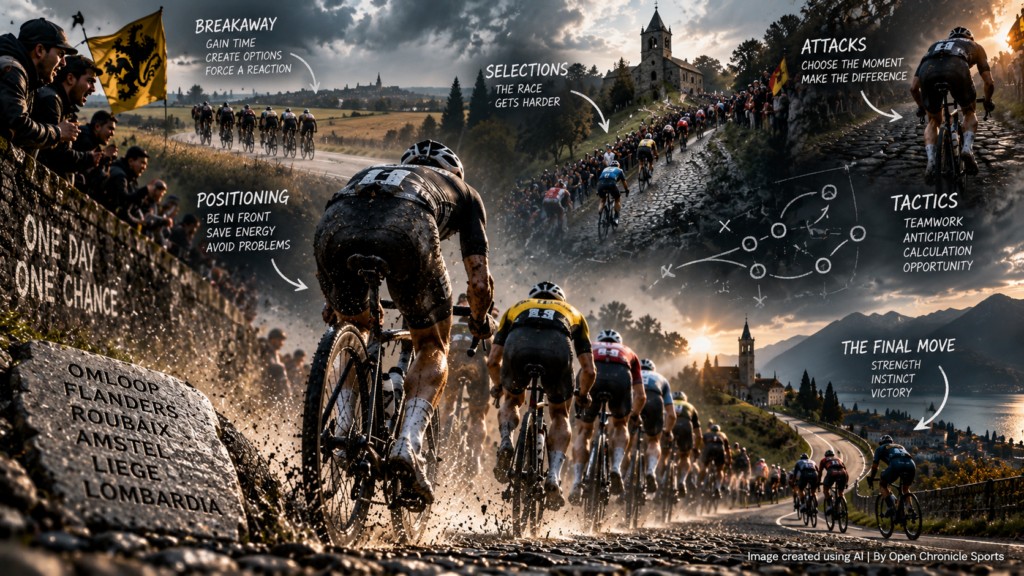
Breakaways, selections, positioning and the decisive moments that turn six hours of racing into one move that matters
By Open Chronicle Sports
A cycling Classic can last six hours. It can cross more than 250 kilometres of exposed roads, cobbled sectors, steep climbs and narrow village streets. Hundreds of attacks may be attempted. Teams can spend an entire afternoon controlling the race.
Yet victory is often decided in seconds.
A small hesitation. A rider entering a climb five positions too far back. A domestique unable to close a gap. A favourite attacking when everyone expects him to wait. A crosswind suddenly splitting the peloton.
This is the tactical paradox of one day racing.
The Classics are endurance contests, but they are also exercises in anticipation. Strength matters enormously, yet the strongest rider does not automatically win. To win a Classic, a rider must understand not only how hard to ride, but when the race has reached the moment when riding hard actually matters.
That is where Classics tactics begin.
There Is No Tomorrow
The fundamental difference between a Classic and a stage race is brutally simple.
There is no general classification to protect and no following stage in which lost time can be recovered.
Everything must be resolved today.
That changes the psychology of racing.
A rider who finishes second in a Grand Tour mountain stage may still have achieved a strategic objective. A rider finishing second in Paris Roubaix has lost Paris Roubaix.
Consequently, teams sometimes make decisions that would appear irrational in stage racing.
A favourite may attack 80 kilometres from the finish.
A team may sacrifice several riders simply to place its leader correctly before one cobbled sector.
A rider in a winning breakaway may refuse to work because a faster teammate is chasing behind.
Another may cooperate with rivals even though doing so increases the probability that one of those rivals eventually beats him.
Classics tactics are rarely about creating a perfect situation.
They are about choosing the least dangerous imperfect situation.
Phase One: The Fight Before the Fight
Television coverage can make the opening kilometres appear relatively calm.
Inside the peloton, they often are anything but.
The first tactical battle concerns the breakaway.
Smaller teams want representation because a break provides visibility and creates the possibility of surviving deep into the race. Bigger teams must decide which combinations are acceptable.
This creates an invisible calculation.
If five relatively harmless riders escape, the favourites’ teams may allow them several minutes.
If a dangerous outsider joins them, suddenly the same breakaway becomes unacceptable.
If several strong teams place riders in front, responsibility for the chase becomes politically complicated.
The composition of the break can therefore matter more than its time advantage.
A six minute advantage involving riders nobody considers capable of winning may be less dangerous than a two minute advantage containing several powerful Classics specialists.
The stopwatch tells only part of the story.
The Breakaway Is Also a Tactical Weapon
A rider in the early escape is not necessarily there to win.
Sometimes his real purpose appears four hours later.
Imagine a team with a major favourite.
One teammate enters the breakaway.
Later, when the favourite attacks from the peloton and bridges across, that teammate can immediately provide food, protection and several kilometres of powerful pacing.
The early breakaway has effectively become a satellite rider.
What looked like an individual adventure was actually a strategic investment.
This is one reason Classics teams often attempt to place riders ahead before the decisive terrain begins.
They are moving pieces across the board before the real game starts.
Positioning: The Battle Nobody Sees
Before almost every famous obstacle in a Classic comes another race.
The race to reach it first.
On an ordinary wide road, being twentieth rather than fifth may have little consequence.
Approaching the Trouée d’Arenberg, Oude Kwaremont, Paterberg, Kemmelberg or another decisive sector, it can determine the entire afternoon.
Roads narrow.
Speeds increase.
Teams form trains around their leaders.
Everybody knows what is coming.
A rider entering a cobbled sector in fifth position has space to react.
A rider entering in fiftieth may already face gaps before his physical ability becomes relevant.
Then comes the accordion effect.
The front riders accelerate smoothly. Further back, riders brake into corners and sprint out of them. Tiny differences multiply through the peloton.
Eventually gaps appear.
This leads to one of the central principles of Classics racing:
Position is energy.
A rider who spends energy moving forward before a critical sector may actually save considerably more energy once the sector begins.
The Selection
At some point, the peloton stops behaving like one race.
It fragments.
This is the selection.
Selections can happen through deliberate attacks, but frequently they emerge through accumulation.
One cobbled sector removes twenty riders.
A climb removes fifteen more.
A crosswind splits another group.
A crash creates separation.
A second climb eliminates those who spent too much energy closing the previous gap.
Suddenly 170 riders have become 35.
Then 35 become 15.
The important tactical question changes.
Early in the race, riders ask:
How do we conserve energy?
Late in the race, the question becomes:
Who must we eliminate before the finish?
Making the Race Hard
Teams with powerful endurance riders often want attrition.
They do not necessarily need an immediate attack. Instead, they increase the general difficulty of the race.
Domestiques ride hard approaching climbs.
The pace remains high across exposed roads.
Recovery disappears between sectors.
Every acceleration becomes slightly more expensive.
This strategy is particularly effective against riders with a dangerous sprint.
If you cannot beat someone in the final 200 metres, one solution is ensuring that rider never reaches the final 200 metres with you.
This is why seemingly uneventful kilometres can be tactically decisive.
A team riding hard with 100 kilometres remaining may not be trying to escape.
It may simply be softening the race.
The Long Range Attack
Then comes one of the most spectacular weapons in modern Classics racing.
The attack from distance.
Traditional tactical logic often encouraged favourites to preserve themselves until relatively late.
But exceptionally strong riders can invert that logic.
Instead of asking:
How long can I wait?
they ask:
How far from the finish can I make everybody else start chasing me?
The long range attack changes the structure of the race instantly.
Once a major favourite escapes, every team behind faces a dilemma.
Who chases?
If one rival performs all the work, the others receive a free ride.
If nobody works, the leader disappears.
If teammates are already exhausted, tactical responsibility becomes irrelevant because nobody has the physical capacity to respond.
This is where strength becomes strategy.
An attack does not need to drop every rival immediately.
Sometimes its purpose is to force them to cooperate.
And cooperation between rivals is fragile.
The Moment of Hesitation
Perhaps no phenomenon defines one day racing better than the tactical pause.
Five riders are chasing one leader.
In theory, five should be stronger than one.
But each rider wants someone else to work.
One attacks.
Another closes the gap.
Everyone looks around.
Nobody pulls.
Three seconds disappear.
Then another five.
The leader ahead continues riding at threshold while the chase conducts a negotiation at 50 kilometres per hour.
Soon a ten second advantage becomes twenty.
Twenty becomes forty.
The race may already be over.
This is why the strongest group does not always win.
A chasing group has more power but also more interests.
The lone leader has only one objective:
Go.
Attack Over the Top
One of the most effective attacks in the Classics does not happen on the steepest part of a climb.
It happens immediately afterwards.
Riders expect attacks on the ascent. They prepare for them.
They reach the summit exhausted and instinctively search for recovery.
That is precisely when another acceleration can become devastating.
An attack over the top exploits the transition between maximum effort and recovery.
The same principle applies after cobbled sectors.
A favourite may not escape on the pavé itself. Instead, he attacks as everyone reorganises on the asphalt.
The obstacle creates fatigue.
The attack exploits it.
Numbers Versus Leadership
Imagine a leading group containing one rider from Team A and three from Team B.
Team B appears to have tactical superiority.
Not necessarily.
If Team A’s rider is clearly stronger than all three, numerical advantage can become difficult to use.
Should one Team B rider attack?
Who follows?
Should another remain behind?
What happens if all three cooperate and deliver the stronger rival to the finish?
Numbers create possibilities.
They do not automatically create victory.
The best Classics teams therefore use numbers aggressively.
One rider attacks.
The rival must respond.
Another attacks immediately afterwards.
The rival responds again.
Then the leader attacks.
This is the classic one two tactical sequence, repeated until the isolated opponent can no longer close gaps.
The Fast Finisher Problem
Every small group eventually performs another calculation.
Who wins the sprint?
Suppose six riders remain with 25 kilometres to go and one is clearly the fastest sprinter.
The other five now share a problem.
If they simply cooperate until the finish, they are potentially riding for second place.
Attacks become inevitable.
The sprinter’s objective is stability.
The others need chaos.
This produces some of the most fascinating finales in cycling because alliances continuously change.
Two riders cooperate for five kilometres.
One attacks the other.
They are caught.
Three new riders counterattack.
The sprinter’s teammate refuses to chase.
Every decision alters the next one.
A Classic finale is sometimes less like an endurance sport and more like high speed game theory.
Why the Favourite Sometimes Refuses to Chase
To spectators, one moment can seem particularly strange.
A dangerous rider attacks.
A favourite looks capable of following.
Yet he does nothing.
Why?
Because cycling is raced by teams.
Perhaps the favourite has a teammate ahead.
Chasing would mean destroying his own team’s advantage.
Perhaps another team has more responsibility.
Perhaps the attacker is not considered dangerous enough.
Perhaps chasing would expose the favourite to an immediate counterattack.
Or perhaps everyone simply miscalculates.
The latter matters.
Cycling tactics are not played with perfect information.
Riders are exhausted. Radio communication can be incomplete. Roads are noisy. Time gaps may be inaccurate. Decisions must be made immediately.
Mistakes are part of tactics.
Crosswinds: The Invisible Climb
Not every decisive obstacle points upward.
Wind can create one of cycling’s most violent tactical situations.
When a strong crosswind hits an exposed road, riders form an echelon to obtain shelter.
But the road has limited width.
Eventually there is no protected position available.
A gap opens.
Teams aware of the conditions move their leaders forward beforehand and then accelerate violently when the road turns into the wind.
Within seconds, a race can split into several groups.
There was no attack in the conventional sense.
The geography attacked instead.
That is why Classics teams study wind direction, road furniture, exposed fields and changes of direction as carefully as climbs.
Mechanical Luck and Controlled Chaos
Paris Roubaix makes another truth impossible to ignore.
Tactics exist inside uncertainty.
A puncture can destroy the perfect strategy.
A crash can remove the strongest rider.
A mechanical problem can force a favourite into a chase at exactly the wrong moment.
Teams cannot eliminate randomness.
They can only reduce exposure to it.
Riding near the front decreases the number of crashes ahead.
Having teammates nearby improves the response to mechanical problems.
Entering sectors well positioned reduces unnecessary overtaking.
Preparation converts some luck into probability.
But never all of it.
That uncertainty is fundamental to the Classics.
The Final Ten Kilometres
By now, physiology and tactics become almost inseparable.
Everyone is tired.
Information becomes extremely valuable.
Who has stopped contributing?
Who is eating?
Who keeps stretching his back?
Who closes gaps immediately?
Who allows a wheel to open?
Professional riders watch these details.
Weakness rarely announces itself.
It appears through small behaviours.
A rider moving two positions backwards.
An unusually slow response.
A teammate speaking repeatedly into the radio.
An opponent refusing a turn.
Then comes the attack.
The best attacks often appear inevitable only afterwards.
Winning Before the Sprint
One of the great tactical skills in Classics racing is recognising when not to wait.
A rider without a strong sprint must transform the race before the finishing straight.
That can mean attacking on the final climb.
It can mean attacking immediately after it.
It can mean exploiting a moment when favourites are watching each other.
Sometimes the winning move comes from a rider nobody initially considered the biggest threat.
The favourites hesitate because they are afraid of one another.
The outsider leaves.
Everybody expects somebody else to chase.
Nobody does.
Another Classic is decided.
Why the Strongest Rider Still Matters
All this tactical complexity can create the impression that Classics racing is primarily chess on bicycles.
It is not.
Tactics cannot manufacture legs that do not exist.
Eventually somebody must produce the watts.
The great Classics champions combine tactical intelligence with the physical ability to make decisions irreversible.
Their attacks work because following them hurts.
Their positioning works because they can hold position.
Their long range moves work because they can sustain enormous power after five hours of racing.
Strategy creates the opportunity.
Strength closes the door.
Reading a Classic Differently
Once these principles become visible, watching a Classic changes.
Do not watch only the rider attacking.
Watch the teams moving forward five kilometres before the climb.
Watch who enters the breakaway.
Watch which team refuses to chase.
Watch riders eating before a decisive sector.
Watch the domestiques disappearing one by one.
Watch who still has teammates with 50 kilometres remaining.
Watch the favourite who suddenly moves from twentieth to fifth.
Something is probably about to happen.
And when a group hesitates, count the seconds.
Those seconds may become the winning margin.
One Day, One Decision
The beauty of Classics tactics is that there is rarely one correct solution.
Attack too early and the peloton may organise.
Attack too late and a faster rider survives.
Chase every move and you exhaust yourself.
Refuse to chase and the winning move may disappear up the road.
Protect your leader too carefully and you surrender initiative.
Race too aggressively and you may have nobody left for the finale.
Every decision carries a cost.
And unlike a Grand Tour, there is no tomorrow in which to correct it.
That is why the Classics produce such extraordinary racing.
After 250 kilometres, thousands of tactical decisions and hours of controlled exhaustion, everything can suddenly depend on one rider recognising something the others have missed.
A weakening rival.
A tailwind.
A moment of hesitation.
An empty road ahead.
Then comes the acceleration.
And sometimes, that is the moment the Classic is won.