
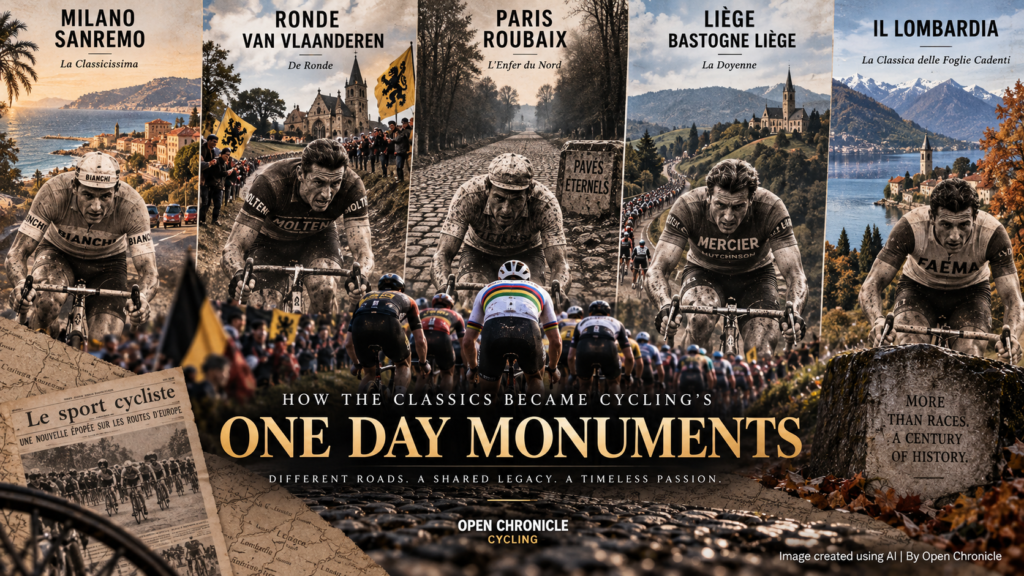
From the first heroic road races of the late nineteenth century to the cobbles of Flanders, the Arenberg forest, the Poggio and the hills of Lombardy, this is the story of how cycling created its great one day institutions
By Open Chronicle Sports
4 September 2026
Before the Tour de France became cycling’s great summer epic, before the Giro painted Italy pink and before professional racing developed its modern calendar, cyclists were already attempting something extraordinary.
They raced from one city to another.
Sometimes the roads were barely roads at all.
They crossed enormous distances on heavy bicycles, over stones, mud and primitive surfaces, often without meaningful mechanical assistance. Riders repaired their own machines. Weather could transform a race completely. Finishing was itself an achievement.
Out of that brutal early world emerged a particular form of competition that cycling never abandoned.
The one day Classic.
More than a century later, the greatest Classics remain among professional cycling’s most coveted prizes. Milano Sanremo, the Tour of Flanders, Paris Roubaix, Liège Bastogne Liège and Il Lombardia have become the Five Monuments, races whose histories extend across generations and whose roads have become part of the mythology of the sport.
But they were not created as monuments.
History made them monuments.
Before the Grand Tours
Competitive cycling expanded rapidly during the final decades of the nineteenth century.
Bicycles were becoming faster and more practical. Newspapers discovered that races could attract enormous public interest. Manufacturers realised that victory provided powerful advertising.
The road itself became an arena.
One of the most important early experiments came in France.
Paris Roubaix was first held in 1896.
The race was conceived partly to promote the new velodrome in Roubaix. What began as a long road race from the French capital towards the industrial north would eventually become something far greater.
Paris Roubaix survived because the landscape around it changed more slowly than the sport.
As roads throughout Europe were progressively modernised, organisers deliberately preserved the race’s relationship with cobbled sectors.
The result was remarkable.
What had once been an ordinary feature of road racing gradually became Paris Roubaix’s defining characteristic.
The race did not merely preserve old roads.
It transformed them into sacred sporting ground.
The Birth of Liège Bastogne Liège
Four years before Paris Roubaix, another race had already appeared in Belgium.
Liège Bastogne Liège was first organised in 1892.
Its extraordinary age eventually earned it the nickname La Doyenne, the Old Lady.
The race developed around the difficult terrain of Wallonia. Rather than the brutal pavé associated with northern France and Flanders, Liège became defined by hills and repeated climbing.
This distinction would become fundamental to the diversity of the Classics.
One day racing was never one discipline.
Different regions produced different tests.
Northern France offered cobbles.
Flanders produced narrow roads, bergs and pavé.
Wallonia provided steep Ardennes climbs.
Italy would create races of immense distance and mountainous beauty.
Each Classic developed a personality from its geography.
Lombardia and the Italian Tradition
In 1905, Italy added another race that would eventually become one of cycling’s great institutions.
The event initially known as Milano Milano soon evolved into the Giro di Lombardia, today known internationally as Il Lombardia.
Northern Italy provided a dramatically different setting.
Lakes.
Mountain roads.
Long climbs.
Autumn weather.
The race became associated with the end of the European season and acquired one of cycling’s most evocative nicknames:
The Race of the Falling Leaves.
Its position on the calendar became part of its identity.
Where the northern Classics announced spring, Lombardia marked approaching winter.
Cycling was already beginning to build a sporting year around landscapes and seasons.
Milano Sanremo: The Long Road South
Two years later, in 1907, another Italian Classic appeared.
Milano Sanremo.
Its concept was wonderfully simple.
Race from Milan towards the Mediterranean.
The distance was enormous.
That became the point.
Milano Sanremo eventually grew into the longest major one day race on the professional calendar, earning the title La Classicissima.
Unlike many other Classics, its difficulty is deceptive.
There are no endless sectors of Roubaix pavé.
There is no succession of Flemish bergs comparable to the Tour of Flanders.
Instead, the race accumulates fatigue almost invisibly across nearly 300 kilometres.
Then, close to Sanremo, everything changes.
The Cipressa.
The Poggio.
The descent.
The Via Roma.
Hours of endurance suddenly become minutes of tactical violence.
That structure has allowed remarkably different types of riders to dream of victory.
Sprinters.
Puncheurs.
Attackers.
Descenders.
Grand Tour champions.
Milano Sanremo became one of cycling’s great tactical paradoxes:
easy enough for many riders to survive, long enough that survival guarantees nothing.
Flanders Creates Its Own Race
Belgium’s Flemish cycling culture needed its own great event.
In 1913, the first Ronde van Vlaanderen, the Tour of Flanders, was organised.
It would become inseparable from Flemish identity.
The race grew through a landscape of narrow roads, cobbled climbs and villages where cycling was deeply embedded in local culture.
The climbs acquired names recognised far beyond Belgium.
Oude Kwaremont.
Paterberg.
Koppenberg.
Muur van Geraardsbergen.
They became more than obstacles.
They became theatres.
Generations of riders attacked on the same slopes. Spectators returned year after year. Images accumulated. Memories accumulated.
This repetition is fundamental to the historical power of the Classics.
Grand Tours continually discover new roads.
The Classics repeatedly return to old ones.
War, Survival and Continuity
European cycling could not escape the political catastrophes of the twentieth century.
Two world wars interrupted sporting life.
Races disappeared temporarily.
Borders, economies and societies changed.
Yet the major Classics returned.
That continuity became part of their prestige.
A race first contested before the First World War could still be won decades later by riders born into an entirely different Europe.
Each new edition added another layer.
The Classics gradually became living historical institutions.
Their importance no longer came solely from the difficulty of winning.
It came from who had won before.
The Roads Become Memory
This is where a bicycle race begins transforming into something larger.
A climb acquires significance because a famous attack happened there.
A cobbled sector becomes legendary because champions repeatedly suffered upon it.
A finishing straight becomes historic because generations crossed it pursuing the same prize.
Paris Roubaix offers perhaps the clearest example.
The Trouée d’Arenberg, Carrefour de l’Arbre and Roubaix Velodrome are now inseparable from the race.
Arenberg is simply a road through a forest.
Yet within cycling culture it represents danger, selection and uncertainty.
The same process occurred in Flanders.
The Oude Kwaremont is not famous because it is the highest mountain in cycling.
It is famous because the Ronde repeatedly made it important.
History changes geography.
The Age of the Great Champions
As professional cycling matured, riders began building reputations around these races.
The Classics created specialists.
Some were powerful enough for cobbles.
Others thrived on short climbs.
Some possessed devastating finishing speed.
A few could win almost everywhere.
And then came riders whose records helped define the meaning of greatness itself.
Eddy Merckx became the supreme example.
Merckx did not respect the increasingly convenient distinction between stage racer and Classics specialist.
He won Grand Tours.
World Championships.
Time trials.
Sprints.
Mountain stages.
And Monuments.
His Monument record remains one of the most extraordinary statistical expressions of dominance in cycling history.
Merckx won 19 Monuments.
Seven Milano Sanremo victories.
Five Liège Bastogne Liège victories.
Three Paris Roubaix victories.
Three Il Lombardia victories.
And one Tour of Flanders.
The message was unmistakable.
The greatest cyclist could not merely dominate July.
He had to conquer the Classics too.
De Vlaeminck and Roubaix
Some champions became associated particularly strongly with individual races.
Roger De Vlaeminck became one of the defining figures of Paris Roubaix.
His four victories helped establish a benchmark that stood as the race’s record for decades.
His reputation also represented something fundamental about Classics mythology.
Certain riders appeared designed for particular roads.
Their physiology, technique and temperament seemed perfectly aligned with the race.
Over time, race and rider became historically inseparable.
Why Five Races Became the Monuments
Professional cycling contains many prestigious Classics.
So why did five acquire a category of their own?
There was no single moment when cycling suddenly declared them sacred.
Their status developed organically.
Age mattered.
Difficulty mattered.
Continuity mattered.
The quality of their winners mattered.
Their place within cycling culture mattered.
And each offered a distinctive challenge.
Eventually, five races stood above the wider Classics calendar:
Milano Sanremo
Tour of Flanders
Paris Roubaix
Liège Bastogne Liège
Il Lombardia
Together they became known as the Monuments.
The term was appropriate.
These were not merely annual competitions.
They had become structures of sporting memory.
Five Monuments, Five Personalities
Their historical power also comes from difference.
Milano Sanremo is about distance and suspense.
Flanders is about cobbles, bergs, positioning and repeated violence.
Roubaix is about pavé, momentum, equipment, chaos and survival.
Liège is about climbing endurance and the cumulative brutality of the Ardennes.
Lombardia is about elevation, autumn and the particular beauty of Italian racing.
A rider who wins all five therefore demonstrates something extraordinary.
He has solved five fundamentally different problems.
Only a tiny group of cyclists has ever achieved that complete collection.
That rarity is part of the mythology.
The Spring Classics Become a Season Within the Season
As the professional calendar developed, the Classics acquired another important characteristic.
They formed their own narrative.
The season begins in the north.
Omloop Het Nieuwsblad traditionally signals the opening of the Belgian Classics period.
Then come races such as Kuurne Brussels Kuurne, Strade Bianche and Milano Sanremo.
The Flemish campaign intensifies.
E3.
Gent Wevelgem.
Dwars door Vlaanderen.
Then the Ronde.
One week later comes Roubaix.
After the cobbles, the terrain changes.
Amstel Gold Race.
La Flèche Wallonne.
Liège Bastogne Liège.
The Ardennes close the great spring campaign.
Cycling effectively created a championship without an official championship table.
Riders build an entire spring around winning individual races.
Cobbles Become Heritage
Perhaps the most fascinating transformation concerned road surfaces.
In the nineteenth century, cobbles were simply roads.
By the late twentieth and twenty first centuries, they had become increasingly unusual.
Modern infrastructure threatened the very terrain that had created the races.
Cycling responded by preserving it.
Cobbled sectors were identified, restored and protected partly because of their sporting importance.
This reversal is remarkable.
Originally, races adapted to existing roads.
Eventually, roads were preserved because races needed them.
The sport began protecting its own geography.
Television Changes the Classics
The arrival and expansion of television transformed their cultural reach.
Spectators no longer needed to stand beside the road or wait for newspaper reports.
They could watch the decisive sectors live.
Arenberg became visually recognisable.
The Muur became international.
The Poggio descent became dramatic television.
Helicopter images turned Flemish landscapes and Italian lakes into part of the spectacle.
The Classics were no longer simply European races.
They became global sporting events.
Yet television also reinforced something ancient.
The landscape remained central.
Modern broadcasting technology did not diminish the importance of the roads.
It made the world understand them.
Technology Changes, the Essential Test Remains
The bicycles used in the first editions bear little resemblance to modern racing machines.
Steel gave way to aluminium and eventually carbon fibre.
Gearing transformed.
Tyres evolved.
Aerodynamics became increasingly sophisticated.
Training became scientific.
Nutrition changed radically.
Teams now analyse power data, weather forecasts and race routes with extraordinary precision.
Yet the central problem remains recognisable.
A rider must cover the road faster than everybody else.
The cobbles still shake the bicycle.
The wind still creates echelons.
The climbs still punish tired legs.
A badly timed puncture can still destroy months of preparation.
The Classics modernised without losing their essential uncertainty.
The Rise of Specialisation
As professional cycling became increasingly scientific, riders often specialised.
Grand Tour contenders focused on stage racing.
Sprinters targeted suitable finishes.
Classics specialists constructed their seasons around March and April.
For a period, it seemed possible that the age of riders capable of dominating both Grand Tours and the great one day races might be disappearing.
The Classics developed their own stars.
Cobbled specialists.
Ardennes specialists.
Puncheurs.
Rouleurs.
Fast finishers capable of surviving difficult terrain.
But cycling rarely remains stable for long.
The Modern Return of the Universal Champion
The current era has challenged specialisation again.
Mathieu van der Poel has combined cyclocross mastery with extraordinary success in the biggest road Classics.
Wout van Aert has demonstrated remarkable versatility across cobbles, sprints, time trials and climbing terrain.
Remco Evenepoel has brought elite time trial power and long range aggression into one day racing.
And Tadej Pogačar has revived something cycling once associated with Merckx.
The Grand Tour champion who wants everything.
Pogačar’s success across radically different Classics has reopened one of cycling’s oldest questions:
How universal can a champion become?
That question connects modern racing directly with its history.
The Classics in the WorldTour Era
Today the major Classics exist within a global professional structure.
The WorldTour stretches across continents.
Teams operate with multimillion euro budgets.
Performance departments analyse every measurable variable.
Race preparation can involve months of reconnaissance and technical optimisation.
Yet the Classics continue to resist complete control.
A Grand Tour offers opportunities for recovery.
A bad day can sometimes be repaired.
A mechanical problem may cost seconds rather than victory.
A Classic offers no such generosity.
One crash.
One puncture.
One missed split.
One badly positioned entry into a cobbled sector.
One moment of hesitation.
The race can be gone.
This is why one day racing remains so emotionally powerful even in cycling’s data driven age.
Why the Monuments Matter So Much
Winning a Monument does not provide a yellow jersey to defend tomorrow.
There is no three week classification.
The reward is more abstract.
Permanence.
The rider joins a list stretching backwards through cycling history.
A Monument victory connects the present champion to riders who raced the same event decades earlier, sometimes on roads that remain remarkably familiar.
That historical continuity gives these races a prestige difficult to manufacture.
A new event can offer enormous prize money.
It can create excellent racing.
It can attract the best riders in the world.
But it cannot instantly create 100 years of memory.
Time is the one ingredient organisers cannot purchase.
More Than Five Races
The Monuments sit at the summit, but the history of Classics racing is much broader.
Amstel Gold Race developed into one of the great Dutch one day events.
La Flèche Wallonne became synonymous with the Mur de Huy.
Gent Wevelgem developed its own identity through wind, Flemish roads and the Kemmelberg.
Omloop Het Nieuwsblad became the traditional opening statement of the northern campaign.
Strade Bianche, although dramatically younger than the historic Monuments, demonstrated that a modern race can quickly develop a powerful identity when geography, sporting difficulty and spectacle combine.
The white roads of Tuscany provided something cycling had always understood.
A distinctive road can create a distinctive race.
Tradition Is Not Stagnation
The survival of the Classics does not mean they remain unchanged.
Routes evolve.
Finishes move.
Safety measures improve.
Cobbled sectors enter and leave races.
Technology develops.
Women’s racing has expanded the Classics tradition, building increasingly prominent editions of many of cycling’s most historic events.
The calendar continues evolving.
That is healthy.
Tradition survives not because nothing changes.
It survives because the essential identity remains recognisable while the sport around it develops.
The Same Roads, Different Generations
This may be the greatest historical power of the Classics.
Imagine the Oude Kwaremont during a modern Tour of Flanders.
Carbon bicycles.
Electronic shifting.
Aerodynamic helmets.
Power meters.
Team radios.
Live global television.
Then strip all of that away mentally.
Different bicycles.
Different jerseys.
Different roadsides.
Different generations.
Yet riders are still fighting for position.
Still attacking.
Still suffering.
Still trying to reach the top before everyone else.
The technology belongs to its era.
The competitive instinct does not.
A Monument Is Built From Memory
No organiser can simply declare a race a Monument.
A Monument is constructed slowly.
One edition at a time.
One champion at a time.
One famous attack.
One unexpected defeat.
One storm.
One crash.
One heroic chase.
One photograph.
One generation tells the story to the next.
Eventually the race becomes bigger than any individual edition.
That is what happened to Sanremo, Flanders, Roubaix, Liège and Lombardia.
They became places where cycling goes to meet its own past.
Why the Classics Endure
The modern sporting world constantly searches for novelty.
New competitions.
New formats.
New markets.
New technologies.
The Classics offer something different.
They offer continuity.
Their power comes partly from knowing that the road has seen this before.
Someone attacked here.
Someone punctured here.
Someone became a champion here.
Someone lost a race they had dreamed about for years here.
And next spring, another generation will arrive believing it can write a different ending.
That is why the Classics remain essential.
Not because cycling refuses to change.
But because these races provide a thread through all that change.
From primitive bicycles and unpaved roads to carbon machines and satellite broadcasting, the fundamental challenge survives.
One road.
One day.
One opportunity.
And more than a century of history waiting at the finish.
That is how races became Classics.
And how Classics became Monuments.