
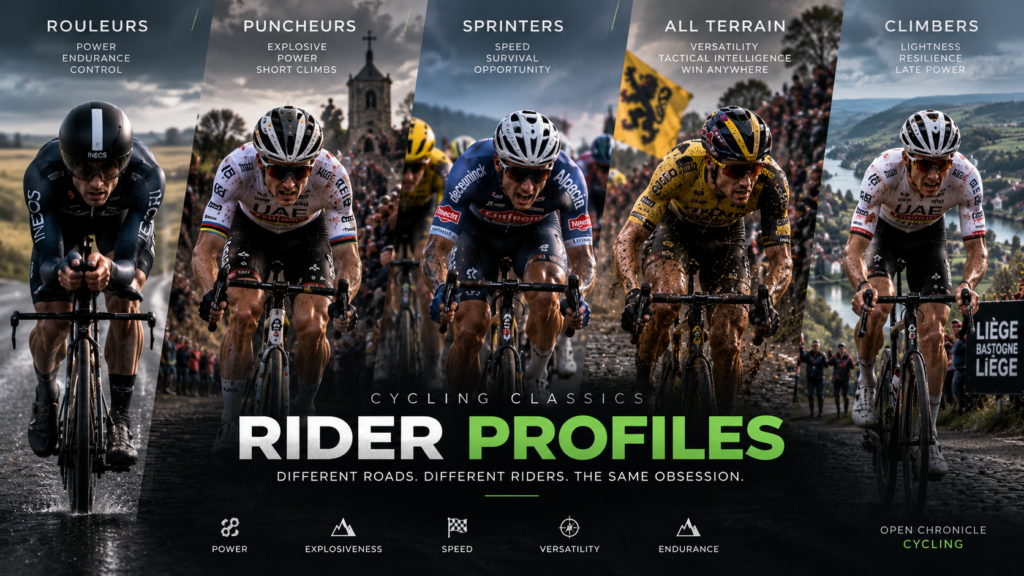
What separates rouleurs, puncheurs, sprinters and the increasingly rare all terrain stars capable of winning almost anywhere
By Open Chronicle Sports
4 September 2026
There is no single body built to win a cycling Classic.
Paris Roubaix rewards power, durability and the ability to keep a bicycle moving across some of the worst roads in professional cycling. Liège Bastogne Liège demands repeated climbing efforts and explosive acceleration after more than six hours in the saddle. Milano Sanremo asks riders to survive nearly 300 kilometres before producing something extraordinary in a matter of minutes. Gent Wevelgem can favour a sprinter, provided that sprinter survives the wind, climbs and tactical warfare that precede the finish.
Then there are riders who seem determined to destroy the categories altogether.
The modern Classics peloton contains rouleurs, puncheurs, sprinters, climbers, time trial specialists and all terrain champions, sometimes competing for exactly the same races.
Understanding those rider profiles helps explain why one Classic can produce completely different tactical possibilities from another.
Because before asking who can win, it helps to understand what kind of rider the road is trying to select.
The Rouleur: Built to Keep Going
The rouleur is one of cycling’s oldest archetypes.
The word derives from the French rouler, to roll, and it describes riders capable of sustaining enormous power over long distances and relatively steady terrain.
They are the engines of professional cycling.
A strong rouleur can ride for kilometres at the front of a peloton, control a breakaway, drive through crosswinds or maintain a punishing pace when everyone else would prefer to recover.
In the Classics, that ability becomes a weapon.
Rouleurs are particularly dangerous when the race becomes exposed, fast and attritional. Cobbles can suit them because momentum and sustained power matter enormously.
They may not possess the explosive acceleration of a pure puncheur.
They do not necessarily need it.
A rouleur’s attack can look almost undramatic.
He accelerates.
Establishes a gap.
Settles into an aerodynamic position.
And keeps going.
Five seconds become ten.
Ten become twenty.
The chase begins to hesitate.
Suddenly the peloton has a serious problem.
The Classics Rouleur
Not every rouleur is a Classics specialist.
The northern races demand additional abilities.
Bike handling.
Positioning.
Resistance to repeated accelerations.
Confidence on cobbles.
The ability to produce power after five hours of accumulated fatigue.
A rider who can generate enormous numbers in a controlled time trial may struggle when that power must be delivered while bouncing across pavé, fighting for position and responding to attacks.
The great Classics rouleurs combine the engine with resilience.
They are not merely powerful.
They are difficult to break.
Filippo Ganna and the Power Model
Filippo Ganna provides an obvious modern example of the power end of this spectrum.
An elite time triallist and pursuit rider possesses precisely the type of sustained output that can become frightening in a one day race.
When such a rider escapes on flatter terrain, the chase cannot assume he will naturally come back.
That changes tactics.
Allowing a lightweight climber ten seconds on a flat run to the finish may be manageable.
Giving an elite rouleur the same ten seconds can be fatal.
The rider profile changes the meaning of the gap.
The Puncheur: Violence in Short Bursts
If the rouleur specialises in sustained pressure, the puncheur specialises in explosive disruption.
Puncheurs thrive on short, steep climbs.
They can accelerate violently when gradients increase, recover sufficiently quickly and repeat the effort later.
This makes them ideally suited to many Ardennes style races.
The Mur de Huy represents perhaps the purest illustration.
The climb is short enough that pure climbing endurance is not the only requirement. The decisive qualities include positioning, timing and the ability to generate exceptional power on steep gradients when the legs are already saturated with fatigue.
A puncheur does not necessarily want a 30 minute mountain.
He wants a wall.
Timing the Punch
The difficulty of puncheur racing lies in timing.
Attack too early and the gradient can punish the effort.
Wait too long and another rider takes the decisive position.
The best puncheurs therefore possess an unusual combination of physical explosiveness and patience.
They know that the difference between winning and finishing tenth may be a few seconds of restraint.
This is particularly visible on steep finishes.
Everybody is suffering.
Everybody knows approximately where the acceleration will come.
Yet somebody still creates separation.
That is the punch.
The Sprinter: Survive First, Sprint Later
A pure sprint appears simple when viewed only through the final television images.
The reality of winning a Classic as a sprinter is considerably more complicated.
First, the sprinter must still be there.
That qualification changes everything.
A sprinter may possess the fastest final 200 metres in the race, but that speed is worthless if the peloton has been reduced on climbs, crosswinds or cobbles.
Classics sprinters therefore need durability far beyond pure finishing speed.
They must survive.
Milano Sanremo and the Sprinter’s Dilemma
Milano Sanremo has historically demonstrated this tension beautifully.
The race is long enough to create enormous accumulated fatigue, yet its final climbs are short enough that sprinters can sometimes survive.
This creates competing objectives.
The attackers want to make the Poggio sufficiently hard that the sprinters disappear.
The sprinters want to remain attached without spending so much energy that their finishing speed vanishes.
Every rider knows the equation.
That does not make solving it easier.
The result is one of cycling’s most fascinating tactical contests.
The sprinter does not need to dominate the climb.
He needs to lose nothing more than contact.
If he reaches the descent with the right group, the entire tactical balance changes.
The Classics Sprinter Is Not a Pure Sprinter
This distinction matters.
A rider capable of winning a flat bunch sprint after an easy stage is not automatically suited to the Classics.
Classics sprinters need endurance.
They need positioning.
They often need excellent bike handling.
They must tolerate repeated changes in rhythm.
They need the psychological resilience to spend five hours fighting simply for the right to use their greatest weapon.
Jasper Philipsen illustrates how dangerous the combination can become.
A fast finisher who can survive demanding one day terrain creates an uncomfortable tactical problem for everyone else.
If rivals take him to the finish, they may lose the sprint.
Therefore they must attack him earlier.
The sprinter’s presence changes the race even when he never attacks.
The Climber Who Should Not Be Here
Traditional cycling categories once suggested a fairly clear division.
Climbers won mountain races and Grand Tours.
Large powerful riders dominated the cobbles.
That distinction has become increasingly unreliable.
Modern training, equipment, nutrition and extraordinary individual talents have expanded what certain riders can do.
No rider demonstrates that better than Tadej Pogačar.
Pogačar possesses the climbing ability expected of an elite Grand Tour champion.
Yet he has also become one of the defining Classics riders of his generation.
That combination fundamentally changes tactical assumptions.
A rider light enough to dominate high mountains should theoretically face disadvantages against heavier specialists on certain northern roads.
But if his power relative to weight, absolute power, endurance, positioning and technical ability are sufficiently exceptional, those disadvantages can become manageable.
The category begins to collapse.
The All Terrain Classics Star
This brings us to perhaps the most fascinating modern profile.
The all terrain Classics rider.
These riders do not simply specialise in one type of one day race.
They possess enough complementary qualities to threaten across radically different terrain.
Mathieu van der Poel is an extraordinary example.
Explosive power makes him dangerous on short climbs.
Exceptional bike handling helps on cobbles and technical roads.
His cyclocross background contributes to confidence when surfaces deteriorate.
He can sustain long attacks.
He can sprint from reduced groups.
Most importantly, he can repeatedly produce enormous efforts deep into races.
That combination makes tactical preparation extremely difficult.
How do you design a course to expose a rider who has so few obvious weaknesses?
Wout van Aert and Versatility
Wout van Aert represents another version of versatility.
He combines sustained power with sprinting ability, endurance and excellent handling.
A rider with those characteristics can potentially win through multiple scenarios.
Solo attack.
Small group.
Reduced sprint.
Attritional cobbled race.
That flexibility matters because rivals cannot simply wait for one predictable moment.
If a rider has only one path to victory, opponents can organise around it.
If he has four, the tactical problem becomes much harder.
Remco Evenepoel and the Long Range Weapon
Remco Evenepoel introduces yet another profile.
His greatest tactical weapon is not merely acceleration.
It is what happens after separation.
When a rider with elite time trial ability establishes a gap, the chase faces a terrifying calculation.
Waiting can be fatal.
Even a small advantage may become structurally difficult to close because the rider ahead can maintain exceptionally high speed alone.
This changes how rivals respond to the initial attack.
They cannot simply assume somebody else will chase later.
The rider’s physiology creates tactical urgency.
Why Body Type Still Matters
Modern versatility does not mean physiology has become irrelevant.
Body size influences aerodynamics, absolute power, climbing efficiency, momentum and energy requirements.
A larger rider may possess advantages on flat terrain and rough cobbles.
A lighter rider may accelerate more efficiently uphill.
But these relationships are not absolute.
Course design matters.
Weather matters.
Race intensity matters.
And individual physiology can produce enormous exceptions.
This is why rider classification should be understood as a spectrum rather than a collection of rigid boxes.
A rider can be predominantly a rouleur while possessing a strong sprint.
A climber can become an outstanding puncheur.
A sprinter can develop enough durability to become a Classics specialist.
The interesting riders often live between categories.
The Cobbles Specialist
Some riders possess a particularly valuable northern Classics profile.
They are powerful enough for the cobbles, technically comfortable on unstable surfaces and capable of maintaining position during violent approaches to sectors.
Their advantage is not necessarily visible in laboratory measurements.
It appears through efficiency under chaos.
A rider who remains relaxed on pavé wastes less energy fighting the bicycle.
A rider who chooses lines instinctively avoids unnecessary braking.
A rider comfortable in a crowded peloton reaches sectors in better position.
Over 250 kilometres, technical competence becomes physiological advantage.
The Ardennes Specialist
The Ardennes produce a different athlete.
Repeated climbs reward riders capable of high aerobic output combined with explosive acceleration.
Weight becomes more significant.
Cobbled handling becomes less decisive.
Recovery between efforts becomes critical.
Liège Bastogne Liège adds another layer because of its length and accumulated climbing.
A rider must remain explosive after enormous endurance stress.
That combination explains why elite Grand Tour riders can increasingly become serious Ardennes contenders.
The physical requirements overlap.
The Finisher
There is another profile that receives less attention.
The rider who is simply extraordinarily difficult to remove.
He may not possess the greatest sprint.
He may not produce the most spectacular attack.
But kilometre after kilometre, he remains.
Bad weather?
Still there.
Cobbles?
Still there.
Climbs?
Still there.
Five hours?
Still there.
Eventually the peloton has been reduced from 170 riders to 15 and the supposedly less explosive rider has acquired something extremely valuable.
Opportunity.
Durability is a talent.
In the Classics, sometimes survival itself becomes a weapon.
The Opportunist
Not every Classics winner begins the day among the biggest favourites.
One day racing creates opportunities for riders willing to recognise unusual situations.
The favourites watch each other.
A secondary rider attacks.
Nobody reacts.
Ten seconds appear.
Then twenty.
Suddenly everyone understands the danger.
Too late.
The opportunist needs tactical intelligence, courage and enough physical strength to exploit hesitation.
This profile is essential to the identity of the Classics.
If only the strongest favourite could win, one day racing would lose much of its uncertainty.
Instead, the road sometimes rewards the rider who understands the moment first.
Why Fatigue Changes Rider Profiles
A rider’s characteristics at kilometre 50 are not necessarily the same at kilometre 250.
This is crucial.
Many professional riders can produce impressive short duration power when fresh.
Far fewer can produce it after six hours.
The Classics therefore measure fatigue resistance.
A rider with a theoretically weaker sprint may become faster than a pure sprinter after an extremely difficult race.
A climber’s acceleration may become relatively more powerful because heavier rivals have accumulated greater fatigue.
The hierarchy changes as the race becomes harder.
This is why testing athletes only through isolated power numbers cannot fully explain Classics performance.
The question is not merely:
How much power can you produce?
It is:
How much can you still produce after everything that happened before?
The Modern Hybrid
Professional cycling increasingly produces riders who resist traditional classification.
A rider may combine time trial power, climbing ability and a sprint.
Another may move from cyclocross to dominate road Classics.
Another may be classified as a sprinter yet survive terrain that once would have eliminated him.
These hybrid riders are tactically disruptive because they possess multiple winning scenarios.
They represent one of the most important developments in modern Classics racing.
Specialisation remains valuable.
But versatility has become increasingly dangerous.
Course Design Selects the Rider
Every Classic asks a different question.
Paris Roubaix asks whether a rider can combine power, handling, positioning and extraordinary resistance to repeated impact.
The Tour of Flanders asks whether he can survive cobbles and repeatedly attack steep climbs.
Liège asks for endurance and climbing explosiveness.
Milano Sanremo asks whether a rider can remain economical for almost an entire day and still possess something extraordinary when the race suddenly becomes violent.
Gent Wevelgem mixes wind, positioning, climbing and sprinting.
The winner is therefore partly selected by the road.
Change the terrain and the hierarchy changes.
Weather Can Rewrite the Profile
Then weather intervenes.
A dry race and a wet race can favour different riders.
Rain increases the importance of handling and confidence.
Wind increases the value of absolute power and positioning.
Cold changes energy expenditure.
Heat changes hydration requirements.
A rider perfectly suited to the course on paper may become less suited once the weather changes.
The Classics do not test athletes inside controlled conditions.
That is part of their appeal.
There Is No Perfect Classics Rider
If one athlete possessed the best sprint, greatest climbing ability, highest sustained power, strongest positioning and best technical skills, tactics would become relatively simple.
Nobody does.
Every rider carries advantages and compromises.
The rouleur wants sustained pressure.
The puncheur wants explosive terrain.
The sprinter wants survival followed by a finish.
The climber wants enough elevation to reduce the influence of absolute power.
The opportunist wants hesitation.
The all terrain star wants almost anything, provided the race is hard enough.
The interaction between those profiles creates the tactical richness of one day racing.
Reading the Riders Before Reading the Race
When looking at the start list of a Classic, ask a different question.
Do not begin with:
Who is strongest?
Ask:
How does each rider need this race to develop?
The sprinter wants the attacks controlled.
The rouleur may want an early selection.
The puncheur wants the decisive group together when the steep climb arrives.
The long range specialist wants hesitation behind.
The team with multiple leaders wants uncertainty.
Suddenly the start list becomes a map of competing tactical objectives.
And that is when the race begins to make sense.
The Rider and the Road
The great Classics champions are remembered partly because they seem inseparable from particular landscapes.
Cobbles.
Bergs.
Ardennes climbs.
The Poggio.
The Arenberg forest.
The road becomes part of their identity.
Yet the greatest riders eventually attempt something more ambitious.
They leave the terrain supposedly built for them and try to win somewhere else.
A sprinter survives the climbs.
A climber conquers the cobbles.
A cyclocross rider wins a Monument on Italian roads.
A time trial specialist attacks where explosive riders were expected to dominate.
Those performances fascinate because they challenge our understanding of what a cyclist is supposed to be.
And perhaps that is the most interesting lesson of rider profiles.
Categories help us understand cycling.
The greatest riders make us rewrite them.