
By Open Chronicle News Desk
September 4, 2026
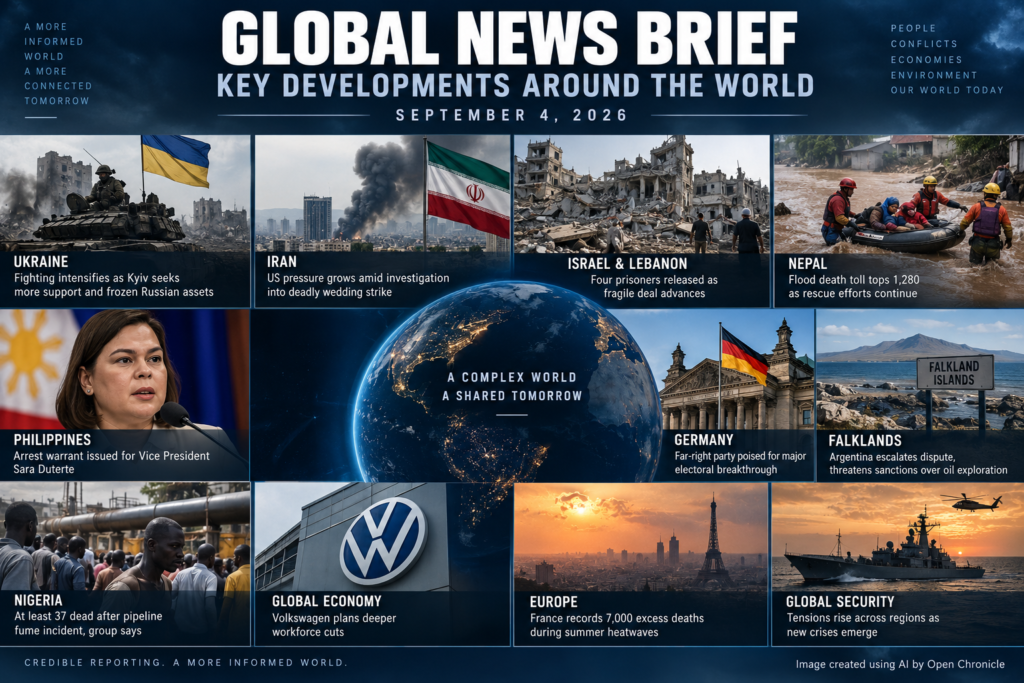
The international agenda on Friday is dominated by renewed fighting in Ukraine, mounting pressure on Iran, political tensions across Europe and Asia, catastrophic flooding in Nepal, and a fresh diplomatic confrontation between Argentina and the United Kingdom over the Falkland Islands.
From the Middle East to Eastern Europe and the Indo Pacific, governments are confronting an increasingly interconnected mix of military conflict, economic pressure, political instability and natural disasters.
Europe: Ukraine war intensifies as pressure on Russia grows
Russia has intensified attacks against Ukraine, including strikes around Kyiv and Odesa. At least three people were reported killed in Russian attacks, while a strike in the Odesa region damaged residential buildings.
A separate air attack reportedly struck one of the World Health Organization’s main warehouses in the Kyiv region.
Ukraine, meanwhile, continues operations against targets inside Russia. Ukrainian drones were reported to have attacked oil facilities on Russia’s Black Sea coast, including sites around Sochi, while other industrial facilities were also targeted.
Diplomacy remains active. Ukrainian President Volodymyr Zelensky is expecting meetings with US representatives in Kyiv in the coming days, while reports indicate American envoys Steve Witkoff and Jared Kushner could travel to Moscow before visiting the Ukrainian capital.
Kyiv is also renewing efforts to gain access to frozen Russian assets as it searches for additional financial resources to sustain the war.
European security concerns are expanding beyond the battlefield. Germany has recorded a growing number of suspected sabotage incidents, while Finland said a surveillance drone discovered near its southern coast was Russian made. NATO Secretary General Mark Rutte has insisted that Russian pressure will not force the alliance to abandon its support for Ukraine.
Middle East: US pressure on Iran intensifies
The confrontation between the United States and Iran remains one of the most consequential international crises.
Washington continues military and economic pressure against Tehran, while US forces remain engaged in operations intended to protect regional bases and commercial shipping.
American authorities are also investigating reports that a US munition may have been responsible for an explosion at a wedding in Iran that killed four people and injured dozens. Vice President JD Vance said the incident was being examined while continuing to reject describing the broader confrontation as a formal war.
Economic pressure is simultaneously increasing. The European Union has reportedly joined the US led campaign to further isolate Iran financially, while restrictions on Iranian oil revenues and trade are placing additional strain on Tehran.
China has called on Washington to remove Iran related sanctions imposed on Chinese companies and citizens.
Concern over freedom of navigation through the Strait of Hormuz is also growing. South Korea is considering possible contributions aimed at keeping the strategic waterway open as fears of further disruption push energy security higher on the international agenda.
Israel and Lebanon move forward with limited agreement
Israel and Lebanon have taken a tentative step toward reducing tensions, with four Lebanese prisoners released as negotiations advance over arrangements concerning the recovery of bodies.
The development comes amid continuing military tensions along the border and disputes over Israeli operations against Hezbollah positions.
In Gaza and the occupied Palestinian territories, violence continues. United Nations reporting cited in the day’s coverage said Israeli attacks killed 24 Palestinians in Gaza over five days, while separate incidents were reported in East Jerusalem and the West Bank.
Asia: Nepal flood catastrophe deepens
Nepal remains at the centre of one of the world’s worst current natural disasters.
The reported death toll from catastrophic flooding has climbed beyond 1,280, with thousands still listed as missing across affected areas of Nepal and neighbouring regions.
Amid the devastation, rescuers pulled two workers alive from a mud clogged hydropower tunnel after they had been trapped for nine days. Their survival has become one of the few positive developments emerging from the disaster.
Economic losses are already estimated in the billions of dollars, while authorities have begun relocating survivors and preparing financial assistance for affected businesses and communities.
Philippines: Arrest warrant issued for Vice President Sara Duterte
The Philippines faces a potentially significant political confrontation after a court issued an arrest warrant for Vice President Sara Duterte over allegations involving threats against President Ferdinand Marcos Jr. and his wife.
The development represents another escalation in the political struggle between two of the country’s most powerful political families.
Elsewhere in Southeast Asia, Malaysia declared a haze emergency in parts of Sarawak as pollution reached dangerous levels, while thousands of Indonesian students have reportedly fallen ill after eating meals provided through a government school programme.
Europe: Germany’s AfD eyes major electoral breakthrough
Germany’s Alternative for Germany party is approaching a potentially historic result in an eastern state election, where reports suggest the far right could emerge as the strongest political force.
The vote comes amid wider concerns over political fragmentation, migration, economic pressure and Germany’s increasingly difficult security environment.
Elsewhere, Giorgia Meloni has reached another political milestone in Italy, with her government becoming the longest serving administration of the Italian Republic’s postwar era.
France, meanwhile, has reported approximately 7,000 excess deaths during summer heatwaves through late July, highlighting the growing human impact of extreme temperatures across Europe.
Britain and Argentina clash again over the Falklands
Tensions between London and Buenos Aires have risen after Argentine President Javier Milei renewed his country’s sovereignty campaign over the Falkland Islands.
Milei has threatened measures against companies involved in oil exploration around the islands as Argentina attempts to increase diplomatic and economic pressure on Britain.
The British government responded firmly, reiterating that its commitment to the Falklands is “absolute and unshakeable.”
The renewed dispute comes more than four decades after the 1982 Falklands War and demonstrates that sovereignty over the South Atlantic archipelago remains one of the most persistent unresolved disputes between Britain and Argentina.
Africa: Deadly incidents in Nigeria and Mozambique
Reports from Nigeria say at least 37 people may have died after inhaling toxic fumes while attempting to access a pipeline, according to an environmental organisation.
In Mozambique, Americans were evacuated after suspected insurgents attacked a camp at a wildlife reserve, underscoring the continuing security problems caused by militant groups in the country’s north.
The United Nations has also warned about the role of foreign supplied drones in Sudan’s conflict, where advanced weapons are increasingly shaping a war already responsible for a severe humanitarian crisis.
Global economy: Volkswagen plans deeper cuts
Economic concerns are also emerging prominently in Europe.
Volkswagen is reportedly preparing substantial additional workforce reductions as the German automotive giant responds to weak demand, international competition and the enormous cost of restructuring its operations for the electric vehicle era.
Reports suggest the company’s longer term restructuring could involve tens of thousands of additional job losses by the end of the decade.
At the same time, China related trade tensions remain significant. Chinese rare earth companies have reportedly suspended some shipments to the United States, potentially adding another strategic dimension to the economic rivalry between Washington and Beijing.
A world under simultaneous pressure
September 4 opens with several crises developing at once rather than a single event dominating international affairs.
The Ukraine war continues to expand its technological and economic dimensions. Washington’s confrontation with Iran is placing growing pressure on global energy routes. Europe is dealing simultaneously with security threats, political fragmentation and economic uncertainty. Asia is confronting political instability and a major humanitarian disaster in Nepal.
Together, these developments illustrate an international environment increasingly defined by overlapping military, political, economic and environmental shocks, with events in one region rapidly producing consequences far beyond their borders.