
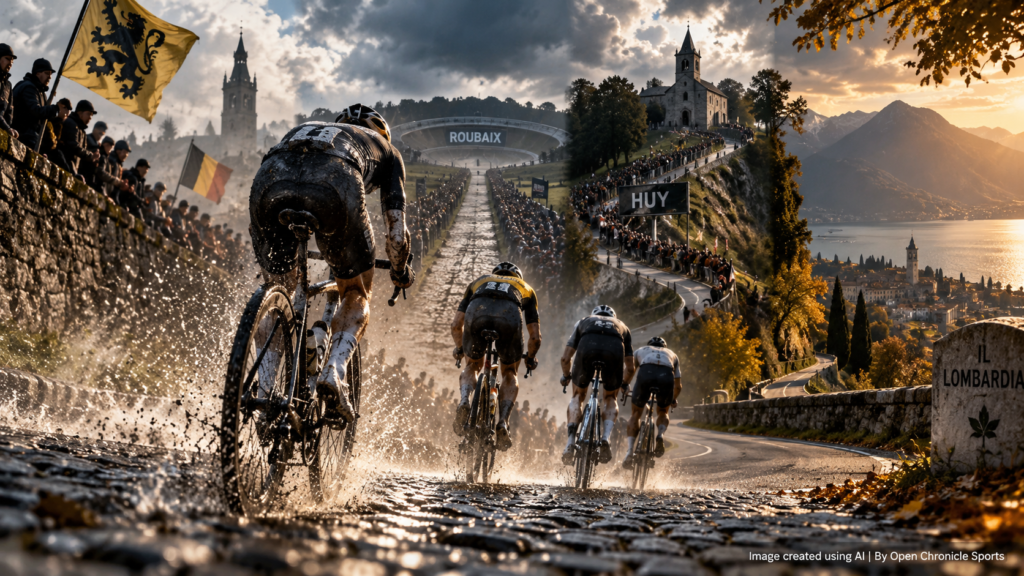
By Open Chronicle Sports
4 September 2026
There are seasons in which the Classics are remembered for a single race, a single attack or one rider who seemed to own the spring. 2026 has been different.
From the rain soaked roads of the Omloop to the white gravel of Tuscany, from the Poggio to the cobbles of Flanders and Roubaix, and from the Ardennes to the Basque Country and Brittany, the one day season has produced something broader: a confrontation between the defining riders of a generation.
Tadej Pogačar has continued to stretch the boundaries of what a Grand Tour champion can accomplish in the Classics. Mathieu van der Poel has reminded the peloton that few riders can turn a race into an individual exhibition quite like him. Wout van Aert finally conquered the cobbles of Roubaix. Remco Evenepoel has added another dimension to the season. And behind those established stars, new winners have continued to emerge.
The final chapter has not yet been written. Québec and Montréal are approaching. Il Lombardia still waits in October.
But already, the 2026 Classics season has given cycling a spring worth remembering.
Van der Poel Fires the Opening Shot
The traditional northern campaign began at Omloop Het Nieuwsblad on 28 February, and Mathieu van der Poel needed only one appearance to make the race his own.
Making his Omloop debut, the Dutchman attacked on the Muur van Geraardsbergen with roughly 16 kilometres remaining and rode alone to Ninove. Tim van Dijke finished second and Florian Vermeersch third.
It was an appropriate opening statement.
The Classics are often described as races of patience, but Van der Poel has spent much of his career demonstrating that patience has limits. When the road becomes sufficiently difficult and the moment feels right, his preferred tactic remains one of cycling’s oldest: ride faster than everyone else and do not look back.
Omloop suggested that another Van der Poel dominated spring might be coming.
What followed was considerably more complicated.
Pogačar and the Expansion of Possibility
Tadej Pogačar entered the heart of the Classics campaign already established as something cycling had once considered increasingly improbable: a rider capable of dominating Grand Tours while simultaneously becoming one of the greatest one day racers of his era.
In 2026, that transformation went even further.
His victory at Milano Sanremo removed another enormous race from the short list still missing from his palmarès. Then came Flanders.
At the Tour of Flanders on 5 April, Pogačar faced Van der Poel on terrain that seemed designed for their rivalry. The decisive moment came on the final ascent of the Oude Kwaremont.
Pogačar attacked.
Van der Poel could not follow.
The Slovenian rode on to his third Tour of Flanders victory, drawing level with the record holders for victories in De Ronde. Van der Poel finished second, while Remco Evenepoel took third on his debut.
That result was about more than another trophy.
Pogačar was increasingly making the traditional classifications of professional cycling look obsolete. Climber, stage racer, puncheur, time triallist, Classics rider. The labels remained useful, but none adequately described him.
And then came Roubaix.
Roubaix Gives Wout van Aert His Day
12 April 2026 may ultimately be remembered as the emotional centre of the Classics season.
Paris Roubaix has never cared about reputations.
Punctures, crashes, dust, mud, positioning and mechanical misfortune have always been as much a part of the Hell of the North as strength itself. In 2026, Van Aert, Pogačar and Van der Poel all encountered punctures during another chaotic edition.
Yet when the race reached the Roubaix Velodrome, two riders remained at the front.
Wout van Aert and Tadej Pogačar.
For Van Aert, it was an opportunity loaded with years of expectation. Few riders of his generation had accumulated such a collection of extraordinary Classics performances while simultaneously enduring so many near misses.
This time there would be no near miss.
Van Aert defeated Pogačar in the showdown and became the 2026 Paris-Roubaix champion. Jasper Stuyven completed the podium.
The Belgian dedicated the victory to the family of Michael Goolaerts, his former teammate who died following the 2018 Paris Roubaix.
That gave the victory a meaning that statistics alone cannot capture.
For Pogačar, second place carried another significance. Victory would have completed his collection of all five Monuments. Roubaix remains the missing piece.
And that unfinished pursuit immediately gives future editions another story.
Evenepoel Takes Control in the Ardennes
If Flanders and Roubaix belonged to Pogačar and Van Aert, Remco Evenepoel made sure the Ardennes would not simply become an extension of their narrative.
At the 60th Amstel Gold Race, Evenepoel found himself with defending champion Mattias Skjelmose in the decisive move.
The Belgian won the two man sprint, with Benoît Cosnefroy taking third.
It was a particularly revealing victory because Evenepoel is most naturally associated with destruction from distance. His greatest performances often involve turning a bike race into an extended individual time trial.
Amstel showed another version of him.
He could wait.
He could calculate.
And he could finish.
That matters enormously in the Classics, where tactical flexibility can be as important as raw power.
The wider Ardennes campaign reinforced the impression that the hierarchy of modern one day racing is extraordinarily difficult to control. Pogačar, Evenepoel, Van der Poel and Van Aert possess different strengths, but increasingly compete for many of the same prizes.
Four Riders, Four Different Ways to Break a Race
That is perhaps the defining story of 2026 so far.
The Classics currently possess a remarkable concentration of riders capable of winning the biggest races in radically different ways.
Pogačar can destroy a race on a climb and sustain an attack over terrain that should favour heavier Classics specialists.
Van der Poel combines explosive acceleration, bike handling and extraordinary resistance to repeated efforts.
Van Aert brings endurance, power, positioning and a sprint that makes him dangerous in almost every possible race scenario.
Evenepoel possesses perhaps the most intimidating long range weapon of all: once he establishes separation, the chase can become mathematically hopeless.
The fascinating part is not simply that all four can win Classics.
It is that each forces the others to race differently.
The Classics Did Not End in April
One of cycling’s persistent misconceptions is that the Classics season ends when the Ardennes finish.
The centre of gravity changes, but one day racing continues.
On 1 August, Remco Evenepoel won the Clásica San Sebastián, adding another major one day success to his season.
Two weeks later, Paul Magnier won the ADAC Cyclassics in Hamburg.
Then, on 30 August, Alex Aranburu captured the Bretagne Classic in Plouay.
These races matter because they reconnect the spring with the autumn. They also create opportunities for different types of riders, from explosive climbers to powerful sprinters and opportunists willing to gamble before the peloton reorganises.
The Classics are not one homogeneous discipline.
That is precisely their appeal.
Why 2026 Feels Important
Cycling has experienced periods when Grand Tour racing and Classics racing seemed to inhabit almost separate sporting worlds.
The best three week racers prepared for July. The great Classics specialists built their seasons around March and April.
That distinction has been eroding for years.
In 2026 it looks increasingly antiquated.
Pogačar is the clearest example. His presence changes the tactical architecture of almost every race he enters because teams cannot simply wait for traditional Classics specialists to decide the race.
Evenepoel operates across the same boundary.
Van Aert and Van der Poel, meanwhile, demonstrate another form of versatility, moving between disciplines and race formats while remaining capable of defining the biggest road Classics.
The result is a fascinating convergence.
The strongest stage racers are entering the territory of the Classics specialists.
The Classics specialists possess increasingly broad racing programmes.
And the biggest one day races have become meeting grounds for cycling’s most complete athletes.
The Roads Remain the Real Stars
Yet focusing entirely on riders misses something essential.
The Classics endure because the roads themselves matter.
The Oude Kwaremont is not interchangeable with the Poggio.
The Trouée d’Arenberg cannot be replaced by an ordinary stretch of asphalt.
The Mur de Huy produces a completely different race from La Redoute.
The Paterberg, Kemmelberg, Muur van Geraardsbergen and the gravel roads around Siena each impose their own physical and tactical logic.
Grand Tours change routes every year.
The Classics return to places.
That repetition creates memory.
A rider attacks where another champion attacked decades earlier. A crash happens on cobbles that have destroyed the ambitions of generations. A new champion enters the same velodrome where the sport’s legends once arrived covered in mud and exhaustion.
It is why these races feel older than the riders competing in them.
They are.
What Comes Next
The European spring is over, but the major one day season still has important appointments.
The Grand Prix Cycliste de Québec arrives on 11 September, followed by the Grand Prix Cycliste de Montréal on 13 September.
Then comes the great autumn conclusion.
Il Lombardia, 10 October 2026.
The Race of the Falling Leaves is the fifth and final Monument of the season. Its hills, lakes and long Italian autumn shadows provide an almost perfect counterpoint to Milano Sanremo.
Sanremo announces spring.
Lombardia tells cycling that the season is beginning to disappear.
And when the peloton reaches northern Italy in October, Pogačar will inevitably be part of the conversation again.
A Season Already Worth Remembering
There is still racing ahead, so any judgement on 2026 must remain incomplete.
But several images have already secured their place in the season’s history.
Mathieu van der Poel accelerating away on the Muur.
Pogačar breaking the Tour of Flanders apart on the Oude Kwaremont and taking a record equalling third victory.
Wout van Aert finally entering the Roubaix Velodrome with victory within reach and this time refusing to let it escape.
Remco Evenepoel beating the defending champion at Amstel.
Different riders. Different roads. Different forms of greatness.
That is what makes the Classics different from almost everything else in cycling.
There is no general classification to repair tomorrow. No mountain stage waiting to reverse today’s defeat. No three week strategy capable of rescuing a missed opportunity.
There is only the road, the weather, the rivals and the moment.
One day. One chance.
And in 2026, the world’s greatest riders have repeatedly treated that chance as if it were the only race that mattered.