
By Open Chronicle History Desk
On September 4, 476, a young emperor named Romulus Augustulus was removed from power in Italy by the Germanic military commander Odoacer.
There was no final battle for Rome.
No great barbarian army stormed the gates of the ancient capital that day.
No one announced that an empire which had dominated the Mediterranean world for centuries had suddenly ceased to exist.
Yet generations of historians would eventually identify September 4, 476 as one of the most famous dividing lines in world history.
It became the traditional date for the fall of the Western Roman Empire.
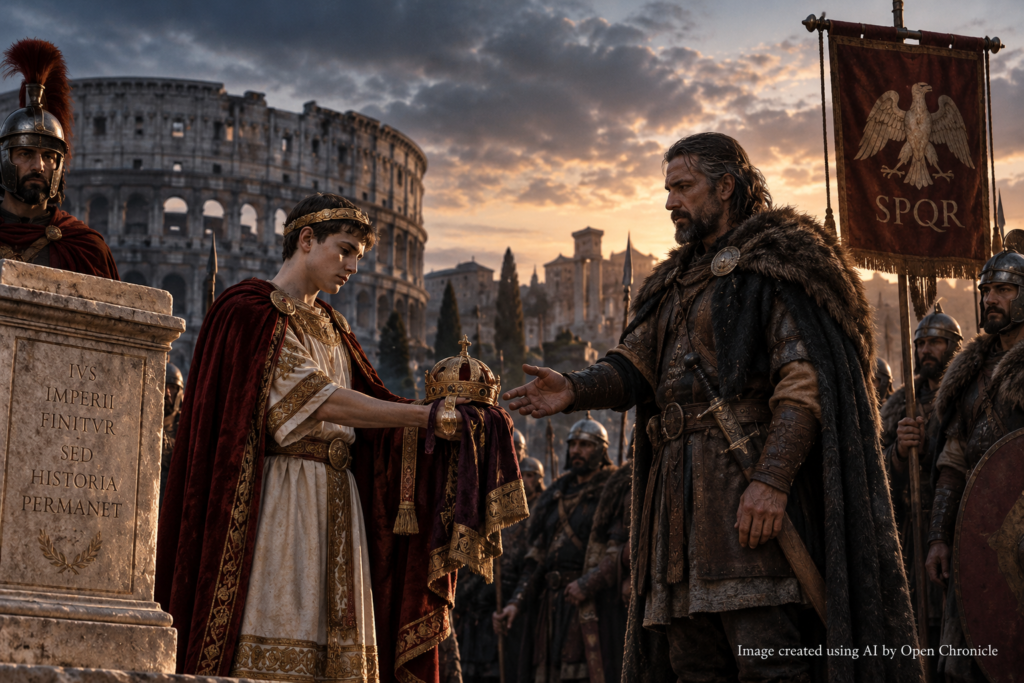
Romulus Augustulus, probably still a teenager, surrendered the imperial insignia. Odoacer chose not to install another emperor in the West. Instead, he ruled Italy while formally acknowledging the authority of the emperor in Constantinople.
The Western imperial throne was left vacant.
But Rome had not collapsed overnight.
The events of September 476 were the culmination of transformations that had been unfolding for generations: political instability, civil war, economic pressures, military change, migrations, foreign invasions and the gradual fragmentation of imperial authority.
The more interesting historical question is therefore not simply why Rome fell.
It is why an empire that had survived so many crises finally reached a point where a western emperor was no longer necessary.
An Empire That Once Ruled the Mediterranean
At its greatest extent under Emperor Trajan in the early second century, the Roman Empire stretched from Britain to the Middle East and from the Rhine and Danube to North Africa.
Tens of millions of people lived under Roman rule.
Roads connected distant provinces.
Aqueducts supplied cities.
Ports linked Mediterranean trade networks.
Roman law provided administrative structures across enormous territories.
The legions defended thousands of kilometres of frontier.
Latin and Greek became languages of administration and culture across much of Europe and the Mediterranean.
Rome was not simply a city controlling conquered territories.
It had created an imperial system capable of integrating extraordinarily different peoples and regions.
For centuries, that system proved remarkably resilient.
The Empire’s First Great Crisis
The first clear warning that Rome’s political system could become dangerously unstable came during the third century.
Between 235 and 284, the empire experienced what historians call the Crisis of the Third Century.
Emperors rose and fell with extraordinary speed.
Many were murdered.
Army commanders were proclaimed emperor by their troops.
Civil wars erupted repeatedly.
Foreign enemies attacked the frontiers.
Breakaway states appeared.
Economic instability intensified.
For a time, it appeared possible that the empire might disintegrate.
It did not.
Emperors including Aurelian restored imperial unity, while Diocletian later introduced major administrative and military reforms.
Rome survived.
But the empire that emerged was changing.
Diocletian Divides Imperial Government
The Roman Empire had become extraordinarily difficult for one emperor to govern.
Diocletian responded by creating a system in which several emperors shared responsibility for different regions.
This arrangement, known as the Tetrarchy, did not permanently divide Rome into separate countries.
But it acknowledged a fundamental reality.
The empire was too large and its military challenges too numerous for political power to remain concentrated in one place.
Eastern and western administrative structures increasingly developed separately.
That distinction would become critical.
Constantine Changes the Empire
Another transformation came under Constantine the Great.
After years of civil war, Constantine reunited the empire under his authority.
He also embraced Christianity and gave the religion imperial support.
In 330, he inaugurated a new imperial capital at Constantinople, built on the ancient Greek city of Byzantium.
Its location was strategically extraordinary.
Constantinople controlled access between the Black Sea and Mediterranean.
It stood between Europe and Asia.
It was closer than Rome to some of the empire’s richest provinces and most important military frontiers.
Rome remained symbolically important.
But the political centre of gravity was shifting eastwards.
Christianity and the Roman World
The religious landscape changed dramatically during the fourth century.
Christianity moved from persecuted religion to one increasingly supported by imperial authority.
Under Theodosius I, Nicene Christianity became dominant within the imperial system.
Traditional Roman religious institutions declined.
The transformation was enormous.
But the old claim that Christianity simply caused Rome’s fall is far too simplistic.
Christianity became deeply integrated into Roman political and cultural life.
The eastern Roman Empire was even more thoroughly Christian and would survive for another thousand years.
Religion changed Rome.
It did not simply destroy it.
395: The Empire Divides Again
When Emperor Theodosius I died in 395, imperial authority passed to his sons.
Arcadius ruled the East.
Honorius ruled the West.
Roman contemporaries did not necessarily believe they were creating two permanently separate empires.
Both halves remained part of the Roman political world.
But the administrative separation became increasingly durable.
And the two halves possessed very different resources.
The East included wealthy provinces, major commercial centres and Constantinople’s formidable defensive position.
The West faced severe structural problems.
Its frontiers were extensive.
Its political institutions became unstable.
And its government increasingly struggled to raise the money and manpower necessary to maintain military power.
Peoples Beyond the Frontier
Rome had always interacted with communities beyond its borders.
Trade, diplomacy, migration, recruitment and warfare crossed the frontiers constantly.
The term barbarian, inherited from Greek and Roman usage, concealed enormous diversity.
Goths, Franks, Vandals, Burgundians, Suebi, Alamanni and many other peoples possessed distinct histories and political structures.
Many served in Roman armies.
Some became senior Roman commanders.
Others settled within imperial territory under agreements with Roman authorities.
The relationship between Rome and these groups was therefore much more complicated than a simple struggle between civilisation and invaders.
But during the fourth and fifth centuries, migration and military pressure intensified dramatically.
The Huns Arrive
One important catalyst was the movement of the Huns into Europe.
Their expansion placed pressure on Gothic communities living north of the Danube.
In 376, large numbers of Goths sought refuge inside Roman territory.
Roman authorities allowed them to cross the Danube.
The settlement was catastrophically mismanaged.
Abuse, corruption and shortages contributed to rebellion.
The crisis culminated in the Battle of Adrianople in 378.
A Roman army confronted Gothic forces.
The result was disastrous.
Emperor Valens was killed.
Large numbers of Roman soldiers died.
The battle demonstrated that major armed groups inside the empire could pose an extraordinary challenge to imperial authority.
Rome Is Sacked
The western government’s difficulties intensified.
The Visigothic leader Alaric repeatedly negotiated and fought with Roman authorities.
In 410, his forces entered Rome.
The city was sacked.
Militarily, Rome was no longer the empire’s principal capital.
Politically, emperors often resided elsewhere.
Symbolically, however, Rome remained the centre of an imperial civilisation that believed itself eternal.
The psychological impact was therefore enormous.
Rome had not been captured by a foreign enemy for centuries.
Across the Mediterranean world, people struggled to understand how such an event could happen.
Britain Slips Away
At roughly the same time, Roman authority was disappearing from Britain.
Troops were withdrawn amid political and military crises on the continent.
By the early fifth century, the imperial government could no longer provide effective protection or administration to the province.
Roman Britain fragmented into local political structures.
This was a pattern that would increasingly appear elsewhere.
The Western Empire did not disappear everywhere simultaneously.
Central government simply became unable to exercise meaningful authority over increasing amounts of territory.
The Rhine Frontier Breaks
On the final day of 406, groups traditionally identified as Vandals, Alans and Suebi crossed the Rhine.
The consequences were profound.
They moved through Gaul.
Some eventually entered Hispania.
The imperial government struggled to restore control.
Meanwhile, competing Roman commanders fought civil wars and proclaimed themselves emperors.
This combination was devastating.
Rome needed military resources to defend its territories.
But Roman political factions repeatedly used those same resources against one another.
Internal conflict weakened the empire’s ability to respond to external threats.
The Vandals Take North Africa
Perhaps one of the most damaging losses occurred in North Africa.
Vandal forces crossed from Hispania into Africa under their king Geiseric.
They eventually captured Carthage in 439.
North Africa was extraordinarily important to the Western Empire.
It supplied grain.
It generated tax revenue.
It supported Mediterranean commerce.
Losing these territories weakened the western government’s finances precisely when it desperately needed resources to maintain armies.
The Vandals also developed significant naval power.
The Mediterranean was no longer securely Roman.
Attila the Hun
During the middle of the fifth century, another threat emerged.
Attila created a powerful Hunnic empire in Central and Eastern Europe.
His forces attacked both halves of the Roman world.
In 451, Attila invaded Gaul.
A coalition led by the Roman commander Flavius Aetius, including Visigothic forces, confronted him at the Battle of the Catalaunian Plains.
Attila’s advance was checked.
The following year, he invaded Italy.
Rome survived the immediate threat.
But the episode demonstrated how dependent the Western Empire had become on coalitions involving non Roman military forces.
The Last Great Roman General
Aetius has sometimes been described as the last great Roman commander of the West.
His military and diplomatic skills helped preserve imperial authority during an exceptionally difficult period.
But imperial politics remained lethal.
In 454, Emperor Valentinian III personally participated in Aetius’s murder.
The decision removed one of the West’s most capable military leaders.
Valentinian himself was assassinated the following year.
The political system descended further into instability.
Rome Is Sacked Again
In 455, the Vandals sailed from North Africa and entered Rome.
The city was subjected to another sack.
The word vandalism would many centuries later derive from the Vandals’ name, although the popular image of mindless destruction exaggerates the historical evidence.
The larger significance was political.
The Western Empire could no longer reliably protect even Rome itself.
Imperial prestige continued to collapse.
Emperors Come and Go
During the final decades of the Western Empire, emperors changed with remarkable frequency.
Some ruled only months.
Others were effectively controlled by powerful generals.
Germanic military commanders increasingly became kingmakers behind the imperial throne.
The office of emperor still carried immense symbolic authority.
But the ability of individual emperors to command armies, collect taxes and control territory was shrinking.
Italy remained central.
Beyond Italy, much of the old Western Empire was already governed by successor kingdoms.
The Visigoths controlled substantial territories.
The Vandals dominated North Africa.
The Franks were expanding in Gaul.
The Burgundians controlled another region.
Roman government was becoming one political power among several.
Julius Nepos
The events leading directly to 476 began with another emperor, Julius Nepos.
Nepos became Western emperor in 474 and had recognition from the eastern imperial government.
But the military commander Orestes rebelled against him.
In 475, Nepos fled Italy for Dalmatia.
Orestes then placed his own young son on the western throne.
His name was Romulus.
Romulus Augustulus
History remembers him as Romulus Augustulus.
His name possessed extraordinary symbolism.
Romulus was the legendary founder and first king of Rome.
Augustus was the name associated with Rome’s first emperor.
The final ruler traditionally associated with the Western Empire therefore appeared to carry both the beginning of Rome and the beginning of imperial rule within his name.
But “Augustulus” was effectively a diminutive.
It could be understood as “little Augustus.”
The young emperor possessed little independent power.
His father Orestes was the real political force behind the regime.
And even Orestes could not control the army on which his authority depended.
Odoacer
The decisive challenge came from troops serving in Italy under a commander named Odoacer.
The precise details of Odoacer’s ethnic background remain debated, but he commanded Germanic troops within the Roman military environment.
These soldiers demanded land in Italy.
Orestes refused.
The troops revolted.
Odoacer became their leader.
His forces moved against Orestes.
The regime collapsed rapidly.
Orestes was captured and executed in August 476.
Odoacer then advanced towards Ravenna, where Romulus resided.
September 4, 476
On September 4, Romulus Augustulus was deposed.
Remarkably, he was not executed.
According to later accounts, Odoacer spared him because of his youth and may have granted him an estate and pension in southern Italy.
Then came the truly important political decision.
Odoacer did not appoint another western emperor.
The imperial insignia were sent to Constantinople.
The message was effectively that one emperor was sufficient for the Roman world.
The western imperial office disappeared.
Did the Roman Empire Really Fall That Day?
Not exactly.
This is one of the most important qualifications in the entire story.
For people living on September 4, 476, there was no universally recognised announcement that “the Roman Empire has fallen.”
Roman institutions continued.
Roman senators remained.
Roman law remained influential.
Roman aristocratic families continued to hold wealth and prestige.
Odoacer ruled Italy while formally recognising the authority of the eastern emperor.
And there was another complication.
Julius Nepos was still alive.
The Eastern Empire continued to regard him as the legitimate western emperor.
Nepos maintained authority in Dalmatia until his assassination in 480.
For this reason, some historians argue that 480 could be considered a more precise date for the definitive end of the western imperial line.
Rome Continued in the East
Even more importantly, the Roman Empire itself did not end in 476.
The eastern half survived.
Its inhabitants considered themselves Romans.
Its rulers called themselves Roman emperors.
Its government preserved Roman law and imperial traditions.
Modern historians usually call this state the Byzantine Empire, but that terminology was developed long after the period itself.
To the people who lived there, it was the Roman Empire.
Constantinople would remain the capital of a Roman state until 1453.
In other words, Roman imperial government survived the deposition of Romulus Augustulus by almost another thousand years.
Why Did the West Fall?
There is no single accepted explanation.
The search for one simple cause has produced centuries of debate.
Military pressure mattered.
So did civil war.
Political instability mattered.
So did declining tax revenues.
The loss of North Africa mattered enormously.
Changing military recruitment mattered.
The increasing autonomy of regional elites mattered.
Migration mattered.
Economic transformation mattered.
The division between eastern and western imperial structures mattered.
Leadership mattered.
Geography mattered.
And these factors interacted.
Rome did not fall because of one bad emperor, one barbarian invasion or one disastrous battle.
It experienced a long erosion of central political capacity.
Were the Barbarians Really Outsiders?
The traditional story often depicts Roman civilisation confronting waves of completely foreign invaders.
Reality was more complicated.
Many so called barbarians had spent generations interacting with Rome.
They traded with Romans.
They served in Roman armies.
Their leaders received Roman titles.
They adopted Christianity.
They used Roman administrative practices.
Some wanted inclusion within the imperial system rather than its destruction.
The successor kingdoms that emerged in former Roman territory frequently preserved elements of Roman government and culture.
The fall of the Western Empire was therefore partly a process of transformation.
The political map changed more dramatically than many aspects of everyday culture.
Economic Fragmentation
The western provinces also experienced profound economic changes.
The Roman Empire had supported extensive networks of long distance trade.
Pottery, grain, olive oil, wine and manufactured goods moved across the Mediterranean.
A sophisticated monetary economy linked regions together.
After western political fragmentation, some of these networks contracted.
Urban populations declined in many areas.
Coin circulation changed.
Infrastructure became harder to maintain.
But again, the process varied enormously by region.
There was no single moment when the Roman economy simply stopped.
The Army and the State
One of Rome’s greatest strengths had always been its ability to raise, pay and supply armies.
That required taxation.
Taxation required functioning administration.
Administration depended on political stability and territorial control.
During the fifth century, these elements increasingly undermined one another.
Territorial losses reduced tax revenue.
Lower revenue made armies harder to maintain.
Military weakness made additional territorial losses more likely.
Civil wars consumed resources.
Powerful commanders increasingly relied on personal military followings.
The Western Empire entered a destructive cycle from which it never fully recovered.
Was Rome Decadent?
The idea that Rome collapsed because Romans simply became decadent or morally weak has long fascinated writers.
It is also a poor explanation of the historical evidence.
Late Roman society was not merely a civilisation waiting passively for destruction.
The empire repeatedly adapted.
Armies changed.
Administrative systems changed.
Tax structures changed.
Cities changed.
Religious institutions changed.
The eastern empire faced many of the same cultural transformations and survived.
The more useful question is not whether Romans somehow lost their character.
It is why western imperial institutions became less capable of responding to a changing political and military environment.
Odoacer’s Italy
After removing Romulus, Odoacer ruled Italy as king.
He did not attempt to destroy Roman society.
Roman administrative structures continued functioning.
The Senate continued to exist.
Elite Romans served under the new regime.
This continuity illustrates the strange nature of 476.
The emperor disappeared.
Much of the machinery beneath the emperor remained.
For an ordinary person living in Italy, September 5 may not have felt radically different from September 3.
Yet something fundamental had changed at the highest level of political authority.
Theodoric and the Ostrogoths
Odoacer’s rule did not last indefinitely.
The eastern emperor Zeno eventually encouraged the Ostrogothic leader Theodoric to invade Italy.
After years of warfare, Theodoric defeated Odoacer.
In 493, Odoacer was killed.
Theodoric established the Ostrogothic Kingdom of Italy.
His regime again combined Germanic kingship with significant Roman administrative continuity.
The political forms of the ancient world and the emerging medieval world existed alongside one another.
Justinian Tries to Restore the West
In the sixth century, Emperor Justinian I attempted something extraordinary.
From Constantinople, his armies sought to reconquer former western territories.
The general Belisarius defeated the Vandal kingdom in North Africa.
Roman forces invaded Italy and fought the Ostrogoths.
For a time, large areas of the old Western Empire returned to imperial rule.
But the wars devastated Italy.
Further invasions followed.
The dream of permanently restoring the old Mediterranean empire proved impossible.
The political fragmentation of Western Europe continued.
From Antiquity to the Middle Ages
Historians traditionally used 476 as a convenient boundary between Antiquity and the Middle Ages.
That division remains useful for organising history.
But it can also mislead.
People did not wake up on September 5 and discover that antiquity had ended.
Historical periods overlap.
Roman political institutions survived.
Latin remained central to Western European culture.
Christianity preserved and transformed aspects of Roman civilisation.
Roman law influenced later European legal traditions.
Roads and cities survived.
Roman titles remained prestigious.
Even medieval rulers repeatedly attempted to claim Rome’s imperial inheritance.
The Roman world did not disappear.
It fragmented and transformed.
Charlemagne and the Roman Idea
More than three centuries after Romulus Augustulus, the Roman imperial title returned to Western Europe in a new form.
On Christmas Day in 800, Pope Leo III crowned Charlemagne emperor in Rome.
The political circumstances were entirely different.
Yet the symbolism was unmistakable.
Rome still represented universal political legitimacy.
Later rulers of the Holy Roman Empire would make similar claims.
Even after the Western Roman state vanished, the idea of Rome remained extraordinarily powerful.
Rome Never Really Left Europe
The legacy went much deeper than political titles.
Latin became the language of scholarship, religion and administration across medieval Western Europe.
Roman law influenced legal systems.
Roman architecture inspired later builders.
Roman roads shaped communication networks.
The Roman Catholic Church preserved the name of Rome at the centre of Western Christianity.
European rulers studied Roman history.
Renaissance intellectuals rediscovered Roman literature and art.
Revolutionaries and republicans later borrowed Roman political symbols.
Empires copied Roman imagery.
Even modern political vocabulary contains Rome everywhere.
Senate.
Republic.
Citizen.
Dictator.
Consul.
Empire.
Rome’s state disappeared in the West.
Its cultural vocabulary did not.
Why September 4 Matters
So why continue to remember September 4, 476?
Because historical dates do not always represent instantaneous transformations.
Sometimes they symbolise the culmination of a much longer process.
Romulus Augustulus’s deposition provides such a moment.
For centuries, Western Europe had ultimately existed beneath the authority of Roman emperors.
After 476, it did not.
Kings and regional powers replaced central imperial authority.
The political unity of the western Mediterranean gradually gave way to a landscape of successor states.
The ancient Roman world became medieval Europe through generations of change.
September 4 gives that transformation a memorable date.
The Fall That Wasn’t a Fall
Perhaps the greatest lesson of 476 is that civilizations rarely collapse in the neat way textbooks sometimes suggest.
Rome did not simply rise, flourish and then suddenly disappear.
Its western government fragmented.
Its eastern government survived.
Its institutions were inherited.
Its religion expanded.
Its language evolved.
Its laws endured.
Its cities changed.
Its political ideas were repeatedly revived.
Even the peoples who established kingdoms inside former Roman territory frequently wanted to participate in Roman civilisation rather than erase it.
That is why historians increasingly speak not only of the Fall of Rome, but of the transformation of the Roman world.
September 4, 476
The scene itself was almost anticlimactic.
A young emperor was removed.
His life was spared.
Imperial symbols were sent east.
A military commander took control of Italy.
There was no dramatic announcement that an age had ended.
Yet history eventually transformed that quiet political revolution into one of its most famous dates.
September 4, 476 became the conventional end of the Western Roman Empire.
But the deeper story is more fascinating.
Rome did not vanish.
It changed.
Its western political system broke into kingdoms.
Its eastern empire continued for centuries.
Its language, law, religion, architecture and political imagination survived in new forms.
The emperor disappeared from Italy.
Rome remained everywhere.
And that may be the most remarkable legacy of the empire’s supposed final day.