
By Open Chronicle with agencies
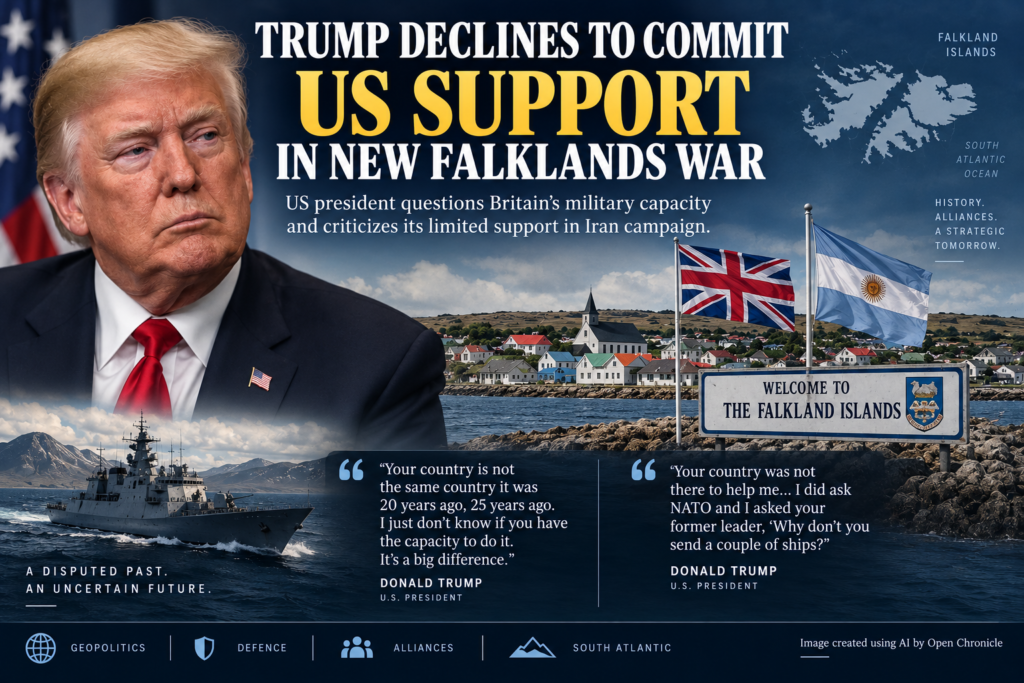
US President Donald Trump has declined to guarantee that the United States would support Britain militarily in the event of another conflict with Argentina over the Falkland Islands, while questioning whether the United Kingdom retains the military capacity needed to defend the remote South Atlantic territory.
Speaking to British broadcaster GB News, Trump reflected on the 1982 Falklands War but stopped short of offering a security commitment when asked whether Washington would assist Britain if Argentina attempted to seize the islands.
“I was there when they had the first war. That was a long time ago, and I watched it so carefully,” Trump said. “You comported yourselves very well. You took it back pretty strongly, but it’s a long way away.”
His remarks introduce fresh uncertainty into a politically sensitive territorial dispute at a time when relations between Washington and London are also being tested by disagreements over the conflict with Iran.
Trump questions Britain’s military capacity
Trump went further by openly questioning whether Britain today could mount an operation comparable to the campaign it conducted more than four decades ago.
“Your country is not the same country it was 20 years ago, 25 years ago,” Trump said. “I just don’t know if you have the capacity to do it. It’s a big difference.”
Britain maintains forces on the Falkland Islands as part of its permanent military presence in the South Atlantic. Their purpose is to deter aggression and ensure that London does not have to repeat the enormous logistical challenge of retaking the territory from thousands of kilometres away.
Trump’s decision not to commit American support does not itself amount to a change in US policy, but his comments are likely to receive close attention in both London and Buenos Aires because of the importance of the US relationship to British defence policy.
Iran campaign fuels tensions with London
The president also used the interview to criticise Britain’s contribution to the US military campaign against Iran.
“Your country was not there to help me,” Trump said, claiming that Washington had asked NATO allies and Britain’s former leadership to provide naval support.
“We didn’t need help, but I did ask NATO and I asked your former leader, ‘Why don’t you send a couple of ships?’” he added.
Trump’s decision to connect the Falklands question with Britain’s response to the Iran conflict suggests that wider disagreements within the transatlantic alliance are increasingly influencing his assessment of Washington’s security relationships.
The comments also come as the United States maintains a substantial military presence in the Middle East amid continued tensions with Tehran and concerns surrounding freedom of navigation through the Strait of Hormuz.
Argentina maintains its claim
Argentina has never abandoned its sovereignty claim over the Falkland Islands, which it calls the Islas Malvinas.
Buenos Aires argues that it inherited sovereignty over the territory from Spain following independence. Britain, which has administered the islands since 1833 apart from the Argentine occupation during the 1982 war, rejects that claim.
The issue has remained an important element of Argentine politics regardless of changes in government.
Trump’s comments came as Argentine President Javier Milei, who has developed a close political relationship with the US president, prepared to deliver a national address concerning the islands.
Milei has continued Argentina’s sovereignty claim while cultivating significantly closer relations with Washington than several of his predecessors.
The legacy of the 1982 war
The dispute erupted into open warfare on April 2, 1982, when Argentine forces invaded the Falklands.
Britain responded by assembling a naval task force and sending it thousands of kilometres into the South Atlantic. After approximately ten weeks of fighting on land, at sea and in the air, Argentine forces surrendered on June 14.
The conflict killed 649 Argentine military personnel and 255 British service members.
The war fundamentally changed Britain’s approach to the defence of the islands. London subsequently established a substantially stronger permanent military presence intended to make another successful invasion far more difficult.
The archipelago consists of East Falkland, West Falkland and hundreds of smaller islands, covering approximately 12,200 square kilometres and lying around 480 kilometres east of the southern Argentine coast.
Strategic significance of the South Atlantic
Beyond the historic sovereignty dispute, the Falklands occupy an increasingly important position in the South Atlantic.
Their location provides access to surrounding maritime areas and places the islands relatively close to routes leading towards Antarctica. Offshore energy exploration and fisheries have also increased their economic and geopolitical importance.
Argentina continues to oppose British oil and gas activity around the islands, regarding exploration in disputed waters as illegitimate.
Britain maintains that the Falkland Islanders themselves have the right to determine their political future. In a 2013 referendum, voters overwhelmingly supported retaining their status as a British Overseas Territory.
An uncomfortable message for London
Trump’s remarks do not indicate that Washington has endorsed Argentina’s territorial claim. Nor did the president say that the United States would refuse assistance if an actual conflict emerged.
Nevertheless, his refusal to provide an explicit guarantee represents an uncomfortable message for Britain, particularly because it was accompanied by criticism of the country’s military capabilities and its contribution to US operations against Iran.
For London, the comments reinforce the importance of maintaining an independent ability to defend the Falklands rather than assuming outside military assistance would automatically be available.
For Buenos Aires, Trump’s words are likely to attract attention because they come from a US president who has developed unusually close relations with Milei.
More than four decades after the Falklands War, the sovereignty dispute remains unresolved. Trump’s intervention has now added another element to the strategic calculations surrounding one of the South Atlantic’s longest running geopolitical disputes.