
By The Grand Strategy Institute · Research Division
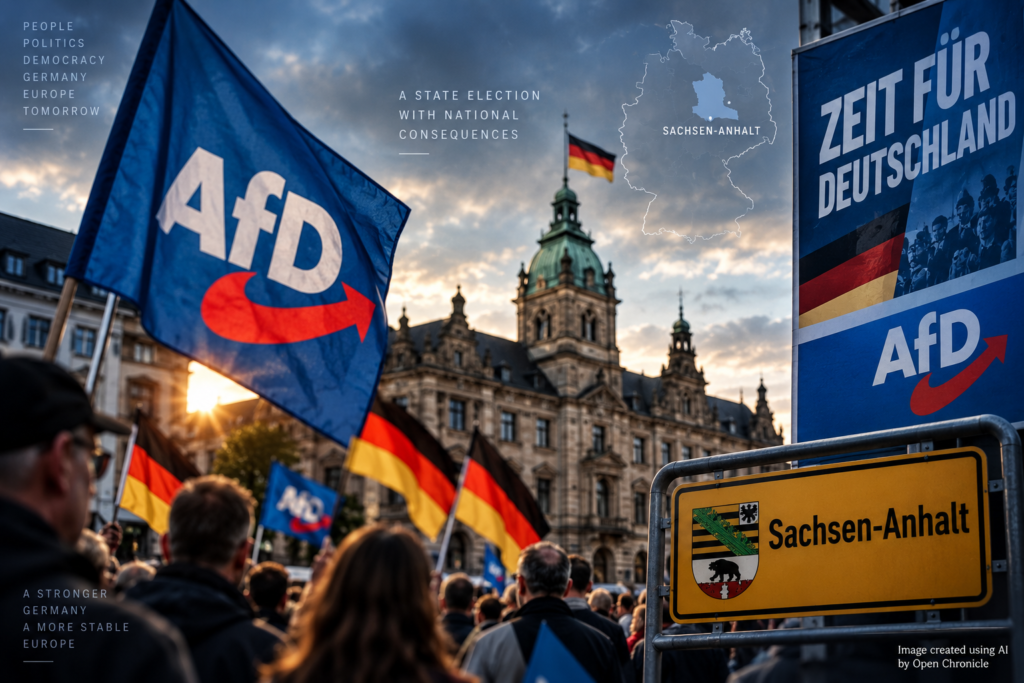
A regional election in Saxony-Anhalt is emerging as one of Germany’s most consequential political tests of 2026, despite the eastern state accounting for less than 3% of the country’s electorate.
Voters head to the polls on Sunday to elect a new state parliament, with the Alternative for Germany, AfD, entering the contest far ahead of its rivals. Polling at around 40% to 43%, the party has a realistic chance of becoming the largest force in the Landtag and, under some electoral scenarios, could even secure enough seats to govern alone.
Such an outcome would represent a historic breakthrough. It could produce the first state government led by the far right in the Federal Republic of Germany since its establishment in 1949.
But the significance of the election reaches well beyond Saxony Anhalt. The vote will test the durability of the political “firewall” maintained by Germany’s mainstream parties against cooperation with the AfD. It could also intensify pressure on Chancellor Friedrich Merz if his Christian Democratic Union, CDU, suffers a major defeat.
Why does Saxony Anhalt matter?
On paper, Saxony Anhalt is a relatively small political battleground. In practice, it could become a laboratory for the next phase of German politics.
The AfD is already the largest opposition party at federal level, but Germany’s established parties have consistently refused to form governing coalitions with it.
That barrier has prevented the AfD from converting growing electoral support into executive power.
Sunday’s election could test whether the strategy remains sustainable when the party approaches, or potentially crosses, the threshold required to govern without coalition partners.
AfD co-leader Alice Weidel has made clear that the party sees Saxony Anhalt as part of a much larger political project.
“We will form the government in Saxony Anhalt,” she said. “We will also govern at the federal level.”
Ulrich Siegmund and the AfD surge
At the centre of the campaign is 35 year old AfD candidate Ulrich Siegmund.
The party received 20.8% of the vote in Saxony-Anhalt in 2021. Five years later, surveys suggest its support has more than doubled.
Siegmund has attempted to present himself as a candidate capable of moving the AfD from opposition into government. He has already published a government programme and a plan for his first 100 days in office.
Immigration occupies a central position in his campaign.
Siegmund has promised to accelerate the removal of people without legal residency, significantly expand detention capacity for deportations and introduce work requirements for asylum seekers receiving benefits.
His growing profile has attracted national attention. German magazine Der Spiegel described him on its cover as “Germany’s most dangerous man”, a label Siegmund subsequently embraced by publicly signing copies of the magazine.
His opponents argue that the relatively controlled public image presented during the campaign obscures more radical elements surrounding the regional AfD.
Germany’s domestic intelligence service has classified the AfD organisation in Saxony-Anhalt as a confirmed right wing extremist organisation, citing anti democratic objectives and connections between members and extremist networks.
Sven Schulze faces a difficult fight
The AfD’s principal rival is Saxony-Anhalt Premier Sven Schulze of the CDU.
Schulze, 47, has only held the position since January, when Reiner Haseloff stepped down after almost 15 years leading the state.
The transition has left the CDU defending its position without the longstanding personal popularity of its former premier.
Polls place the CDU at approximately 22% to 23%, dramatically below the 37.1% it secured in the 2021 election.
Schulze has focused heavily on the economic consequences of an AfD government, particularly the party’s Eurosceptic policies.
He argues that leaving the euro and withdrawing from Europe’s Schengen system would damage investment and threaten the economic position of a state closely integrated with the European single market.
“The AfD has no contacts whatsoever to make things better in Europe. It only wants out of the EU. That would be an economic catastrophe,” Schulze said.
He has presented the CDU as the only realistic force capable of preventing an AfD government.
Why the 5% threshold could decide everything
The decisive factor on Sunday may not simply be how many votes the AfD receives.
Germany’s electoral system means parties generally need at least 5% of the vote to enter the state parliament. Votes cast for parties that fail to reach the threshold can therefore significantly alter the distribution of seats among those that do.
That creates several possible outcomes.
The AfD currently stands at around 40% to 43%. The CDU follows at approximately 22% to 23%. The Left is polling at around 11% to 13%, while the Social Democrats stand between roughly 7% and 9%.
The Greens, at around 5% to 6%, are dangerously close to the threshold.
Meanwhile, the Free Democrats are polling at approximately 3%, while the Sahra Wagenknecht Alliance, BSW, stands at around 3% to 4%.
Those smaller parties could determine whether the AfD merely finishes first or actually obtains a parliamentary majority.
If several parties fail to cross 5%, a larger share of Landtag seats would be distributed among the remaining parties. That could allow the AfD to obtain a majority without winning an absolute majority of votes.
Estimates suggest Siegmund may need roughly 45% to 48% of the popular vote to secure an outright majority, depending on how votes are distributed.
Could the AfD govern alone?
The standard Saxony-Anhalt Landtag has 83 seats, meaning 42 would normally be required for a majority.
Siegmund has not focused his campaign on finding coalition partners. His objective is an AfD government with sufficient parliamentary strength to govern independently.
That is important because the CDU has ruled out cooperation with the AfD. Germany’s other mainstream parties have adopted similar positions.
If the AfD finishes comfortably first but falls short of 42 seats, Saxony Anhalt could face a complicated period of coalition negotiations and political deadlock.
One possibility discussed during the campaign is some form of CDU led minority government involving the Social Democrats and potentially the Greens.
That arrangement could require outside support on individual votes.
Schulze, however, has said he does not want his government dependent on the Left.
BSW founder Sahra Wagenknecht has also argued for a non party premier and rejected the idea that her movement should simply provide the votes necessary to keep the CDU in power.
The result could therefore produce a fragmented parliament in which forming a stable government becomes extremely difficult.
The firewall faces its biggest test
The election will also test one of the central principles governing German politics in recent years, the refusal of mainstream parties to cooperate with the AfD.
The so called firewall has largely prevented the party from translating electoral strength into government participation.
But the strategy becomes more difficult as AfD support increases.
If the party approaches half of the electorate in an individual state, the remaining parties may have to construct increasingly complicated coalitions simply to prevent it from entering government.
Saxony Anhalt could therefore provide an early indication of whether Germany’s established political system can continue containing the AfD without fundamentally reshaping coalition politics.
Why Friedrich Merz will be watching closely
The consequences could extend directly to Berlin.
Chancellor Friedrich Merz is already confronting dissatisfaction with his federal government amid economic weakness and tensions within the governing coalition.
According to the polling data provided ahead of the election, 83% of eligible voters surveyed by public broadcaster ARD said they were dissatisfied with Merz, while only 13% expressed satisfaction.
A heavy CDU defeat in Saxony Anhalt, particularly if accompanied by an AfD result above 40%, would intensify questions about Merz’s leadership.
It would not automatically trigger a federal election.
Calling an early Bundestag election would itself risk being interpreted as an admission that the governing CDU/CSU and Social Democratic coalition had failed.
Instead, political pressure could emerge within the Christian Democrats themselves.
If internal opposition eventually forced Merz to resign, Germany’s parliament could elect another chancellor without automatically dissolving the Bundestag.
A regional election with European consequences
The immediate question on Sunday is who will govern Saxony-Anhalt.
The larger question is whether the election marks another stage in the AfD’s transformation from a powerful opposition movement into a party capable of exercising executive power.
An outright AfD majority would break one of the most important political barriers in postwar Germany. Even without a majority, a result above 40% would demonstrate the growing difficulty facing mainstream parties trying to isolate the party while simultaneously constructing viable governments without it.
For the CDU, the election is therefore both a regional contest and a judgment on its ability to contain the AfD.
For Merz, a poor result could deepen an already serious leadership problem.
For the AfD, Saxony-Anhalt offers something potentially much more important, a chance to demonstrate that the path from opposition to government is no longer theoretical.
The Grand Strategy Institute
Continue Exploring Strategic Analysis
Return to The Grand Strategy Institute for strategic assessments, long-form analysis and research examining geopolitics, military affairs, international security, emerging technologies and the changing international order.
← Back to The Grand Strategy Institute