
By Open Chronicle with agencies
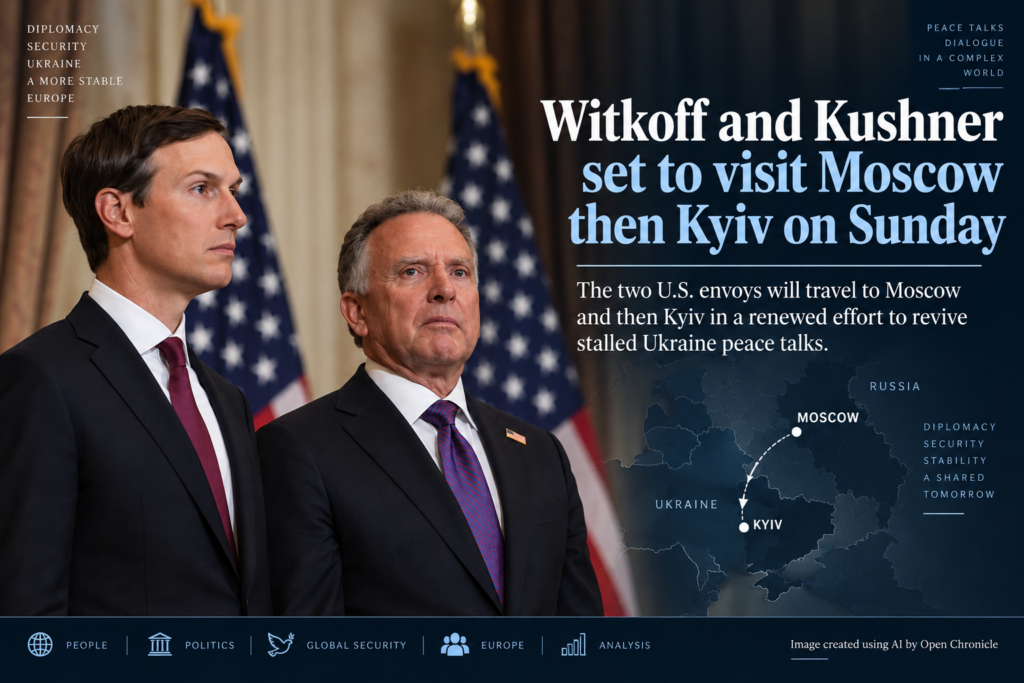
US President Donald Trump’s envoys Steve Witkoff and Jared Kushner are expected to travel to Moscow and then Kyiv on Sunday as Washington launches another attempt to revive stalled negotiations aimed at ending the war in Ukraine.
Ukrainian President Volodymyr Zelenskyy announced the planned diplomatic mission after discussions surrounding the next stage of US efforts to bring Russia and Ukraine back into negotiations.
“We discussed today that Steve Witkoff and Jared Kushner will visit Moscow and then Kyiv on Sunday,” Zelenskyy said in a Telegram post.
Details of the meetings, including who the American envoys will meet in Moscow and the proposals they intend to present, have not been publicly disclosed.
A US official told CNN that Witkoff and Kushner intend to use the trip to push for a diplomatic solution to the conflict. Russian state news agency TASS also reported that the two envoys planned to travel to Moscow and Kyiv over September 5 and 6.
Washington makes another diplomatic push
The mission represents the latest attempt by the Trump administration to restart a peace process that lost momentum earlier this year.
Witkoff has played a prominent role in Washington’s diplomatic engagement with Moscow since Trump returned to the White House in 2025.
He travelled to Russia several times during 2025 and early 2026 for discussions with Russian President Vladimir Putin and other senior officials. Witkoff has also met Zelenskyy during talks in the United States, Germany and France.
The coming mission, however, is expected to mark the first visit to Kyiv by Witkoff and Kushner as part of their current mediation efforts.
The decision to travel first to Moscow and then to the Ukrainian capital suggests Washington is attempting to establish whether there is sufficient common ground to reopen substantive negotiations.
Peace process stalled earlier this year
Trump made ending the Russia Ukraine war one of the major foreign policy priorities of his second administration.
Following his return to office in January 2025, Washington launched an intensive diplomatic initiative involving both Moscow and Kyiv.
The negotiations concentrated on several of the most difficult questions surrounding any eventual settlement, including territorial arrangements, security guarantees for Ukraine and the financing of postwar reconstruction.
Washington initially placed considerable pressure on Kyiv to accept elements of the proposed framework.
By early 2026, however, the diplomatic process had largely broken down as fundamental disagreements remained over territory, Ukraine’s long term security and the conditions under which hostilities could end.
Neither Russia nor Ukraine has subsequently indicated that it is prepared to abandon its central demands.
Moscow engagement resumes
The Witkoff and Kushner mission follows signs that Washington has been quietly rebuilding diplomatic channels with Moscow.
CIA Director John Ratcliffe travelled to the Russian capital in late August for talks that extended beyond Ukraine.
According to reports about the visit, Ratcliffe pressed Moscow to reduce its military and economic support for Iran and urged Russian officials not to escalate tensions with America’s NATO allies.
The trip demonstrated that direct communication between Washington and Moscow has continued despite the breakdown of the earlier Ukraine negotiations.
Sending Witkoff and Kushner now indicates that the White House believes there may be an opportunity to test whether those contacts can again be used to address the war.
Difficult questions remain
Any renewed peace initiative will confront essentially the same obstacles that derailed previous negotiations.
Territory remains perhaps the most difficult issue. Russia controls substantial areas of internationally recognised Ukrainian territory, while Kyiv has repeatedly rejected any settlement that legitimises Russian annexations.
Security guarantees represent another major challenge.
Ukraine has sought strong Western commitments intended to prevent another Russian attack after a settlement. Moscow, meanwhile, has consistently opposed arrangements that it believes would deepen Ukraine’s military integration with Western powers.
The future size and capabilities of Ukraine’s armed forces, sanctions against Russia and the reconstruction of Ukraine could also become central components of negotiations.
The sequence of meetings may therefore be particularly important. Discussions in Moscow could allow Witkoff and Kushner to determine whether the Kremlin’s negotiating position has changed before carrying any proposals or messages directly to Zelenskyy’s government.
A test for Trump’s peace strategy
The diplomatic mission comes at a complicated moment for Washington.
The Trump administration is simultaneously dealing with the conflict involving Iran, growing tensions between Russia and European governments and increasing concerns about the sustainability of Western military commitments.
Ending the Ukraine war would represent a major foreign policy achievement for Trump, but previous efforts have demonstrated the difficulty of reconciling the positions of Moscow and Kyiv.
For Ukraine, the renewed American initiative will also raise questions about whether Washington intends to return to the pressure tactics used during earlier negotiations or pursue a more balanced mediation effort.
For Moscow, the visit provides another opportunity to communicate directly with figures close to Trump while testing how far Washington is prepared to go in seeking a settlement.
The immediate significance of the trip may therefore lie less in expectations of an imminent peace agreement than in whether the two sides can restart a diplomatic process that has effectively been frozen for months.
If Witkoff and Kushner leave Moscow with proposals that Kyiv considers worth discussing, Sunday could mark the beginning of another negotiating phase.
If the fundamental positions remain unchanged, the latest US diplomatic initiative may instead demonstrate just how far Russia and Ukraine remain from an agreement.
Explore International Relations
Discover more reporting and analysis on diplomacy, international security, global governance and the changing balance of power.
Return to International Relations →