
By Open Chronicle History Desk
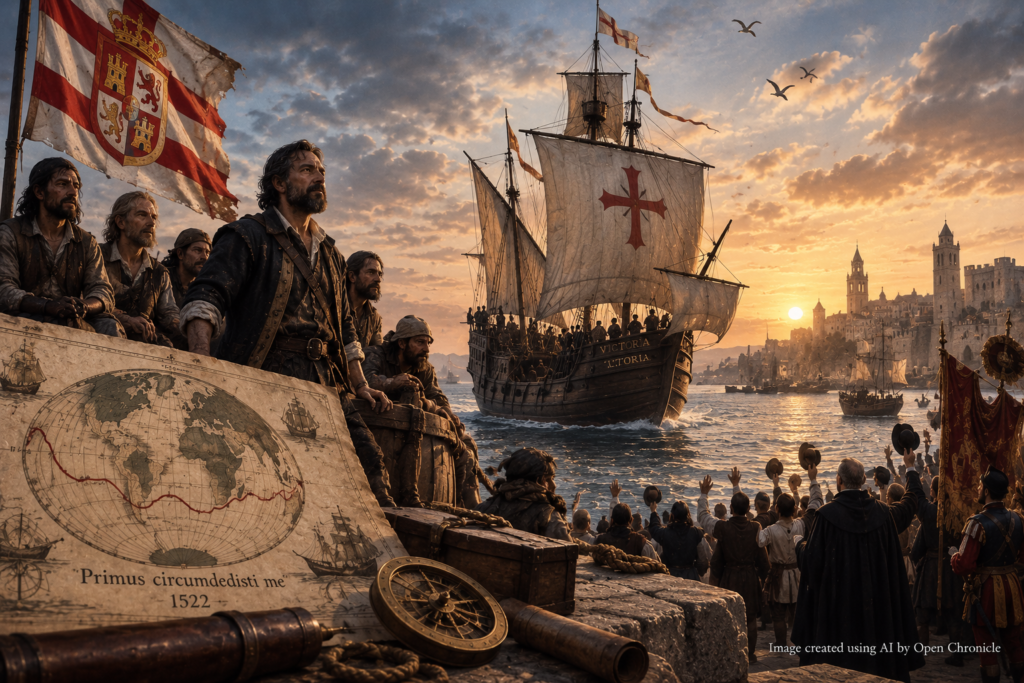
On September 6, 1522, a battered wooden ship appeared off the coast of southern Spain and entered the harbour of Sanlúcar de Barrameda.
Her name was the Victoria.
Almost three years earlier, she had sailed from Spain as one of five vessels in an ambitious expedition commanded by the Portuguese navigator Ferdinand Magellan, known in Portuguese as Fernão de Magalhães.
The expedition’s original objective was not to sail around the world.
It was to find a western maritime route to the spice producing islands of Southeast Asia.
Instead, the voyage became something much greater.
The Victoria had crossed the Atlantic, navigated an unknown passage through the southern tip of South America, traversed the immense Pacific Ocean, reached Southeast Asia, crossed the Indian Ocean and rounded the Cape of Good Hope before returning to Spain.
Only 18 men who had sailed with the expedition reached Spain aboard the Victoria after completing the entire circumnavigation.
Magellan was not among them.
He had been killed in the Philippines more than a year earlier.
Command of the final voyage home eventually passed to the Spanish Basque navigator Juan Sebastián Elcano.
When the exhausted survivors reached Spain in September 1522, they had accomplished something no known expedition had ever achieved before.
They had sailed around the Earth.
A World Divided Between Spain and Portugal
The expedition emerged from the fierce maritime rivalry between Portugal and Spain.
During the fifteenth century, Portuguese navigators had explored progressively farther along the western coast of Africa.
Under royal sponsorship, Portugal developed navigational expertise, maritime networks and trading posts connecting Europe with Africa and eventually Asia.
In 1488, Bartolomeu Dias rounded the southern tip of Africa.
A decade later, Vasco da Gama reached India by sea.
Portugal had discovered a commercially viable maritime route connecting Europe directly with the markets of the Indian Ocean.
The consequences were revolutionary.
The Spice Trade
Spices were among the most valuable commodities in early modern international commerce.
Cloves, nutmeg, mace, pepper and other products could command extraordinary prices in European markets.
They were used in food, medicine, perfumes and elite consumption.
Some of the most valuable spices originated in a small group of islands in what is now Indonesia.
Europeans called them the Spice Islands.
Today they are usually known as the Maluku or Molucca Islands.
Control over maritime access to these islands promised enormous profits.
Portugal was establishing itself along the eastern route around Africa.
Spain needed another way to reach Asia.
Columbus Had Changed the Map
Spain’s western ambitions had begun decades earlier.
In 1492, Christopher Columbus sailed west across the Atlantic hoping to reach Asia.
Instead, his voyages connected European maritime powers with lands in the Americas previously unknown to them.
Europeans gradually realised that these territories formed continents standing between Europe and Asia.
The question therefore changed.
Could ships somehow pass through or around this enormous landmass and continue westwards towards Asia?
That possibility fascinated navigators.
One of them was Ferdinand Magellan.
Fernão de Magalhães
Magellan was born in Portugal around 1480.
He entered Portuguese royal service and gained extensive experience in the maritime world created by Portuguese expansion.
He travelled to India and participated in expeditions across the Indian Ocean and Southeast Asia.
This experience gave him unusually valuable knowledge of Asian geography and maritime routes.
But Magellan’s relationship with the Portuguese Crown deteriorated.
King Manuel I of Portugal refused to support his proposed western expedition.
Magellan therefore turned to Portugal’s greatest maritime rival.
Spain.
A Portuguese Navigator Serving Spain
Magellan presented his plan to the young Spanish king Charles I, the future Holy Roman Emperor Charles V.
The proposal was strategically attractive.
Spain and Portugal had attempted to divide newly encountered overseas territories through the Treaty of Tordesillas of 1494.
An imaginary line divided spheres of expansion.
But determining exactly where the corresponding division lay on the opposite side of the globe was extremely difficult.
Magellan argued that the Spice Islands could potentially be reached by sailing west and might fall within Spain’s sphere.
If he was correct, Spain could challenge Portugal’s lucrative Asian spice trade without using the Portuguese controlled route around Africa.
The Spanish Crown approved the expedition.
Five Ships Leave Spain
The fleet consisted of five ships:
Trinidad, Magellan’s flagship.
San Antonio.
Concepción.
Victoria.
And Santiago.
The expedition departed Sanlúcar de Barrameda on September 20, 1519, after previously leaving Seville and travelling down the Guadalquivir River.
Around 270 men participated, although exact totals vary among historical reconstructions.
They came from several European countries.
Few could have imagined that only a small fraction would complete the journey around the world.
Across the Atlantic
The fleet sailed southwest across the Atlantic.
It reached the coast of South America and began searching for a passage towards the sea believed to lie beyond the continent.
This was the central geographical problem.
Nobody in the expedition knew with certainty whether such a navigable passage existed.
The coastline seemed endless.
The ships moved progressively southwards.
Every inlet raised hope.
Every dead end consumed time and supplies.
The southern winter approached.
Winter at Patagonia
In 1520, Magellan decided to winter at Puerto San Julián in Patagonia.
Conditions were harsh.
Cold weather, limited food and uncertainty increased tension among the crews.
Some officers questioned Magellan’s leadership.
The expedition had already travelled enormous distances without finding the promised passage.
Then came mutiny.
Several captains rebelled against Magellan.
The crisis threatened to destroy the expedition before it reached the Pacific.
Magellan responded ruthlessly.
The mutiny was suppressed.
Some leaders were executed.
Others were abandoned.
His authority survived.
The Santiago Is Lost
The expedition soon suffered another setback.
The Santiago was sent to explore the coast.
It was wrecked during a storm.
Its crew largely survived, but the expedition had lost one of its five ships.
Four remained.
Magellan continued south.
Then, in October 1520, the explorers encountered an opening in the coastline.
This time it was not another dead end.
The Strait
The ships entered a complex labyrinth of channels surrounded by mountains.
Navigation was extremely difficult.
The crews could not initially know whether the waterway truly crossed the continent.
Exploration continued.
Eventually, evidence accumulated that they had discovered the passage.
The route would later become known as the Strait of Magellan.
It connected the Atlantic with another enormous ocean.
But before the fleet completed the passage, another ship disappeared.
The San Antonio Deserts
The San Antonio, the largest vessel in the fleet, became separated from the others.
Its officers decided to abandon the expedition.
The ship turned around and returned to Spain.
Magellan was left with only three vessels:
Trinidad.
Concepción.
And Victoria.
In late November 1520, those ships finally emerged from the strait.
Before them stretched an ocean whose scale Europeans had profoundly underestimated.
The Pacific
Magellan called the waters Mar Pacífico, the peaceful sea, because of the relatively calm conditions encountered after leaving the violent waters around southern South America.
The name was deceptive.
The Pacific was vast beyond anything the expedition had expected.
European maps badly underestimated the distance between the Americas and Asia.
The ships sailed west.
Days became weeks.
Weeks became months.
Food deteriorated.
Fresh provisions disappeared.
Hunger became severe.
Crossing the World’s Largest Ocean
The Pacific crossing became one of the most extraordinary endurance episodes in maritime history.
The crews were unable to find substantial sources of fresh food for long periods.
Contemporary accounts describe men eating increasingly desperate provisions.
Scurvy and malnutrition spread.
Sailors died.
The ocean seemed endless.
Yet the expedition continued westwards.
The voyage itself revealed something fundamental.
The Earth was considerably larger than many European geographical calculations had assumed.
Guam
After more than three months crossing the Pacific, the expedition reached islands in the western Pacific in March 1521.
They stopped at Guam in the Mariana Islands.
For the starving sailors, contact with inhabited islands meant food and water.
But relations with local people quickly became tense.
After replenishing supplies, Magellan continued west.
Soon the expedition reached an archipelago that would become central to both the voyage and Spanish imperial history.
The Philippines.
Arrival in the Philippines
The fleet reached the Philippine archipelago in March 1521.
Magellan established relations with local rulers.
Christian missionary activity became intertwined with diplomacy and alliance building.
Some rulers accepted baptism.
Magellan increasingly involved himself in local political disputes.
This decision would prove fatal.
On the island of Mactan, a local ruler named Lapulapu resisted the authority of one of Magellan’s allies.
Magellan decided to intervene militarily.
The Battle of Mactan
On April 27, 1521, Magellan and a relatively small force landed on Mactan.
The attack went badly.
Shallow water prevented the expedition’s ships from providing effective close support.
Magellan’s men faced a much larger local force.
During the retreat, Magellan was wounded and surrounded.
He was killed.
The commander who had led the expedition across the Atlantic, discovered the strait bearing his name and crossed the Pacific would never reach Spain again.
His death creates one of history’s great ironies.
Magellan is permanently associated with the first circumnavigation.
But Magellan himself never completed it.
The Expedition Nearly Collapses
The disaster did not end with Magellan’s death.
Relations with local rulers deteriorated.
Additional members of the expedition were killed.
The surviving Europeans now faced a serious manpower problem.
There were no longer enough sailors to operate three ships effectively.
They made a difficult decision.
The Concepción was abandoned and burned.
Only two vessels remained.
Trinidad and Victoria.
The survivors continued towards their original objective.
The Spice Islands
In November 1521, the expedition finally reached the Moluccas.
This was the destination Magellan had promised the Spanish Crown.
The ships arrived at Tidore and began acquiring cloves.
From a commercial perspective, the expedition had finally reached the source of one of the world’s most valuable commodities.
The holds were loaded.
Now came the challenge of returning to Spain.
The surviving commanders made a remarkable decision.
The two ships would attempt different routes.
Two Attempts to Reach Home
The Trinidad attempted to cross the Pacific eastwards towards the Americas.
It failed.
The ship encountered terrible conditions, returned towards the Moluccas and eventually fell into Portuguese hands.
The Victoria chose the opposite direction.
It would sail west.
That meant entering waters dominated by Portugal.
It also meant completing a voyage around the planet.
Command of the Victoria fell to Juan Sebastián Elcano.
Juan Sebastián Elcano
Elcano was a Basque mariner from Getaria in northern Spain.
His role in the expedition had been complicated.
He had participated in the earlier mutiny against Magellan but was eventually restored to service because skilled sailors were desperately needed.
After Magellan’s death and several subsequent changes in command, Elcano emerged as the man responsible for bringing the Victoria home.
His task was extraordinary.
He had to cross the Indian Ocean and round Africa while avoiding Portuguese authorities.
Portugal considered Spanish activity in the region an intrusion into its sphere of influence.
Capture could end the voyage.
Across the Indian Ocean
The Victoria left the Spice Islands in December 1521.
Rather than following heavily travelled Portuguese routes close to major ports, Elcano attempted to remain distant from places where the ship might be discovered.
This reduced the risk of capture.
It also made resupplying extremely difficult.
The crew crossed enormous stretches of ocean.
Food shortages returned.
Men became sick.
The ship itself had endured years of continuous sailing and required constant maintenance.
Yet the Victoria continued west.
The Cape of Good Hope
To return to Europe, Elcano had to round the southern tip of Africa.
Portuguese navigators had pioneered this route decades earlier.
But sailing it in an exhausted, overloaded ship after years at sea was extremely dangerous.
Storms battered the vessel.
Cold conditions added to the suffering.
The Victoria eventually rounded the Cape of Good Hope.
The expedition had now travelled through all the major oceans required to encircle the globe.
But reaching Spain remained uncertain.
Hunger and Death
The final voyage up the Atlantic coast of Africa became desperate.
Men continued dying.
Food was running out.
The crew faced a terrible choice.
Stopping at Portuguese controlled territory risked arrest.
Continuing without provisions risked starvation.
Eventually, necessity won.
They decided to stop in the Cape Verde Islands, controlled by Portugal.
The sailors attempted to conceal their true identity and claimed they had sailed from the Americas.
Initially, the deception worked.
Then Portuguese authorities became suspicious.
The Calendar Mystery
Cape Verde produced one of the voyage’s most fascinating discoveries.
The sailors believed it was one day earlier than local people said it was.
They had carefully maintained their calendar throughout the voyage.
How could an entire day have disappeared?
The answer lay in their circumnavigation.
By continuously travelling westwards around the Earth, they had effectively accumulated a one day difference relative to people who had remained in the same region.
The phenomenon would later be addressed through the concept underlying the International Date Line.
The missing day was another remarkable confirmation that the expedition had encircled the planet.
Escape from Cape Verde
Portuguese authorities eventually detained some members of the crew who had gone ashore.
Elcano could not risk waiting.
The Victoria escaped with the sailors who remained aboard.
The final stage of the journey began.
The ship crossed towards the Iberian Peninsula.
Its surviving crew were exhausted.
Many were severely malnourished.
The vessel was in poor condition.
But Spain was finally within reach.
September 6, 1522
On September 6, the Victoria entered Sanlúcar de Barrameda.
The first circumnavigation of the Earth had been completed.
Of the hundreds who had originally sailed with the expedition, only 18 men aboard the Victoria completed the entire voyage and returned on the ship.
The scale of the losses was extraordinary.
Magellan was dead.
Most of the original crew were dead, missing, imprisoned or stranded.
Four of the five ships had been lost, abandoned, captured or had returned separately without completing the circumnavigation.
Only the Victoria had travelled all the way around the world.
The Survivors Reach Seville
Two days later, on September 8, the Victoria travelled upriver to Seville.
According to accounts of the voyage, the surviving sailors went ashore and gave thanks for their survival.
Their physical condition testified to what they had endured.
They had spent nearly three years away.
They had crossed oceans whose true dimensions had not been understood by European geographers.
They had experienced mutiny, shipwreck, hunger, disease, warfare and the death of their commander.
And they had returned to the place from which the expedition began.
From the west.
The Eighteen
The names of the surviving men became part of maritime history.
They represented several European backgrounds, reflecting the multinational nature of early modern seafaring.
At their head stood Juan Sebastián Elcano.
The Spanish Crown rewarded him for his achievement.
Emperor Charles V granted Elcano a coat of arms bearing a globe and the Latin phrase:
Primus circumdedisti me.
“You first encircled me.”
The statement referred to the Earth itself.
It was one of the most extraordinary honours a navigator could receive.
Did Magellan Circumnavigate the World?
This question is more complicated than it appears.
Magellan did not complete the 1519 to 1522 voyage around the Earth because he died in the Philippines.
However, before the expedition, he had previously travelled eastwards from Europe into Southeast Asia while serving Portugal.
By reaching the Philippines from the opposite direction in 1521, he came remarkably close to linking his earlier eastern travels with his later western voyage.
Some arguments therefore suggest that Magellan may personally have travelled across longitudes encompassing almost the entire globe over the course of separate journeys.
But the first documented continuous expedition to complete a full circumnavigation was the voyage finished by the Victoria under Elcano.
That distinction matters.
Enrique of Malacca
Another fascinating figure was Magellan’s interpreter, usually known as Enrique of Malacca.
Enrique had come from Southeast Asia and had previously travelled westwards with Magellan to Europe.
He then accompanied the expedition across the Atlantic and Pacific back towards Southeast Asia.
Because of this extraordinary route, historians have sometimes speculated that Enrique may have become the first individual to effectively circumnavigate the globe if he returned to his original homeland after disappearing from the expedition’s records.
The evidence is insufficient to establish this conclusively.
But his story reminds us that the voyage was not simply an achievement of European navigators.
It depended upon knowledge, labour and encounters involving people across the world.
Antonio Pigafetta
Much of what historians know about the expedition comes from Antonio Pigafetta, an Italian scholar and traveller who accompanied Magellan.
Pigafetta survived the circumnavigation aboard the Victoria.
He kept detailed notes describing geography, peoples, languages, animals, plants and events encountered during the voyage.
His account became one of the most important documents in the history of European exploration.
Without Pigafetta, many details of the expedition would have disappeared.
He was not merely recording a maritime adventure.
He was documenting a world Europeans were only beginning to understand.
Did the Voyage Prove the Earth Was Round?
A common popular claim says that Magellan’s expedition proved the Earth was spherical.
That is misleading.
Educated Europeans had known that the Earth was spherical for many centuries.
Ancient Greek scholars had demonstrated the concept long before the Roman Empire.
Eratosthenes had even produced a remarkably sophisticated estimate of Earth’s circumference in the third century BCE.
Medieval European scholars also understood the Earth’s spherical shape.
What the circumnavigation demonstrated dramatically was something different.
A ship could sail continuously around the planet.
And the distances involved could now be measured through direct experience.
The Pacific Was Enormous
One of the voyage’s greatest geographical revelations concerned the Pacific Ocean.
European maps had significantly underestimated its size.
The distance between the Americas and Asia was vastly greater than many navigators expected.
This discovery changed European geographical understanding.
It also explained why Columbus’s original assumption that Asia could be reached relatively quickly by sailing west from Europe had been so mistaken.
A massive ocean stood between the American continents and East Asia.
Magellan’s expedition had crossed it.
The Earth Becomes Connected
The circumnavigation also demonstrated the potential for global maritime connectivity.
The Atlantic, Pacific and Indian oceans were not isolated geographical worlds.
They formed parts of a continuous planetary system.
Ships could theoretically travel from Europe to the Americas, Asia, Africa and back to Europe without reversing direction.
This understanding would have enormous consequences.
Global commerce expanded.
Empires became increasingly interconnected.
Plants, animals, commodities, diseases, technologies and people moved across oceans at unprecedented scales.
The early modern world was becoming genuinely global.
Spain and Portugal Continue Their Rivalry
The voyage did not end the dispute over the Spice Islands.
Spain argued that the islands lay within its sphere under the geographical logic of Tordesillas.
Portugal disagreed.
Because longitude was extremely difficult to calculate accurately, determining the precise opposite side of the Tordesillas division remained problematic.
The dispute continued.
Eventually, the Treaty of Zaragoza of 1529 produced a settlement.
Spain relinquished its immediate claim to the Moluccas in exchange for Portuguese payment.
Portugal retained its position in the spice trade.
But Spain had discovered something else of enormous importance.
The Philippines.
The Spanish Philippines
Spanish interest in the Philippine archipelago continued after Magellan.
Permanent colonisation began later in the sixteenth century.
In 1565, Miguel López de Legazpi established a lasting Spanish presence.
Manila became the centre of Spanish rule.
The Philippines would remain under Spanish control for more than three centuries.
The islands also became a crucial link in a remarkable global commercial network.
The Manila Galleons
From the late sixteenth century, Spanish ships connected Manila with Acapulco in New Spain, present day Mexico.
These Manila galleons carried Asian luxury goods across the Pacific.
Silver from the Americas travelled in the opposite direction.
Goods could then move across Mexico and onward across the Atlantic.
For the first time, sustained commercial networks connected Asia, the Americas and Europe on a global scale.
The world glimpsed by the Victoria in 1522 was becoming an economic reality.
The Human Cost of Exploration
The heroic language traditionally surrounding voyages of exploration can obscure their human consequences.
The Magellan expedition was an extraordinary navigational achievement.
It was also part of an age of imperial expansion.
European maritime exploration increasingly produced conquest, colonial rule, forced labour, missionary activity and competition over indigenous lands and resources.
The Philippines would eventually experience centuries of Spanish colonial government.
The Moluccas became a battleground for European commercial empires.
Maritime connections enriched some societies while devastating others.
The first circumnavigation therefore belongs simultaneously to the history of exploration and the history of empire.
Magellan and Elcano
Historical memory has treated the expedition’s two principal names differently.
Magellan conceived and commanded the voyage through its most revolutionary geographical stages.
He found the strait.
He led the first documented European crossing of the Pacific from east to west.
He brought the expedition to Southeast Asia.
But he died before reaching the Spice Islands and before completing the circumnavigation.
Elcano inherited a shattered expedition.
His achievement was different but equally essential.
He made the decision to continue west.
He navigated the Victoria across the Indian Ocean.
He rounded Africa.
He avoided Portuguese capture.
And he brought the ship home.
Without Magellan, there would probably have been no expedition.
Without Elcano, there would have been no completed circumnavigation.
Elcano Returns to Sea
Remarkably, Elcano did not remain safely in Spain.
He later joined another expedition attempting to reach the Spice Islands, this time commanded by García Jofre de Loaísa.
The voyage again attempted the dangerous route through the Strait of Magellan and across the Pacific.
Elcano would not survive.
He died in the Pacific in 1526.
Like Magellan, his life ended during the era of oceanic exploration he had helped define.
The Victoria
The Victoria itself became one of history’s most famous ships.
It was not enormous.
It possessed none of the technology later generations would associate with global navigation.
There was no engine.
No satellite navigation.
No accurate marine chronometer.
No modern weather forecasting.
Its crew depended on sails, celestial navigation, dead reckoning, experience and incomplete charts.
Yet this wooden vessel crossed the world’s great oceans and returned.
Its survival remains one of the remarkable achievements of early modern seamanship.
A Revolution in Geography
The intellectual significance of the voyage was enormous.
Maps could no longer represent the world merely as disconnected coastlines discovered from separate directions.
The oceans had been physically linked by a single expedition.
Europeans gained a much clearer sense of the planet’s scale.
The voyage demonstrated that global navigation was possible.
It also revealed how difficult that navigation could be.
The Earth had become simultaneously more connected and much larger.
Why September 6 Matters
The importance of September 6, 1522 lies not simply in the fact that one ship returned home.
The Victoria carried evidence of a transformed understanding of the planet.
Its voyage connected the world’s great oceans.
It revealed the immense scale of the Pacific.
It demonstrated that a continuous westward circumnavigation was possible.
It intensified competition between maritime empires.
It contributed to the emergence of global trading networks.
And it transformed the geographical imagination of Europe.
But perhaps the most extraordinary fact is the human scale of the achievement.
Five ships had departed.
Only one completed the journey.
Hundreds had set out.
Only a tiny group aboard the Victoria returned after travelling the entire route.
Their commander had died halfway around the world.
The survivors arrived exhausted, sick and almost unrecognisable.
Yet they had done something unprecedented.
September 6, 1522
When the Victoria entered Sanlúcar de Barrameda, there was no satellite map showing a line around the Earth.
No instant communication announced the achievement globally.
No one watching from the shore could fully understand how profoundly the voyage would enter history.
They simply saw an exhausted ship returning home.
But that ship had sailed west from Spain and eventually returned from the east.
It had crossed the Atlantic.
Passed through South America.
Crossed the Pacific.
Reached Southeast Asia.
Crossed the Indian Ocean.
Rounded Africa.
And crossed the Atlantic again.
For the first time in recorded history, a single expedition had completed a voyage around the planet.
Magellan had begun it.
Elcano had finished it.
And on September 6, 1522, the battered Victoria returned to Spain carrying eighteen survivors and one extraordinary message:
the world could be sailed around.