
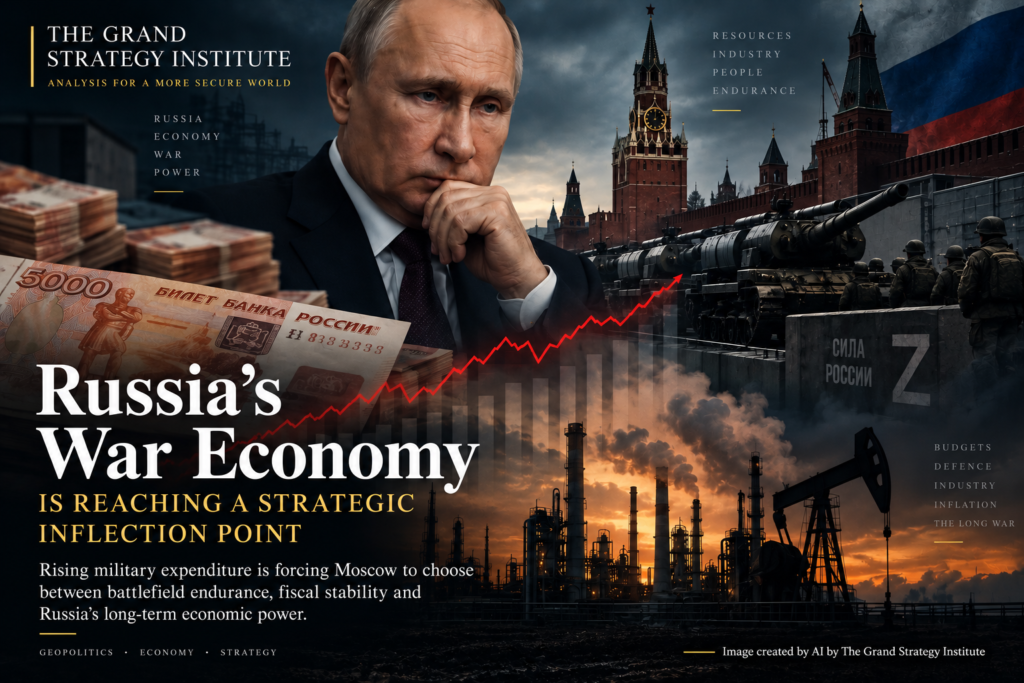
Rising military expenditure is forcing Moscow to choose between battlefield endurance, fiscal stability and Russia’s long-term economic power
By The Grand Strategy Institute Research Division
For much of the war in Ukraine, one of the most persistent questions surrounding Russia has been deceptively simple: how long can Moscow afford to keep fighting?
The question has often produced equally simplistic answers.
Early expectations that Western sanctions would rapidly cripple the Russian economy proved mistaken. Moscow redirected energy exports, imposed capital controls, expanded domestic defence production, mobilised financial reserves and transformed government expenditure into an enormous engine of wartime demand.
Russia adapted.
But adaptation should not be confused with unlimited economic capacity.
By 2026, the more important question is no longer whether Russia can finance another month or another year of war. It is what Russia must sacrifice to do so — and whether the cumulative cost of those sacrifices will eventually weaken the foundations of Russian power.
The latest budget figures suggest that this trade-off is becoming considerably more severe.
Russia intended to reduce military expenditure in 2026. Instead, spending accelerated sharply. Military expenditure during the first half of the year reportedly increased by around 30 per cent compared with the same period in 2025, reaching approximately 10.7 trillion rubles.
That is not simply a budgetary anomaly.
It is evidence of a deeper transformation.
Russia is becoming increasingly dependent on a war economy whose military requirements are beginning to collide with the fiscal, monetary and developmental requirements of the state itself.
And that collision could become one of the most important strategic variables of the war.
The Kremlin’s New Strategic Equation
Wars consume resources long before they consume states.
A country does not need to become bankrupt for the economic burden of war to alter its strategic behaviour. The pressure emerges much earlier, through increasingly difficult decisions about where national resources should be allocated.
Russia now faces precisely such a problem.
The Kremlin must simultaneously finance military operations in Ukraine, replenish equipment losses, expand weapons production, recruit and compensate personnel, protect critical infrastructure, sustain regional budgets and preserve enough civilian economic activity to maintain political stability.
Each objective competes for the same underlying resources: labour, capital, industrial capacity and government revenue.
For several years, Moscow was able to postpone many of these contradictions.
Large financial reserves provided protection.
Energy exports generated substantial revenue.
Government military orders stimulated industrial production.
High payments to soldiers and defence workers supported household consumption.
Western expectations of an immediate economic crisis repeatedly underestimated the Russian state’s ability to mobilise resources.
But mobilisation changes an economy.
The longer it continues, the more difficult it becomes to distinguish temporary wartime measures from structural transformation.
Russia may now be entering that second stage.
From Wartime Stimulus to Wartime Constraint
The first economic phase of the full-scale war contained an apparent paradox.
The enormous increase in defence expenditure helped stimulate economic activity.
Factories received government contracts. Defence companies expanded. Workers became scarce and wages increased in sectors connected to military production. Regions supplying soldiers received substantial flows of government money.
Measured through conventional indicators such as employment and output, parts of the Russian economy appeared remarkably resilient.
But producing a tank is not economically equivalent to building a factory that will generate productive capacity for decades.
A missile contributes to military capability, but once fired it disappears.
A destroyed armoured vehicle represents industrial output that must be produced again.
A large mobilisation payment may stimulate household consumption, but it does not necessarily increase the productive potential of the economy.
This distinction becomes increasingly important during prolonged wars.
Military expenditure can generate economic activity while simultaneously consuming the capital, labour and industrial capacity required for future growth.
Russia’s problem is therefore not that the war economy produces nothing.
It produces enormous quantities of military power.
The problem is the opportunity cost of producing that power.
A Budget Built Around War
The scale of Russia’s military expenditure illustrates how deeply the conflict has penetrated the structure of the state.
During the first half of 2026, military spending reportedly reached approximately 10.7 trillion rubles, equivalent to around 4.7 per cent of projected annual GDP.
If expenditure continued at a similar pace, the annual military burden could reach levels unprecedented in Russia’s post-Soviet history.
The strategic significance is greater than the headline number.
Moscow had expected military expenditure to decline.
Instead, it increased.
That means Russia’s fiscal planning is being overtaken by battlefield requirements.
War is determining the budget rather than the budget determining the resources available for war.
For a state fighting an existentially framed conflict, this is understandable.
But it carries consequences.
When military expenditure becomes effectively protected from normal fiscal discipline, adjustment must occur elsewhere.
The Civilian State Faces the Squeeze
The Kremlin therefore confronts a difficult political choice.
It can tolerate larger deficits.
It can raise additional revenue.
It can borrow more.
It can reduce civilian expenditure.
Or it can combine all four.
None is painless.
Cuts to infrastructure, healthcare, education or regional development would gradually transfer the cost of the war from the military budget to Russian society.
Higher taxes would do the same more visibly.
Greater borrowing preserves expenditure today but creates future interest obligations.
Monetary accommodation risks reinforcing inflation.
The Russian state has sufficient coercive and administrative capacity to impose these choices.
That is not the same as saying they have no consequences.
A central objective of the Kremlin since 2022 has been to maintain a separation between the battlefield and everyday life for much of the Russian population.
The political bargain is implicit: the state conducts the war while society continues functioning with as much normality as circumstances permit.
The more the economic cost penetrates civilian life, the more difficult that bargain becomes to maintain.
Russia’s Financial Cushion Is Thinner
Moscow entered the war with another important advantage.
For years, Russia had accumulated financial reserves designed partly to withstand precisely the kind of confrontation that followed the invasion of Ukraine.
The National Wealth Fund became an important strategic reserve.
It allowed the government to finance deficits without immediately resorting to substantially higher taxation or debt.
But reserves exist to be spent only once.
Repeated wartime withdrawals have reduced the liquid portion of the fund significantly. The figures supplied for this analysis place remaining liquid assets at roughly 1.6 per cent of GDP.
Russia is therefore gradually losing one of the mechanisms that made the early years of wartime financing easier.
This does not create an immediate solvency crisis.
It changes the available options.
As liquid reserves decline, Moscow becomes increasingly dependent on current revenue and domestic borrowing.
That makes interest rates strategically relevant.
The Cost of Borrowing Matters
Russia’s overall sovereign debt remains comparatively low.
That fact is frequently cited as evidence that Moscow retains enormous capacity to finance the war.
There is considerable truth in the argument.
But debt sustainability is determined not simply by how much a government owes. The cost of acquiring new debt matters as well.
Long-term Russian government bond yields approached 17 per cent in July, according to the figures provided for this analysis.
Borrowing at those rates is expensive.
And government borrowing does not occur in isolation.
When the state absorbs increasing amounts of domestic capital, businesses compete for the remaining financing.
Investment becomes more expensive.
Companies postpone expansion.
Civilian industries struggle to obtain affordable credit.
A state can therefore finance today’s military expenditure partly by reducing tomorrow’s productive investment.
That is manageable for a limited period.
Over a decade, it becomes a question of national power.
Labour May Be an Even Greater Constraint Than Money
Financial resources are only one component of Russia’s war economy.
People are another.
Russia requires soldiers.
It requires engineers.
It requires machinists, technicians, drivers, construction workers and specialists capable of producing increasingly sophisticated weapons.
The civilian economy needs many of the same people.
Military mobilisation and defence-industrial expansion therefore compete directly with civilian production for labour.
This produces another wartime paradox.
Workers become more valuable and wages rise, which can improve household incomes.
But companies face increasingly severe labour shortages.
Higher wages increase production costs.
Businesses compete against defence companies backed by enormous government contracts.
The military can ultimately outbid many civilian employers because its demand is political rather than purely commercial.
The result is an economy increasingly organised according to strategic priorities rather than market efficiency.
That may improve Russia’s ability to fight today.
It may simultaneously weaken its ability to modernise tomorrow.
The Defence Industry Is Becoming the Centre of Gravity
This transformation has profound implications for the Russian political economy.
The defence-industrial sector is no longer merely supporting the state.
The state is increasingly being reorganised around the requirements of the defence-industrial sector.
Factories operate expanded production cycles.
Military procurement shapes investment.
Regions containing defence facilities receive disproportionate economic stimulus.
Workers migrate towards better-paid military industries.
Research and technological resources are redirected toward defence applications.
Such mobilisation can create formidable military capacity.
History demonstrates that centrally directed wartime economies can sustain extraordinary levels of production for surprisingly long periods.
But the strategic question is what happens if extraordinary mobilisation becomes permanent.
Russia risks developing an economy increasingly effective at producing military capability but progressively less capable of generating diversified civilian productivity.
That distinction matters because military power ultimately depends upon economic power.
Ukraine Is Attacking the Economics of War
There is another factor complicating Moscow’s calculations.
The battlefield is expanding economically.
Ukraine’s growing long-range strike capability means that important elements of Russia’s industrial and energy infrastructure can no longer be regarded as safely removed from the conflict.
Refineries, fuel facilities, warehouses, logistics centres and other infrastructure increasingly require protection.
This changes the economic equation.
Russia must not merely manufacture weapons for the front.
It must allocate air-defence systems, electronic warfare assets, personnel and infrastructure protection across an enormous territory.
Every additional strategic site requiring defence imposes another cost.
Every damaged industrial facility requires repair.
Every temporary production disruption creates secondary effects.
Every air-defence interceptor fired against an incoming Ukrainian drone consumes a weapon that must eventually be replaced.
The strategic objective of such operations does not need to be the destruction of the Russian economy.
It can simply be to make the war progressively more expensive.
This is economic warfare through cumulative friction.
The Geography of the War Is Changing
This development also undermines one of Russia’s traditional strategic advantages: depth.
Russian strategic culture has historically benefited from geography.
An enormous territory allows military infrastructure, industry and logistics networks to be distributed far from immediate front lines.
Long-range drones and missiles are eroding that protection.
The distinction between front and rear is becoming less clear.
A refinery hundreds of kilometres from Ukraine may still be part of the battlefield.
A weapons factory deep inside Russia may require protection.
A railway hub far from the trenches can become operationally significant.
The expansion of the battlespace imposes costs on both sides, but Russia’s enormous geography creates a particular defensive challenge.
Protecting everything is impossible.
Prioritisation becomes unavoidable.
Once again, the war becomes a problem of allocation.
Why Russia Is Not About to Collapse
None of this supports predictions of imminent Russian economic collapse.
Such predictions have repeatedly underestimated Moscow’s capacity for adaptation.
Russia remains a major commodity exporter.
It retains substantial industrial infrastructure.
The state possesses extensive control over domestic financial institutions.
Public debt remains manageable.
Trade has been redirected toward China, India and other markets.
Sanctions enforcement remains imperfect.
And authoritarian political systems can impose economic sacrifices that might prove much harder for governments dependent upon frequent competitive elections.
Russia therefore possesses considerable capacity to continue the war.
A serious strategic assessment must acknowledge this.
But rejecting the collapse narrative does not require accepting the opposite argument that Russia can sustain any level of military expenditure indefinitely.
Both positions are too simplistic.
The relevant question is one of diminishing strategic flexibility.
The Real Measure Is Opportunity Cost
Suppose Russia can finance another year of war.
What cannot it finance because it has chosen to do so?
That is the more revealing question.
Every trillion rubles directed toward the battlefield cannot simultaneously modernise transport infrastructure.
Every engineer absorbed by defence production cannot simultaneously contribute to civilian technological development.
Every unit of capital consumed by government borrowing becomes harder for private industry to obtain.
Every year in which investment is postponed changes Russia’s future productive potential.
The consequences may not become visible immediately.
Strategic decline rarely works that way.
It accumulates.
A state can remain militarily formidable while progressively consuming the economic foundations upon which future military power depends.
The Kremlin’s Time Horizon
This leads to perhaps the most important question.
How long does Moscow believe the war will last?
If the Kremlin expects a favourable settlement relatively soon, extraordinary military expenditure may appear rational.
Temporary economic distortions can later be corrected.
Defence production can be reduced.
Interest rates can fall.
Workers can return to civilian industries.
Government finances can be consolidated.
But if the conflict becomes a prolonged confrontation extending through the remainder of the decade, the calculation changes dramatically.
Temporary distortions become structural.
Military expenditure becomes embedded.
Defence industries acquire political constituencies.
Investment patterns change.
Human capital is redirected.
Technological isolation compounds.
The difference between a three-year war economy and a ten-year war economy is not simply seven additional years of spending.
It is a different economic system.
Strategic Endurance Is Now the Battlefield
The war in Ukraine is usually measured through territory.
How many kilometres has Russia advanced?
How much territory has Ukraine recovered?
How many weapons has each side received?
These measurements are important.
But wars of attrition are decided through deeper systems of endurance.
Russia must generate soldiers, weapons and money faster than the conflict consumes them.
Ukraine must do the same while relying heavily on external support.
Europe must determine whether its political and industrial mobilisation can endure.
The United States must decide how Ukraine fits within its broader global strategic priorities.
The battlefield is therefore only one component of a much larger competition.
Industrial capacity is a battlefield.
Public finance is a battlefield.
Energy infrastructure is a battlefield.
Political cohesion is a battlefield.
Time itself is a battlefield.
GSI Strategic Assessment
Russia remains capable of financing and conducting a prolonged war.
The evidence currently available does not justify claims that the Kremlin faces imminent fiscal exhaustion.
But the direction of travel matters.
Military spending is exceeding previous plans.
The budget deficit is widening.
Liquid financial reserves are smaller.
Borrowing has become expensive.
Civilian expenditure faces increasing competition from military priorities.
Labour shortages constrain production.
Inflation complicates monetary policy.
And Ukrainian long-range strikes are increasing the cost of protecting the economic infrastructure supporting the war.
None of these pressures alone is decisive.
Their strategic significance lies in their interaction.
Russia’s greatest economic vulnerability may therefore not be a dramatic financial crisis.
It may be something slower.
The gradual erosion of choice.
At the beginning of the war, Moscow could finance military expansion while drawing on reserves, increasing government expenditure and preserving much of the civilian economy.
As the conflict continues, those objectives become increasingly difficult to reconcile.
The Kremlin can still choose guns.
It can still choose fiscal stability.
It can still choose civilian investment.
It can still choose long-term technological development.
What is becoming harder is choosing all of them simultaneously.
That is the strategic inflection point Russia may now be approaching.
Key Judgements
- Russia retains the economic and institutional capacity to continue financing the war, and there is currently insufficient evidence to support predictions of imminent fiscal collapse.
- The rapid increase in military expenditure during 2026 is nevertheless strategically important because it contradicts Moscow’s earlier expectation that defence spending could begin declining.
- Russia’s fiscal flexibility is narrowing. Declining liquid reserves and expensive domestic borrowing reduce the number of relatively painless mechanisms available to finance future deficits.
- The principal danger to Russia is cumulative rather than immediate. Persistent wartime mobilisation risks suppressing civilian investment, increasing inflationary pressure and redirecting labour and capital away from long-term economic development.
- Ukraine’s long-range strike campaign adds another layer of economic pressure by forcing Russia to defend, disperse and repair infrastructure far beyond the traditional battlefield.
- Military production can strengthen Russia’s immediate combat power while weakening aspects of its future productive capacity. This contradiction will become more significant the longer the conflict continues.
- The central strategic question is therefore not whether Russia can afford the war today, but how much national power Moscow must consume to sustain it tomorrow.
- A prolonged war extending toward the end of the decade would present a fundamentally different economic challenge from a conflict ending relatively soon, because temporary wartime distortions could become structural features of the Russian economy.
- Russia’s emerging vulnerability is best understood as declining freedom of action rather than approaching bankruptcy.
- The economic dimension of the Russia–Ukraine War is becoming a contest of strategic endurance, in which fiscal capacity, industrial production, labour, technological development and political resilience will increasingly influence battlefield outcomes.
Sources and Further Reading
Primary and institutional sources
- Ministry of Finance of the Russian Federation — federal budget execution data
- Central Bank of Russia — monetary policy, inflation and interest-rate data
- Russian Federal Treasury — federal expenditure data
- National Wealth Fund reporting
- Russian federal budget legislation and budget amendments
Research and analysis
- German Institute for International and Security Affairs (SWP) — Russian Budget Monitor
- Janis Kluge — research on Russia’s wartime economy and military expenditure
- International Monetary Fund — Russian economic indicators and outlook
- World Bank — Russian macroeconomic data
- Stockholm International Peace Research Institute — military expenditure research
- International Institute for Strategic Studies — Russian military capabilities and defence expenditure
Research note: The quantitative figures concerning the acceleration of Russian military expenditure, the 2026 budget deficit, National Wealth Fund liquidity and government borrowing costs used as the starting point for this analysis were supplied from research by Janis Kluge and the SWP Russian Budget Monitor. The strategic interpretation, structure and conclusions presented here are those of The Grand Strategy Institute.
The Grand Strategy Institute
Continue Exploring Strategic Analysis
Return to The Grand Strategy Institute for strategic assessments, long-form analysis and research examining geopolitics, military affairs, international security, emerging technologies and the changing international order.
← Back to The Grand Strategy Institute