
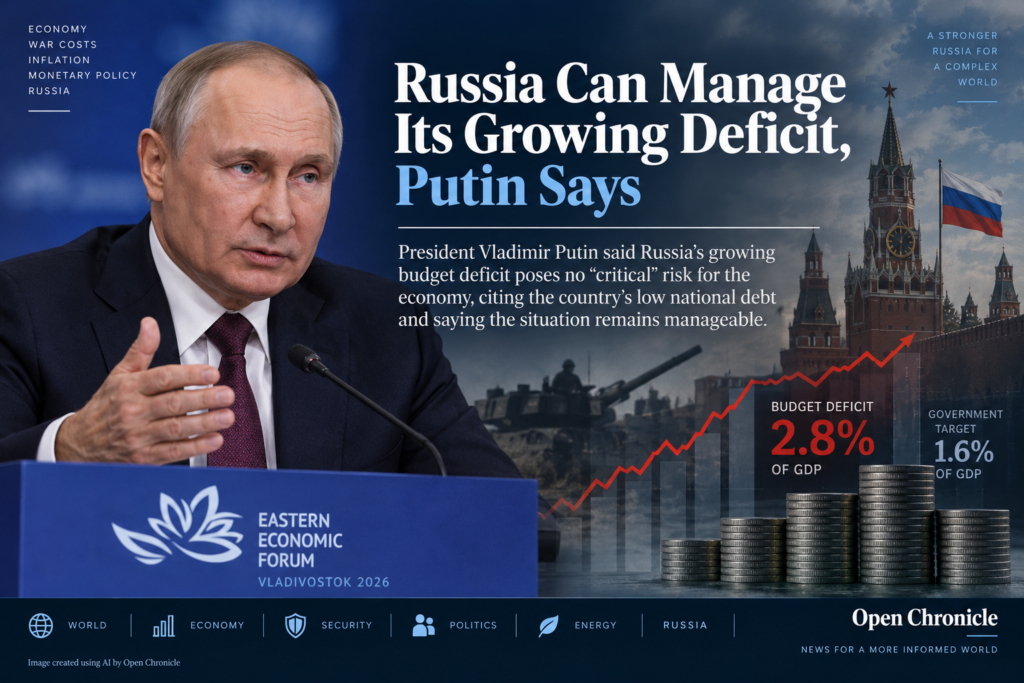
Russia’s budget deficit has climbed well beyond the government’s annual target, but President Vladimir Putin insists the country’s low public debt means the situation remains manageable.
By Open Chronicle with agencies
Russian President Vladimir Putin has dismissed concerns over the country’s widening budget deficit, arguing that Russia’s relatively low national debt gives the government sufficient room to manage growing financial pressures.
Speaking at the Eastern Economic Forum in Vladivostok on Thursday, Putin said the deficit did not represent a critical threat to the Russian economy despite its sharp increase during the first half of the year.
Russia’s budget deficit grew by around 40% during the period, reaching approximately 2.8% of gross domestic product. That puts it substantially above the government’s official target of 1.6% of GDP for the year.
“Considering that we have one of the lowest levels of national debt in the world, there is nothing critical here,” Putin said.
War spending puts pressure on Russia’s finances
The deterioration in Russia’s public finances comes as the economic cost of the war in Ukraine continues to rise.
Since Moscow launched its full scale invasion in February 2022, the Kremlin has dramatically increased spending on defence, security and the country’s military industrial base.
Financing those commitments has forced the Russian government to search for additional revenue. Authorities have raised taxes and increased borrowing in recent years as military expenditure absorbs a growing share of government resources.
The expanding deficit therefore provides another indication of the financial pressures facing Moscow as the war continues.
Putin nevertheless presented the country’s debt position as an important financial buffer, suggesting that Russia has considerably more room to borrow before sovereign debt itself becomes a major threat to economic stability.
Central Bank faces difficult interest rate decision
The budget situation is also complicating monetary policy.
Russia’s Central Bank is preparing for its next key interest rate meeting with policymakers balancing inflationary risks against growing pressure from businesses for cheaper credit.
The benchmark interest rate currently stands at 14%, making borrowing expensive for companies seeking to finance investment or expand operations.
Russian businesses have repeatedly pushed for lower rates, arguing that restrictive monetary conditions are constraining economic activity.
Analysts surveyed by Reuters, however, expect the Central Bank to keep its benchmark rate unchanged.
The growing government deficit is one factor supporting a cautious approach. Higher public spending can increase demand across the economy and potentially add to inflationary pressures, making rapid interest rate reductions more difficult.
Inflation remains a central concern
Annual inflation stood at 6.3% as of August 31, according to Russia’s Economic Development Ministry.
Putin acknowledged the tension between controlling prices and ensuring businesses retain access to affordable financing.
He said it was important that high borrowing costs did not excessively restrict investment, while also stressing that monetary policy must continue addressing inflation risks.
The Kremlin therefore faces a difficult economic balancing act. Lower interest rates could provide relief to businesses and encourage investment, but reducing borrowing costs too quickly could risk reigniting inflation.
Maintaining high rates for too long, meanwhile, could weaken investment and put additional pressure on companies already dealing with the effects of sanctions, labour shortages and the broader economic consequences of the war.
Kremlin points to business support programmes
Putin also rejected claims that high interest rates had effectively shut some companies out of the credit market.
He said the government had introduced multiple lending programmes designed to provide businesses with financing despite restrictive monetary conditions.
Such programmes allow the state to channel preferential credit toward selected industries and companies even while the Central Bank maintains comparatively high rates across the wider economy.
That approach has become increasingly important as Moscow attempts to sustain industrial production while simultaneously financing military operations and controlling inflation.
Russia’s economic balancing act
The widening deficit does not necessarily represent an immediate fiscal crisis, particularly given Russia’s relatively low sovereign debt. It does, however, illustrate how the country’s economic choices are becoming more difficult as the war enters another year.
Moscow must finance substantial defence expenditure while supporting businesses, maintaining social spending and preventing inflation from accelerating.
At the same time, policymakers must decide how long the economy can tolerate high interest rates before restrictive borrowing conditions begin to significantly weaken investment and growth.
Putin’s comments in Vladivostok suggest the Kremlin remains confident that it has sufficient fiscal room to absorb the growing deficit.
Whether that confidence can be sustained will increasingly depend on government revenue, inflation, borrowing costs and, above all, how much longer Russia must finance its increasingly expensive war against Ukraine.